DeFi has evolved through 3 generations, but the structural vulnerabilities remain unresolved.
Gen 1 died from cascading liquidations.
Gen 2 died from infinite inflation.
Gen 3 died from yield decoupling.
Why does this cycle keep repeating? 🧵👇
@saveibeks@THEONLY_KLEMS Exactly. Real yield must come from real economic activity, not dilution. That's the core thesis of RSV.
Thanks for the support! 🤝
@Token_Logic@aave@iris_credit Congrats to @iris_credit! Fixed rates solve volatility in borrowing costs. But what about liquidations?
RSV Protocol takes it further: anchoring leverage to NAV instead of spot price for zero-liquidation. Read the math: https://t.co/wgZjcp9zIf
@Token_Logic@base Excellent data. But as institutions scale on-chain, real-time liquidation models become a structural bottleneck. We built RSV Protocol to solve this with NAV-anchored Floor-Price Leverage (zero-liquidations). Read our math here: https://t.co/wgZjcp9zIf
@Sherlockwhale This is exactly why the industry needs a paradigm shift. Real-time oracle liquidations are structurally broken. That’s precisely why we built RSV Protocol with NAV-anchored Floor-Price Leverage. We published the math here: https://t.co/wgZjcp9zIf
3/ What about token supply? We built a 4-Engine Destruction Mechanism:
(Check our core architecture blueprint below. Treasury sits at the heart.)
🔥 Burn on issuance
...
1/ The biggest lie in DeFi? "Yield is paid in our native token."
If you must sell your reward token to pay rent, your yield is hostage to volatility.
RSV Protocol changes this. Here is how we built a zero-reserve, hyper-deflationary engine. 🧵👇
3/ What about token supply? We built a 4-Engine Destruction Mechanism:
🔥 Burn on issuance
🔥 3-12% trading tax burns
🔥 Redemption burns (Exit = buy wall)
🔥 Gas burns (Every action destroys RSV)
Every interaction makes RSV scarcer. 📉
4/ Supply caps at 1B. Deflation outpaces emission.
This is Reserve-Standard Finance. No overnight wealth promises, just a mathematically sound, non-zero-sum environment.
Read the paper: https://t.co/wgZjcp9zIf
@RSV_Research 🇨🇭
4/ Game theory dictates this creates a strictly negative expected payoff for dumping. The whale incurs an 8%+ tax, gets locked in, and faces the Self-Healing Redemption buy wall.
The Nash Equilibrium shifts from (Dump) to (Hold/Stake).
Read the math: https://t.co/wgZjcp9zIf
1/ MEV bots and malicious whales have ruined DeFi for too long.
Flash crashes, sandwich attacks, and instant dumps drain billions from retail investors. Why do AMMs allow this?
RSV Protocol introduces the Two-Tier Circuit Breaker via @Uniswap V4 Hooks. Here’s how we fight back
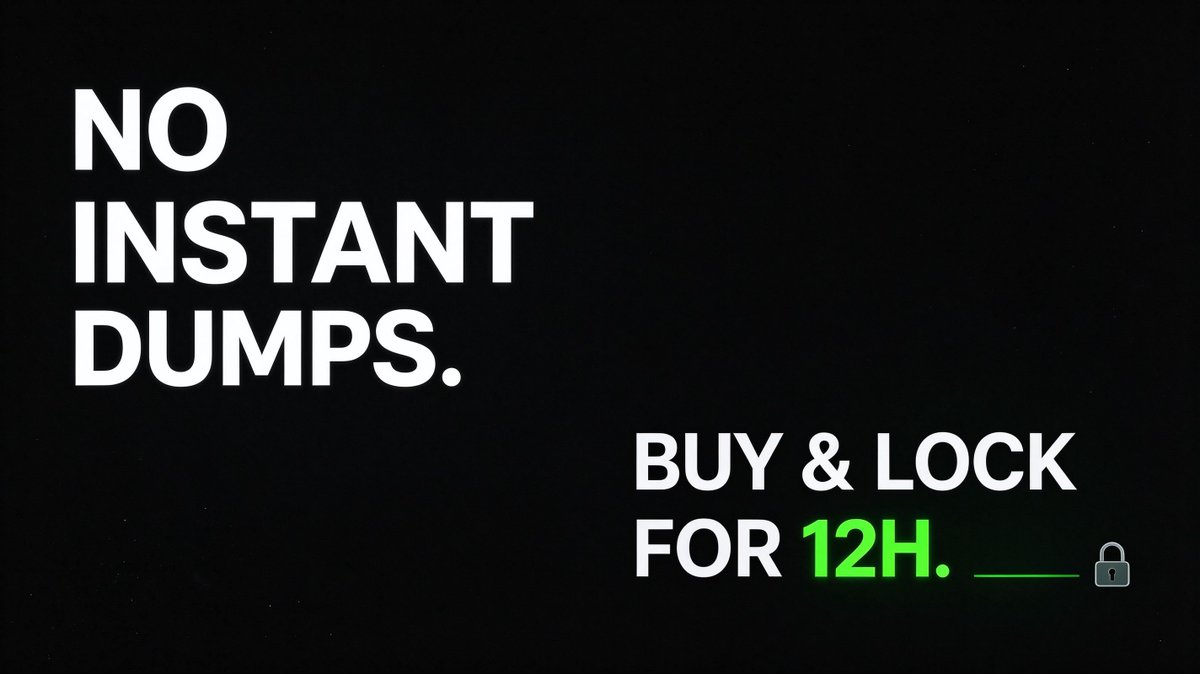
3/ But the real weapon is the Cooldown Brand (Time-Lock). ⏱️
If you buy during a Tier 1 or Tier 2 extreme state, the smart contract flags your address. Any attempt to sell before 12/24 hours results in a hard EVM Revert.
You want to catch a falling knife? You must hold it. 🛡️
1/ The biggest lie in DeFi: "Liquidation protects the protocol."
In reality, real-time oracle liquidations are a systemic accelerator. During a crash, they force users to realize losses at the worst possible time.
How do we fix this mathematically? Enter Floor-Price Leverage.
4/ Theorem 1: As long as the Treasury reserve is non-decreasing, your collateral value based on NAV will never decrease.
No cascading liquidations. No forced selling. Just pure, reserve-backed security.
Read the full math in our paper: https://t.co/wgZjcp9zIf
5/ The industry doesn't need another hyper-optimized AMM. It needs a paradigm shift: Reserve-Standard Finance.
RSV mathematically eliminates liquidations via NAV-anchored leverage and enforces USDT-denominated yield.
Read the paper: https://t.co/wgZjcp9zIf
🇨🇭 @RSV_Research
DeFi has evolved through 3 generations, but the structural vulnerabilities remain unresolved.
Gen 1 died from cascading liquidations.
Gen 2 died from infinite inflation.
Gen 3 died from yield decoupling.
Why does this cycle keep repeating? 🧵👇
4/ Gen 3 (Fake RWA):
Users earn "yield," but it's paid in the protocol's volatile native token. To realize purchasing power, you must sell it on the secondary market. The unit of account and the medium of exchange remain completely disconnected. 💔