High Risk Online Payments. Former pro poker player. Traveling the world. @UF alum. Interested in online business, high risk payments and exploring the world.
@Adityalch@BadTechBandit You mentioned BPC 157 and Mot C. I’m fairly certain you can’t get legit script certified selling these, even if prescribed by DR. I could be wrong though.
It's been a while, but I have quite a bit of content that I would like to share with everyone. This week, I'll post screenshots of all the charities that I donated to with a short explanation. Next Monday, I will do a bankroll update, but let's start with a breakdown of this hand that I played yesterday:
A like on this post is much appreciated.
We find ourselves heads-up (HU) in the big blind (BB) with a hand that we 3-bet always at 100 BB stack sizes. The flop brings 2h5h7s, which doesn't seem great, but as the 3-bettor, we have plenty of double-suited hands, so on average, we still c-bet 50% on these kinds of boards. With the 7h, I think this hand works better as a c-bet than as a check-call. The most important thing is that you know the rough percentages well and not that you exactly nail every combination from a GTO perspective.
On average, we c-bet 73% as the 3-bettor on all the boards that are provided on vision. We try to 3-bet 18.4% from the BB versus a small blind (SB) open. Our opponent doesn't 4-bet, so we have a big equity advantage going to the flop; that's the reason we can c-bet so much in general.
The turn brings a Kd, which is super good for the range of hands that we have here. The difference between decent mid-stakes players and high-stakes crushers is recognizing how equities are shifted by different cards and applying the right kind of pressure with enough "bluffs" when the board favors us. I'll provide some screenshots underneath to illustrate this. We bet the turn as a bluff and hit two pair on the river.
The river spot is very interesting, and I ran a quick sim to find out how the solver would approach this. For some, this might look like an easy check-call, but betting for value is definitely an option instinctively. Most better two pairs are shoved by our opponent, and holding the T makes it less likely that our opponent rivered a higher two pair. You could make an argument for shoving here, but mixing seems to be the way to go. Loads of missed draws, so in this instance, I decided to go for the check, and my opponent puts in the rest of his stack as a bluff.
So after double-checking, the solver is mostly checking here with hands like KKxx and KTxx, so not exactly approved by the solver, my line. My opponent turns his QQxx into a bluff, which is also not approved by the solver. I constantly make plays that are not the most optimal move; in this case, it was just a combination of a lack of knowledge and a gut feeling.
Let me know if you enjoy this kind of content and if I can do anything to make it more appealing. Other posts are coming this week!
Week 6:
Total on account: $14,717
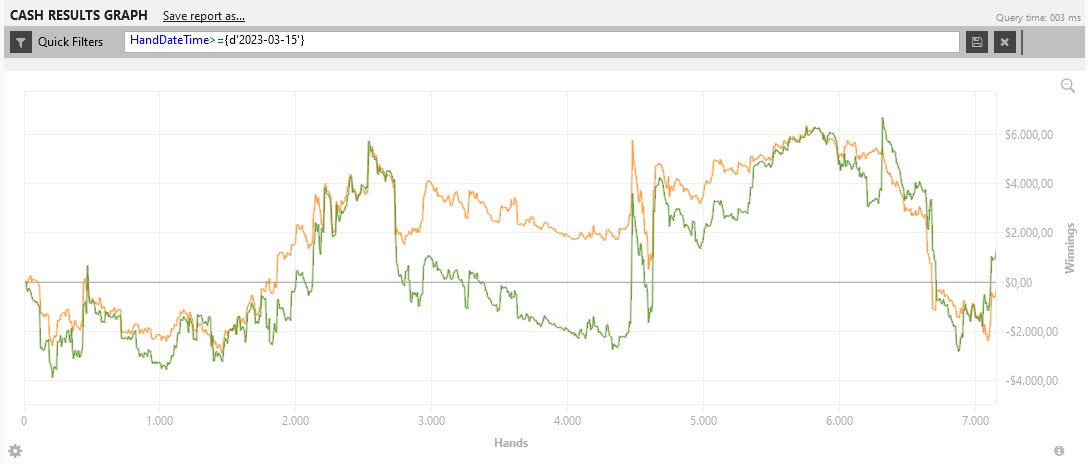
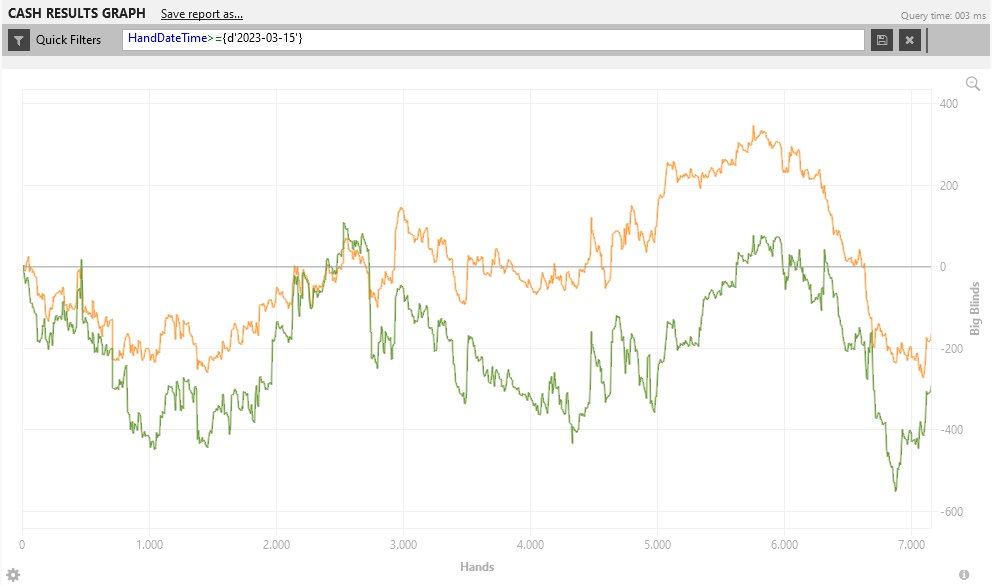
Cash games: +$1,317
Tournaments: -$3,624
I'm excited to share that playing on ACR has been a great experience lately. My plan for next week is to dedicate serious time to both studying and playing. If you enjoy this post, a like would be greatly appreciated.
One major benefits of the current low rake environment is the ability to play a lot of heads-up games, which should significantly improve my win rate. While I still need to work on my 6-max game to match my confidence in heads-up play, I'm making steady progress.
While I had hoped for better results after six weeks, it's important to remember that success in poker doesn't come easily. Even when making the right moves, it's still possible to lose money. It's a reality that poker players must become comfortable with.
I'll be back next week with another update on my progress!