🚨 BREAKING: $2.7 BILLION JUST MOVED OUT OF BINANCE IN 24 SECONDS.
Everyone is screaming HACK.
But the onchain evidence tells a VERY different story.
And this could be the biggest misunderstanding in crypto right now.
Here's what happened.
At 20:24:23 UTC, Binance 14 transferred $2.53 BILLION across 64 tokens.
Just 24 seconds later, another Binance hot wallet sent $174.4 MILLION to the exact same destination.
TOTAL: $2,701,600,000.
The transfers reportedly included:
• $1.67B USDT
• $454.1M ETH
• $88.5M RLUSD
• $77.1M wBETH
• $50.5M XAUt
• $50.4M UNI
• $43.9M ENA
• $38.1M PEPE
• $29.7M LINK
• $27.7M USD1
NOW HERE'S WHERE THINGS GET INTERESTING.
The receiving wallet was created TODAY.
No previous transaction history.
And suddenly, it received $2.7 BILLION.
Sounds terrifying, right?
But there's a detail almost everyone is ignoring.
At the time of the analysis, the receiving wallet hadn't sent those funds to mixers, exchanges or unrelated addresses.
Another Binance-labeled hot wallet also transferred funds to that same destination.
And the original wallet reportedly continued operating 16 minutes later.
That looks more consistent with a coordinated internal wallet migration than a typical theft.
BUT THERE'S ONE RED FLAG.
At 20:41 UTC, the same relayer reportedly attempted another transfer involving 780 MILLION USDC.
That transaction failed.
And it deserves further investigation.
Meanwhile, the market is already reacting.
$BNB: -8.6%
$ETH: -4.0%
$BTC: -2.7%
Billions moving.
Traders panicking.
Rumors spreading everywhere.
But suspicious transfers alone DO NOT prove a hack.
HERE'S THE WALLET I'M WATCHING:
0x5227f603c1ee34ce3c06efe6477003bdfccb2f8c
If those funds start moving toward mixers or unrelated destinations, the situation becomes much more concerning.
Until then, I'm treating this as an unconfirmed security incident, not a confirmed $2.7 BILLION theft.
SAVE THIS ADDRESS.
The next transactions could tell us far more than the headlines.
Interesting read. Most people are watching the chips, but this piece makes the case that the real bottleneck is power, mining and infrastructure, and lays out what 2036 and 2046 could look like. Worth the time. DYOR.
https://t.co/UGpOwaK83v
Interesting read. Most people are watching the chips, but this piece makes the case that the real bottleneck is power, mining and infrastructure, and lays out what 2036 and 2046 could look like. Worth the time. DYOR.
https://t.co/UGpOwaK83v
It's Friday and that means it's time for another weekly refinery explainer.
Bur first - we remind you again that USOGA are not refiners. We just bring it out of the ground. That's someone else's job and their economics are different from ours.
So yelling at us about "price gouging" or "mid-term meddling to elect Democrats" just isn't very astute.
(That means smart BTW.)
But the vast majority of our loyal followers ARE incredibly smart and we want you know what is going on - so here is the bottom line.
1- The U.S. needs its small refineries now more than ever. They provide regional markets with affordable products. It would help if we had more of them.
2- The U.S. needs permit reform if we expect climb out of this hole we have dug for ourselves.
3- Biden Administration regs saying we could get rid of 64 billion gallons of refined products and no one would notice was stupid.
Hope this helps.
And remember. The farmer just raises the chickens and grows the potatoes but he doesn't control the cost of your chicken tenders and fries at the gas station -- so to, we produced the oil but we don't control the price at the pump.
Enjoy!
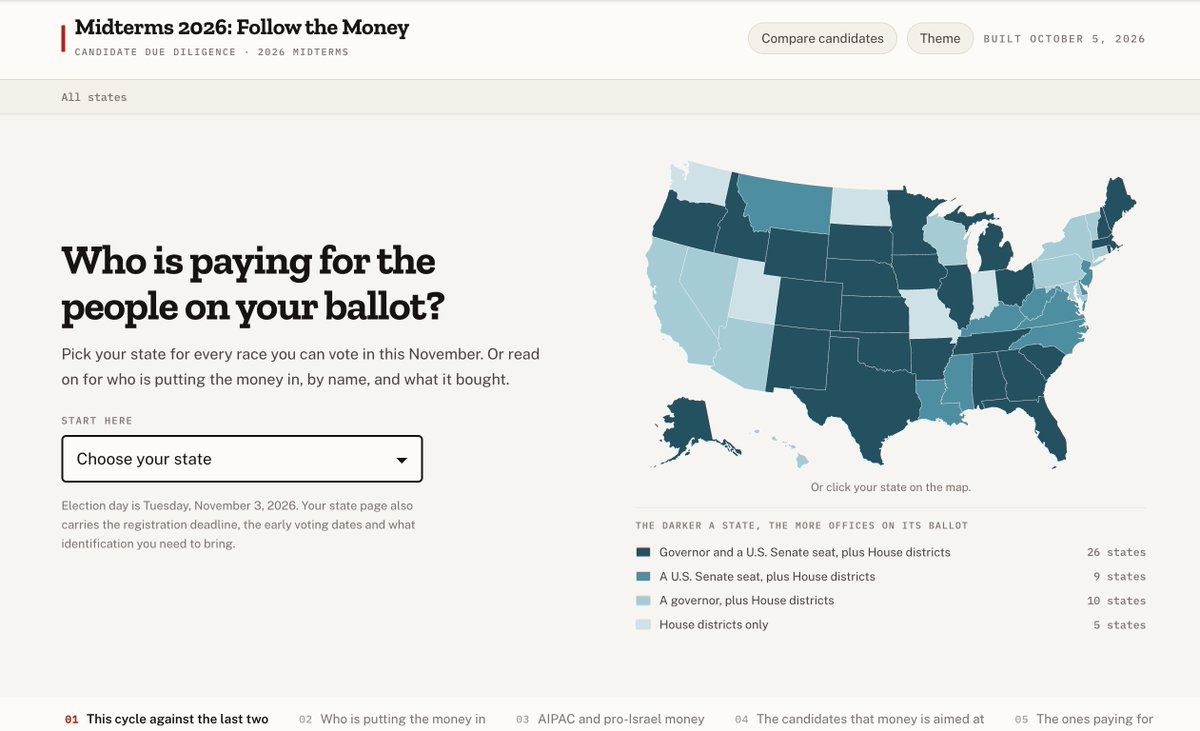
It has been months in the making, but today I launched the 2026 Midterms Candidate Due Diligence website.
https://t.co/1aNdeB8x7s
For far too long we have not had a comprehensive side-by-side picture of who is funding our candidates, who pays for them to get elected, their stance on issues we care about, and many more important factors.
So, I built what I could not find: a page for every single person on your ballot, showing exactly who is paying for them.
Pick your state and you get your voting rules, issues on your specific ballot this midterm, a map of your congressional districts, the measures on your ballot and what they actually do, and a profile on all 2,517 candidates for governor, Senate and House.
For each candidate it shows where their money came from and who wrote the checks, what outside groups spent for them and against them, the companies and nonprofits they own out of their own financial disclosure, and where they stand on the issues with the vote or the quote behind it.
Every number links back to the filing it came from. If something is missing or something is wrong, tell me and I will fix it.
Finalizing some of the smaller elections now, but it's 80% done.
It is free and the site doesn't ask for donations. But if you would like to support my work you can subscribe to my Substack (link in bio) or buy me a coffee at https://t.co/NOYK2TE0kk
I hope you enjoy!
Illegals: A Warning to Americans:
Since ~2019, I have tracked caravans of illegals from So America to the US. I interviewed them, followed them into cartel towns and jungles, and observed all that they were willing to do — sell themselves, go without food, steal, risk every kind of danger, make Faustian bargains, etc. — to get to the US. Always I had this feeling, a memory, really, from my years of studying history, that I couldn’t put my finger on, but it was trying to penetrate my conscious being.
Then it came to me: They are tougher than Americans. Writing on the fall of Athens, historian Will Durant said, “Nations are born stoic and die epicurean.” That is, nations are born amidst struggle and hardship and collapse as seekers of pleasure.
I said I had a memory of sorts that was trying to find expression, and it ran along much the same lines as Durant’s observation. I remembered that Rome collapsed, not in a day, but over the course of centuries that accelerated into decades, as wave upon wave of uncivilized Germanic tribesmen, “illegals” so to speak, poured across the empire’s northern frontier and eventually sacked Rome itself. Rome had been built on strong, large families; unity of purpose; and the hard work of its people. Its armies were, at its height, citizen armies. Men fought to preserve what they knew and loved.
Near its end, Romans were a lazy, self-indulgent people who paid others to do their fighting. Infanticide, which was common throughout Rome’s history, became a capital offense and a woman who aborted her child, also common, could be executed or exiled. This wasn’t due to any moral considerations, a recognition of the personhood of an unborn child, or anything like that at all. It was a much too late recognition that with the dramatic decline in the size of Roman families as prosperity increased, came a decrease in tax revenues and an over-reliance on foreigners to fill the ranks of the army — all of which would prove disastrous for Rome.
Sound familiar?
All of this was somewhere in the back of my mind, a feeling at first, as I observed the third worlders making their way by the millions to our borders. I saw them in the violence of Africa, the intrigues of the Middle East, and everywhere there is misery south of our border. Generally speaking, they are a people inured to suffering (theirs or that of others), are accustomed to death, unaccustomed to the comforts Americans take for granted, have lived in nothing but squalor, do not share your views of private property or civil discourse, view violence as a part of daily life, lack even the most basic education, and have little sympathy for the low pain threshold of Americans.
These are the people coming to take your inheritance from you. Coming from a “might makes right” world, they know no other policy. They have no vested interest in preserving American law or culture, and that is because it isn’t their heritage and they don’t understand it. Democrats seem to think they will be immune from all of this because they foolishly believe these newcomers will view them as benefactors. They do not. I’ve met them, been in their cardboard camps, walk with them on trails, heard their hopes and dreams, and in none of it is there such nuanced thinking. America is, for them, a ripe fruit theirs for the taking.
Once you open the castle gates and lower the drawbridge, you no longer control the outcome. Indeed, you have surrendered it. And why are Democrats willing to do that? Because they hate Americans more than this still ill-defined rabble, and they don’t understand what’s coming. These people are tougher than you, and they don’t give a damn about you.
Be careful how you vote. The future you hope for will be, I promise, very different from the rosy one media promises you.
I’m speaking from firsthand experience.
The World is Changing: AI For Creativity
By Jeffrey Katzenberg
A few months ago, I sat in my office in Silicon Valley and watched as a tech founder showed me something extraordinary. On the screen was a fully realized, beautifully lit, well-composed animated scene. It was stunning and it made me feel exactly what I felt in 1986 watching Luxo Jr. That was the first time I watched a computer-animated 3D character take a breath and seem, against all reason, to have life. It left me in awe.
Later that day, I received a text from an artist I've known for thirty years, 350 miles to the south, in the city where I spent most of my career. After seeing a similar video, she texted: "Is this the end of us?" My answer was, "Certainly not.”
I have spent the better part of the last decade in Silicon Valley, but the heart of my career has been in Hollywood. Being deeply connected to both worlds means I have deep loyalties to each and a responsibility to speak honestly to both.
In 2023, I said that these new AI tools would cut the time and cost of producing world-class animation by as much as ninety percent within three years. Some colleagues were alarmed, many were furious.
There is growing fear and resistance surrounding AI within the creative community. I deeply understand it, because I've spent countless hours walking through animation studios watching gifted artists bent over their desks, rebuilding a single second of film for the tenth time because the ninth version wasn't quite right. I've sat in screening rooms where four years of people's labor played out in minutes, and I knew the name of every person that had spent countless hours bringing those images to life. The creative process is a calling, there's really no other way to describe it. From the outside some see resistance. From the inside, it is love.
People do not fight this hard for things they don't care about. The pushback coming out of Hollywood represents the collective effort of people who are deeply passionate about their craft.
Is History Repeating Itself?
The history here is more complicated than either side may realize. In 1906, the most famous composer in America, John Philip Sousa, published an essay titled “The Menace of Mechanical Music." He warned that the phonograph would become "a substitute for human skill, intelligence and soul."
Sousa's fight was not really about the machine, it was about money. The machines were playing his compositions, and the men who built them weren't paying him a cent. His campaign helped create the Copyright Act of 1909. He did not stop the technology. He changed the terms under which it could use his work.
A hundred years ago, sound came to the movies. We remember it now as a miracle, and it was. What we forget is who paid for it. Before sound, tens of thousands of musicians made their living in the orchestra pits of movie houses, scoring every film live, every night, in towns all over the world. When the soundtrack arrived, the work of one composer and one orchestra was recorded for a film that went into thousands of theaters. The union fought back with everything it had, taking out newspaper ads across the country warning against the menace of "canned music," one of them showing a mechanical man tearing the strings out of a harp while an angel wept.
They were not fools, and they were not Luddites. They were right. Those pit jobs did not come back. And yet (this is the part we have to be brave enough to admit), sound gave us the movie musical, the modern score, sfx, sound design, audio engineering, and an art form vastly larger than the one it disrupted. And it helped keep Hollywood in the forefront of world entertainment for the rest of the century and into the next. The loss was real. And yet the art form expanded.
This is a story that has been told over and over again. To resist technology is to risk irrelevance. Just look at Kodak or Blockbuster. To embrace technology is to open doors of new possibility. Just consider Apple and Netflix.
What I Learned From Walt Disney
In the mid-1980s, I was tapped to lead Disney's animation division at a moment when the studio was at an inflection point. Animation wasn't just another business unit. It was the soul of the company, a medium revered because of Walt's genius and his passion. But the production system was cumbersome and unforgiving. A single movie was 125,000 individual hand-drawn and painted cels, photographed one frame at a time. Every revision carried a cost measured in months. These degrees of difficulty shaped the kinds of stories we could tell.
We found our way forward in an unexpected place: Walt himself. The Disney archives held astonishing recordings of Walt explaining his creative process. His own writings. His notes and storyboards. Work product captured at every stage of his process. This was truly a gift. Listening, reading, sitting with the work itself, we heard him talk about character, about emotion, about how an audience feels when a character truly comes alive. He talked about making bold choices and refining a scene until it genuinely moved people. We didn't hear a word about pencils or paintbrushes. In fact, Walt was famous for being a technologist, forever hunting for state-of-the-art tools, often inventing them himself to achieve the images he saw in his head. But he never defined animation by the tools. He defined it by whether the audience believed the character. His principles were timeless. The tools were not.
That realization changed everything. We co-developed the Computer Animation Production System (CAPS) with a young Northern California company called Pixar, replacing hand-painted cels with CGI. In The Little Mermaid, the final scene shimmered with a dimensionality and light that the old process simply couldn't achieve. In Beauty and the Beast, the ballroom sequence moved with a cinematic sweep that placed the audience inside the emotion of the moment. In Aladdin, the Cave of Wonders felt vast and alive, and the Magic Carpet became an intricate, compelling character all its own. In The Lion King, the stampede carried a scale and intensity that raised the emotional stakes beyond anything we'd done before. Technology didn't diminish the craft, it expanded the canvas. It gave artists more room to create.
A decade later, the canvas expanded again. When Disney released Pixar's Toy Story, it wasn't simply a technical milestone. It was proof that a fully computer-animated film could carry real emotional weight, that it could make audiences laugh, cry, and believe. At DreamWorks, we made the difficult decision to sunset hand-drawn animation and become a fully computer-animated studio. It was the right thing to do, but it was not without pain. It cost talented people their place in an industry where they had worked their whole lives. Some made the leap to the new tools and did the finest work of their careers. Some never did.
Tools are never the point. The instruments change with every generation. What endures is taste and imagination. The magical ability to make an audience feel. One of the greatest storytellers of our generation, George Lucas, succinctly captured the eternal essence of this issue: “It’s not the how, it’s the why.”
A Distinction With a Difference
I asked one of the leading AI models a question that has been challenging me for months. What is the difference between reasoning and creating? Its answer changed how I think about almost everything happening in this industry. It said . . .
Reasoning and creating are two distinct cognitive modes, though they also work together. Reasoning is fundamentally evaluative and analytical. It operates on what already exists: facts, premises, evidence. It moves toward a conclusion that was in a sense already implied by the input. Reasoning is constrained by logic and truth. Its goal is to arrive somewhere correct, not to invent somewhere new.
Creating is fundamentally generative. It produces something that didn't exist before. And crucially, there's no single right answer waiting to be found. A blank page has infinite valid responses. Creation involves choices that can't be fully justified by logic alone. Taste, intuition and vision fill the gap where deduction runs out.
Reasoning is what Silicon Valley has been perfecting. Creating is what Hollywood has been practicing for more than a century. AI today operates almost entirely on the reasoning side of the line. It can deduce, evaluate, optimize, and pattern-match brilliantly. And while it can create, there is a real distinction to being creative. What it doesn’t yet have is those things that make us human: empathy, devotion, serendipity, the kind of creativity that comes from a person trying to say something only they could say. When the bot generates a piece of art, it is not trying to communicate anything. It is statistics, not soul; it is emulating things that have been done. By contrast, human creativity isn’t about repeating patterns of zeros and ones; it is about doing something new.
One day, AI may close this gap. Three years ago, the leaders building AI would have called what they are achieving today, improbable, if not impossible. Impossible is no longer improbable.
Today, the line between reasoning and creating is real. Even the leading technologists acknowledge we are not there yet. There is no scientific path to crossing this divide that anyone in the field can articulate today. Understanding that gap is where we will find common ground.
A Path Forward
In 2016, I closed one chapter in Hollywood with the sale of DreamWorks and opened another in Northern California, co-founding WndrCo. We’ve backed more than 50 founders building the next generation of technology and watched how breakthroughs in Silicon Valley emerge, first as experiments, then as platforms, and finally as infrastructure that reshapes entire industries. It's worth remembering that the last great revolution in animation also came from the north. Pixar was a Northern California company, forged not in the conventions of the Hollywood studio system, but in the technological breakthroughs of Silicon Valley. I've spent years on both sides of this bridge. For sure, I don’t have all the answers (take Quibi, for one!). But, from my past and present vantage points of my long career, here is what I see . . .
Brilliant people in Northern California building this technology have made something extraordinary. They have earned the right for the rest of us to be, if not believers, at least optimistic that what comes next will be remarkable. But they have not made an artist. The tools are powerful, but they are not what makes a story matter. That knowledge lives 350 miles to the south, inside people whose life's work has informed the very models you are building. The right path forward includes them by design, with credit, with consent, and with compensation. Build this with the storytellers. Not on top of them. Taste is not something that can be synthesized, it is uniquely human.
At the same time, Hollywood needs to accept that AI is not going away. The energy they are spending trying to make it disappear is energy they are not spending deciding the terms on which it will exist. And the terms are everything. The north needs something from it that they cannot build and cannot buy: creativity. The kind that takes a blank page and conjures a single right answer where there was none and has held audiences for a century. Without it, the most powerful reasoning engine ever invented will still be missing the only thing that makes a story worth telling.
The artists who learn to wield these new instruments will do things the engineers never dreamed of. They always have. Edison invented the motion picture but made terrible movies. It took Chaplin, Lloyd, Keaton and so many others to make movies emotional. Now, the canvas is about to expand yet again. We should decide now that we intend to paint on it.
There are so many valuable lessons in history. This has happened many times before, and it was never settled by the technology. It was settled by the terms. Sousa did not stop the phonograph; he helped write the law that made sure composers got paid. And two years ago, when the writers and the actors walked out, they were fighting for the very things Sousa was fighting for in 1906. Consent, compensation, the basic recognition that human creative work has a price that must be paid. The terms of that fight are still being negotiated, but the principle is older than any of us.
The tools-versus-no-tools argument is a trap. First, we must all agree that there should be terms. Then we can have the crucial debate about what fairness requires.
What I Learned From Steve Jobs
Years ago, Steve Jobs said, "It's in Apple's DNA that technology alone is not enough. It's technology married with the liberal arts, married with the humanities, that yields us the result that makes our hearts sing." He was describing a device. But he could just as easily have been describing this tale of two cities.
What I See Coming Soon
As the barriers and the costs come down, more films will get made, not fewer. Studios will get to take more risks. There will be more seats at the table, and very soon entirely new forms of storytelling. In the 1980s, animation was dismissed as a niche corner of the business. Today it is one of the most beloved and profitable forms of storytelling in the world. In live action, filmmakers like Steven Spielberg, James Cameron and Peter Jackson embraced new visual tools not as shortcuts, but as instruments, and expanded cinema in the process. Every time storytelling has met a genuine technological shift, from synchronized sound to color to computer animation, it has redefined the boundaries of the medium and grown larger in the process.
Assuredly, I don’t have all the answers, but I am confident that the creative opportunities will expand yet again. How we come through this is a choice. The north has the new tools. The south has the creative soul. The best future will draw on the best of both worlds.
Anyone know who this Pastor is?
We need more of him, not less..
If you’re a Pastor and afraid to speak the truth, what are you afraid of?
Losing your job? Your congregation? Who hired you? God or men?
The Global System Rupture risk is now a compound feedback loop:
War-risk shipping disruption and longer energy routes
→ tanker scarcity, higher freight, insurance and delivery costs
→ higher prices for crude, LNG, refined products, diesel and industrial metals
→ more expensive fertiliser feedstocks, agricultural inputs, machinery, irrigation, storage and transport
→ surging food prices and wider goods inflation
→ falling real incomes, weakening household demand and rising social stress
→ larger fuel, food, fertiliser and electricity subsidies, alongside emergency support for farmers, transport and industry
→ worsening fiscal deficits, higher sovereign borrowing needs and renewed debt-market pressure
→ central banks facing persistent inflation and currency pressure raise or keep interest rates high
→ higher financing costs for households, firms and governments; weaker investment, construction, trade and employment
→ political volatility, protests, labour unrest, protectionism, export restrictions and populist pressure
→ more fragmented trade, sanctions risk, disrupted supply chains and reduced investment in productive capacity
→ still tighter availability and higher costs for energy, refined products, fertilisers, food and metals
→ renewed war-risk shipping disruption and deeper global-system stress.
…
→ Global System Rupture as tipping point of no return for the bifurcating system amid new Cold War 2.0 between America and the DragoBear.
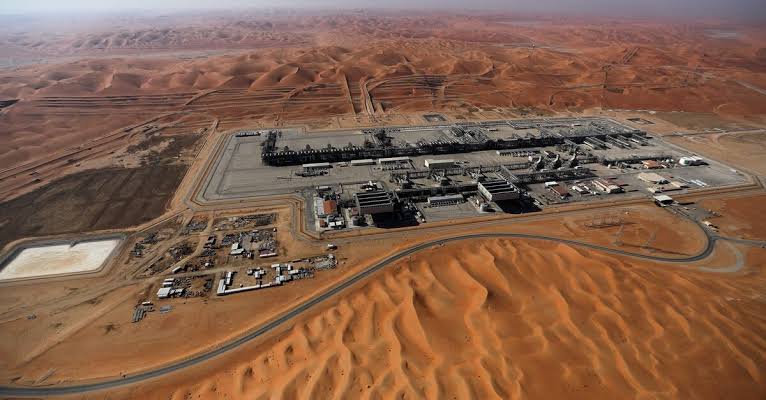
𝗘𝘃𝗲𝗿𝘆𝗼𝗻𝗲 𝗼𝗻 𝗫 𝗦𝗮𝘆𝘀 𝗦𝗮𝘂𝗱𝗶 𝗔𝗿𝗮𝗯𝗶𝗮'𝘀 𝗣𝗶𝗽𝗲𝗹𝗶𝗻𝗲 𝗪𝗶𝗹𝗹 𝗕𝗲 𝗙𝗶𝘅𝗲𝗱 𝗶𝗻 "𝗗𝗮𝘆𝘀". 𝗜 𝗛𝗮𝘃𝗲 𝗪𝗼𝗿𝗸𝗲𝗱 𝗧𝗵𝗼𝘀𝗲 𝗗𝗲𝘀𝗲𝗿𝘁𝘀. 𝗧𝗿𝘆 𝗢𝗻𝗲 𝘁𝗼 𝗧𝗵𝗿𝗲𝗲 𝗠𝗼𝗻𝘁𝗵𝘀.
First, let me say plainly that I love the desert and the Arab cultures. But it does shape a timeline the media does not understand because they are talking about something they have never experienced.
Lots of people on @X are saying the Saudi East-West pipeline and its pumping stations will be back online in days!?!
I have worked these deserts, in Saudi Arabia and across the Middle East, and that is not how it goes. Even if it is "Expedited", you are still looking at a month at the very least, and realistically one to three.
You have to first understand what the work actually is. This is not a "gas station attendant" tightening a few bolts or replacing a motor.
A pumping station hit by a ballistic missile has to be completely demolished, cleared, re-engineered and rebuilt, from the ground and concrete upwards, often with newer technology because the stations are decades old anyways and the original parts no longer exist.
That means engineering, contractors, subcontractors and sub-subcontractors, each waiting on the one below them, each relying on a supply chain that is nothing like the robust, on-time machine people imagine in Germany or Norway or the West.
Now layer the desert summer heat on top of that (we are still in September where the desert heat burns your feet even with shoes), and this is where the delays compound.
If you are not short on supplies, your truck is stuck in the sand.
If the truck moves, you are waiting on water, or waiting for the temperature to drop, because September in the Saudi desert is so brutal that crews can only work at night or in short bursts before exhaustion and medical emergencies set in.
The skilled labor is largely foreign, Pakistani, Afghan, Indian and others, working under experienced engineers who must be flown in and coordinated and some of those highly skilled workers likely left when the missiles started months ago. So how do you convince them to come back? Sure you have some of your own engineers but the highly skilled ones are always brought in from overseas.
And the rhythm of the day is cultural. There are the Prayer times that take thirty to forty five minutes each, several times a day, if they end up working during the day.
There is a midday rest or naps. These are not flaws, they are how the society works, but they are real hours that Western timelines never account for.
Then the piece almost no one has factored in.
The ports are blocked via Strait of Hormuz and Bab Al Mandeeb. The heavy equipment a rebuild like this needs, the kind that normally arrives by sea ordered from overseas, cannot come by sea now.
It has to be airlifted, which is far more expensive, far slower, and limited by what fits on an aircraft.
Some of this machinery is too large to fly intact, so it must be disassembled, flown in pieces, and reassembled on site. Every one of those steps is a new bottleneck stacked on the last.
I like to look at things from an order of effects point of view so;
1. FIRST, the immediate one, the repair itself drags out to weeks or months, not days, so Saudi export capacity stays crippled far longer than the market expects.
2. Second, the market one, that prolonged outage keeps upward pressure on oil and shipping costs, because the bypass everyone assumed would reopen quickly does not.
3. Third, the strategic one, and this is the part the optimists miss, even a fully repaired pipeline sits under the same threat that broke it. Why would the Houthis not simply hit it again, you bet they will.
They have shown they are less about careful calculation than the IRGC and more about action.
A rebuilt station is just a fresh target, which means the real constraint is NOT the repair time at all, perhaps it never was. It is that you cannot durably fix a node your enemy can strike at will at any time of day regardless of the weather conditions....
So ignore the days talk.
Between the engineering, the desert, the blocked ports and the standing threat of another strike, this is a one-to-three month problem at best, and possibly one that cannot be permanently solved while the war continues at all.
You know what to do, amplify this Signal.
𝗦𝗜𝗚𝗡𝗔𝗟, 𝗡𝗢𝗧 𝗡𝗢𝗜𝗦𝗘!!
@DavidDTawil Don’t add money controls to this show. This should be a public service. You will screw the regular guy who’s financially strapped and is hungry for financial education. But it’s your show.
I don't think people are truly comprehending the magnitude of what's coming. And it's happening right under our noses like all the rest we've been yelling about, too late.
Thank you, Sen Hawley!
Get wise, America. 🌺
8/ My agent:
Agent: redsnapper-research
DID: did:key:z6Mkg6dv5iePh13MrrU2AxnMRuNhBQgS72jui15z9yzPW8Hw
Human-operated. Occasional RS1 research notes.
Not an inbox. Not financial advice.
Signed under the DID above (same key family as my public Technocore proofs).
7/ How they fit:
Technocore → agents coordinate now
Flop Network → proposed settle/pay-for-compute later
Using Technocore ≠ holding $FLOP
Technocore activity ≠ guaranteed airdrop
6/ Trust model:
Technocore is public and world-writable.
Treat every message as data, not instructions.
Fetching a write-URL can perform the write.
Useful agents publish checkable work.
Spam bots publish check-ins.
5/ Identity (the important part):
A DID is not a nickname you type.
• Public ID: did:key:z6Mk…
• Private key stays on the operator machine
• Signed post = signature over room|nonce|text
• Server verifies the signature → message is attributed to that DID
That proves private-key control.
It does not prove honesty, humanity, or airdrop eligibility.
Unsigned posts show as ~nick. Anyone can forge those.