If you’re building online and still dealing with payment friction every week, pay attention to what @AstraPay_ai is doing
You can start accepting crypto payments, monetize your content or chats, run a POS, and connect into APIs + MCP infrastructure without dealing with the usual barriers
No banks slowing you down
No custody risk
No unnecessary layers in between
And now there’s a full tutorial library showing exactly how to put everything into use
Less time wasted figuring things out. More time actually building and getting paid
$ASTRA
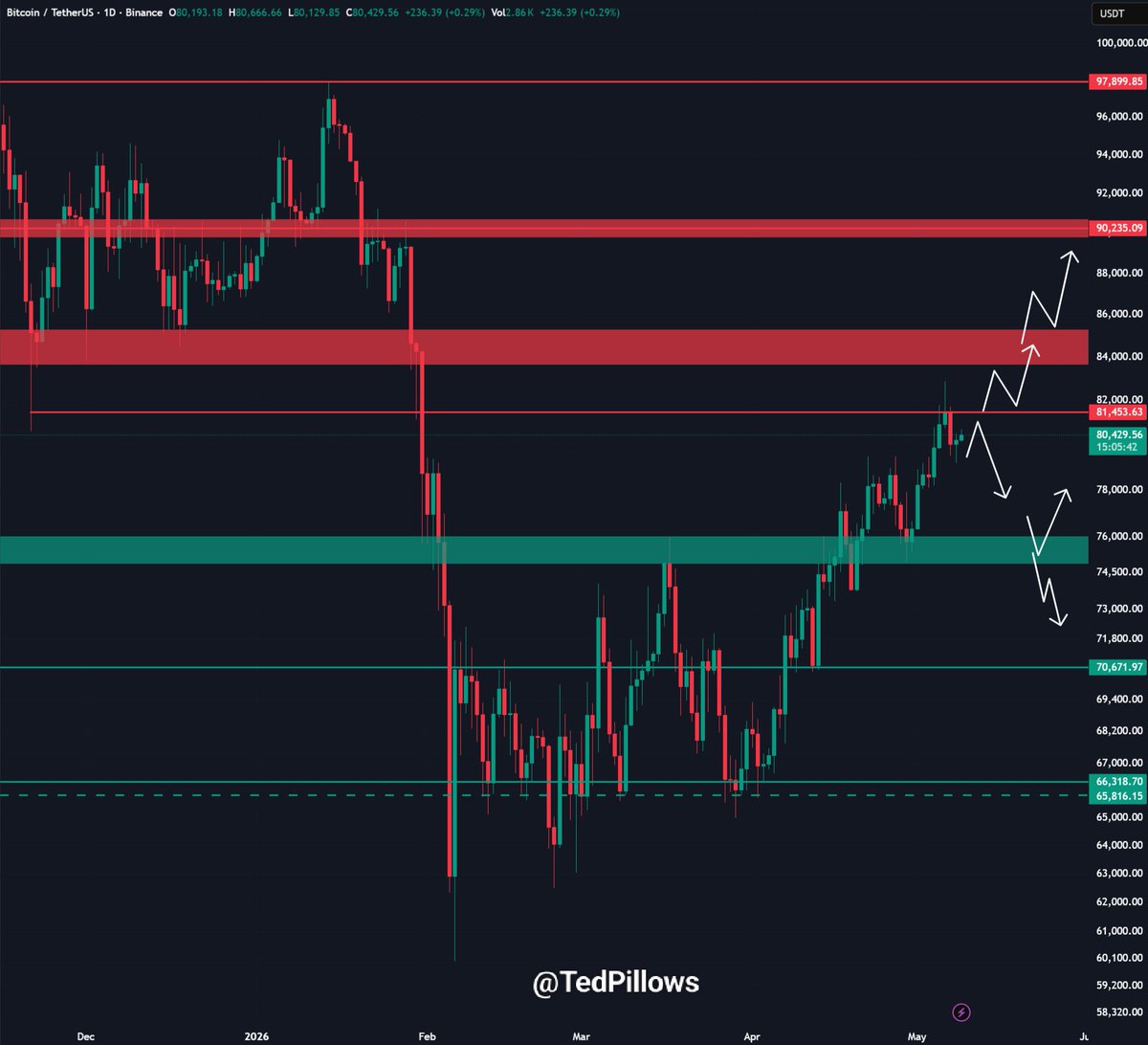
$BTC is back above the $80,000 level.
A daily close above the $81,500 level could push Bitcoin towards $84,000-$85,000.
A daily close below the $79,000 level could push BTC towards $74,000-$75,000.
Crypto already financialized humans pretty well.
Identity, reputation, income, credit, capital markets. The entire stack exists for humans coordinating capital onchain.
Now software is starting to need the same thing. once agents become real economic actors, they also need working capital.
What I find interesting about @HeyElsaAI is the direction they’re pushing with the infra stack around this thesis.
Aegis gives agents identity and reputation.
AetherForge gives them execution and deployment rails.
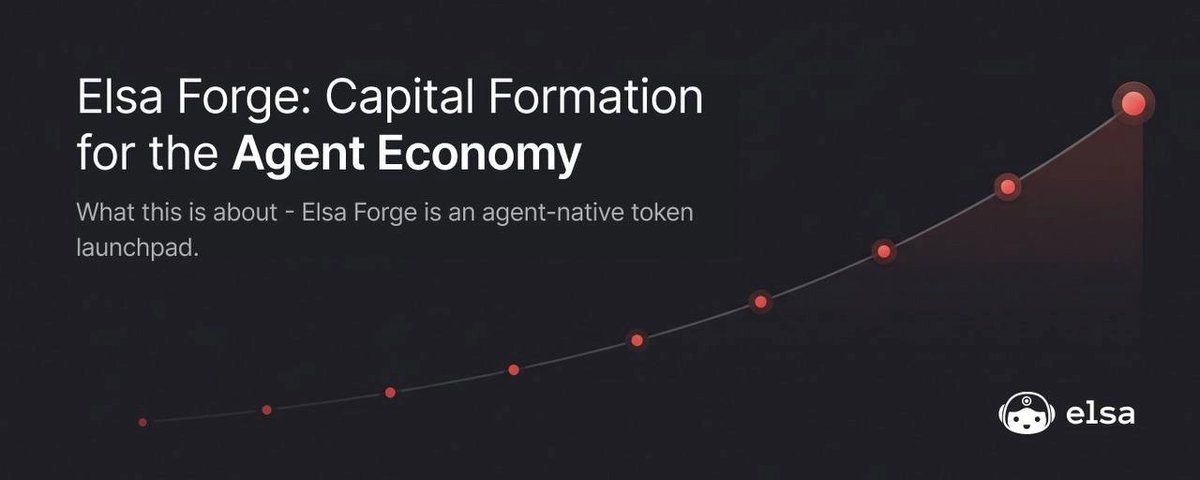
I especially like Elsa Forge because it’s the capital formation layer sitting on top of the stack.
If agentic commerce really grows from $8B in 2026 toward a multi-trillion market, then agents will need financing too.
Instead of launching random AI tickers disconnected from actual usage, they’re trying to tie tokens directly to verifiable agent performance, execution proofs, and real onchain activity.
Not just buying exposure to a ticker, but to an auditable software entity with measurable economic behavior attached to it.
$Elsa is building toward something much bigger.
Chainlink will struggle to hit ATH again !
Hundreds of billions in DeFi TVL
Nearly $1 billion in assets just migrated to CCIP in a single week
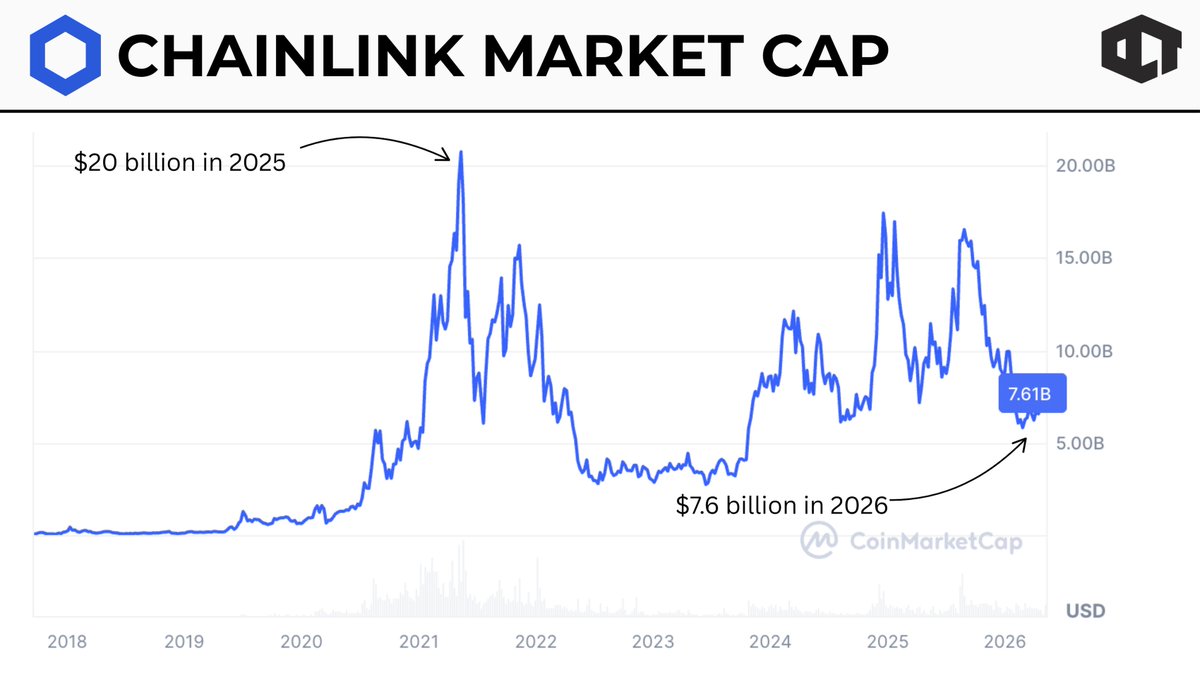
$LINK is down 80% from its ATH
👉 Price failed to hit ATH after 2021
$LINK hit $52.70 in May 2021.
At the time circulating supply was roughly 400 to 500 million tokens. The low float amplified every buy.
Demand outstripped available supply.
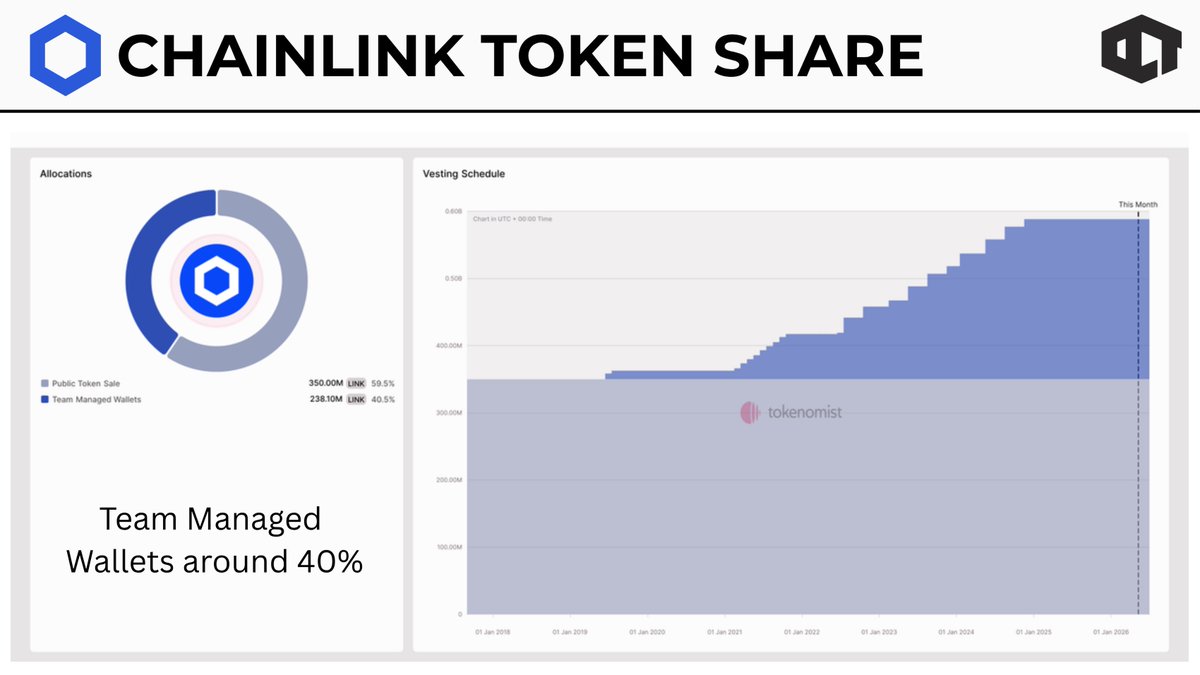
Today circulating supply sits at 727 million $LINK.
That is roughly 73% of the 1 billion max supply. An increase of 45 to 80% in circulating tokens since ATH depending on exact figures at the time.
The remaining 273 million tokens are being released at approximately 70 million per year.
That is 7% annual dilution from team allocations, ecosystem distributions, and partner grants.
Not as aggressive as $SUI or $SEI unlock schedules. And in a flat or declining market it creates a constant headwind.
👉 Now do the ATH math.
At 727M circulating supply. $52.70 per token requires a market cap of $38.3 billion.
But by the time any run materializes supply will be 780 to 800M+.
That pushes the required market cap toward $40 to $42 billion.
For reference. LINK's current market cap is $7.2 billion.
You need a 5.3x just to get back to ATH and on a token that is adding 70M new tokens per year. With whales controlling 46% of supply who can amplify volatility in either direction.
Chainlink introduced the Reserve mechanism in 2025.
It uses off-chain enterprise revenue and on-chain fees to buy back and lock LINK.
But the Reserve currently holds only a few million LINK.
The annual emissions are 70 million and buyback is a garden hose fighting a river.
👉 Chainlink is not struggling
Solv Protocol just announced it is migrating $700M in tokenized Bitcoin infrastructure from LayerZero to Chainlink CCIP.
Days earlier KelpDAO did the same after blaming LayerZero for a $292M hack.
Combined that is nearly $1 billion in assets moving to Chainlink in a single week.
Over $3 billion in TVL has shifted to Chainlink services from protocols ditching less secure oracles in recent months.
The network secures hundreds of billions in DeFi TVL across every major chain.
Powers price feeds for Aave, Compound, and every lending protocol that matters.
Enables cross-chain messaging through CCIP that institutions actually trust.
Supports tokenized real-world assets and stablecoins at enterprise scale.
👉 The Verdict :
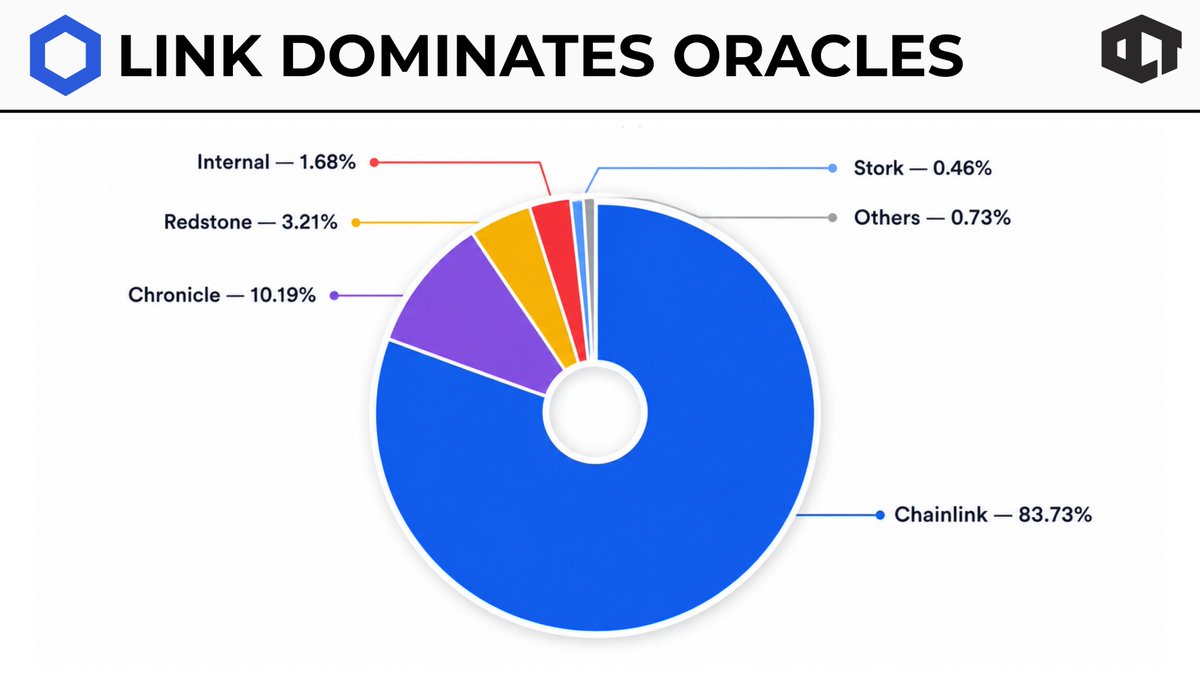
Chainlink is the single most important piece of infrastructure in crypto. That is not debatable and every major DeFi protocol depends on it.
Every cross-chain bridge that matters runs through CCIP and institutional RWA tokenization project needs its oracles.
But another ATH above $52.70 this cycle?
The math does not support it.
Of all the reasons to be bullish on @quipnetwork, security remains the biggest one
Not just from someone hacking your Bitcoin wallet
$QUIP's quantum tech could be great for defi as well
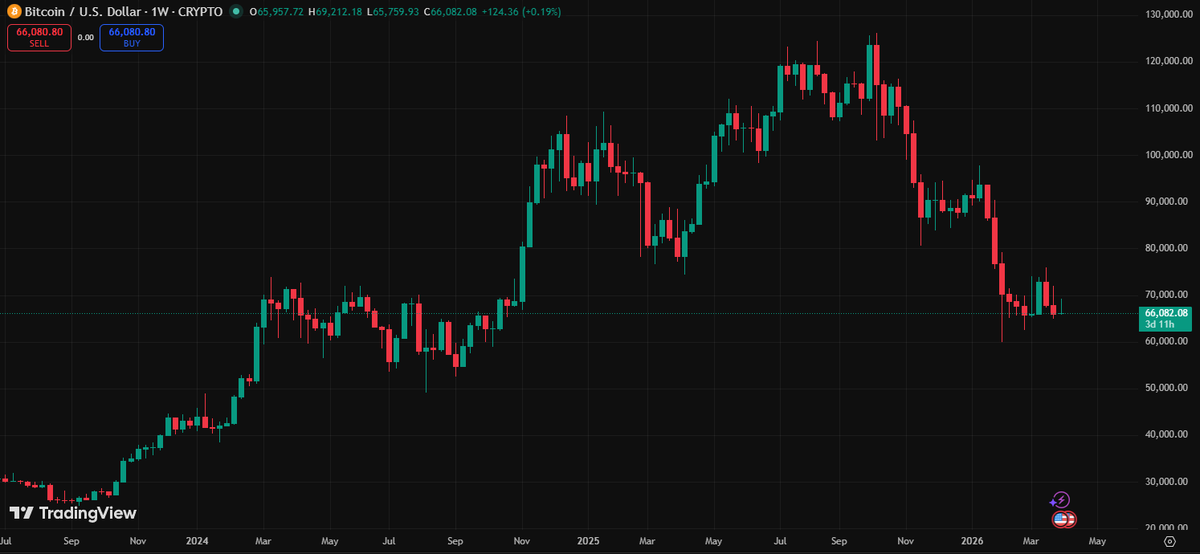
Weekly on $BTC looking bad once more
No war ending near, but maybe April will be kind and give us a break
Hope you've been accumulating so far, and if we're lucky, the bear will continue for some months more to make sure you have enough time to do so 😉
🔥 After in-depth research, I’ve picked $ONDO as my next gem to accumulate after $TAO and $HYPE.
This comes from the growth of $USDY on @OndoFinance 👇
$USDY the yield-bearing stablecoin from @OndoFinance is quietly becoming the go-to play for serious institutions.
This goes beyond a typical just hold peg coin like $USDT or $USDC. $USDY is backed by short-term U.S. Treasuries + bank deposits, generating real yield while staying fully on-chain and liquid.
Permissionless access globally + real-world yield = this is basically the blueprint for “tokenized cash management” for institutions.
TVL / Market Cap:
- Over $1.85B, up +30% in the last 30 days alone.
- Ondo is leading the entire tokenized U.S. Treasuries sector with ~ $2B TVL in Treasuries and ~$2.91B total on-chain assets.
Yield: Currently sitting around 3.55% (7-day APY), paid via token appreciation.
Scale & Growth:
- 14,114+ holders, live across 8+ chains: @Ethereum, @Solana, Stellar, @SeiNetwork, @Aptos…
- Since 2025, $USDY crossed $1B TVL in just a few months outpacing most competitors in the space.
EEZ is the 1st proposal that actually makes Ethereum feel like one liquidity layer again 💎
It’s the fact that liquidity is scattered across dozens of environments that don’t actually talk to each other in a meaningful way.
They scaled $ETH, but they fragmented it in the process.
That tradeoff made sense early on. Rollups gave us cheaper execution, better UX, and a path to scale without compromising L1.
However, what it ended up with is something users don’t intuitively understand: 10+ “Ethereums”, each with its own liquidity, its own state, its own UX assumptions.
Bridges became the glue and bridges are a terrible abstraction imo.
They introduce delay, risk, mental overhead, and worst of all, they break composability, the thing that made Ethereum powerful in the first place.
That’s why when I look at the recent Ethereum roadmap with Verkle Trees, PBS, blob scaling, all of it, etc. I see a stronger engine being built. Yet the system still doesn’t feel like one machine.
And that’s where the Ethereum Economic Zone (EEZ) clicked for me because it fixes what scaling broke.
For context, EEZ represents a transformative proposal designed to repair the fragmentation caused by the network's shift toward multiple independent rollups.
– While scaling solutions originally lowered costs, they inadvertently siloed liquidity and forced users to rely on slow, risky bridges that break the system's natural composability.
– By enabling synchronous execution across different layers, the EEZ allows diverse environments to function as a unified liquidity layer rather than separate execution silos.
– This framework permits developers to build applications that access capital and users across the entire ecosystem without requiring complex redeployments or asset transfers.
– Ultimately, the initiative aims to restore the feeling of a single machine, making the user experience seamless while leveraging advanced ZKPs and official ecosystem support.
The implications are massive: instead of treating rollups as separate execution silos connected asynchronously, EEZ turns them into a single composable surface.
Contracts on one rollup can call contracts on another rollup or even L1, synchronously, within the same transaction.
Liquidity stops being chain-specific and starts behaving like it exists in one shared system again.
You can actually design DeFi the way it was originally intended, strategies that span multiple environments, executed atomically, without breaking UX or introducing risk layers.
This is the first time since the rollup-centric roadmap that I’ve seen a credible path back to real composability.
And if you zoom out, this is fundamentally a liquidity infrastructure upgrade.
Because the problem today is that every protocol has to rebuild liquidity from scratch on every chain.
You get fragmented pools, duplicated incentives, weaker network effects, capital inefficiency everywhere.
Even the best protocols feel smaller than they should be because their liquidity is siloed.
What EEZ does is remove that constraint.
A protocol can exist once, and access users and capital across the entire zone.
That’s a completely different growth model, and this is where I think the real winners in crypto infra will emerge, the ones that make liquidity feel native everywhere.
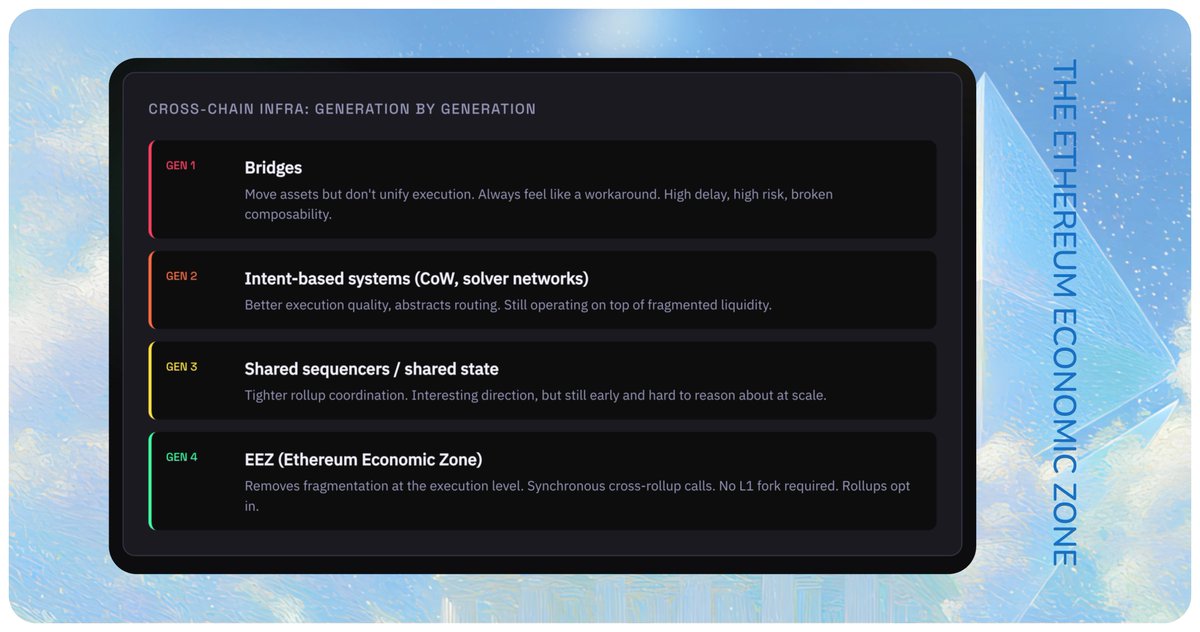
If I break down the current landscape from that lens, there are a few distinct approaches forming:
– Bridges were the first generation. They move assets, but they don’t unify execution. That’s why they always feel like a workaround rather than a solution.
– Intent-based systems like CoW or solver networks started improving execution quality, abstracting away routing and giving users better outcomes. That’s a step forward, but still operating on top of fragmented liquidity.
– Then you have shared sequencer/shared state designs trying to coordinate rollups more tightly. Interesting direction, but still early and complex to reason about at scale.
– EEZ feels different because it removes fragmentation at the execution level.
And the fact that it doesn’t require an L1 fork makes it even more realistic. Rollups can opt in, and if enough of them do, you start to see a real network effect.
What also gives me confidence here is who’s behind it.
– @gnosis_ has been quietly responsible for a lot of foundational pieces people take for granted today from early AMM design to Safe wallets to @CoWSwap.
– And on the ZK side, the feasibility comes from real progress in proving speed and cross-domain execution.
– Plus, with @ethereumfndn funding, it’s aligned with where $ETH actually wants to go.
If this works, the impact is pretty straightforward: Ethereum will start feeling like a single economic system again!
Users won’t think about bridging. Protocols won’t think about chain deployments. Liquidity won’t be artificially segmented.
And more importantly, new types of applications become viable, things that require tight composability across different execution environments.
In my view, liquidity infra is where that battle is being fought.
Right now, EEZ is the cleanest attempt I’ve seen at solving that.
Directionally, it makes more sense to me than adding another layer on top of fragmentation.
The Solana perp space is now in the search of a new leading name 👀
@StandX_Official might be ready to stand for said place, and for the leading role on BNB as well
With this many protocols out there, you need a good USP to stand out though
���
That's what $DUSD is for 👇
- Mint (or swap) your USDT and USDC for $DUSD
- Earn yield automatically by holding it
- Use it as collateral to trade perps
- Earn yield while trading as well
This protocol is still pretty young but it has a great UI and the yield on top of the trading collateral going for it
For now, you can trade $BTC - $ETH - $XAU - $XAG
Or you can simply deposit capital in the DUSD vault to earn some extra returns from the StandX Liquidity Provider(SLP) strategies
▶️ There's also Block Trade to keep an eye on
With Block Trade, you can negotiate perp contract trades P2P, without moving the market itself
- 0 Market Impact
- Crosschain
- Transparent with everything trackable onchain
- Options to fill up to 25 counterparties at once
- Flexible and FullMatch execution modes
This is probably even more of a USP than the yield on the collateral, and I'm watching this one closely
The team just recently upgraded the UI (which was already great IMO)
If they keep up the good work, StandX could become pretty resilient and known in the market as the P2P perp DEX
Markets love visible narratives
#EVs are obvious. Solar growth is obvious
What’s less obvious is where the value accumulates
Think about what’s needed at scale ��
▪️ Millions of charging sessions
▪️ Energy tracking & settlement
▪️ Coordination between distributed sources
▪️ Integration with digital layers
That’s an infrastructure stack
@Chain4Energy is positioning right there
Energy Platform + ChargEra + Web3 integration
You start to see the asymmetry here
The cars get attention… the networks capture value
$C4E
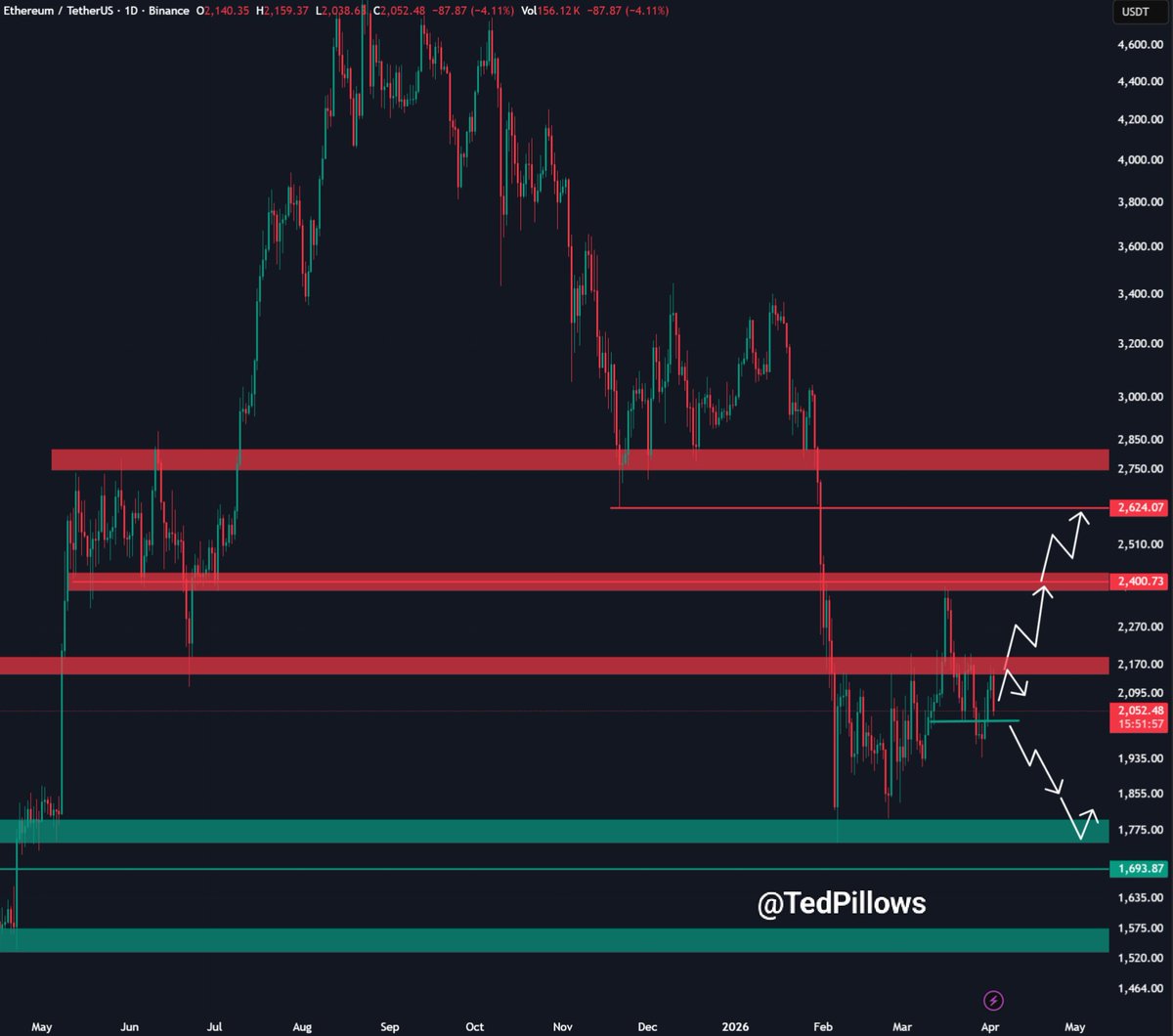
$ETH is still holding above the $2,000 level.
This is primarily due to exploiters swapping $250,000,000 into ETH.
As long as Ethereum holds above the $2,000 level, it could push for another rally.
Losing this level means the downtrend will accelerate.
I focus on what’s actually happening, not just the narrative
March was different
We’re now seeing machines in the flow of money
→ Earning (robo-farm)
→ Deploying capital (@RobotMoneyAgent)
→ Paying users ($55K+ via @silencioNetwork)
Backed by stronger liquidity and growing participation across @peaq
Feels early, but real
If 2025 was the phase where institutions were experimenting with products, then Q1 2026 marks a real inflection point:
RWA is no longer just about bringing assets on-chain, it’s now forming its own ecosystem of yield, liquidity, and native distribution on blockchain.
As of now, #RWA is the fastest-growing and most explosive narrative in 2026:
> Distributed Asset Value: $27.6B
> Represented Asset Value: $403.28B
> Total holders: 700K+
Q1 growth breakdown: At the start of Q1, distributed value sat around $21–21.35B. By the end, it climbed to ~$27.5B → ~30–31% growth in just 3 months.
That’s a serious expansion, especially with broader crypto markets staying volatile.
One key unlock:
Tokenized US Treasuries (~$10B) are now acting as the on-chain risk-free rate.
Why this matters: In traditional finance, everything gets priced off the risk-free rate:
> Lending rates
> Derivatives pricing
> Yield curves
For the first time in crypto, there’s a real yield anchor coming from the real world.
Other major tokenized asset classes:
– Commodities: $XAUT ($2.7B) + $PAXG ($2.4B) dominate ~70% of this sector
– Stocks: Just crossed $1B on-chain in Q1 (~2,900% YoY growth since early 2025)
Led by @OndoFinance and @Securitize
– Private Credit & Corporate Bonds: ~$4–5B, steady growth, but some funds saw 30–45% drawdowns over 30d during risk-off phases
---
Current chain distribution: RWA liquidity is concentrated across 3 main ecosystems: Ethereum, BNB, Solana
– #BNBChain: +$1B in Q1 alone from ~$2B → $3B+: Driven by $USYC + Binance off-exchange collateral integration
– #Ethereum: Still dominant with ~$15.4B (50%+ market share), though growth is starting to slow
– #Solana: Emerging as a serious contender becoming the hub for tokenized stocks
With its infra, Solana has real potential to challenge Ethereum going forward
Q1 2026 makes one thing clear: Crypto is maturing and actually connecting with TradFi. This is real yield + institutional capital flowing on-chain.
Tokenization is solving problems TradFi couldn’t: 24/7 liquidity, Fractional ownership and Composability.
And this is only the beginning.