Owning the token isn’t the same as owning the share.
A breakdown of what tokenized stock holders can actually do:
→ ~5%: the token is the share. Superstate, Securitize and fairmint put it on the company’s own register.
→ ~31%: can swap into a share. Binance bStocks (via Nest Trading, eligible non-US users only) and Backpack (into an entitlement held at a broker, not your name on the register).
→ ~60%: can only become cash. Ondo, xStocks, Robinhood, RealityFi, Dinari.
So about 36% can be, or become, a real share, while 60% can only be sold or cashed out.
Terms vary too. xStocks redemption needs KYC and a $5K minimum, and Coinbase says you can redeem but hasn’t published how.
Not a flaw on its own, but worth knowing which kind you hold.
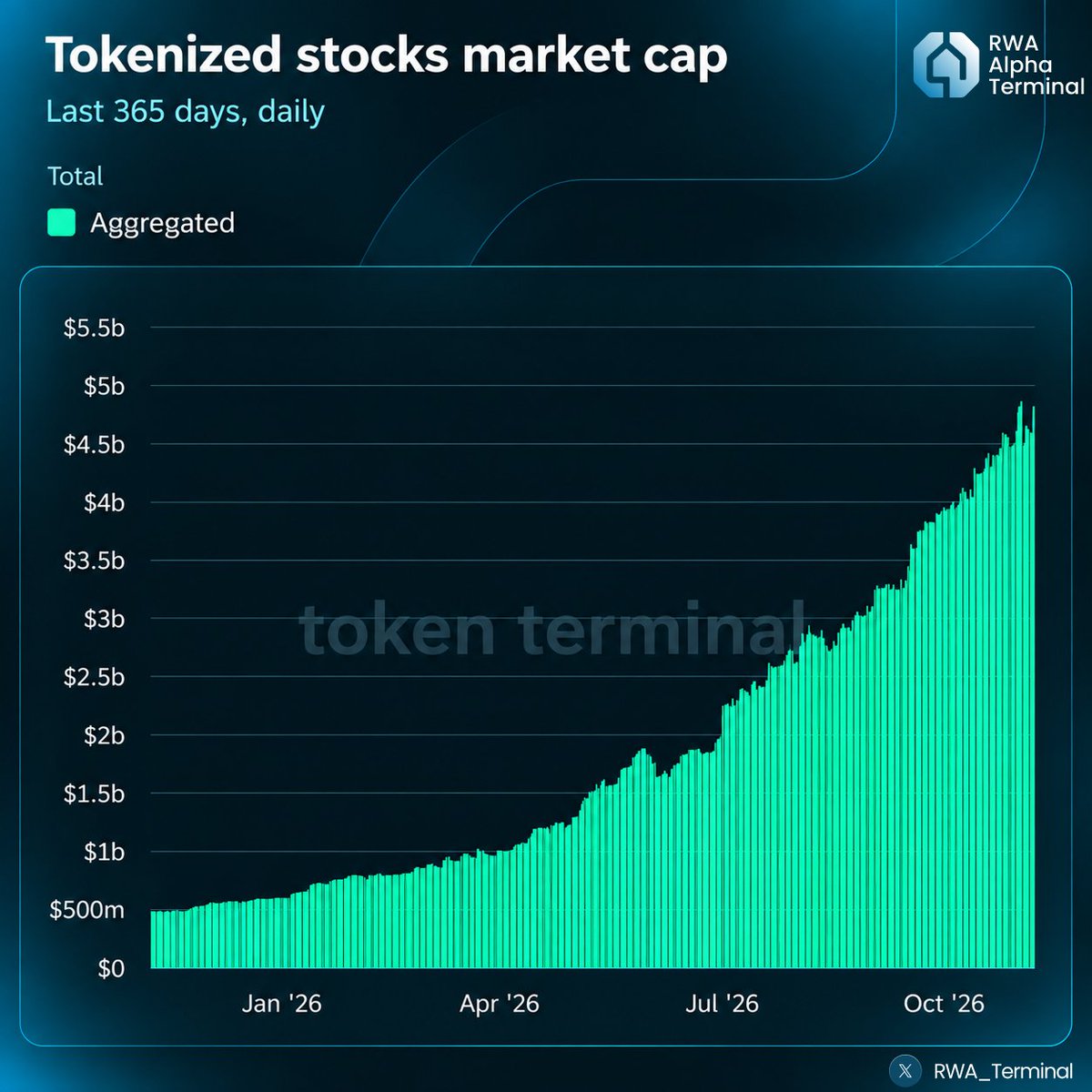
📈 Tokenized stocks: nearly 10x in one year.
1 year ago: $485M
6 months ago: $1.50B
3 months ago: $2.86B
Now: $4.82B
That’s about 3x in six months, and roughly $2B added in just the last three.
From millions to billions in a year. The question now is how many more zeros are coming.
📍 Source: Token Terminal
Tokenized stocks’ biggest DeFi venue isn’t a DEX or a lending market. It’s a yield market.
Pendle: $53.5M, about 18.5% of the $289.1M total, up from #7 to #1 in just 1.5 months.
The rest of the top 5: Uniswap V4 ($46.1M), Kamino Lend ($44.4M), Uniswap V3 ($33.5M), Raydium CL ($23.0M). Uniswap is split by version here.
Holders aren’t only trading or borrowing against tokenized stocks. They want to earn on them.
Total DeFi TVL for tokenized stocks is up 2,283% in a year.
📍 Source: Token Terminal
24/7 markets, but Wall Street still sets the rhythm.
Tokenized stocks on Solana never stop trading, yet volume jumps when NYSE opens. The busiest weekday hour in October was 9am New York time.
NYSE hours are only 21% of the month but carry 38% of tokenized equity volume (31% on Solana).
The flip side matters just as much: more than 60% of volume happens outside NYSE hours. That’s the access traditional markets can’t offer, and it’s where tokenized stocks add something new.
📍 Chart: @banbannard
Wall Street is not watching tokenization anymore. It’s building it.
This map from RWA Foundation lists the institutions already working onchain, across four groups:
→ Asset managers: BlackRock, Franklin Templeton, WisdomTree, Fidelity, Apollo, Invesco, VanEck and more
→ Banks: JPMorgan, BNY, HSBC, Standard Chartered, Citi, Goldman Sachs, UBS, Morgan Stanley and more
→ Market infrastructure: DTCC, ICE, Euroclear, Nasdaq, LSEG, Broadridge, Tradeweb
→ Corporates, payments and custody: Visa, Mastercard, Stripe, Robinhood, Siemens, Uber, Fireblocks, Anchorage, Paxos, Circle
The most telling row is the third one. When the companies that clear, settle and custody the market are on this list, tokenization is no longer a side experiment.
Worth noting: the map shows who is building, not who has launched at scale. Some of these names have live products, others are pilots or announcements.
Not exhaustive. Who did they miss? 👇
📍 Source: RWA Foundation
The structure behind tokenized stocks matters more than the label.
$4.17B of the $4.60B market (91%) is backed by shares held at a single broker: Alpaca Securities. Seven issuers route through it, including Binance bStocks, Ondo, xStocks, Robinhood and Coinbase.
Those shares sit at DTC, so on the company’s books the owner is Cede & Co., not the token holder.
Only issuer-sponsored tokens (Superstate, Securitize) put shares on the company’s own register, with no broker and no DTC. That’s about 5% of the market.
Different apps, different chains, same back door: 4.7M holders, one broker between them and the real shares.
That’s not a problem on its own, but it’s a single point of dependency worth understanding.
💳 Stablecoin Card Payment Volume Across Chains
🥇 Base: $1.8B
🥈 Solana: $970.7M
🥉 Optimism: $861.3M
Polygon: $686.0M
Stellar: $495.5M
Arbitrum: $494.8M
Ethereum: $466.1M
Scroll: $369.7M
Gnosis: $216.0M
Plasma: $184.0M
Base alone handles about 26% of the top-10 total of roughly $6.5B, nearly double #2 Solana.
The pattern is clear: card payments run on cheap L2s and alt-L1s, not on Ethereum mainnet. Ethereum ranks 7th here, behind Base, Optimism, Polygon, Stellar and Arbitrum.
Spending stablecoins in the real world needs low fees and fast settlement, and the ranking shows where that’s happening.
🌍 Stablecoin holder addresses just crossed 300M. The count is now 310M.
Share of holder addresses:
→ Tether: 71%
→ USDC: 20%
→ Other: 7%
→ DAI: 2%
That’s roughly 220M addresses holding USDT and about 62M holding USDC.
The growth curve is the real story. It took years to reach the first 100M, and the last stretch has been far steeper, with the count nearly tripling in under three years.
Tether also looks even more dominant by holders than by anything else. The majority of the world’s stablecoin wallets are USDT wallets.
📍 Source: CryptoRank, Blockworks
📱 Samsung Wallet has officially launched Stablecoin Account for eligible U.S. Galaxy users (Nov 5, 2026).
Users can buy, hold, and transfer USDC on Solana directly in the app, with no separate crypto wallet to install and no private keys to manage.
Key details:
→ About 82 million U.S. Galaxy devices are compatible
→ Send USDC to another Samsung Wallet user or a compatible external wallet with no Samsung transfer fee
→ Send money to bank accounts in 60+ countries, where recipients may receive local currency (fees vary by destination)
→ Custody: Bastion runs the accounts and transfer infrastructure, while Coinbase holds the USDC as sub-custodian via Coinbase Prime Vault
→ Samsung says it will explore online and in-store stablecoin payments and expansion to more markets, subject to local regulation
Requirements: 18+, a Samsung Account, and a device running Android 13 or later. New York residents are excluded.
Solana Foundation President Lily Liu: “For a decade, stablecoins have proved the technology works. What they lacked was a way to reach the mainstream.”
One thing to keep in mind: 82 million is the number of compatible devices, not users. Actual adoption is what’s worth watching.
📍 Source: The Block (Nov 5, 2026)
Another 200-year-old industry giant joins the tokenization race
Schroders, a UK-based asset management firm with $1.15 trillion in client assets, has partnered with Centrifuge to bring an emerging market bond fund onto the Solana blockchain.
• The underlying assets consist of government and corporate bonds from emerging economies, providing exposure to markets beyond the US and the EU.
• Investors hold tokens representing an intermediary fund, which in turn allocates capital into a Schroders bond fund; investors do not own the bonds directly.
• Returns - whether gains or losses - depend on the debt-repayment capacity, exchange rates, and economic conditions of the invested countries. This risk profile differs significantly from that of the short-term US government bonds currently popular in the market.
The RWA ecosystem is now big enough to need a map.
500 companies across 10 sectors: stablecoins, tokenization, blockchains, institutions, lending, trading, custody, exchanges, oracles and perps.
And that’s the curated view. The full directory lists 1,000+.
What stands out is the mix. Institutions, custody and exchanges sit next to lending and perps, so tokenization is turning into a full stack, not a single product category.
The RWA ecosystem.
500 companies across 10 sectors. Stablecoins, tokenization, blockchains, institutions, lending, trading, custody, exchanges, oracles and perps.
Full directory of 1,000+ at https://t.co/Et0VgKsIVz
Tagging the biggest names in each sector ⬇️
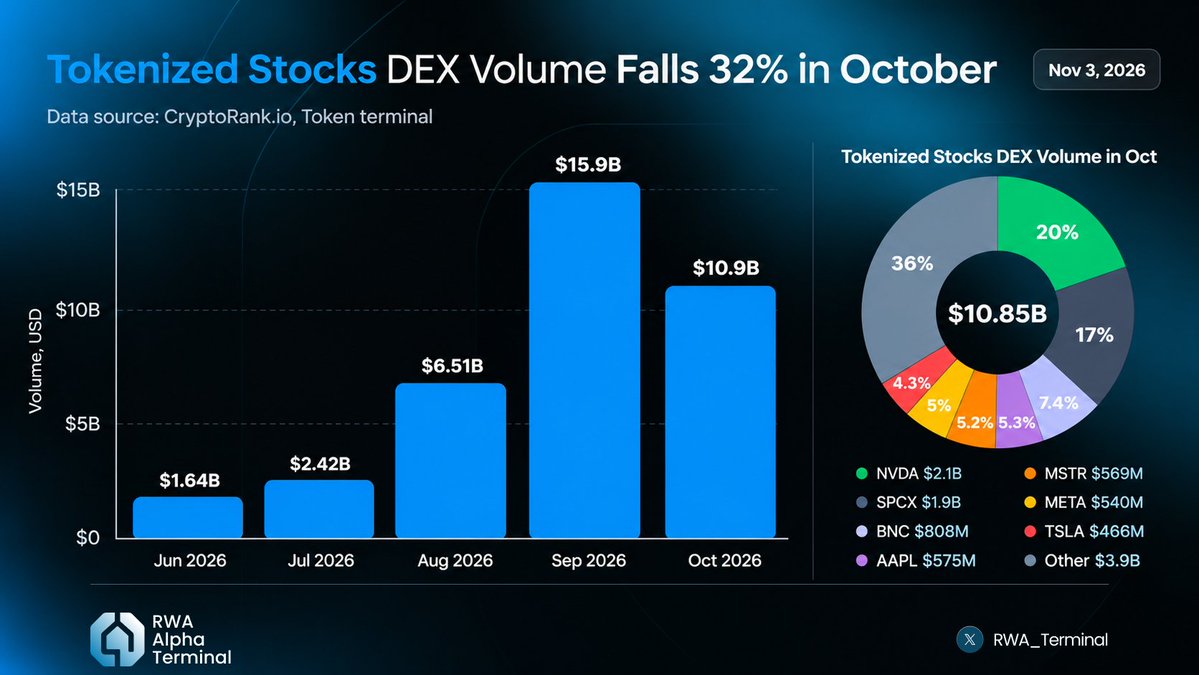
📉 Tokenized Stocks DEX Volume Falls 32% in October
Monthly DEX volume:
Jun: $1.64B
Jul: $2.42B
Aug: $6.51B
Sep: $15.9B (peak)
Oct: $10.9B
October’s drop is a pullback from an exceptional September, not a return to where things started. Volume is still about 6.6x higher than in June.
Top tokenized stocks by DEX volume in October ($10.85B total):
→ NVDA: $2.1B (20%)
→ SPCX: $1.9B (17%)
→ BNC: $808M (7.4%)
→ AAPL: $575M (5.3%)
→ MSTR: $569M (5.2%)
→ META: $540M (5%)
→ TSLA: $466M (4.3%)
→ Other: $3.9B (36%)
The top two names alone account for 37% of the volume, and NVDA leads for the month.
📍 Source: CryptoRank, Token Terminal
📊 Tokenized Stocks Reach New Highs in October
DeFi TVL by network (as of Nov 2, 2026):
🥇 Solana: $97.3M
🥈 Robinhood Chain: $68.9M
🥉 Ethereum: $53.0M
BNB Chain: $42.0M
Base: $25.5M
X Layer: $12.8M
Total across these six networks: roughly $300M.
Two things stand out:
→ Solana leads with about 32% of the total
→ Robinhood Chain is already #2, ahead of Ethereum, with Solana and Robinhood Chain together holding more than half
The chains where tokenized stocks are actually being used in DeFi look very different from the chains with the most overall DeFi TVL.
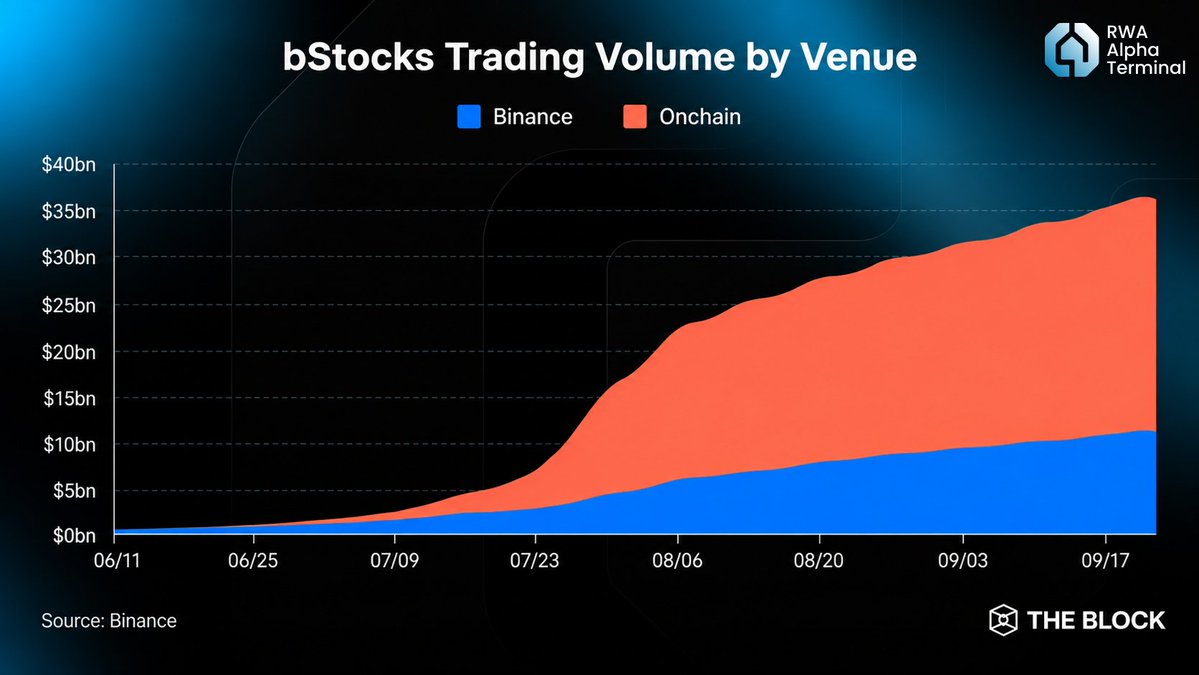
📊 bStocks trading volume by venue
Binance’s tokenized stocks have now done roughly $36B in cumulative trading volume.
The split is the interesting part:
→ Onchain: ~$24-25B (about two-thirds)
→ Binance: ~$11-12B (about one-third)
Most of the growth came in a short window. Volume jumped from ~$7B to ~$22B between late July and early August, then kept climbing at a slower pace.
A tokenized stock product from a centralized exchange is doing most of its volume onchain, not on the exchange itself.
📍 Source: Binance, The Block
Tokenized stocks are starting to work in DeFi, not just sit in wallets.
$304.7M across 20 venues, up 2,290% in a year.
Uniswap leads at $88.7M, ahead of Pendle ($51.4M) and Kamino ($46.6M). Those three hold about 61% of the total.
The mix is the interesting part: DEX liquidity, yield trading and lending all sit in the top 5. The full DeFi stack is forming around equities.
And it’s still early. That’s only ~6-7% of the ~$4.6B tokenized stock market.
📈 RWA share of on-chain perps volume hit a new monthly high.
RWA perpetuals made up 28.4% of total on-chain perps trading volume in October, up from 20.5% in September.
Monthly share:
Jul: 27.5%
Aug: 22.2%
Sep: 20.5%
Oct: 28.4%
The jump came from two things at once: RWA trading activity growing, while volumes in other perps markets declined.
That second part matters. This isn’t RWA perps just riding a bigger market. Their share rose because the rest of the market shrank, so RWA is holding up better than crypto-native perps.
📍 Source: CryptoRank, DefiLlama