لَا إِلٰهَ إِلَّا الله
"They say the Most Merciful has taken a Son. You have said an atrocious thing.The heavens almost rupture therefrom and the earth splits."
@scaryhourspdcst SAYS ON FACE VALUE CHRISTIANITY IS FALSE AND I HAVE A VALID ARGUMENT ✝️🪦🪦😂🥀
@destroysunnis come pick up the pieces of your husband like you had to with ur man-god in Matthew 27 MUTTAH BOY! 😂✝️🪦
THE FATHER OF ANTI ISLAMIC APOLOGETICS HAS ENTERED TWITTER.
The Orthodox Muslim did a segment on Discord where he brings Muslims on to debate him while he plays devil’s advocate as a Christian and was proud of a Muslim knowing how to present his argument well against him!
Without lies Christianity dies...
It seems that Inspiring Polytheism, did not read the study he shared properly.
Jonathan Fox explicitly states in his study: "The results show that there is INSUFFICENT evidence to support the stereotype of the Islamic militant." (Is Islam More Conflict Prone than Other Religions? A Cross-Sectional Study of Ethnoreligious Conflict, Jonathan Fox, p. 1.)
Fox also explains that similar stereotypes of religious violence can be applied to other religious groups. He specifically mentions Christian fundamentalists who violently oppose abortion, Jewish settlers, and the conflict between Catholics and Protestants in Northern Ireland. (Is Islam More Conflict Prone than Other Religions? A Cross-Sectional Study of Ethnoreligious Conflict, Jonathan Fox, p. 2.)
Although Fox finds that religion plays a more prominent role in conflicts involving Islamic ethnoreligious groups, he does not conclude that Muslims are inherently more militant or inclined towards violence. His findings distinguish the importance of religion in particular conflicts from the stereotype that Muslims are naturally more violent. (Is Islam More Conflict Prone than Other Religions? A Cross-Sectional Study of Ethnoreligious Conflict, Jonathan Fox, p. 1.)
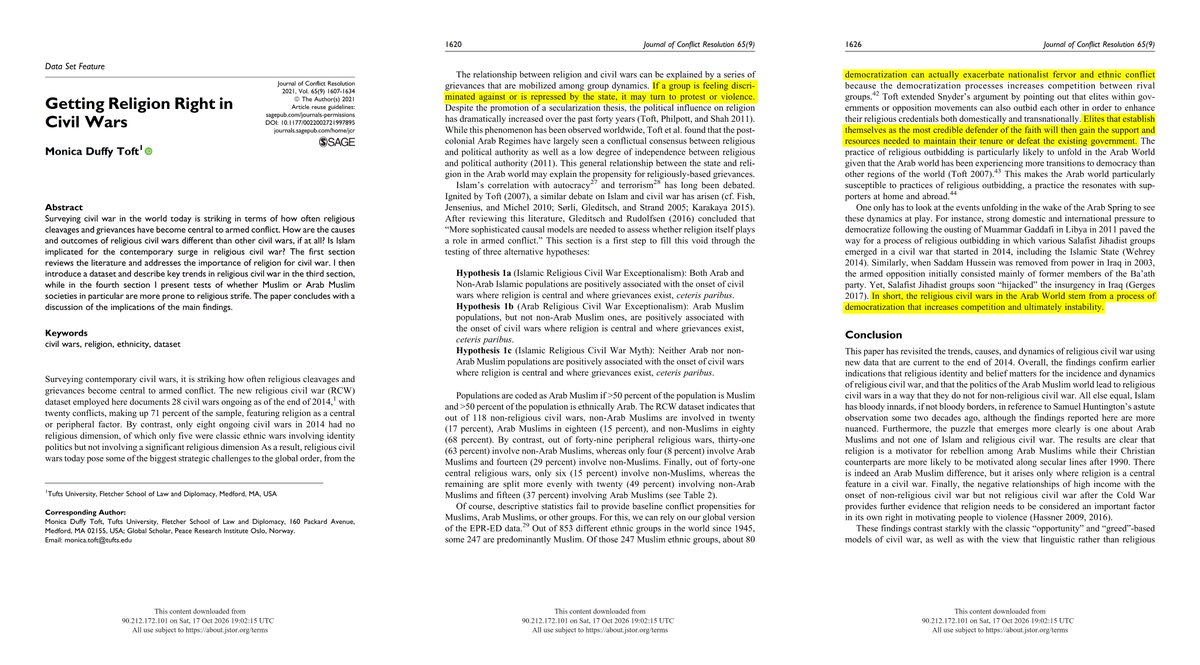
As for Monica Duffy Toft's study, Getting Religion Right in Civil Wars, her research does not establish that Islam inherently causes violence. Her principal statistical finding concerns politically excluded Arab Muslim populations and a particular category of religious civil war. She explicitly states: "There is no evidence of Arab Muslim exceptionalism for other kinds of civil wars." (Getting Religion Right in Civil Wars, Monica Duffy Toft, p. 1624.)
Toft herself distinguishes this finding from a general association between Islam and religious warfare. Although she concludes that religion can motivate rebellion, her research does not show that Islamic teachings inherently encourage violence, as IP attempts to suggest. In fact, she explains that the findings concern Arab Muslim populations in particular, rather than Muslims generally. (Getting Religion Right in Civil Wars, Monica Duffy Toft, pp. 1624, 1626.)
She also discusses how political leaders and armed organisations compete to present themselves as the most credible defenders of religion, thereby gaining political support and resources. (Getting Religion Right in Civil Wars, Monica Duffy Toft, p. 1626.)
She provides two relevant examples.
Iraq, 2003: Following Saddam Hussein's removal, the armed opposition initially consisted largely of former members of the Ba'ath Party. Toft explains that militant religious organisations subsequently became increasingly influential within the insurgency. (Getting Religion Right in Civil Wars, Monica Duffy Toft, p. 1626.)
Libya, 2011 to 2014: Following Muammar Gaddafi's removal, political instability and competition created conditions in which several militant Islamist organisations emerged, including the Islamic State. (Getting Religion Right in Civil Wars, Monica Duffy Toft, p. 1626.)
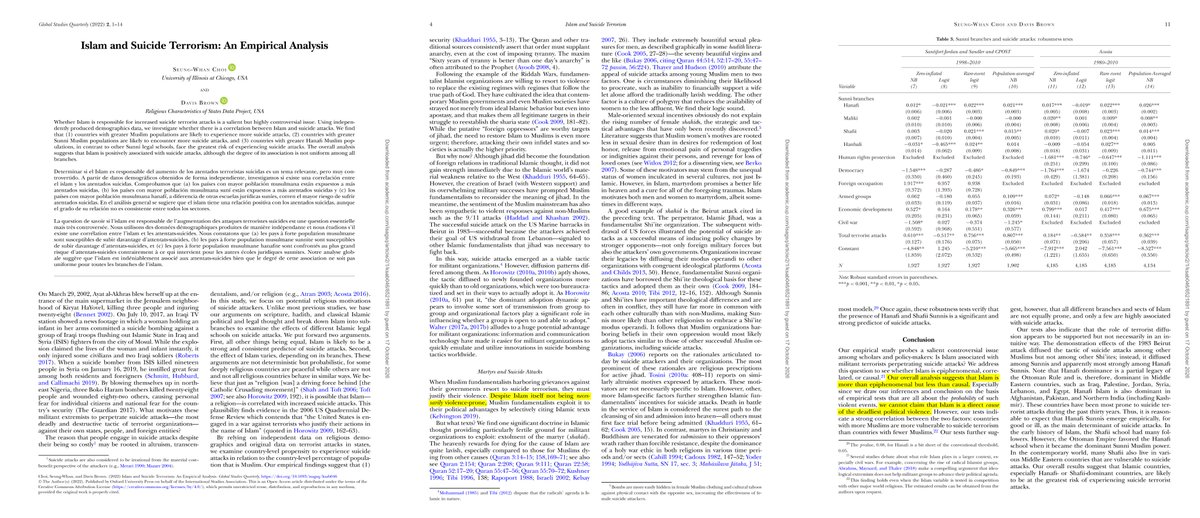
Turning to Seung Whan Choi and Davis Brown's empirical study, the authors explicitly acknowledge: "Despite Islam itself not being necessarily violence-prone", before discussing how militant organisations may exploit religion to justify political objectives. (Islam and Suicide Terrorism: An Empirical Analysis, Seung-Whan Choi and Davis Brown, p. 4.)
They also conclude: "Our overall analysis suggests that Islam is more than epiphenomenal but less than causal." (Islam and Suicide Terrorism: An Empirical Analysis, Seung-Whan Choi and Davis Brown, p. 11.)
Furthermore, they explicitly acknowledge: "We cannot claim that Islam is a direct cause of the deadliest political violence." (Islam and Suicide Terrorism: An Empirical Analysis, Seung-Whan Choi and Davis Brown, p. 11.)
In other words, although the researchers find an association between Islam and particular patterns of suicide terrorism, they cannot demonstrate that Islam itself directly causes these attacks. Which is what IP tried to make it out to be.
Regarding Davis Brown's study, The Influence of Religion on Interstate Armed Conflict: Government Religious Preference and First Use of Force, 1946–2002, the research identifies relationships between government religious preferences and the likelihood of initiating armed conflict.
However, Brown acknowledges that the study does not establish why these relationships differ between religions. He explicitly states: "No explanation is offered for the different results herein", before discussing several possible explanations, including religious identity, religious commitment, political circumstances and religious teachings concerning warfare. (The Influence of Religion on Interstate Armed Conflict: Government Religious Preference and First Use of Force, 1946–2002, Davis Brown, p. 817.)
Consequently, these studies does not establish that Islamic teachings are responsible for the observed relationship.
This raises an important question: Why do countries with a Muslim majority account for a disproportionate share of armed conflict???
Nils Petter Gleditsch and Ida Rudolfsen address this question in their study Are Muslim Countries More Prone to Violence? (2016). They discuss several possible explanations for the greater concentration of armed conflict in Muslim countries.
Colonialism: European colonial powers imposed artificial borders that contributed to territorial disputes and subsequent conflicts. (Are Muslim Countries More Prone to Violence?, Nils Petter Gleditsch and Ida Rudolfsen, p. 5.)
Foreign interventions: Military interventions in Afghanistan, Iraq and Libya contributed to political instability and armed conflict. The authors suggest that the increase in conflicts after 2001 may partly reflect reactions to interventions by major powers. (Are Muslim Countries More Prone to Violence?, Nils Petter Gleditsch and Ida Rudolfsen, pp. 5, 6.)
Political repression: Authoritarian governments, state repression and political instability may contribute to the emergence and continuation of violence. (Are Muslim Countries More Prone to Violence?, Nils Petter Gleditsch and Ida Rudolfsen, p. 6.)
Economic conditions: Lower levels of economic development, dependence on oil revenues and large young populations are among the factors associated with greater conflict. (Are Muslim Countries More Prone to Violence?, Nils Petter Gleditsch and Ida Rudolfsen, p. 6.)
Sectarian conflicts: Fighting between Sunni and Shia groups contributes to violence in parts of the Muslim world. The authors also compare this phenomenon with historical conflicts between Catholics and Orthodox Christians. (Are Muslim Countries More Prone to Violence?, Nils Petter Gleditsch and Ida Rudolfsen, p. 6.)
Declining conflicts elsewhere: Muslim countries account for a greater proportion of global civil wars partly because the overall number of civil wars elsewhere declined considerably after the Cold War. Nils and Ida explain that this does not necessarily indicate a substantial increase in the absolute number of civil wars involving Muslim countries. (Are Muslim Countries More Prone to Violence?, Nils Petter Gleditsch and Ida Rudolfsen, pp. 1, 3.)
Most importantly, Gleditsch and Rudolfsen reference Karakaya's 2015 study, which found that the increased conflict proneness of Muslim countries disappeared after accounting for economic development, political repression, oil dependence and large young populations. (Are Muslim Countries More Prone to Violence?, Nils Petter Gleditsch and Ida Rudolfsen, p. 6.)
This is particularly significant because it demonstrates that the statistical association between Muslim countries and civil war can disappear when relevant political, economic and demographic variables are taken into account.
Conclusion
None of these studies proves that Islam itself causes violence. Although several identify statistical associations between religion and particular forms of conflict, these findings should not be confused with evidence that Islamic teachings inherently produce violence.
Choi and Brown explicitly acknowledge that they cannot establish Islam as a direct cause of the deadliest political violence. (Islam and Suicide Terrorism: An Empirical Analysis, Seung-Whan Choi and Davis Brown, p. 11.)
Furthermore, Gleditsch and Rudolfsen identify numerous political, historical and economic explanations for the concentration of armed conflict in Muslim countries. They also reference Karakaya's findings, which show that the association between Muslim countries and civil war disappears after controlling for several important factors. (Are Muslim Countries More Prone to Violence?, Nils Petter Gleditsch and Ida Rudolfsen, pp. 5, 6.)
Therefore, presenting these studies as proof that Islam itself is inherently violent MISREPRESENTS what their findings actually establish.
I repeat it, GodLogic @GodLogic_GL keeps proving that islam makes sense, here u have a Random Muslim (Ayan) completely dog walking Derron Dorsey his student on this objection 👇🔥
WATCH: DERANGED Evangelical lunatic David Wood interviews top Biblical Scholar of the age, ex-evangelical Christian Dr. Bart Ehrman, and recieves the most GRUESOME GRILLING of his career since his debate with Muhammad Hijab
--------
Note: In the video above the quoted video below, you will see David Wood admit that he is a "diagnosed psycopath" in the middle of his debate with Muhammad Hijab, which is the most viewed debate on record between Islam and Christianity in Youtube history, and where David Wood could not produce the name of ONE church father who believed in the Trinity as Christians know it today, which stipulates that the three "God-heads" of the Trinity are Co-equal, Co-existent, and Co-eternal.
This doctrine was first introduced in the council of Nicea in 325CE for the "God The Father-Head", then in 381CE for "God The Holy Spirit-Head"
--------
Dr Ehrman tells him that even before leaving Christianity when he was a Christian scholar, he did not beilieve Jesus walked around saying he is God and will die for people's sins in the synoptic Gospels. He completely eradicates the ressurrection, and informs deranged maniac that his views as an athiest, secular historian are that he was a prophet who did not "ressurrect" then disappear again for 2000 years.
Bart Ehrman has firmly expressed prior that the sole reason Jesus was ki11ed by the Romans was that he told them he is the King of the Jews (Mark 15:2-9), which has NOTHING to do with the prescription of the real Messiah the Jews were waiting for
Credit: The youtube channel in the video
Bible and Quran Scholar Samuel Zinner, says that the word “Ahmed” with its root “hamd” is a synonym with “Doxa”
Jesus describes the Son of Man as coming with “doxa” in the Gospel of Mark Chapter 8 Verse 38
Many scholars including zinner believe that the Son of man is distinct from Jesus in its earliest historical layer of the son of man sayings, however Zinner takes the view that this “distinction” is due to Jesus making reference to his heavenly counterpart.
As Muslims we can take the distinction to be evidence for the arrival of Ahmed instead.
Dr Samuel Zinner a scholar who is well informed in both the Bible and the Quran believes that the Quran knows the Gospels very well (even knowing the texts itself)
He informs us on why he believes most scholars today disagree with him on this:
(Full interview will be up tomorrow in sha Allah)
Fraud Logic says he beat me in court. There was no court no trial, no judgment, and they claim they didn’t get the papers. He raised $78,000 to fight a case that was never fought. Then he quietly deleted the donation page. Too late grifter I kept the receipts. If 78,000 was stolen from Muslim donators to fill preacher’s pockets I don’t think anyone would accept it.