Happening now: Panel discussion #UgEconUpdate23, on “Assessing the Adequacy, Efficiency, Equity, and Effectiveness of Public Spending in Health” moderated by @SolomonSerwanjj, Executive Director @AfricanIIJ
▶️Mr. Richard Kabagambe – Assistant Commissioner, Health Services Planning, @MinofHealthUG.
▶️Prof. Fred Ssengooba - Associate Professor, Health Economics and Health System Management, @Makerere
@RogersAyiko#UgEconUpdate23: @RogersAyiko Recommendations include:
▶️ Improve the availability and productivity of health workforce
▶️ Increase access to efficacious and affordable medicines and health technologies
▶️ Improve healthcare service quality and client engagement
#UgEconUpdate23: @RogersAyik@RogersAyiko Recommendations include:
▶️ Strengthen the health-financing system to enhance adequacy, equity, effectiveness, efficiency, and sustainability of health financing
▶️ Focus investments on primary health care, health promotion, and disease prevention and carefully managed investments in specialized healthcare
▶️ Strengthen public-private partnerships and collaboration for health
#UgEconUpdate23: @RogersAyik@RogersAyiko
Consequences of public health spending inadequacies on health and human capital service delivery systems include:
▶️Low service readiness of health facilities
▶️ health workforce shortages, maldistribution, and low productivity
▶️ Persistent stock-outs of essential medicines mainly due to inadequate public spending and weakness in the supply chain system
#UgEconUpdate23: @RogersAyiko
"As we know it, one extra year of life expectancy increases the GDP per cation of a country. By 2040, we expect the Uganda population have increased significantly. We are also seeing the rising burden on non-communicable diseases."
#UgEconUpdate23: @RogersAyiko The government has not adequately prioritized health spending. In nominal terms, general government health spending from domestic sources declined from 6.5 percent of total health spending in FY14/15 to 3.9 percent in FY20/21, increasing the share borne by households and external development partners.
#UgEconUpdate23: @RogersAyiko
"Health and nutrition are key determinants of human capital development and economic growth.
Access to high-quality health services reduces the prevalence of disability and premature death, while positive health outcomes are associated with increased worker productivity and gains in social development indicators."
#UgEconUpdate23 Mr. Joseph Enyimu; "In 2023, ERA and UMEME's power consumption records show that for the 1st time in Uganda, we had industrial power consumption rising by 100MW. This means that if we had not planned for this increased demand, we would have blackouts and wouldn't be able to support Uganda's potential growth in manufacturing."
#UgEconUpdate23 Dr. Kenneth Mugambe;
"As we talk about broadening the tax base, what options are there? We need to plug the loopholes in the tax regulatory system to thrive as a country. If we can't curb public expenditure, we are not doing our people justice. If we go on the ground, is PDM working? Are we addressing the core challenges faced by ordinary Ugandans?"
Happening now: a panel discussion on “Managing risks to sustain recovery and an inclusive development” moderated by @SolomonSerwanjj, Executive Director
@AfricanIIJ
▶️Mr. Joseph Enyimu, Ag. Commissioner, Economic Development, Policy & Research at
@mofpedU
▶️Dr. Kenneth Mugambe – Chief Executive Officer, Global Pearl Services Limited
They are joined by @RachelSebudde, Senior Economist @WorldBank
#UgEconUpdate23
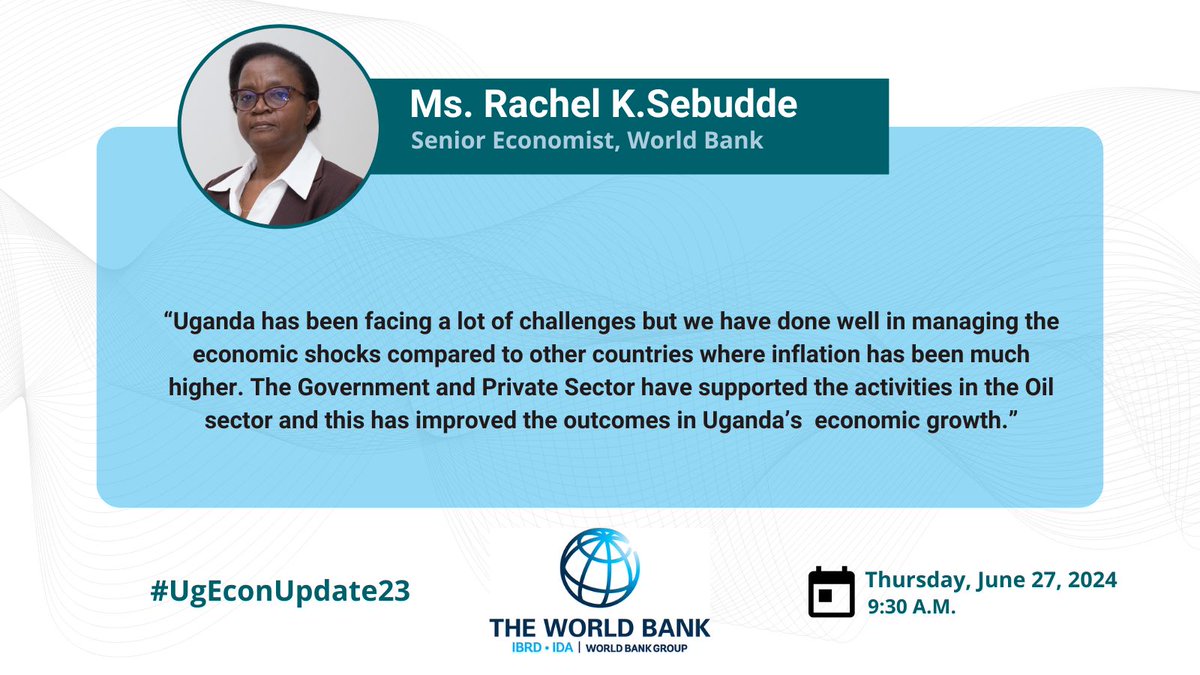
#UgEconUpdate23: Presentation on the "State of the Economy" by Ms @RachelSebudde, Senior Economist @WorldBank
"Uganda’s risk of debt distress is rated “moderate,” but debt vulnerability could increase. Lower growth could further limit the fiscal space to absorb shocks. In addition to an uncertain external outlook, environmental shocks, inconsistent reform efforts, delays in oil production, and the finite capacity of commercial banks to provide deficit financing could heighten the risk of debt distress."
#UgEconUpdate23: Presentation on the "State of the Economy" by Ms @RachelSebudde, Senior Economist @WorldBank
"A combination of macroeconomic and structural policies will be necessary to prevent Dutch disease by increasing productivity and diversifying the economy. Structural reforms will establish the basis for robust private-sector-led growth in line with the Third National Development Plan and the strategic orientation of its successor."
#UgEconUpdate23: Presentation on the "State of the Economy" by Ms @RachelSebudde, Senior Economist @WorldBank
"During the first half of FY23/24, Uganda’s economy maintained strong growth momentum despite
successive domestic and external shocks. Despite the uneven performance of the global economy, fluctuations in commodity prices, rising geopolitical tensions, regional conflicts, and domestic developments that likely affected investor sentiment, GDP grew at an average rate of 5.4 percent during the period,7 albeit down from 6.8 percent during the first half of FY22/23."
#UgEconUpdate23: Presentation on the "State of the Economy" by Ms @RachelSebudde, Senior Economist @WorldBank
"Global economic conditions improved in the first half of 2024, which was marked by incipient
monetary easing and an increase in trade, but global growth is projected to reach just 2.5 percent for the full year,1 continuing the declining trend of the past three years."
#UgEconUpdate23: Presentation on the "State of the Economy" by Ms @RachelSebudde, Senior Economist @WorldBank
"Economic activity has remained resilient despite multiple successive shocks. Real GDP growth accelerated from 5.3 percent in FY22/23 to an estimated 6 percent in FY23/24. The expansion was driven by oil-related construction activity and the growth of the mining and quarrying sector, which benefited from sustained increases in gold prices and an improved domestic environment for artisanal mining."
#UgEconUpdate23: Presentation on the "State of the Economy" by Ms @RachelSebudde, Senior Economist @WorldBank
"With a young and growing population, Uganda has a one-time opportunity to capture a demographic dividend, but success is not guaranteed. As the economy grows and fertility and mortality rates decline, countries pass through a period when the size of the working-age population (ages 15–64) exceeds the dependent population of children and the elderly."
Today's launch of #UgEconUpdate23, will have two presentations;
1⃣ from @RachelSebudde, Senior Economist @WorldBank on “The State of the Economy”.
2⃣ @RogersAyiko will also make a presentation on “Linking Public Spending on Health to Human Capital Outcomes”. Rogers is a Senior Health Specialist @WorldBank
Follow #UgEconUpdate23 for updates.