We cannot sit back and allow the government to take crucial legal rights from disabled children - sign the petition here: https://t.co/gIGyhy2j2n #SEND@LBC@SpcialNdsJungle
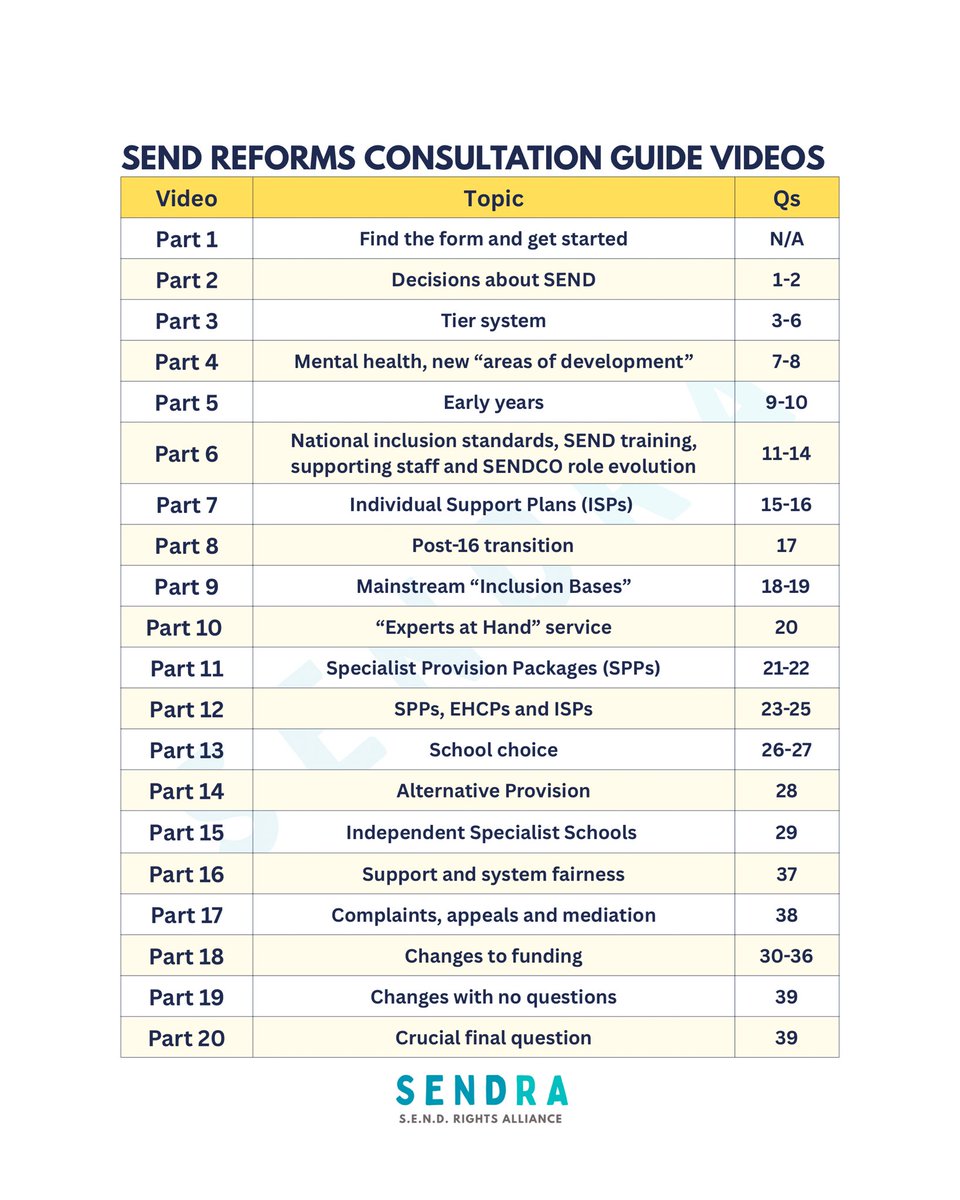
The YouTube playlist has all the videos in order, here’s a guide to the sections with video parts and question numbers in case you’re filling it in selectively… better to answer one or two questions than none! #SENDReform#SEND
I’ve made a #SEND reform consultation guide video series, breaking down the proposals and questions so you can respond before the deadline (18/05). Full playlist: https://t.co/um6djP0Oye Spread the word
#SENDReform#SaveOurChildrensRights#SENDParents
@samanthajbooth Calling them specialist places is a massive stretch, and is what has led to the widespread confusion. Getting some money to build breakout rooms is about 3 billion miles away from a specialist place. That press release was very deliberately misleading.
@Samfr@catrionamoore13 And absolutely nowhere in that list? Parents getting to choose an expensive specialist placement without professional evidence that this is needed, because that misrepresents parental rights and furthers resentment of vulnerable children
@Samfr@catrionamoore13 You’ve missed failure to invest in infrastructure to minimise outsourcing. Funding that doesn’t account for the increase in the cost of provision / staff / number of plans. And crucially the exacerbation of need when it is unmet, exactly what would happen if EHCPs are restricted
@Samfr@catrionamoore13 If the law is at fault, why is it happening everywhere? I didn’t say they were the only issues. Anyone in it can see the knock-on effects of delaying support especially in the last 5 yrs due to the deficits - has it reduced costs or the opposite?
@Samfr@catrionamoore13 That’s a huge the problem and a big factor in why the number of plans and the extent of support required is increasing. My brother was diagnosed with ADHD in the 1990s and his school was able to support him without a statement - wouldn’t happen now, they’re firefighting
@Samfr@catrionamoore13 The cost of employing one TA on minimum wage has essentially doubled in that decade. And that’s before the increases in costs for EPs, SALTs, or the reliance on the private sector
@Samfr@catrionamoore13 How much provision can the £6k of notional budget get a school now compared to a decade ago when introduced? Is it any surprise mainstream schools are having to request more plans, and can’t meet the needs of more children without one?
@Samfr@catrionamoore13 That’s completely backwards. The needs being identified is why a child is referred for assessment in the first place - that’s when support should start, not delaying years while needs are exacerbated by a lack of provision. But early intervention like portage has been slashed
@Samfr@catrionamoore13 The needs exist whether there’s a diagnosis or not, so more children being diagnosed is not a reason for plans to increase. Has need increased or has a failing system made those needs more apparent? Likely both, given the heritable nature of neurodivergence.
@Samfr@catrionamoore13 Funding has been chasing the tail of the cost for a decade. That means lack of funding for schools to provide support without a plan, lack of investment in infrastructure, more costly outsourcing. You obviously know this.
@Samfr@catrionamoore13 What can be provided as standard in a school obviously has the greatest influence on how many children need support beyond that.
@Samfr@catrionamoore13 You know that support for SEND is based on needs and not diagnosis. Yes, when the law is changed without sufficient funding, the amount available for non-stat support decreases. Which means stat support has to increase, as demonstrated by schools applying in most cases
@Samfr@catrionamoore13 This is such a blinkered narrative. You’re just completely disregarding the erosion of non-statutory support as plans have increased, and the resulting increase in need for EHCPs? Most EHCNA requests come from schools, not parents.
@Samfr@catrionamoore13 The irony here is that parental preference only outweighs costs if they want a mainstream placement - their child has a legal right to mainstream education, no matter the cost, even if accommodating them in mainstream costs many times more than a specialist placement
@Samfr@catrionamoore13 It’s not demand, it’s need. This narrative fuels resentment and misunderstanding of the law. The LA have to decide specialist is needed or it won’t be named, and that comes from professionals, not parents. Claiming otherwise is incredibly damaging.
@Samfr@catrionamoore13 Parents are welcome to have a different opinion. It won’t matter if what they want is more expensive than what professionals say they need. This plays into the narrative that children are in specialist schools only because it’s what parents want regardless of cost which is untrue
@Samfr@catrionamoore13 Parents can express a preference for whatever they want. It doesn’t mean the LA is legally required to name a specialist setting if it is not needed. The opposite is in fact true - they have a duty to name the cheapest suitable school
@Samfr@catrionamoore13 Have you taken an LA to tribunal to challenge an inappropriate placement? I have. You have to prove it. Your article implies parental preference is responsible when it is not. It’s lack of provision in mainstream which makes it increasingly unsuitable, hence the increase