Learning Go?
Pick your path:
Go + Gin → Backend APIs
Go + gRPC → Distributed Systems
Go + Kafka → Event-Driven Systems
Go + Kubernetes → Cloud Native
Go + Docker → Containers
Go + Terraform → Infrastructure
Go + Prometheus → Observability
Go + Redis → High-Performance Caching
Go + WebSockets → Real-Time Apps
One language. Countless engineering careers. 🫡
FREE Math Book.
"Notes on Combinatorics" by Cameron. Students should study combinatorics to develop structured, creative problem-solving skills necessary for counting, arranging, and optimizing complex systems in fields like computer science, probability, and logistics
Preface: What is Combinatorics?
1 Subsets and binomial coefficients
2 Selections and arrangements
3 Power series
4 Recurrence relations
5 Partitions and permutations
6 The Principle of Inclusion and Exclusion
7 Families of sets
8 Systems of distinct representatives
9 Latin squares
10 Steiner triple systems
Solutions to odd-numbered exercises
Miscellaneous problems
These notes accompanied the course MAS219, Combinatorics, at Queen Mary, University of London.
Link: https://t.co/uKb7oCI75V
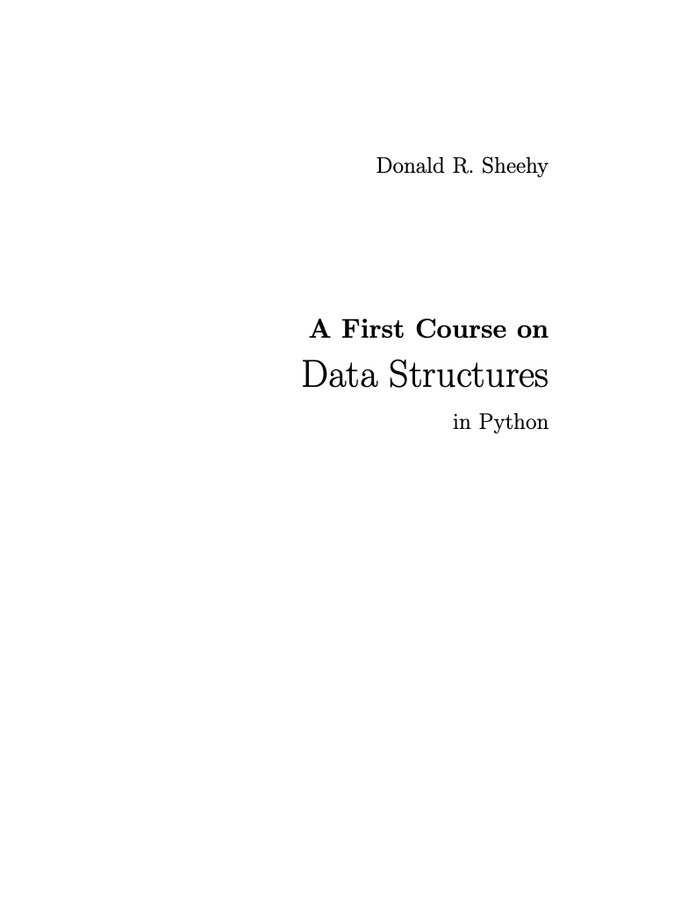
"Data Structures & Algorithms using Python" - book
It covers all types of data structures from Arrays to Graphs. Simple to complex algorithms. 100% FREE
MIT's Books on AI & ML (FREE DOWNLOAD):
1. Foundations of Machine Learning
https://t.co/78p57EBbL8
2. Understanding Deep Learning
https://t.co/D2oyRrXqcE
3. Introduction to Machine Learning Systems
❯ Vol 1: https://t.co/IezLFJdhDV
❯ Vol 2: https://t.co/NYP3xAPZ6u
4. Algorithms for ML
https://t.co/lntuD4Q19H
5. Deep Learning
https://t.co/vCHVIZQYTI
6. Reinforcement Learning
https://t.co/JNWhFCuCkH
7. Distributional Reinforcement Learning
https://t.co/GXpkV4BDZi
8. Multi Agent Reinforcement Learning
https://t.co/T8zVmQVutO
9. Agents in the Long Game of AI
https://t.co/HeD3Nsm5zz
10. Fairness and Machine Learning
https://t.co/csAjhdf7Lb
11. Probabilistic Machine Learning
❯ Part 1 : https://t.co/5Leef9ypGj
❯ Part 2 : https://t.co/vRbF0rEIuh
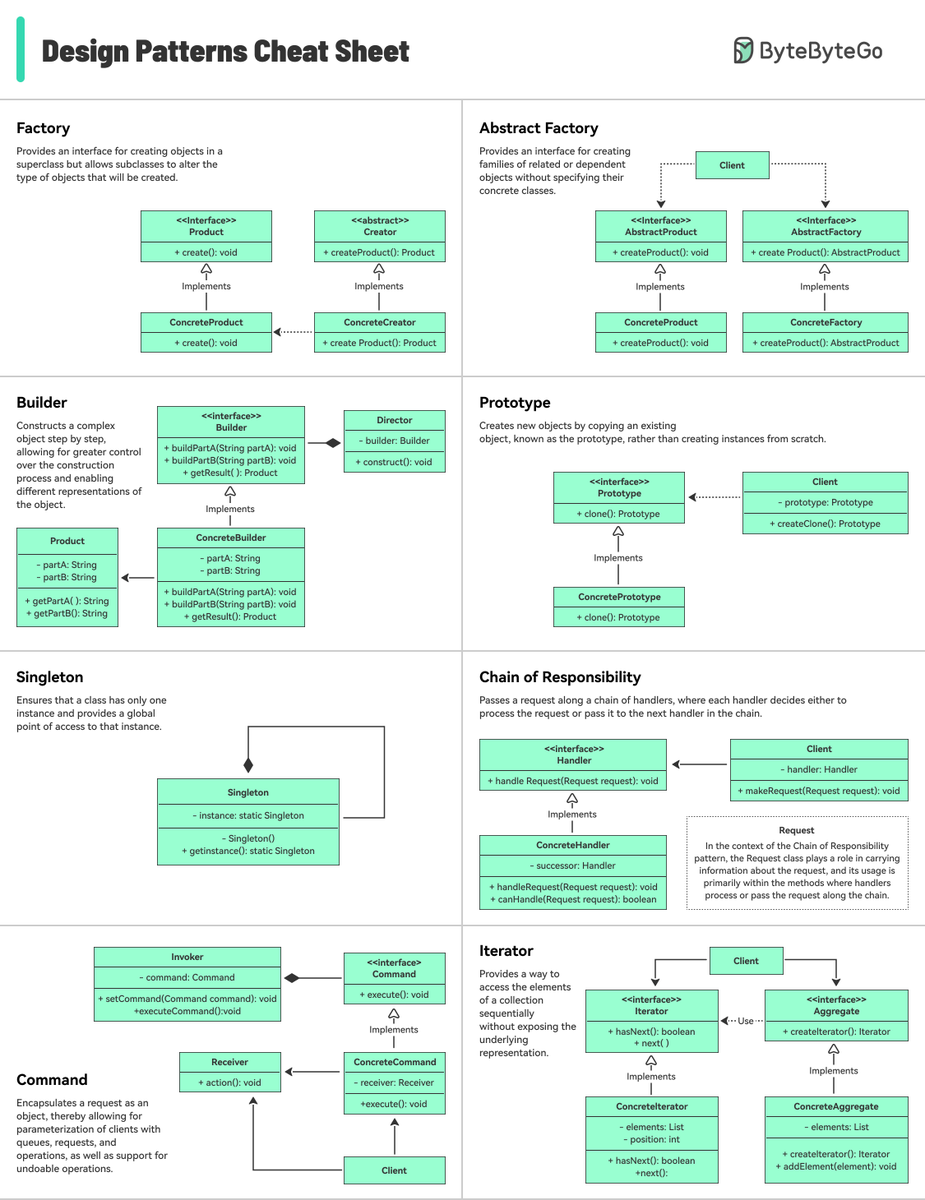
Design Patterns Cheat Sheet
The cheat sheet briefly explains each pattern and how to use it.
What's included?
- Factory
- Builder
- Prototype
- Singleton
- Chain of Responsibility
the four pillars of loop engineering.
the loop itself is six lines, and nobody competes on it. every serious agent framework lands on the same tiny while-loop. model reads context, calls a tool, you feed the result back, repeat until it stops asking.
so if that part is solved, what is everyone actually engineering?
the answer is everything around the model. Boris Cherny, who built Claude Code, put it plainly. he doesn't prompt Claude anymore, he writes loops and lets them run.
that shift has a name now, and it rests on four pillars that are harder than the six lines make them look. these are the parts that actually break:
→ knowing when to stop. a terminal message ends the turn, not the task. an agent will write failing code, glance around, and declare victory. "done" has to mean the tests pass, not the agent feeling good about its work.
→ keeping the context clean. long loops rot from the inside as old outputs and dead ends pile up. a worse context produces a worse decision, which adds more noise, and the agent gets dumber the longer it runs. you fight it by treating context as a budget, not a bucket.
→ tools the agent can actually use. pile on a hundred tools and it loses track of which one to reach for. writes have to be safe to repeat, because loops retry, and a retried "create customer" call leaves you with duplicate records.
→ something that can say no. left alone, an agent agrees with itself. the fix is to separate the maker from the checker so the worker never grades its own homework.
put those four together and your job changes. you stop steering the agent move by move and start designing the system that steers it.
Karpathy runs research loops overnight that tweak a script, test it, keep what works, and throw away what doesn't, with himself nowhere in the loop. he arranges it once and hits go.
the model is becoming a commodity. the loop around it is where the real engineering lives now.
the best builders stopped asking what they should tell the agent to do. they started asking what system would do this without them.
I wrote the full breakdown. the article is quoted below.
stay tuned for more on this!
FREE Math Book. 692 pages.
"Introduction to Statistics" by Lane et al. Studying statistics is vital because it allows us to make informed decisions and identify the truth behind complex, real-world issues. Distributions, Bivariate Data, Probability, Advanced Graphs, Estimation, Logic of Hypothesis Testing, Testing Means, Power, Regression, Analysis of variance, Transformations, Chi Square, Distribution-Free Tests, Effect Size, Case Studies, Sampling Distributions, etc.
From the book: "Like most people, you probably feel that it is important to 'take control of your life.' But what does this mean? Partly, it means being able to properly evaluate the data and claims that bombard you every day. If you cannot distinguish good from faulty reasoning, then you are vulnerable to manipulation and to decisions that are not in your best interest. Statistics provides tools that you need in order to react intelligently to information you hear or read. In this sense, statistics is one of the most important things that you can study."
Link: https://t.co/bPlLJB67NU
Applied Linear Algebra from Stanford University is one of the best free introductions to applied linear algebra have come across.
This resource develops vectors, matrices, and least squares from first principles, connecting them to data fitting, machine learning, optimisation, image processing and control systems.
It is a resource would recommend to students, engineers, and anyone interested in understanding the mathematical foundations of modern data science.
- https://t.co/yGyOEmspSJ
IN 1999 MIT FILMED A MATH LECTURE THAT QUIETLY BECAME THE FOUNDATION OF EVERY AI MODEL YOU'VE EVER USED AND ALMOST NO ONE WAS TAUGHT TO SEE IT THAT WAY
39 minutes from Gilbert Strang, who taught this at MIT for over 60 years -- the linear algebra course an entire generation of engineers and data scientists grew up on.
-> The shift it creates: you stop seeing matrices as boring grids of numbers and start seeing them as the language of space, data, and motion itself.
School drilled you to crunch matrices by hand and never told you why. Strang shows you what they actually mean.
Every neural net, every embedding, every model you prompt is linear algebra running underneath. The math you skipped is the engine of the thing you use all day.
Memorizing the steps was never the skill -> seeing what the numbers do is. This is where it finally clicks.
Most people fear linear algebra and move on. The ones who watched this see straight into how AI actually works.
Bookmark & Watch it today, this one's a legend ↓
Research papers every LLM engineer must read:
- Attention Is All You Need
- BERT
- GPT-3: Language Models are Few-Shot Learners
- Scaling Laws for Neural Language Models
- Chinchilla
- InstructGPT
- Chain-of-Thought Prompting
- Retrieval-Augmented Generation
- LoRA: Low-Rank Adaptation
- LLaMA
- FlashAttention
- DPO: Direct Preference Optimization
A senior Google engineer dropped a 424-page doc on agentic design patterns.
424 pages.
Most engineers bookmarked it and never opened it again.
I read the whole thing.
Here are the 15 patterns that actually matter — explained in plain English, with exactly when to use each one ↓
Free Math Book. 600 pages of conceptual machinery for navigating the hidden architecture of computation, logic, and reality.
"Applied Discrete Structures" by Doerr & Levasseur. Logic, set theory, functions, relations, recursion, graphs, trees, elementary combinatorics, binary operations, groups, matrix algebra, Boolean algebra, monoids and automata, rings and fields. Is reality discrete?
Link: https://t.co/pDi2A14Oh3





![KirkDBorne's tweet photo. [Free 704-page PDF Download] Introduction to Probability for Data Science: https://t.co/A739rZoFDQ by @stanley_h_chan
—————
#StatisticalLiteracy #Mathematics #ML #MachineLearning #DataScience #DataScientist #Statistics https://t.co/OHME8xR3CL](https://pbs.twimg.com/media/HMLQsknXkAAXcak.jpg)