We’re partnering with @redstone_defi to bring independently verified visibility into portfolio performance, exposures and capital deployment.
The future of crypto isn’t just transparent. It’s verifiable.
RedStone has partnered with @RadiantPrimeXYZ to provide a Proof of Reserve dashboard, giving investors independently verified insight into portfolio performance and capital deployment using data collected directly from underlying exchange accounts.
Full breakdown coming soon
A surprising amount of crypto “alpha” is simply market exposure in disguise.
When prices rise, directional risk can look like skill. When the cycle turns, the truth becomes obvious.
Radiant Prime is built to outlast market cycles.
Capital is allocated by weighing expected return against volatility, liquidity, correlation, concentration and execution cost. Positions are then hedged at the portfolio level to target near-zero market exposure, with risk and execution monitored continuously as conditions change.
The strategy is built to generate returns without waiting for the next bull market.
"Tokenizing an asset is just the first step. The real value comes from actually using that asset within DeFi."
@MarcinRedStone sat down with @defillama_res at TokenizeThis to talk RWA infrastructure and what's coming for the next phase of institutional DeFi. Full interview:
Real yields are the biggest headwind facing crypto.
Liquidity remains risk-on in aggregate, but the margin of safety has thinned and system fragility is building.
That backdrop rewards the strongest assets and weighs on the broader altcoin market. Bitcoin dominance is the typical expression of that dynamic.
Bitcoin's correlation to real yields has turned negative again.
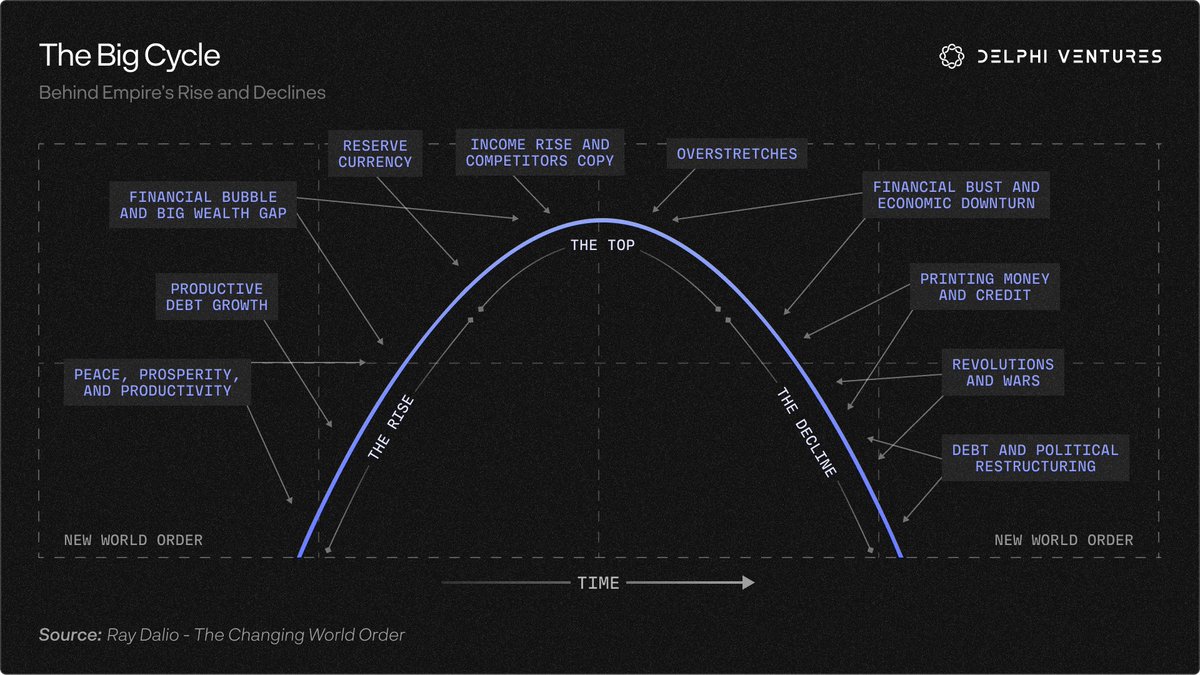
The world is pulling away from the dollar but the demand for it keeps climbing.
For decades the US issued the world's reserve currency and traded away its industrial base for the privilege, but that bargain is now unwinding. Freezing a country’s reserves showed that assets held abroad could be blocked. The shift away from Treasuries was already happening, and the freeze sped it up.
Ordinary people are moving the other way. In countries where the local currency keeps losing value, households and businesses buy dollars to hold their savings in something stable. Less of the world's surplus is flowing back into Treasuries, while private dollar demand keeps climbing.
That demand is finding a new outlet. Stablecoins let people hold and move dollars without a US bank account. That access is spreading fast across the developing world.
(Original content provided by @PonderingDurian at Delphi Ventures)
$1.79T in stablecoin volume in June. Up 63% in a month while the broader market slid.
Stablecoin Signals #8:
▶️ 140 companies behind OUSD
▶️ Fed digital dollar frozen until 2030
▶️ MiCA pulls USDT from EU exchanges
Full edition: https://t.co/Vq8XARn858
Scarcity today. Abundance tomorrow?
Our latest BlackRock 2026 Midyear Global Outlook argues we're in a world shaped by supply.
AI raises the prospect of a lasting growth breakthrough, but the path to abundance may first run through scarcity: https://t.co/xxIlO4G4lX
Crypto trades around the clock, but liquidity does not.
Market depth, spreads, participant behavior, and venue conditions shift throughout the day. The same signal can incur very different execution costs depending on when it is deployed.
A true 24/7 strategy demands continuous execution, real-time risk oversight, and infrastructure that adapts as conditions evolve.
Radiant Prime is built for the way markets actually function.
Because generating alpha is only part of the equation, preserving it through execution is what matters.
Another First for Us at LNMS
We just published our first No More Information Overload Report!
It's a short, chart packed weekly report that cut through noisy market narratives and explain what actually matters.
The topic of this week:
How to think about Strategy's risks for BTC
Link below👇
Bringing RWAs onchain is only the first step.
Long-term value comes from making them productive through trading, lending, & collateralization.
Lending protocols & spot DEXs that become the preferred venues for tokenized assets stand to gain the most.
In crypto, a strategy can be right and still fail.
A 10 bps spread can disappear through fees.
A good signal can decay through latency.
A hedge can fail through poor venue routing.
A profitable trade can become crowded before it fills.
Execution is part of the alpha.
The observed spread is not the executable edge.
What remains after fees, slippage, latency and market impact is the opportunity the portfolio can actually monetize.
In the earliest days of blockchain-based record keeping experimentation at Franklin Templeton, we had one big challenge to overcome: it was way too precise!
Mike Reed, SVP of Digital Assets shares how the old system just couldn’t reconcile against *that* many decimal points of accuracy.
@CoinGapeMedia | @VoiceOfWeb3_
One of the most overlooked risks in digital asset management isn't external attacks.
It's concentration of authority.
When a single individual can initiate, approve, and sign transactions, organizations become vulnerable to:
• Human error
• Internal fraud
• Key-person risk
Institutional-grade custody introduces controls designed to separate responsibilities and strengthen governance.
Security is not just about technology, it is also about process.
#RiskManagement #Custody #Governance #DigitalAssets #CryptoSecurity
"Institutions see this as the future."
On the floor of the @NYSE, Chainlink Labs' @AndrewMcMarkets explains why the institutional adoption of onchain finance is accelerating ⤵️
The June U.S. jobs report was weaker overall despite a lower-than-expected unemployment rate.
Nonfarm payrolls: +57K vs. +110K expected
Unemployment: 4.2% vs. 4.3% expected
Average hourly earnings: +0.3% MoM, +3.5% YoY
Labor-force participation fell to 61.5%
A macro surprise can shift rate expectations, the dollar and risk appetite at once. That can change volatility, correlations and hedge performance even when the underlying signals remain valid.
The systematic response is not to make a one-way bet on one release. It is to update forecasts, reassess correlations and keep only the positions that still justify their risk.
Most institutions won't change their operations to bring a product onchain.
Accountable's Vault as a Service was built on that assumption, infrastructure that adapts to the business rather than the business adapting to it.
@WojtekP on why that distinction matters ↓