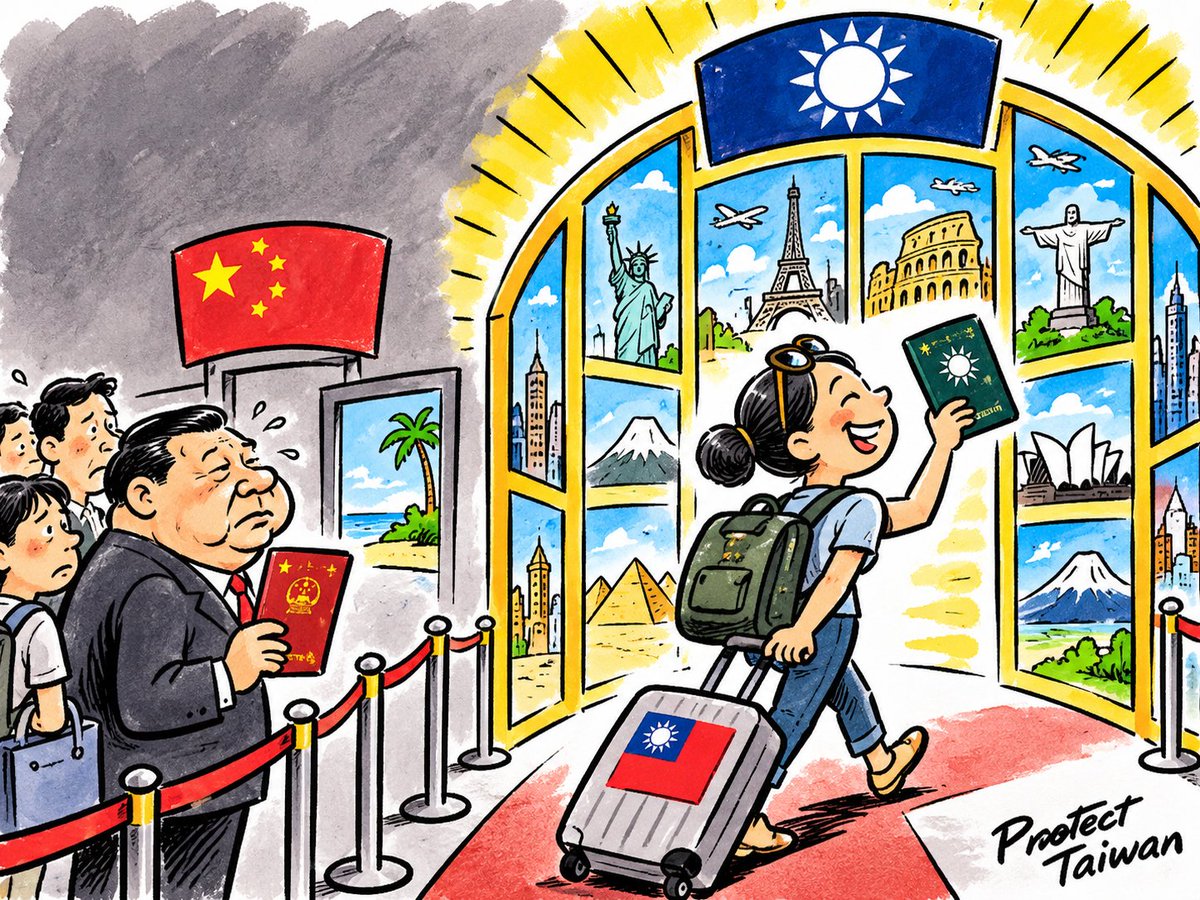
Nombre de destinations accessibles sans visa préalable avec un passeport :
🇨🇳 Chine : 82
🇹🇼 Taïwan : 134
Pékin prétend que Taïwan est une province chinoise.
Embarrassant : le passeport de cette « province » ouvre 52 portes de plus que celui du pays qui prétend la posséder.
Beijing’s Cold Shoulder Backfired. Sanae Takaichi Left Shenzhen With Her Head High.
By November 19, China News Service had reportedly pulled its video of Japanese Prime Minister Sanae Takaichi stepping off her plane in Shenzhen. The clip showed an unusually big drop from the aircraft door to the stair platform. The account that flagged the deletion offered no explanation from the agency, and the footage alone leaves the question of intent open. But if Beijing wanted Japan’s prime minister to look diminished on her first visit to China, the episode backfired. Viewers were asking how the host of an international summit could get something as basic as the stairs wrong. teapawt
Takaichi arrived on November 18 for the Asia-Pacific Economic Cooperation summit. There was a red carpet and an honor guard. The welcoming crowds and music that greeted other leaders were absent. Japan’s chief cabinet secretary said Tokyo understood that China had extended the customary courtesies. Japanese television put the arrivals side by side, and the difference was plain enough. Xi Jinping shook Takaichi’s hand twice during the summit. A formal meeting between the two leaders never took place.
An airport greeting can be calibrated down to the last bouquet. The stairs are a matter of safety. Taiwan’s Eastern Broadcasting Company estimated the drop at roughly 40 centimeters. Yasuhide Nakayama, a Japanese lawmaker and former vice defense minister, asked how the stairs had been positioned and what safety checks had been carried out. That question deserves a straight answer. Any government that invites foreign leaders onto its territory assumes responsibility for getting them safely off their planes.
On her way out of Shenzhen the next day, Takaichi observed the courtesies of departure with the same composure she had shown at the summit. There was something distinctly Japanese about how she carried herself. She shook Xi’s hand, thanked him for the invitation and treated the occasion with the respect Japan brings to these encounters. She could do all of that while holding her ground on the issue that had put her at odds with Beijing in the first place.
That issue was Taiwan. In Japan’s parliament a year earlier, Takaichi said a Chinese attack on Taiwan could create circumstances in which Japan might have to respond militarily. Beijing demanded a retraction. In Shenzhen, she reaffirmed Japan’s longstanding position under the 1972 joint communiqué and called China an important neighbor with which Japan should keep talking. She left without giving Beijing the retraction it wanted. A Japanese prime minister is entitled to tell Japan’s parliament what a war in the Taiwan Strait could mean for Japanese security. That is part of the job. Reuters
Beijing’s displeasure carries real costs. Reuters reported restrictions on critical mineral exports, a ban on Japanese seafood imports and advice to Chinese citizens against traveling to Japan. Those measures reach businesses and communities far from the summit hall. They also give governments across the Indo-Pacific a reason to pay attention. If Beijing can make a neighbor’s exporters absorb the cost of a prime minister’s remarks in parliament, every country with a large trade exposure to China has to ask what it might be pressured to keep quiet about. Reuters
Look at what Japan was doing that same week. Before Shenzhen, Takaichi sat down in Manila with the leaders of the United States, Australia and India. Their Quad statement opposed attempts to change the regional status quo through force or coercion and singled out arbitrary export restrictions as a concern. Hours after Takaichi returned to Tokyo, President Donald Trump called and briefed her on his talks with Xi and on the U.S.-China-Russia summit. According to Japan’s foreign ministry, he reaffirmed Washington’s commitment to the alliance. Anyone judging Japan’s international standing from the reception in Shenzhen should account for what its partners actually did that week. Ministry of Foreign Affairs of Japan
Takaichi showed the same independence with Washington. After the call, she made clear that Japan supported the International Criminal Court and held a different position from the United States. That mattered after President Trump had joined Xi and Vladimir Putin in a declaration warning against abuses of jurisdiction by the court and similar institutions. Tokyo could welcome a direct briefing from its closest ally and say openly where it differed. That is the conduct of a country that takes its alliances seriously and expects its own judgment to be taken seriously, too. Prime Minister's Office of Japan
At home, Japanese voters have every right to ask whether Takaichi’s approach will produce a more workable relationship with China. Public opinion was already divided. Deutsche Welle cited a Kyodo survey in which 54.7 percent approved of her firm stance toward Beijing. A separate Jiji survey, conducted before the trip, found more respondents disapproved than approved of her cabinet’s overall approach to China. Shenzhen’s effect on her approval will take time to measure. But the visit gave her supporters something concrete to point to. Their prime minister went to China, dealt civilly with Xi and came home without surrendering a position she had taken in Japan’s parliament.
A bilateral meeting would have been worth having. Japan and China have serious business to discuss, and a year of strained relations makes direct contact more important. But if the price of getting into that room was a public climbdown on Taiwan, Takaichi was right to leave without the meeting. Beijing could have used the summit to show that a major power can handle a disagreement with its neighbor. Instead, it left people arguing about a stairway and asking why a video had reportedly vanished. Japan’s prime minister gave them a better image to remember. She kept her manners, kept her position and went home with her head high.
ACI — Aric Chen | Insights