Nūl flagged it before the question was even asked- looks like demand, but it was a markdown event. full price velocity is weak.
Same reasoning engine everyone has. The difference is context- their sell-through curves, their promos, their history.
Context is the product.
A brand we onboarded in May almost reordered 4,000 units of a dress last week.
Last spring it did huge numbers. Reorder on-sight numbers. Their planner pasted the history into ChatGPT and asked- should I buy more?
The answer came back fast and confident: strong demand, deepen the buy.
Here's what a general model couldn't know.
That "demand" was a 40% off clearance event to clear a previous overbuy. Strip the discount out and the dress barely moved at full price.
The spike was a wrong signal and it was about to get repeated at scale.
Coding agents solved part of software creation. The next big opportunity is not another code generator.
It is the system that extracts business context, decides what should be built, and converts messy enterprise workflows into build-ready instructions for coding agents.
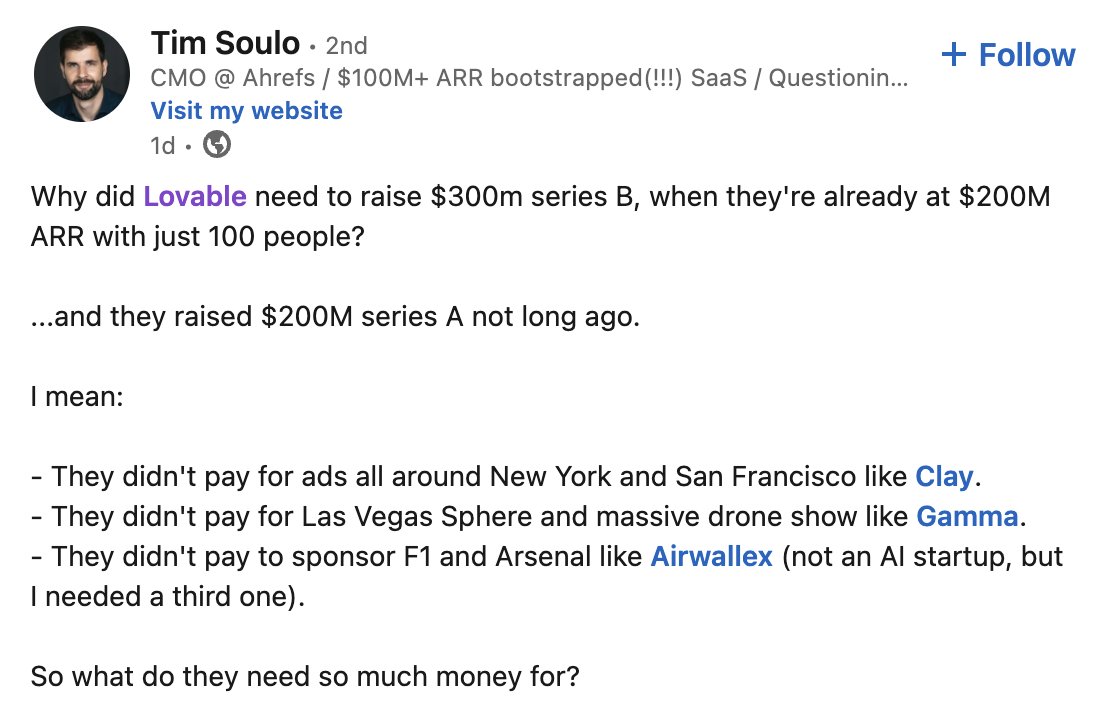
Came across this very interesting post on LinkedIn.
So the biggest cost driver is AI models?
So Lovable raised to pay for the models who are burning money to pay for the compute?
When and how these AI companies can make money?
If you feed the model a noisy, unstructured mess, don't be surprised when you get back a noisy, nonsensical answer. Quality context requires significant data preparation.
Do you think "Context Engineer" will become a standard job title, separate from "Prompt Engineer" or "AI Engineer"? What would be the core responsibilities of that role in your mind?
What's the most essential tool in your Context Engineering stack right now? Is it a vector database like Pinecone/Chroma, a framework like LlamaIndex/LangChain, or something else entirely? #LLMops#RAG