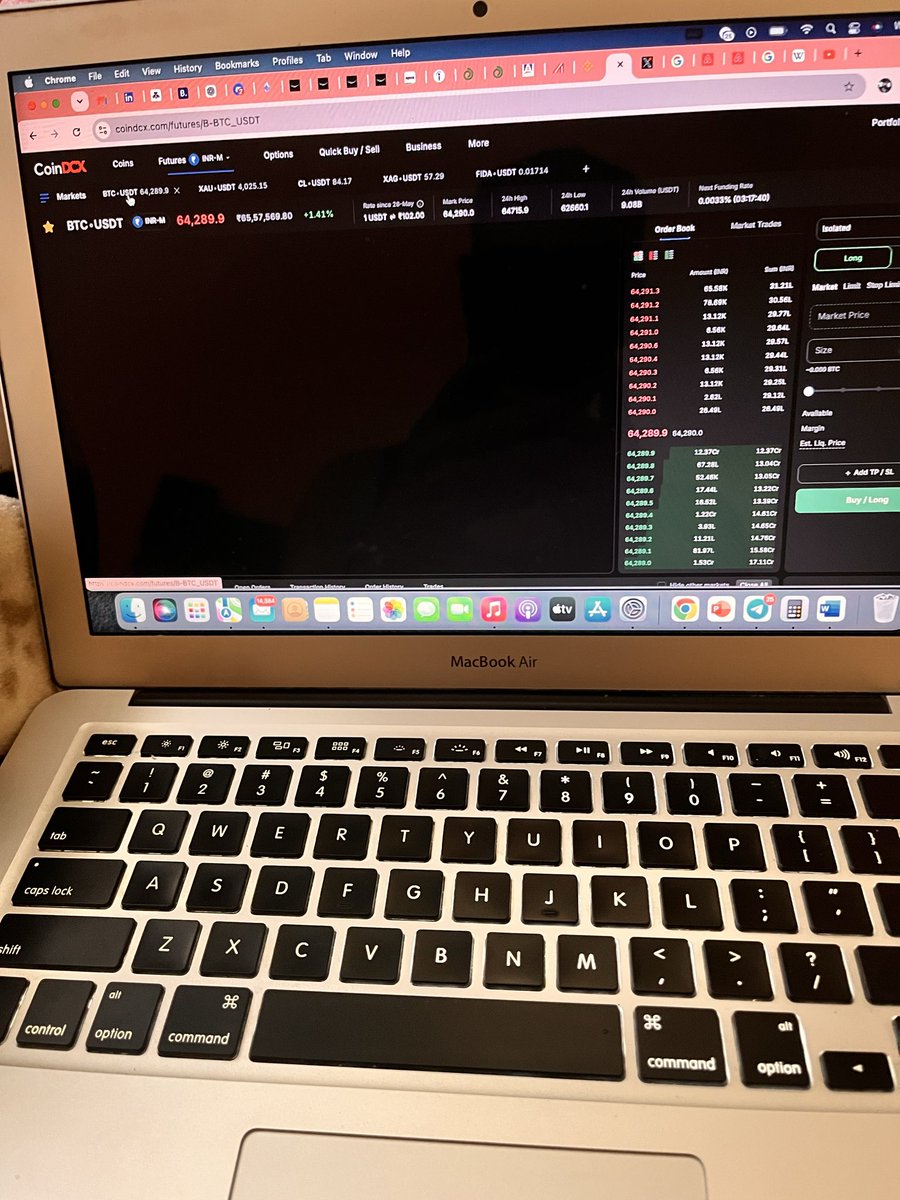
@CoinDCX_Cares I tried all your solutions and the problem is still occurring, it was working fine for sometime though countdown next to bar wasn’t working.
🚨 @CoinDCX Futures charts have been down for 30+ minutes.
• Open positions are live.
• Risk is real.
• Charts? Missing.
This isn’t a minor bug—it’s a serious service failure for a derivatives platform. Traders deserve better infrastructure and faster communication.
@LinkedIn has never helped me land a single job.
Now I’m getting ads that look suspiciously close to extremist propaganda.
How did a professional networking platform become this broken?
Thread ↓
It gets even stranger.After checking the company page further, I found only three associated members listed — and all three are named Muhammad.Yet this account is running sponsored hiring campaigns across countries on LinkedIn.Professional platforms need some strict policies.
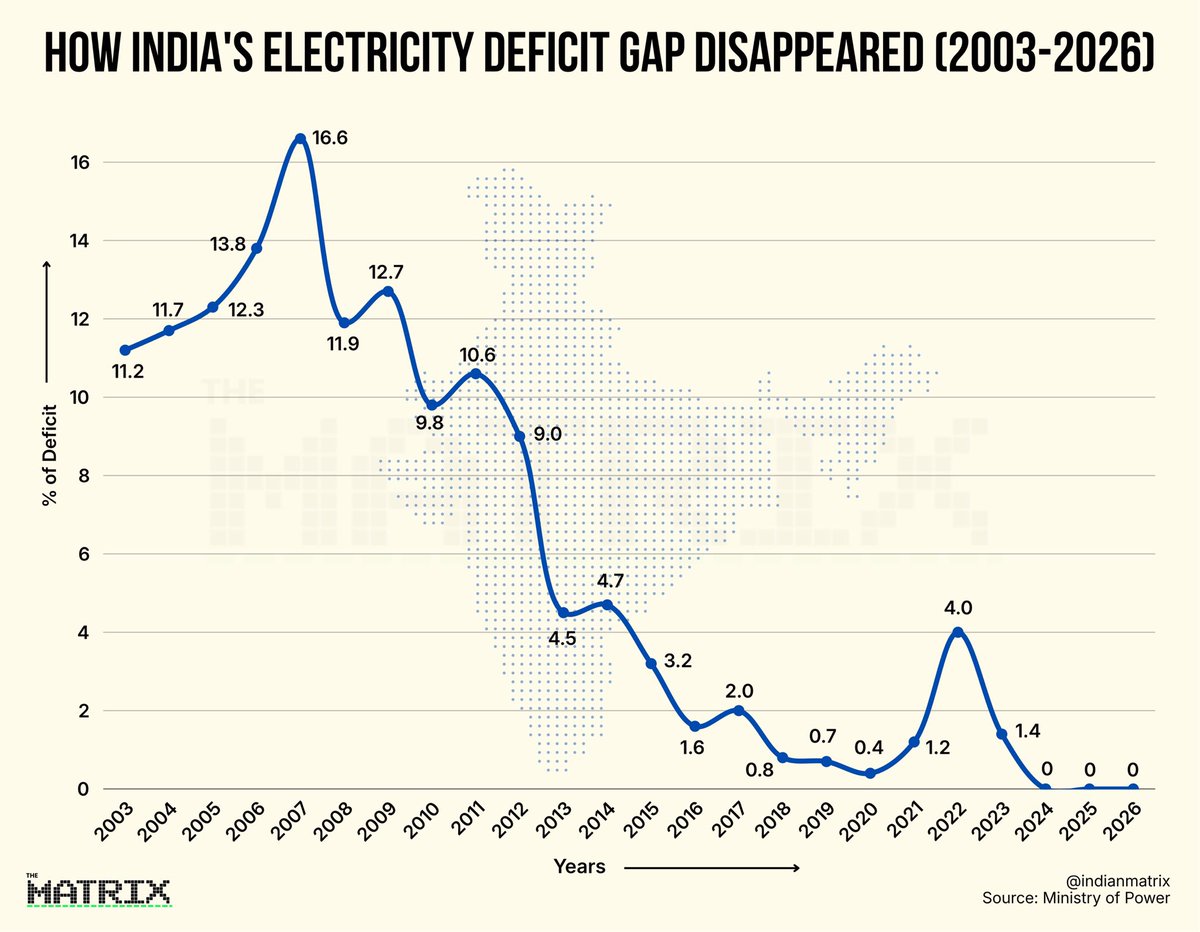
In 2005, India couldn’t meet 12.3% of its own peak demand. By 2007, the shortfall had widened to nearly 16.6%, and close to 18,000 megawatts were unavailable.
The early 2000s were years of genuine electricity poverty. Factories ran on diesel backup generators as a matter of routine. Homes in smaller cities and villages received power for a few hours a day.
Distribution, which is the final link between the grid and the household, was historically the most neglected and most corrupt part of the chain. Electricity theft was widespread, billing was unreliable, and state electricity boards were financially broken.
Reforms here were uneven and politically difficult, but schemes like UDAY, launched in 2015, restructured the debt of state distribution companies and pushed them toward financial viability. The Saubhagya scheme, from 2017, connected the last unelectrified households, around 25 million of them, to the grid by 2019.
India’s solar capacity in 2010 was negligible. Today, it is measured in hundreds of gigawatts. The price of solar panels fell globally by over 90% across this period, and India made a strategic bet to capture that cost decline at scale. Rooftop solar programmes brought electricity generation to homes, factories, and commercial buildings. And the International Solar Alliance, co-founded by India in 2015, helped build global momentum.
The timing proved critical. India’s peak electricity demand now falls in the afternoon, driven by air conditioning in an increasingly hot country. Solar generates hardest in exactly those hours.
On April 25, around 12:30 pm, solar plants and rooftop systems together supplied roughly one-third of all electricity being generated at that moment. Across the full day, solar’s share was around 22%.
India today draws 52% of its electricity from non-fossil sources. More than half of every unit generated comes from sun, water, wind, or nuclear.
The deficit percentage, which once sat stubbornly above 10%, has now collapsed. Since 2024, it has been effectively zero.
Reliable electricity means a small business owner does not budget for a diesel generator as a fixed cost. It means an electric vehicle is practical for someone who cannot afford to be stranded. It means a student in a rural home can study at night without planning around power cuts. It means a hospital runs its equipment on the assumption that the supply will hold.
Electricity reliability is, in the end, a quiet form of equity. When the grid is unreliable, those with money buy backup. Those without simply go without. India's closing of its power deficit means that the gap no longer falls along economic lines.
The country that once rationed darkness now delivers light on demand, at the moment of highest need, to everyone connected to the grid.
That took two decades and thousands of infrastructure decisions. It is not the kind of achievement that fits in a headline. But on an April afternoon, when 256 gigawatts flowed, and nothing broke, it showed.
Open letter to Indians in America.
--
Dear brothers and sisters from Bharat:
Like I did 37 years ago, you arrived in America with no money but with a good education and cultural heritage from Bharat. You achieved outstanding success. America was good to us. For that we must remain grateful - gratitude is our Bharatiya way.
Yet today, a significant number of Americans, may be not the majority but not too far from it either, believe that Indians "take away" American jobs and our success in America was unfairly earned.
You may think the next election will fix this, but your choice would be between people who hate our Bharatiya civilisation and people who hate civilisation itself. That is the "hard right" vs "woke left" battle. You are mere bystanders to that conflict.
Meanwhile there is one thing that is true now and will be true in the future: the respect Indians command world-wide will substantially depend on the fortunes of India herself. If India remains poor, the woke left will give us moral lectures with pity and the hard right, different moral lectures with scorn ("hellhole") and we must not confuse either with respect.
Respect in today's world, along with prosperity and security, comes from one source: a nation's technological prowess. India produces sufficient brain power to achieve that prowess but alas we exported so much of that talent, particularly to America. As we develop that prowess in India, our civilisational strength will assert itself.
As difficult as it is for many of you to contemplate this, please come back home. Bharat Mata needs your talent. Our vast youthful population needs the technology leadership you gained over the years to guide them towards prosperity. Let's do it with a missionary zeal.
Respectfully
Sridhar Vembu
@spvaid Sir, regarding your concern about police verification, it is commonly observed that officials may ask for ₹500–₹1000 during the process, irrespective of whether all documents are valid.
India’s Innovation Engine is Unstoppable! 🇮🇳
Our patent filings soared to a historic 1.43 lakh+ in FY 2025-26, marking a 30.2% increase over last year.
With over 69% of patents filed domestically, led by innovators from Tamil Nadu, Karnataka, and Maharashtra, we are showing the world that “Made in India” is powered by “Invented in India”.
We are the world’s 6th largest patent filer, reflecting a confident India set to become a global innovation powerhouse.