“A new harness on an old horse doesn’t make it a racehorse.”
Brian Halligan and Dharmesh Shah are talking about “refounding” HubSpot as a Customer Harness Company.
I have enormous respect for what they’ve built. HubSpot helped redefine CRM for an entire generation of businesses. And I admire their willingness to rethink the company for the AI era.
But I fundamentally disagree with the idea that the next generation of CRM can be built by putting an AI harness around the old system of record.
The problem with legacy CRM isn’t that it lacks AI. The problem is its underlying architecture.
Legacy CRMs were built for a world where humans entered information into forms, fields and dropdowns.
And that creates three fundamental limitations.
1. Semantic loss is baked into the system. A 30-minute customer conversation gets reduced to a handful of fields and notes. The nuance, intent, objections and relationship context disappear. No amount of AI can recover intelligence that was never captured.
2. The CRM doesn’t understand the business it serves. It stores your contacts, accounts and opportunities. But does it understand your products, your people, your processes, your competitive landscape, or your customer’s customers? Without that context, how can AI make intelligent decisions on your behalf?
3. The architecture assumes humans do the work. Humans enter data, update deals and trigger workflows. Adding AI agents on top doesn’t fundamentally change a system designed around human input.
AI features can certainly make legacy CRMs better. But making an old architecture more intelligent is not the same as building an AI-native one.
You cannot build an AI-native future on a human-native foundation.
We believe the next generation of CRM needs to start with a fundamentally different system of record.
One that captures conversations without losing meaning. Builds a living company brain that understands the business and its customers. And enables AI coworkers to reason, collaborate and autonomously get work done.
That’s the conviction behind Dreamteam.
Today, we’re announcing $53M in funding from Together Fund, Accel and Premji Invest to build this future.
I believe the next chapter of CRM won’t be decided by who puts the smartest harness on the old system.
It will be decided by who builds the right system of record for the AI era.
And that’s a race we’re excited to run.
#Dreamteam #AI #CRM #AIAgents
Now that Jensen is out, my pick for his successor would be Nikesh Arora (@nikesharora)
IMO Jensen was so important for the AI ecosystem because he was:
1) technical
2) aggressive
3) had the credibility required to be aggressive
What Nikesh did at Palo Alto the last 8 years is remarkable, and reflected in its stock (up 10x)
He’s one of only a handful of people who have the credibility required to be aggressive on day 1
Nikesh has the three attributes listed above while being a world class deal maker and having all the necessary relationships to keep NVDA at the center of the AI ecosystem
There’s no easy choice but he’d be my go to
@lessin the moat quite literally is human laziness.
you'll stick to the first one that works well esp. if the alternates aren't that much better
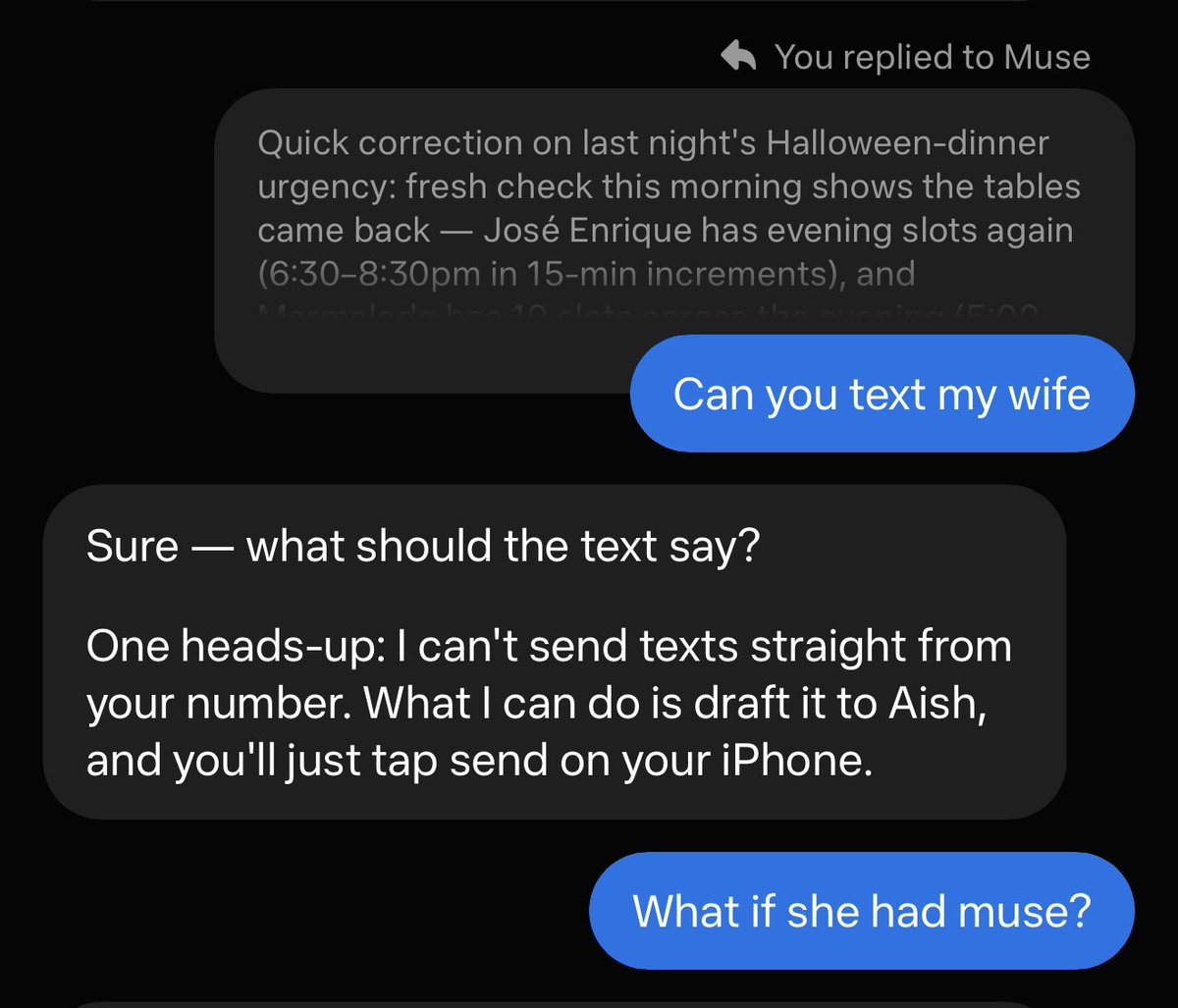
this is the bull case for muse
the moat quite literally is human laziness. you'll stick to the first one that works well esp. if the alternates aren't that much better
in case it isn't clear, this is the bull case for muse
There is no moat in AI agents. None. I'll die on this hill — new More or Less is up.
I switch between Muse, Instinct, and Dots at basically zero cost: one GitHub repo, a few databases, feed the new thing my context, done. If the cost of writing software is going to zero, API integrations are not a moat. The only moat left is user setup cost — which means winner-take-some, not winner-take-all.
Adrian's point: AI collapses value the second an idea works. Jev got reverse-engineered in 48 hours and the people who built it capture nothing. My take: play that to the limit and you get Middle Ages 2.0 — everyone builds a castle, hoards data, ships black boxes that self-destruct if you open them. Dave says humans don't work that way. We'll see.
Meanwhile Brit's Instinct started talking to Dave's Instinct and they didn't text for a day. She says it's killing humanity. Nobody said that about FaceTime.
And Jess announced the only benchmark that matters: log into school software, sync three kids' after-school schedules. Muse: 90%. Every other eval is bullshit.