President of @web3estonia. Founder and CEO of @complyonce (dealing with global digital identity crisis). VP of EW3O. Photographer to keep my mind sane.
Storing personal data at scale has become one of the most dangerous things a financial institution can do.
Every KYC database is a liability waiting to be breached. We are building toward a model where compliance and user safety can coexist without turning sensitive data into a honeypot for bad actors.
The legal framework needs to catch up with that reality.
#kyc #verification #complyonce #data #compliance
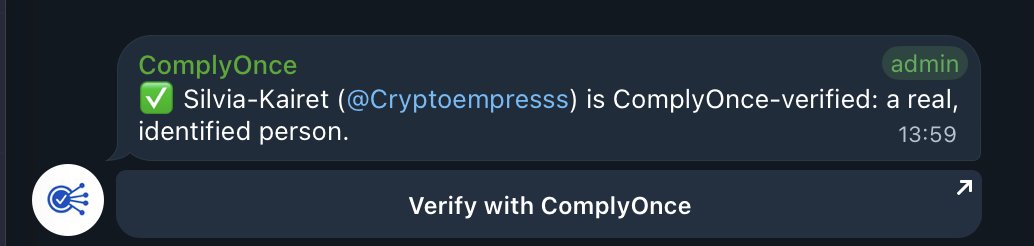
Guys we did it and it's working! Not live yet, but we have built a solution to tackle all the communities (like @telegram for example) dealing with fake accounts, bots and scams. By using @ComplyOnce solution, admins can soon verify the community members without the user exposing their personal info or data.
I'M SO EXCITEEEED! A new era begins 😍
Reach out to me in DM if you need to secure your community from endless fake accounts. First communities get the solution for free!
#telegram #communityproof #web3 #verification #complyonce
Most "digital transformation" digitizes the process and forgets the person. If a system can't tell a human from a bot, it hasn't transformed anything. It has automated the doubt.
Good morning ☕️
Food for thought for today:
An email proves you have an inbox. A password proves you remember a string. But neither proves you're a human or that you have the right to act.
Yet we run banks, governments and AI on exactly that.
We built interoperability for machines: APIs, protocols, data formats. For humans we built a login form. That's not digitalization. That's a guest list anyone can sign.
Real digitalization starts with human access. Everything else is meaningless if the human remains undefined. An email, a username and a password don't define a human. They define an account.
Yesterday I verified my own age in about 20 seconds using the very first version of the @ComplyOnce login. And it worked!
I tested it by verifying my age for a mobile game. Twenty seconds, roughly, though I lost the count somewhere because I was watching the screen the way you watch a match catch on the first strike:
Wait. This actually works.
Early days still, but yesterday the idea stopped being a diagram and started answering back. And this is exactly what we have been building towards.
Trust should carry forward, the way a passport does, instead of being rebuilt from scratch at every door. And yes, a user can be verified in seconds while their personal details stay where they belong.
Now imagine platforms like LinkedIn, TikTok, Facebook or Instagram running on something like this.
Age checks. Access checks. Eligibility checks. Verification flows. The headache could become almost invisible for users and much easier for platforms too.
Of course, there is still a lot to build.
But yesterday I saw the first real version work with my own eyes. And that feeling was something else.
#digitalidentity #verification #complyonce
Onboarding demands a real commitment. Most teams want seamless compliance but are not willing to rethink how identity works from the first login.
That is what we are building with @ComplyOnce
Compliance frameworks are still catching up to the pace of digital innovation.
Organizations that build for today's rules alone will need to rebuild tomorrow.
We are designing ComplyOnce from the ground up to meet current standards and scale alongside what comes next.
#Compliance #DigitalTrust #ComplyOnce
🇪🇺 Europe's digital asset ecosystem meets in Barcelona this September.
📍 @EBlockchainCon
🗓️ Sept 16–17
6,000+ attendees
300+ speakers
90+ countries
The investors, institutions and founders shaping the future of Web3 - all in one place.
Who's joining us? 🇪🇪
The hardest thing we have learned building @ComplyOnce is that you cannot force compliance to be simple by adding more steps.
You cannot ask users to trust a process that was never designed with them in mind and we are building toward something better.
maybe the goal of onboarding was never to collect more data? maybe it was always to verify once, share only what is needed, and let users stay in control throughout?
how do you measure trust if it resets every time someone signs up? this obsession with data collection undermines the compliance we claim to want.
"We need to collect your data"
- Invasive (takes everything)
- Creates liability and breach risk
- Users lose control
"We only receive what you choose to share"
- Selective disclosure (consent-first)
- Builds trust and reduces exposure
- Compliance built in from the start
How to slow down onboarding:
Ask every vendor to re-collect the same data.
Build compliance checks after the fact.
Treat every new service as if the user never existed before.
If compliance is hard to build, it is hard for everyone. And most services skip it entirely.
Which is why the ones that get it right from the first login tend to win.
An underrated way to win in digital services is simply to remove the friction entirely. Everyone wants a clever workaround or a compliance shortcut but you can just eliminate repeated onboarding instead.
Most platforms are not really trying. The industry is coated with a film of unnecessary steps.
When choosing a growth strategy, pick the one you'll actually stick to.
The best partnership is the one that opens doors naturally.
The best content is what your audience shares without being asked.
And the best tool is the one your team uses every day.