@hankisinvesting@Truunik@Valos_io@infiniFi@mezzanine_fi Yes, especially if vaults evolve beyond storage.
The future is probably secure assets + verifiable ownership + programmable access, all without exposing more identity data than necessary.
Customer No. 1! And this time, it really means something.
@ComplyOnce has officially become the first member and customer of Roksnet’s newly launched X-Road based trust framework.
Being customer number one is both an honour and something meaningful to us. We share a vision of how trusted data exchange should work and how many of today’s data protection and security problems could be solved by changing the way organisations exchange information.
Roksnet has enormous potential, especially when federated with national X-Road networks. Estonia’s own X-tee ecosystem, operated by Riigi Infosüsteemi Amet // Estonian Information System Authority (NCSC-EE), has already shown what secure, authenticated and auditable data exchange can look like at national scale.
Instead of building yet another jungle of APIs, sharing credentials and trusting that everyone handles sensitive information properly, we can build on infrastructure where organisations authenticate each other and data exchanges are cryptographically protected, documented and auditable.
Having watched from the sidelines how much hard work Riho Oks and his team have put into building the Roksnet trust service, we have enormous respect for what they have achieved.
Building trust infrastructure is not easy. Building it properly is even harder.
Their dedication is also a great example for us at ComplyOnce.
We believe that digital trust should not depend on blind trust between systems. It should be built into the architecture.
#ComplyOnce #Roksnet #XRoad #DigitalIdentity #DigitalTrust
Interesting perspective. User-owned data is an important part of the conversation, but how do you see verified identity fitting into the iAgent ecosystem? As AI agents begin acting on behalf of individuals, proving who they represent becomes just as important as the data they hold.
Estonia proved it over 20 years ago: verify the human at the entry point and everything after gets simpler.
Signatures, taxes, health, business. Access comes first. The rest follows.
Identity is becoming one of fintech’s most important infrastructure layers 🤯
@raidosaar and @themagnusjones are in London at FTT Fintech Festival & Future Identity Festival, where the conversation is moving well beyond onboarding alone.
Digital identity now sits at the intersection of fraud prevention, customer experience and compliance.
Great to see the team on the ground, meeting the people shaping what trusted digital access looks like next.
#FTT26 #FutureIdentity #DigitalIdentity #Fintech #ComplyOnce
eIDAS 2.0 puts a digital identity wallet within reach of every EU citizen. Prove who you are or just the one fact needed without handing over everything. The tech exists. What's missing is the will to stop defaulting to passwords.
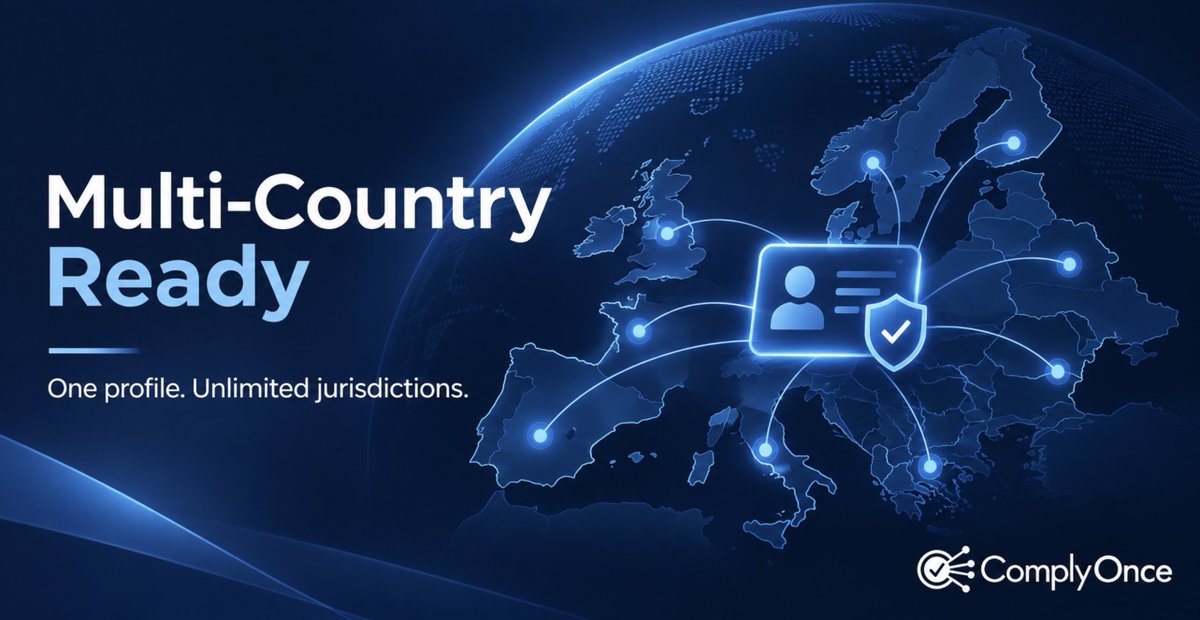
Your identity shouldn’t stop working at the border.
People live in one country, work in another, invest through a third and use services across the entire EU.
Yet identity verification is still often built country by country. A user verifies with one national eID. Then they move, open an account elsewhere or need access to another regulated service and suddenly the process starts from zero again.
That is exactly the problem behind Multi-Country Ready in ComplyOnce™. A single @ComplyOnce identity profile can link verified identities from multiple jurisdictions.
The user authenticates through a trusted source such as a national eID, EUDI Wallet or regulated identity broker. That identity is then bound to the user’s profile once.
From there, the same trusted identity profile can be used across connected services and jurisdictions.
ComplyOnce supports eIDAS High and Substantial assurance levels, allowing services to work with identity proofs that meet the level of trust their use case requires.
And because the architecture is cross-border native, the user doesn't need a completely separate identity profile every time they interact with a service in another EU Member State.
Why does this matter?
Because the future of European digital services cannot be built on 27 disconnected onboarding experiences. Fintechs, gaming platforms, age-restricted services and other regulated businesses increasingly serve users across borders. Their identity infrastructure needs to be able to do the same.
And this brings us closer to what digital identity was always supposed to become: portable, interoperable and trusted across borders.
Comply once. Move freely.
#verification #Europe #EU #digitalidentity #fintech #gaming #eID #complyonce
"We have a few blissful years left until enforced telepathic readings." - Julian Assange (2018)
Guess what? those "blissful years" are over.
Welcome to the new world.
⚠️YOUR BRAIN 🧠 IS HACKABLE⚠️
🤖▸🛰⤻🧬∿🧠🆘
🚨 BREAKING: 11 UNPATCHED Security Flaws Exposed in Tailscale and Headscale. Researchers Demonstrate a Potentially WORMABLE Attack That Can Take Over Entire Server Networks.
A new security report called Tailworm has revealed serious vulnerabilities in Tailscale, the widely used zero-trust networking platform.
The most alarming finding? Researchers demonstrated how ONE compromised device could gain ROOT access to other servers across a private network in under a second per hop.
Here's what researchers discovered:
➜ ROOT ACCESS: Tailscale SSH forwarding flaws reportedly allow an attacker with access to one authorized device to escalate privileges on other permitted servers, bypassing normal Linux user restrictions.
➜ WORM-LIKE PROPAGATION: In laboratory tests, exploitation spread automatically between permitted devices without additional passwords, SSH keys, or user interaction.
➜ CREDENTIAL THEFT: Attackers could potentially capture device enrollment credentials and register malicious machines as legitimate network members.
➜ CLOUD INFRASTRUCTURE EXPOSURE: A vulnerability in experimental app connectors could bypass network access restrictions, potentially exposing AWS cloud credentials, Kubernetes services, and internal infrastructure.
➜ SERVER DISRUPTION: Additional flaws in Headscale, the self-hosted alternative, could allow unauthenticated attackers to exhaust server memory and disrupt device registration.
➜ ADMINISTRATIVE TAKEOVER: Certain Tailscale Serve configurations could expose privileged local management interfaces to remote devices.
🚨 Why this matters:
Tailscale is specifically designed to provide secure, private access to infrastructure without exposing servers directly to the internet.
But these findings suggest that in vulnerable configurations, an attacker who compromises ONE authorized machine could potentially pivot across multiple servers with administrator-level access.
And the vulnerabilities remain unpatched as of October 26.
Security researcher Erica Windisch of Cyberdione Labs disclosed the findings after testing Tailscale v1.104.2 and Headscale v0.29.5.
Tailscale has acknowledged related security issues and says fixes are underway. The company is NOT recommending that everyone disable Tailscale SSH.
⚠️ Important: The most serious attack requires an existing foothold and specific SSH permissions. This is not an unauthenticated attack against every Tailscale installation. The worm-like propagation was demonstrated in a laboratory, not observed in the wild.
What administrators should do NOW:
→ Audit Tailscale SSH permissions and eliminate unnecessarily broad access rules.
→ Disable SSH forwarding if it isn't required.
→ Review app connector permissions and Tailscale Serve configurations.
→ Enable device key expiration and restrict access to sensitive servers.
→ Monitor Tailscale's official security updates for patches.
🔒 At Lucid Security, we're offering FREE website security reviews to help businesses identify exploitable vulnerabilities before attackers do.
Request yours: https://t.co/RGeLnslnlj
Full technical disclosure: https://t.co/kI5FJ2XY5d
🚨 BREAKING: Hackers are BYPASSING Microsoft 365 MFA, hijacking corporate accounts, and secretly replacing victims' authentication methods to maintain access.
97 accounts compromised across 79 organizations. In some cases, attackers took over sessions in just 12 MINUTES.
And now, researchers have separately exposed a critical flaw in Microsoft Authenticator that allowed malicious apps to steal login tokens with ZERO permissions.
Microsoft's authentication security is facing two serious threats, and one is already being exploited in the wild.
Here's what's happening:
🔴 1. MICROSOFT 365 ACCOUNTS HIJACKED IN THE WILD
Cybersecurity researchers at Huntress uncovered a widespread token-replay attack campaign targeting Microsoft 365.
The numbers are alarming:
→ 200,000+ failed login attempts observed.
→ 497 successful sign-in events.
→ 97 compromised accounts across 79 organizations.
→ 48 rogue devices registered inside Microsoft Entra environments.
→ 19 organizations had victims' MFA methods removed and replaced.
Attackers used sophisticated phishing techniques to capture legitimate authentication tokens AFTER victims completed MFA.
They then replayed those tokens to access Microsoft 365 without another authentication challenge.
But it gets worse.
Once inside, attackers registered their OWN authenticator apps and devices to maintain persistent access.
They also created hidden email rules to intercept or delete messages involving payroll, banking, and direct deposits.
In one case, attackers hijacked a session just 12 MINUTES after the victim reached the MFA prompt and registered their own authenticator less than an hour later.
Changing your password alone may NOT remove the attacker.
🔴 2. CRITICAL MICROSOFT AUTHENTICATOR TOKEN THEFT FLAW
In a separate discovery, researchers at Enclave exposed CVE-2026-80097 (CVSS 8.6), a vulnerability allowing malicious Android apps to steal Microsoft authentication tokens.
→ ZERO Android permissions required.
→ No password required.
→ No additional MFA prompt.
→ Malicious apps could impersonate Microsoft Teams.
→ Stolen tokens could provide access to corporate email, files, calendars, and sensitive account functionality.
The underlying flaw? Microsoft Authenticator trusted an application's claimed identity without properly verifying the actual caller.
Microsoft has since patched this vulnerability.
These are TWO separate security issues, with no confirmed connection between them.
But they expose the same dangerous reality:
🚨 MFA ALONE IS NO LONGER ENOUGH TO STOP ATTACKERS WHO CAN STEAL OR REPLAY AUTHENTICATION TOKENS.
And businesses relying entirely on MFA for protection may have a serious blind spot.
🛡️ IS YOUR BUSINESS EXPOSED?
At Lucid Security, we're offering FREE security reviews to help businesses identify vulnerabilities, authentication weaknesses, and potential security gaps before attackers exploit them.
Get your free security review:
🌐 https://t.co/RGeLnslnlj
Sources:
https://t.co/DSLazi8oJk
https://t.co/Zi0gydR8Dr
We see a lot how people are against digital identity, because usually this requires you to expose your privacy. Thankfully, not all digital identity solutions take your data or store it for hackers.
#complyonce
@MTSlive “The internet itself is on the verge of collapse” = digital ID incoming
“You need this to be safe online”
It’s so incredibly obvious how hat this has been in the works all along
Problem reaction solution
SITUATION DETECTED: Following the massive cyberattack on Japan's GMO Internet Group, which led to fraudulent trades across 70+ brokerages and FX platforms, CEO Masatoshi Kumagai warns that the internet itself is on the verge of collapse.
Your identity shouldn’t need a new copy every time you verify.
Raido explains how the @ComplyOnce ID Vault keeps verified identity data protected while services receive only the proof they need.
Less data copied. Less data exposed.
#verification#digitalidentity#compliance #KYC #complyonce #data
The undefined human is the real attack surface. Phishing, account takeovers, bot farms, synthetic identities all exploit the same gap: the system knows the credentials, never the person.