We’re raising a pre-seed round for https://t.co/33Fz2WG71E
We’re currently speaking with angel investors and early-stage funds. Investor introductions would be greatly appreciated.
Feel free to DM me to connect or schedule a call.
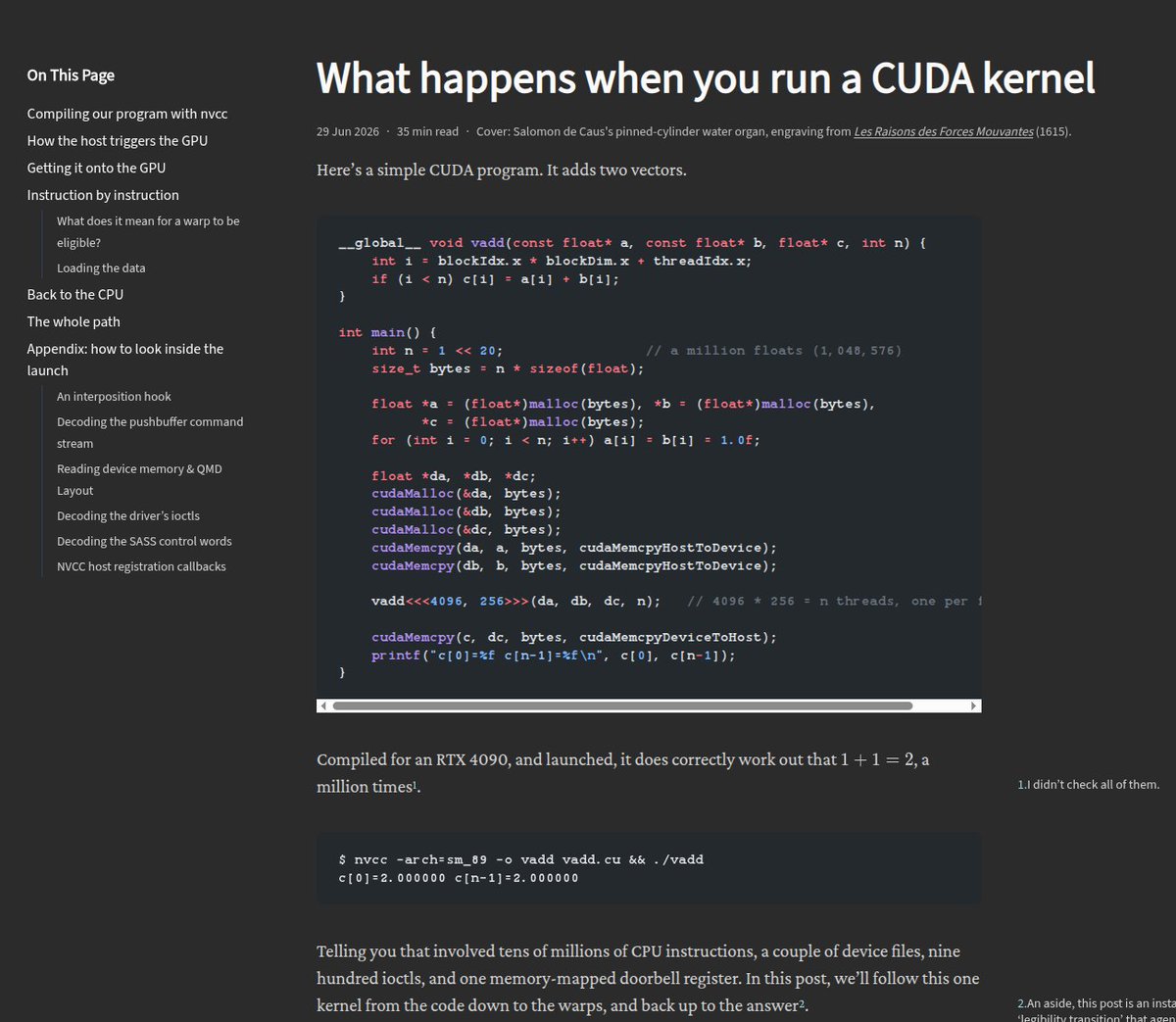
Saturday reading: "What happens when you run a CUDA kernel" - very cool blogpost on the details about the CPU<->GPU communications required for lauching a kernel
Some guy on Reddit just handed out a 12-week plan to break into quant finance for free.
He went from bombing mock interviews alone in his bedroom to 3 offers in a single month.
Then he wrote down every single step that got him there:
> Weeks 1-3: foundation - probability, mental math, easy coding
> Weeks 4-7: second pass on everything, start applying before you feel ready
> Weeks 8-10: mock interviews until they stop humiliating you
> Weeks 11-12: don't cram, just sleep and stay sharp
Tried https://t.co/JRiL1v0x3J on a project with more then 30+ repositories, things started getting smoother with context around deployment, sdlc and now working through old agile style stories specifications... people are calling the it product spec.
If you want to become an ML Systems Engineer or AI Infrastructure Engineer, bookmark this.
ML Engineering by Stas Bekman is a free open book that covers the engineering behind building, training, and serving machine learning systems at scale.
What you will learn:
🧠 Machine Learning Systems
⚙️ GPU Architecture & CUDA
🚀 LLM Training & Inference
💾 Memory Management
📦 Data Loading Pipelines
🔄 Distributed Training (DDP, FSDP, DeepSpeed)
🌐 NCCL & Multi-GPU Communication
📊 Profiling & Performance Optimization
⚡ FlashAttention & Kernel Optimizations
🗄️ KV Cache & PagedAttention
📉 Quantization & Model Compression
🔍 Debugging ML Systems
📈 Benchmarking & Scalability
☁️ Cluster & Infrastructure Design
Building great AI models is only half the job.
Knowing how to train, optimize, scale, and deploy them efficiently is what makes an exceptional ML engineer.
https://t.co/iAIy4E1apR
If you're struggling to land your next job, do this:
> stop grinding LeetCode all day
> learn to work with agents
> build cool stuff, post it publicly, and tag the CEO
> don’t let AI mass apply for you
> curate 10 strong applications instead of sending 100 lazy ones
> cold email with what you can do, what you’ve done, and what problem you’ll solve for them
Steve cold emailed me like this. Now he works at HackerRank.
It works. I promise.
Excellent slides on RL for Economists from the great @ben_moll, who just taught us RL+SRL at the PKU-Zurich Summer School on ML for Macro & Finance! More slides+code from the summer school, updated in real time: https://t.co/CqyFUppomR
Wow this is an absurd candidate experience.
One of my clients is converting nearly 100% of their offers because they finish the process in three days flat. A great interview process is like crack for candidates. They will love you and they won’t be able to say why.
And then there’s this 👇
this article is complementary material for Class 2: Distillation of the Training an Agent series
sharing here the rest of the resources for this class👇
🎥 session recording: https://t.co/jUNgbox4Rs
📄 slides: https://t.co/Ngi7vfsWMy
📜 history of distillation article: https://t.co/RlZWCpdwpA
➕ collection of resources (scripts, models, datasets, trackio...): https://t.co/d9IC0vIfod
Best job search advice thread on twitter, hands-down.
Make your outreach extremely personalized and always go through the side door over the front door.
+1 as a recruiter: this strategy works and I always send this thread to people who ask for job search advice
also +1 having used this strategy successfully in life: I got into college (Yale, UChicago), grad school (UW ML PhD) and my current role (early team at @harvey) all through the side door
Foundation models are reshaping computational biology.
Adapting models to a specific task is nontrivial, so to reduce the difficulty of building these workflows, @nvidia BioNeMo Recipes provide step-by-step training recipes built on familiar PyTorch, Hugging Face, and other patterns.
This post walks through two case studies that show how the same parameter-efficient and readable recipe applies across biological modalities.
Read the full post: https://t.co/7dcAtvDHDp
A while ago we found a race condition in DeepGEMM's FP8 kernels. In our case this sometimes caused Illegal Memory Accesses & NaNs in the gradients, but also affected ~0.5% of the gradients to be silently corrupted.
Very cool to see @i_komarov's fix merged into DeepGEMM now
https://t.co/lNE8VlJ4aQ
Agentic AI adoption is on fire at @Uber, and it's changing the way we build, not just in engineering, but across the entire company.
Today, 99% of our engineers use AI tools. More than 70% of pull requests are attributed to local or cloud agents. And our engineers have built 2,500+ agent skills across the software development lifecycle.
Those numbers are exciting, but they led us to a much bigger question:
How do we bring agentic AI beyond engineering?
Finance. Legal. Operations. Marketing. Customer Support. HR. Procurement.
These functions run on complex workflows that are often manual, highly nuanced, and spread across dozens of systems. You can't automate them effectively by looking at process diagrams or documentation. You have to understand how the work actually gets done.
So we created something called Agentic Pods.
The idea is simple.
We handpicked ~30 of our most AI-proficient engineers (people with deep knowledge of Uber's systems) and paired each of them with a domain expert from a business function.
Then we gave every pod just two weeks.
• Days 1 – 2: Shadow the expert. Observe every step. Document workflows. Ask questions. Build intuition.
• Day 3: Prioritize opportunities based on scale, repetition, business impact, and data availability.
• Days 4 – 5: Build a working agent alongside the person doing the job.
• Days 6 – 9: Validate with several others performing the same work. Does it generalize? Does it actually make their job better?
• Day 10: Ship.
In just the past two months, we've run 16 Agentic Pods across 16 different business functions.
• Capital allocation across 150 cities: 15 hours → 30 minutes.
• Financial pacing reports: 2 days → 10 minutes.
• Marketing web quality assurance: 2 weeks → 50 minutes.
• Support workflow creation: 9,000 manual workflows → self-service automation.
The productivity gains are impressive, but what surprised us most wasn't the speed.
• It was how quickly engineers embedded in unfamiliar domains uncovered opportunities that had been hiding in plain sight.
• The biggest wins rarely come from automating one task. They come from rethinking an entire workflow. Once you redesign the workflow around AI, you often eliminate handoffs, remove unnecessary approvals, replace legacy tooling, reduce vendor spend, and dramatically accelerate decision-making.
• The workflow becomes the unit of automation - not the individual task.
• The most impactful agent skills cut across teams, orgs, functions, tools, and systems.
The biggest lesson? The best AI opportunities are rarely visible from the outside.
You discover them by sitting next to the people doing the work, understanding every friction point, and building with them, not for them.
We're now forming a dedicated team to scale this further and go deeper. They'll deeply understand the work, redesign it from the ground up, and use AI to fundamentally change how the business operates.
It's exciting times!
Shipaton is back. Submissions open August 1 – September 30.
14 categories.
2 months to ship.
$500k+ in prizes.
Plus, your app on a giant billboard in Times Square.
We're now building loops that improve the harness itself.
With strong instruction-following models (e.g. GPT-5.6 Sol), more exploratory models (e.g. Fable 5), and efficient competitive ones (e.g. GLM-5.2), the next bottleneck is meta-harnesses that can safely rewrite their own scaffolding.
I just released the Self-Improvement Loops skill (with its loop-design-evidence reference) in the Agent-Skills-for-Context-Engineering repo.
https://t.co/OiXy0MooLl
It distills patterns for systems where the harness becomes the optimization target.
“just let the agent improve itself” is the wrong mental model. The loop will optimize whatever signal you give it.