The Opposition has seized the moment effectively, with images of Leader of the Opposition Rahul Gandhi being dragged away from the prime minister’s residence making headlines across world capitals. The sharp reaction from Aam Aadmi Party leaders Atishi and Sanjay Singh appeared to vindicate Rahul Gandhi’s political instincts. The AAP did not expect Rahul Gandhi to return from vacation and hijack the political narrative around NEET. The late-night march on Thursday to Gandhi Smriti, where Mahatma Gandhi was gunned down by Nathuram Godse in 1948, added another twist to the political drama.
With the Opposition, the middle class and students arrayed against the government, the government had no option but to offer concessions. But those measures are still not enough to quell the disquiet, ease the disappointment, or restore the middle class’s faith in the Modi government. Allegations surrounding the Ram temple donations and the alleged theft of medical seats, put together, have dealt a debilitating blow to the BJP’s image. The party with a difference has failed its core constituency.
In its search for beneficiaries for welfare schemes in the poorer regions of Bihar, Madhya Pradesh, Rajasthan and Uttar Pradesh, the BJP seems to have forgotten the middle class that helped propel it from two Lok Sabha seats in 1984 to 85 in 1989 to 120 in 1991. Governments can do little for this opinion-making class when all it wants is less officialdom and more of freedom for enterprise. But the new BJP seems to have more bureaucratic red tape coupled with greater freedom for the business classes, while neglecting the middle class.
It was just a year ago that the middle class in Delhi, after a long hiatus of 27 years, voted the BJP into power. And now the very same state has become the epicentre of public anger. Tens of thousands of youngsters have gathered at the protest site even without a call to action from political parties. The dam of disaffection had burst.
The key difference between this moment and 2011, however, lies in the Opposition’s ability, or the lack of it, to turn this into a nationwide mass upsurge capable of defeating the incumbent government three years down the line. Just as the BJP in its political journey used the Muslim community as the perceived “other”, the Congress has recently been turning the Hindu middle class into its political and cultural enemy.
Rahul Gandhi has been assiduously cultivating the PDA ––– pichhda(backward classes), Dalit and alpasankhyak (minorities) ––– offering no space to the rest of the Hindus, who are the most vocal critics of any government.
So, just as a ministerial reshuffle with a relook at priorities is imperative for the government, the Congress too needs to recalibrate its choice of the “other”. The Congress loses its credibility and raison d'être when it ceases to be an umbrella party that represents all and even contradictory voices. Rahul Gandhi’s march to Gandhi Smriti is a good start. He should stop disliking and start embracing the middle class.
https://t.co/I8oe6rOvGI
By silently endorsing a news report on its botched plan to install former Iranian President Mahmoud Ahmadinejad, the Israel intelligence agency Mossad was effectively admitting to its own failures. Mossad’s flawed intelligence, analysis, and operational decisions have turned the world’s most important energy chokepoint from an open shipping lane into a closed one. Instead of degrading Iran’s military capabilities, the US-Israeli campaign triggered retaliatory attacks that had a debilitating impact on US bases, turning the Strait of Hormuz into a military quagmire. With each passing day, the US finds itself drawn deeper into this bog of uncertainty.
The biggest intelligence failure was the attempt at regime change. The primary precondition for such an attempt was to topple the government. However, the assassination of the Supreme Leader, it seems, was anticipated by the Iranian government and perhaps even embraced by Ayatollah Khamenei as a path to religious martyrdom. Whether sought or not, the outpouring of grief and reverence that followed was in keeping with the highest traditions of martyrdom as a religious symbol of a civilisational struggle for sovereignty.
Khamenei’s assassination made the Iranian government appear stronger, more credible, and even more idealistic. The Supreme Leader had laid down his life for that very government. And at the same time, the assassination portrayed the enemy as rapacious — killing an 86-year-old leader and schoolchildren on the same day in pursuit of the same objective of conquest. Once it became impossible to topple the government, the next step in the plan to install a puppet regime also failed.
And the chosen puppet, it seems, was double-crossing Mossad all along. Former President Ahmadinejad appears to have served the same purpose as the drone- and missile-manufacturing sites — they were all decoys. It is one thing to make a web series claiming that Mossad can disable Tehran’s entire traffic-signalling network, but it is quite another to repeatedly misidentify the locations of drone and missile factories over five months. No amount of support from friendly nations such as Russia or China could have helped Iran, had Mossad correctly mapped all the underground missile cities. The Americans were bombing decoys most of the time.
Then came the failure of the armed Kurdish rebels to march on Tehran. They had allegedly been armed, trained, and kept ready for precisely such an eventuality. But when the time for rebellion arrived, they either hesitated or were effectively neutralised. This represented a failure on a much larger scale. Again, the only plausible explanation may be the decoy theory. Mossad appears to have been dealing with decoys from Iranian counterintelligence rather than the real Kurdish rebels. Otherwise, five months would have been ample time for an organised uprising to materialise.
The entire sequence of special operations that ought to have brought the Iranian government to its knees ultimately failed. Mossad is admitting only to the double-crossing by Ahmadinejad, who turned out to be the star decoy. Yet his survival encapsulates the story of all other decoys, double-crossings, and the derailment of Mossad’s intelligence-gathering inside Iran. As part of its damage-control effort, Mossad has enlisted its asset in Budapest to denounce Ahmadinejad. But that is of little consequence. Ahmadinejad attended Khamenei’s funeral, where two other former presidents were not invited, and, for an Iranian leader, that is all that matters.
Read more…
https://t.co/xV3g4ZtjHZ
It has been a week of the grand theatre of grief in Tehran, in Najaf, and in Karbala, across two nations divided by colonial boundaries and united in mourning. No national wartime leader has had such a final journey with representatives from all over the world queueing up to pay respects and millions of ordinary people thronging the streets and clenching their fists against the US-Israel combine, proving that they have not been defeated by nearly five decades of sanctions and the recent relentless bombing of their homes, schools, and military installations.
It has also been a week of broken promises. Along with the Islamabad Memorandum of Understanding, the post-World War rules-based order lies in tatters. The US proved that it does not believe in mutually agreed rules. The latest round of US bombing that happened during Ayatollah Ali Khamenei’s funeral was triggered by Iran’s actions to enforce a vital clause in the MOU. It was as if the US was waiting for Iran to get provoked before unleashing its bombers.
The MOU places Iran at the centre of arrangements for the passage of commercial vessels through the Strait of Hormuz. After the US attack on the oil tanker MT Settebello on June 10 in the Gulf of Oman, which killed three Indian sailors, Tehran could argue that the agreement entitled it to challenge commercial vessels sailing on July 6 without coordinating with it. “What is good for the US is obviously not good for Iran” is the neo-colonial message that has been conveyed to Asian countries over the past five months. In this context, it is worth re-reading Point No. 5 of the MOU:
“Iran will make arrangements using its best efforts for the safe passage of commercial vessels... The traffic of commercial vessels will immediately start and considering the need for removing the tactical and military obstacles and de-mining by Iran will be initiated within 30 days. Iran will conduct dialogue with Oman to define the future of administration and maritime services in the Strait of Hormuz, in discussion with Persian Gulf littoral states...”
The clause recognises a substantial Iranian role in arranging safe passage, removing obstacles, and shaping the Strait’s future administration. US acceptance of the MOU amounted, at the very least, to an acknowledgement of that role. Point No. 5 was therefore at the heart of the Iran-US deal, because the Strait represented Iran’s principal leverage against the forces attacking it. If Iran relinquishes control of the Strait, making it open to control by the US directly or through proxies, Iran will have fought in vain. It was in this context that Iran challenged commercial vessels that disregarded the arrangements and continued sailing as though the war begun by the US and Israel on February 28 had not altered the status quo.
US President Donald Trump, in his daily rhetoric about Iran, helps to draw an obfuscating curtain over the attack on Iran, the assassination of its Supreme Leader, the devastation of its civilian and military facilities, including the strike on the Minab school that killed 120 children. Those were the starting points of this war and not the Iranian response. Iran has so far bombed only US bases and military assets in the region while suffering immense losses and absorbing incalculable pain.
In fact, Iran’s greatest act of military defiance has been its ever-rising threshold for misery rather than radar-defying missiles or drones. This people’s resolve was on display on the streets of Iran and even in Iraq, which had fought an eight-year war engineered by Saddam Hussein, who was then aided by the West. The latest round of bombings by the US seems more an attack on the Iranian people’s will than a response to Iran’s avowal of sovereignty over its extended territorial waters. Again, the US often makes the world forget that the Strait was open before the war and Iran closed it as its only leverage against attacks.
Read More…
https://t.co/5fKtp7R4fq
It has all the makings of a first-rate political scandal that could unseat governments. The Ayodhya Ram temple donation scam is one such case, with all the ingredients in abundance ––– shockingly brazen theft of public money, the involvement of politicians linked to the governing party, and the targeting of a high-profile place of worship. Worst of all, the donation case symbolises the rot within the sanctum sanctorum of religious identity politics that propelled the Sangh Parivar to power.
The next round of assembly polls is just around the corner, with Punjab, Goa, Manipur, Uttar Pradesh and Uttarakhand scheduled to go to polls in March 2027 or earlier. The terms of the UP and Uttarakhand assemblies end only in May, but there is speculation that elections will be held simultaneously in all these states. In that event, the Ayodhya donation theft is expected to play out in the poll campaign, not just in UP and Uttarakhand, but also by cornering the BJP leadership.
It was the political mobilisation over a temple in Ayodhya, against the presence of the medieval Babri mosque at the birthplace of the Hindu deity Ram, that established the BJP as a prime political force in the country, helping the party come to power in North Indian states and then at the Centre in 1998. The Ram temple in Ayodhya remains a powerful metaphor for the rise of Hindutva as an electoral strategy, which gradually gained momentum and helped the BJP achieve a simple majority in the 2014 Lok Sabha polls.
The idea of a temple built to celebrate Hindu revival is now under a cloud because of the worst possible scandal. Money and jewellery donated by believers have allegedly been stolen by those entrusted with their collection, counting, and safekeeping. A hurriedly constituted special investigation team has arrested eight employees of the Sri Ram Janmabhoomi Teerth Kshetra Trust, constituted by the Union government in 2020. All this has happened within two years of the consecration of the temple on January 22, 2024.
The bhumi pujan, or foundation stone-laying ceremony, of the temple was performed by the Prime Minister on August 5, 2020. Soon, construction work began in full swing despite allegations of corruption in land acquisition, compensation and real estate speculation linked to the temple project and the city’s infrastructure. The grand opening ceremony was timed just three months ahead of the Lok Sabha polls. The PM led the pran pratishtha (consecration) rituals with RSS chief Mohan Bhagwat, UP Chief Minister Yogi Adityanath and others standing by.
The polls proved disastrous for the BJP in UP, where it struggled to win just 33 out of 80 seats, down from 71 in 2014 and 62 in 2019, leaving the party short of a simple majority in the Lok Sabha. Its total tally was just 240. The 32-seat shortfall was roughly equal to the number of sitting seats it lost in UP. The most dramatic loss came in Faizabad constituency, within which the Ayodhya temple falls. Lallu Singh, one of the original accused in the Babri Masjid demolition case and the sitting MP of Faizabad, lost to the Samajwadi Party’s local MLA Awadhesh Prasad.
Was UP teaching the BJP a lesson for ignoring allegations involving land acquisition, compensation and real estate speculation? It is easy for any analyst to jump to that conclusion, particularly in the context of Lallu Singh’s loss. Much was made of the differences of opinion within the larger Sangh Parivar and the RSS’s anger over its chief getting sidelined during the opening rituals. The then-BJP president also proclaimed that the party no longer needed the RSS to win polls.
All of it could have contributed to the BJP having to depend on its NDA allies to regain power; the Samajwadi Party (SP) grabbing 37 seats in UP; the Congress winning six; and Rahul Gandhi’s emphatic victory in Rae Bareli with a larger margin…
https://t.co/D6RfPbjZOY
Heart warming to see Austrian kids connecting so easily with the Panchatantra.
Pleased to be part of this cultural bridge that connects continents and generations with a few colourful stories.
Special thanks to Austrian cartoonist Klaus Pitter for his vibrant illustrations.
That diplomacy is a tightrope walk is known, but the funeral of former Supreme Leader Ayatollah Ali Khamenei is more than that. Iranian President Masoud Pezeshkian has invited Prime Minister Narendra Modi to the funeral, which will begin on July 4 in Tehran. This is one engagement Modi must attend himself for when he visits Tehran, it would be an assertion of India’s standing in the world, still fighting forces of Anglo-American imperialism in the neighbourhood.
Read all the reasons Modi should attend the funeral himself in this article by Rajesh Ramachandran: Five Reasons Why Modi Should Attend Khamenei’s Funeral on BasisPoint Insight.
https://t.co/U0U9D68qu6
@rajeshramand
#IndiaIran #Modi #Geopolitics #WestAsia
First: Khamenei’s death was the result of a violent assassination aimed at forcing a change of regime in Iran. The 86-year-old leader was targeted and killed on the first day of the war by the US-Israeli coalition on February 28. Though it was a repeat of similar politico-military operations in Iraq and Libya not so long ago, the brazenly murderous attempt to foist a puppet government on a sovereign nation sent shockwaves across the w
This is an unacceptable politico-military strategy for any developing nation – friend or foe of the US. So, attending the funeral of the victim or the martyr of such a regime-change assassination is a political, diplomatic and military statement of resistance that must be made by every head of government of a truly independent nation. India cannot afford not to attend the funeral, particularly when its governing party repeatedly talks of regime-change attempts being made by Western billionaire-speculators.
Second: India made a terrible mistake by undertaking a geopolitical cost-benefit analysis when Modi visited Israel on February 25 and 26, just two days before Khamenei was assassinated. What prompted this diplomatic faux pas will remain a secret as long as the principal players refuse to speak about it. But the world took note of it, particularly when India remained reluctant to condemn the murder.
Behind-the-scenes efforts already seem to have helped India overcome this diplomatic misstep, but Prime Minister Modi’s visit to Tehran to offer final respects to the departed leader would fully mitigate Iran’s grievances if any. Also, such a visit would be read as a statement of genuine contrition.
Third: India has to accept and respect the changed power structure in West Asia. Iran is no longer a museum piece – the seat of an ancient civilisation – nor is it just another oil-rich colony up for grabs. This repository of the world’s third-largest oil and second-biggest gas reserves is now the greatest regional military power. It won this status without even going nuclear, fighting the world’s lone superpower and a neighbour that boasts of an Iron Dome, deadly cyber weapons and an unmatched spy service.
What Iran achieved in 110 days is more than what any nation could have hoped for in a battlefield, and it did it without letting the vastly superior enemy occupy an inch of its territory. The prime minister’s visit would be an acknowledgement of this changed situation.
Fourth: India still has not responded politically to the killing of three unarmed sailors on June 10 when an aircraft from the US Central Command shot a precision munition into the engine room of MT Settebello for what it claims to be a violation of the naval blockade of Iran. Apart from vacuous gestures of diplomatic correctness, India is yet to express its anger, assert its maritime rights and refute the imposition of unilateral military blockades.
Prime Minister Modi’s visit to Tehran would be the ideal response to the reckless kinetic action against unarmed Indian sailors bringing in crucial energy supplies.
Fifth: There have been many attempts to hyphenate India and Pakistan yet again over the Iran-US deal starting from a former Israeli government spokesperson to many pro-West commentators to US Vice President JD Vance, who needlessly invoked his wife’s country of origin while talking to Pakistani interlocutors. Pakistan remains the US’s crucial vassal, its instrument of diplomacy in the Muslim world, military base, source for useful Islamist radicalism and much else. But it is no longer a source of strategic concern for India.
Hence, Prime Minister Modi’s visit to Tehran would prove all those who try to re-hyphenate India and Pakistan wrong, because India does not care. When Modi visits Tehran, it will be an assertion of India’s standing in the world, still fighting forces of neo-colonialism, completely unmindful of small instruments of Anglo-American imperialism in the neighbourhood
https://t.co/6MIppmWX6Z
It is strange for a former Israeli government spokesperson and pro-West strategic affairs experts to frame the US-Iran deal as India’s loss ––– of prestige, a seat at the high table and the leadership of the global south. By any stretch of the imagination, India is not the loser. Of course, it is not the winner either because India sat out this game of greed and gore. Just because the White House calls the deal the “Islamabad Memorandum of Understanding” between the US and Iran, India does not lose its global standing.
Pakistan got to do the bidding of its American masters, playing host to US and Iranian negotiators, passing messages personally by a liveried Field Marshal and finally to sign an already-signed deal for the cameras. So, what?
What affects India immediately is the killing of three innocent, unarmed sailors of a merchant vessel, the lack of remorse of the killers, the US refusal to acknowledge the Indian right to carry out its legitimate maritime business and the renaming of the USINDOPACOM or the US Indo-Pacific Command back to USPACOM or just the Pacific Command as it existed from 1947 to 2018. The renaming happened on Tuesday, a day prior to the meeting of PM Narendra Modi and US President Donald Trump on the sidelines of the G7 summit in France.
It is very clear that the US is pressing the reset button on its relationship with India and China. From 2018 onwards, the US was wooing India to contain and confront China. That is when it renamed the Pacific Command as Indo-Pacific Command, making India central to its hostile wargaming against China, linking up the Pacific Ocean powers ––– US, Japan and Australia ––– with India as its biggest Indian Ocean ally. The Quad, thus, was an attempt to create an Asian NATOagainst China. Now, the renaming points towards the quiet burial of Quad because the Indo-Pacific and India as its fulcrum were the foundational principles behind the military alliance.
The US realised that India would not play the proxy role to contain China when, with Vladimir Putin’s mediation, Modi met Chinese President Xi Jinpingat Kazan in Russia in 2024 to de-escalate bilateral tensions and walk back from the Himalayan brink.
Since then, the downward spiral in the US’ relationship with India has gained speed, signalling a disengagement. In May 2025, during Operation Sindoor, India found out that the US had suddenly become Pakistan’s security guarantor, protecting its nuclear arsenal pointedly solely at India. Despite Modi’s best efforts, Trump has been insulting in his assertions and hurtful in slapping trade tariffs. In such a context, not to be Trump’s messenger in West Asia is actually a matter of privilege, a celebration of India’s strategic autonomy. Unfortunately, the West is conditioned to view independent foreign policy choices only as attempts to invite the Empire’s displeasure.
But that does not make India a losing party in a war, where the real losers are the US and its closest ally (or proxy?) Israel. India’s mistake was in Modi making a hasty visit to Israel when war was imminent. At that point in time, Israel was the biggest regional power. No longer. That honour now belongs to Iran, even without nuclear weapons. After a century of colonial occupation, oil extraction and complete military control, Iran has broken free and is now a big power capable of checkmating the world’s superpower…
Read on…
https://t.co/FDTTWg0RnI
@91basispoints@kkalyanram
Cockroaches, Central Banks and the Business of Trust
An RBI buying time through capital-flow measures. A fiscal framework confronting divergent demographic realities. Corporate India revealing itself through buybacks, cash piles and capital allocation decisions.
This week's pieces on BasisPoint Insight explored some of the biggest questions facing the Indian economy, markets and policymakers. Check out the newsletter for the full coverage:
https://t.co/w81DDGCKkO
@rajeshramand, @Dhananj89102936, @apirk16, @ssmumbai, @MayaramArvind
#Economy #RBI #MPC #MiddleEastWar #Rupee
Cockroach Janata Party leader Abhijeet Dipke is expected in Delhi on Saturday. The debate so far has been on whether CJP is a Western-scripted, regime-change attempt to dislodge PM Narendra Modi like successful similar movements in Sri Lanka, Bangladesh and Nepal.
There are tell-tale signs all around: a Magsaysay awardee readily endorsing the new political outfit; a self-explanatory reference to Tories, Quakers, Suffragettes and Queer, which is a tough one to crack for the Indian Gen Jee; algorithms that allow growth on social media and most importantly the current country of residence of the Chief Cockroach.
The hashtag #Mainbhicockroach reminds one of the older, staler #Mainbhianna that helped Opposition defeat the UPA in 2014.
Even Dipke was an AAP volunteer before he went to the US for his master’s degree. And a master’s degree ought to cost over ₹10 million, which is beyond the paying capacity of a regular Indian student. History this time is supposed to be repeating itself as satire; but it is more of a see-through puppet show.
India is reeling under a devastating economic crisis fuelled by the war in West Asia. Routine frustrations of unemployment, inflation and governmental apathy have been aggravated by hostile US tariffs, a falling rupee, crashing markets and fleeing investors. An economy that refuses to self-start without bright ideas, where the Prime Minister talks of austerity that would only further contract consumption, is an ideal incubator for agitational politics.
At that very moment, the NDA government’s biggest failures began getting exposed: the question paper leak in the National Eligibility cum Entrance Exam (NEET) that involves the fate of 2.2 million students; the glitches in the Central Board of Secondary Examination Class XII paper evaluation that have made lives of 1.7 million students miserable; the technical failure in the Common University Entrance Test (CUET) affecting about 3,700 students across 533 centres. These failures are systemic, pan-India and entirely caused by the government’s incompetence.
That was the moment the Cockroach was born. The “objective conditions” were most conducive. It really does not matter who funds a cockroach when the environment is rotten; for only dirt and apathy can breed cockroaches. The story of the National Testing Agency (NTA) that conducted the NEET and the CUET is fast replacing the mythology of the NDA government’s efficiency. The failure to get CBSE answer papers scanned has hollowed out the government’s claims of scaling new heights in technology.
Indian education is facing its fake robot crisis. And this is the inflection point before the steep drop in the bell curve of the people’s trust in the government’s ability to run the country. If it cannot even conduct regular, annual exams diligently, how can it make people’s lives better? This is a question that is gaining traction. The Cockroaches may be videshi, but the rot is desi.
NTA has failed miserably. Unlike its predecessor, CBSE, which used to conduct the All India Pre-Medical Test, the NTA seems to have roped in substandard vendors who hire godforsaken venues for the tests.
Noida is a bustling city of university campuses, top-class classrooms and prosperous parents. But, under NTA, a parent had to trudge all the way to Habibpur, a village in Greater Noida, to get his ward to appear for the NEET exam last year. The Chaudhary Kesram Inter College did not have doors on its toilets, nor an approach road. There were two bulls that almost caused a stampede. Why did the NTA’s vendor have to drag students to Habibpur? To cut costs and maximise its profits.
The paper leak, the re-test, children taking their own lives in frustration are all examples of governmental failures at its worst. This is a political context in which people might look for political alternatives regardless of the desi or phoren origin of the circus stilts that make the Cockroaches walk tall.
https://t.co/1e7epAPIrX
This is an absolute gem; a warning siren for those suffering from chronic gastric reflux disorder. Dependence on Proton Pump Inhibitors can cause peripheral neuropathy and even dementia.
Which common medication, if taken daily for years, can quietly lead to nerve damage and memory loss?
A) Paracetamol / Acetaminophen
B) Omeprazole / Pantoprazole
C) Cetirizine / Levocetirizine
D) Atorvastatin / Rosuvastatin
Bonus: How?
The ‘Art’ of Not Getting It and Why the Second Look Matters
A common thread running through several developments today is that institutions are being asked to solve problems they were never designed to solve.
Central banks are being expected to counter supply-side inflation. Regulators are trying to retrofit copyright frameworks for AI. Capital markets are grappling with unprecedented concentration, while governments seek to rebuild supply chains without sacrificing growth or climate goals.
Many of today's debates are presented as crises. They may be better understood as signs that economic, financial and political institutions are struggling to keep pace with a world that has changed faster than they have.
For more insights on what's keeping the world on edge, check out the newsletter: https://t.co/uXWOkW0g5t
@akshmita, @MayaramArvind, @apirk16, @kaul_vivek, @SakshiGupta86, @IndiaEconomists, @rajeshramand, @DeepPal_, @csoyantar, @krishnadevanv
#Markets #Economy #Geopolitics #RBI #MiddleEastWar #Investing
What is being lost in the fog of war is the bigger picture: the loss of US, or rather Western, supremacy in the Persian Gulf. The post-war world order that survived the rise and fall of the Soviet Union, the US invasions of Iraq and Afghanistan, the decimation of Libya, the pulverisation of Syria, the genocide in Gaza, and the coups and digital regime-change operations in the Indian subcontinent has now become stuck in the shallow waters of the Strait of Hormuz.
The current war in West Asia was not about exhibiting US military might or even its unquestioned hegemony. With Israel to the west and Pakistan to the east, Anglo-American imperialism had controlled the entire Persian Gulf without a murmur of dissent for about 100 years. Iran was, at best, a heavily sanctioned, impoverished Third World nation trying to stay afloat, selling crude oil that others were reluctant to buy. Then, why did the Americans go to war?
The US attempt was to maximise strategic and economic gains for itself and its allies, and corporations, while also seeking to pressure oil-importing China. The US, if victorious in West Asia, could have unfurled the flag of Pax Americana over Asia and Europe yet again. This was part of the old British imperial playbook used to maintain global supremacy. But the American planners forgot the epilogue to the colonial classic — nationalism ultimately defeats colonialism, albeit at the cost of martyrdom.
On the very first day of the aerial invasion, Iran’s supreme leader became a martyr. And that very day, Iran became a bigger quagmire than Vietnam for the US. Unlike in Vietnam, where the south offered a base to launch the inhuman attack on the northern people, even three months later, the US does not possess an inch of Iranian soil. Their bases across Gulf Cooperation Council countries continue to be targeted, depleting the vast armouries of the biggest armed forces in the world. The allies in the region have had enough.
The excuse of Israel and its Prime Minister Benjamin Netanyahu pushing the US into an unwanted war is wearing thin. It might well have been a factor — for Netanyahu could even persuade Indian Prime Minister Narendra Modi to make an ill-timed visit to Israel on the eve of the war — but the prospect of exploiting and selling the world’s third-largest oil reserves and second-largest gas reserves, and controlling the biggest population in West Asia with a puppet regime, cannot be discounted.
All of those hopes have come to nothing. First, the covert operation to engineer regime change, as seen in Pakistan, Sri Lanka, Bangladesh, and Nepal in recent years, did not work. The tricks of the espionage trade work for the West only in a wired world with social media and mainstream media working in tandem to discredit a government and foist a proxy. With the internet shut down and the Western media thoroughly exposed as a force multiplier for regime-change operations, Iran was an alien territory…
https://t.co/s7BfPSP7Bz
Let me trace the timeline here because nobody's connecting it.
Step 1: Scrape the entire internet. Every book, every article, every conversation, every piece of art, every forum post. Do it without asking. Do it without paying.
Step 2: Train a model on all of it. Call it "artificial intelligence."
Step 3: Go to BlackRock's Infrastructure Summit and announce: "We see a future where intelligence is a utility, like electricity or water, and people buy it from us on a meter."
Step 3 is where you sell people's own knowledge back to them. On a meter.
They took the collective output of human thought, compressed it into a model, and now they want to charge you by the token to access a version of what you and everyone you know already created.
One Reddit user put it perfectly: "They stole all this data from us, the people, our life's work, creativity, art, by devouring the internet and blowing through all copyright laws. Now they want to sell it back to us in the form of a utility."
Imagine if someone photocopied every book in the public library, burned the library down, and then opened a subscription service for the copies.
That's the metered intelligence business model.
And they're pitching it to infrastructure investors as though they invented water.
A Leaked Cable that Tells a Post-Colonial Story
The leaked message from Pakistan’s ambassador in Washington Asad Majeed Khan, dated March 7, 2022, proves beyond any doubt that the source of India’s greatest strategic challenge is not China or Pakistan ––– but the US. In the shifting quicksand of global instability and energy insecurity, the only constant factor for the India subcontinent has been American intervention in domestic politics and policies. It is time to internalise this lesson, abandon self-defeating alliances like Quad and embrace BRICS.
The diplomatic cable or the for-your-eyes-only message from Majeed Khan to the private secretary to Prime Minister Imran Khan, Foreign Secretary, Chief of Army Staff and Director-General ISI reveals the extent of US intervention in the internal affairs of the nations of the Indian subcontinent. Now onwards, when a no-confidence motion comes up against an elected government anywhere in the region, it would be difficult to outrightly dismiss the possibility of a US attempt at regime change. For that was what the US achieved in Pakistan against a hugely popular Prime Minister.
In what Imran Khan has alleged as the “London Plan”, Asim Munir, after being sacked as ISI Chief, was supposed to have travelled to London in 2019 to conspire with former PM Nawaz Sharif and members of the judiciary to bring down Imran Khan and install a government led by a US puppet. Finally, it happened in 2022. The trigger was Khan’s audacious Moscow trip when Russia attacked Ukraine.
The leaked cable, which was published by news portal Drop Site, quotes then US Assistant Secretary of State for South and Central Asian Affairs Donald Lu threatening the Pakistan ambassador with an ultimatum: get rid of Imran Khan or face the music.
“I think if the no-confidence vote against the PM succeeds, all will be forgiven in Washington because the Russia visit is being looked at as a decision by the PM. Otherwise, I think it will be tough going ahead… I would argue that it has already created a dent in the relationship from our perspective. Let us just wait for a few days to see whether the political situation changes, which would mean that we would not have a big disagreement about this issue, and the dent would go away very quickly.”
In a month’s time, Imran Khan was thrown out of power, only to be jailed on trumped-up charges, his party de-legitimised, and the elections rigged to offer an open playing field for the Western actors. In three years, the Pahalgam attack happened with the West turning against India to celebrate the self-appointed Field Marshal, the key footman who tethered Pakistan back to Washington’s post. Imran Khan’s mistake was to have wrongly assumed sovereignty for Pakistan, going far beyond the role assigned by its British creators to stand guard over the West Asian oil wells.
Donald Lu’s threat, Majeed Khan’s cable, the subsequent events leading up to Trump’s gushing endearments for his “favourite Field Marshal” and Pakistan’s elevation as a West Asian mediator establish the fact that there is a considered continuity of action between Joe Biden’s subtleties and Donald Trump’s eccentricities ––– at least, as far as Pakistan is concerned. Hence, India should be worried. The US has unambiguously pivoted towards Pakistan, away from its strategic partnership with India, using the former as a pawn and for leverage with its neighbour, Iran...
@91basispoints@kkalyanram
https://t.co/7JfaLc1hoe
On the Cipher, the Coverup, and the Consequences:
Drop Site News published a document, claiming that it is the original Cipher I-0678 dated 7 March 2022, and it came from a military source. The world now believes that this is the smoking gun. Let's dissect it from there.
Pakistan's establishment spent four years suppressing, prosecuting people over it, claiming that it did not exist. The truth was forced out not from within Pakistan, but by an American investigative outlet. That fact alone is the indictment.
Donald Lu told Pakistan's Ambassador plainly: “All will be forgiven in Washington”, if the no-confidence motion against PM @ImranKhanPTI succeeded, while warning of isolation if it did not. This was not diplomacy. It was a threat and a bribe, delivered in the same breath, to a sovereign nation's ambassador. The NSC in its two meetings clearly stated that this amounted to unacceptable and blatant interference in the internal affairs of Pakistan and that the Govt. rightly issued a démarche.
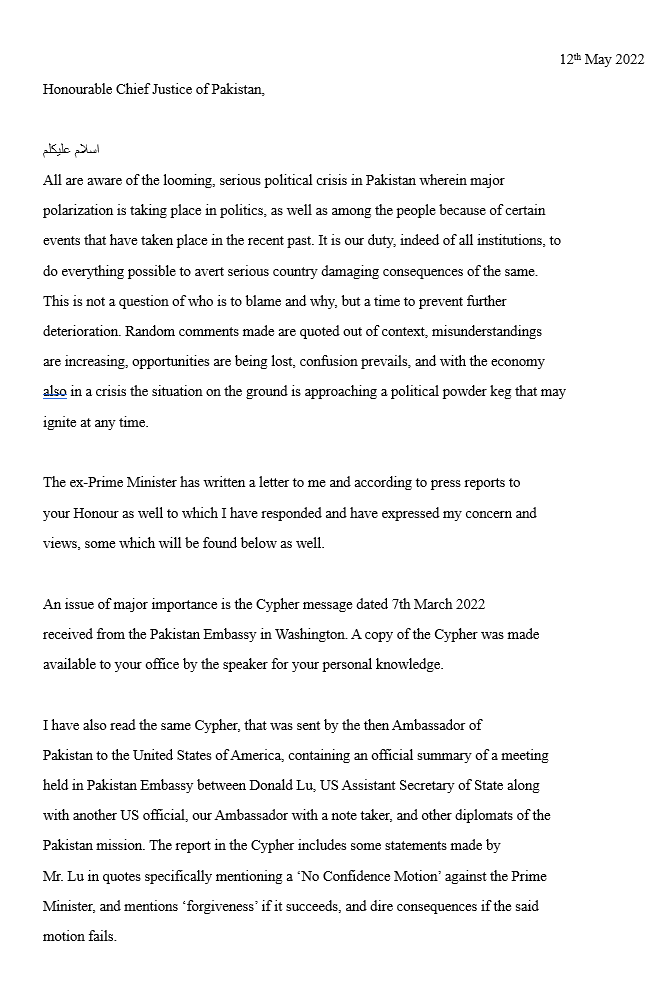
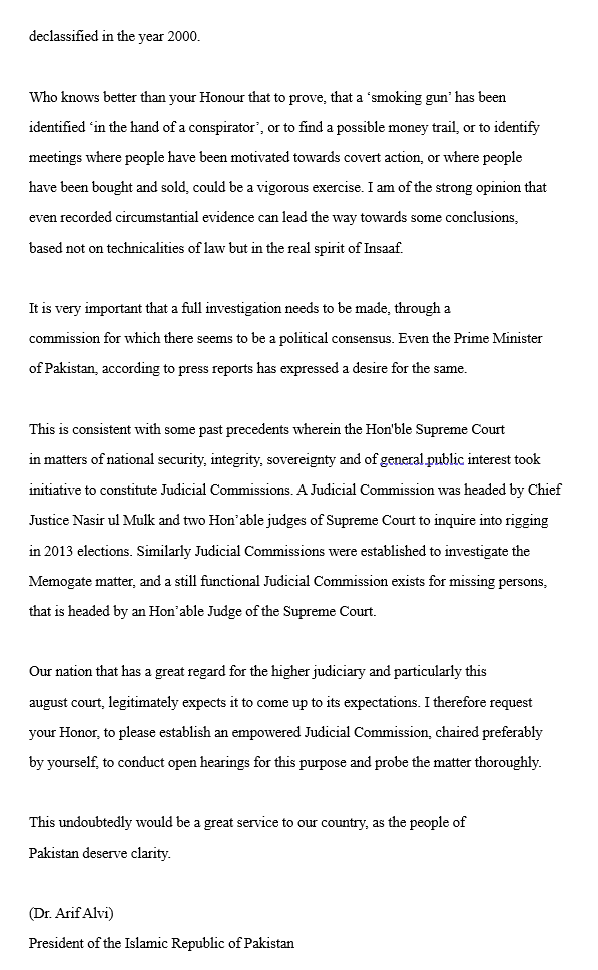
On 12 May 2022, I as President formally wrote to CJP Umar Bandial requesting a Judicial Commission, open hearings, full investigation and truth be placed on record. This was published in all newspapers. (Please read the letter below, every word carries historic weight in world affairs of this nature).
CJP received that letter. Did not comment. Did not act. The judiciary's silence marked the beginning of its institutional surrender. Had that Commission been constituted, these questions would have been answered under oath: who received the cipher, who acted upon it, who domestically facilitated the foreign signal, and which institutions of the Pakistani state collaborated in the removal of an elected prime minister.
Pakistan would have had the truth. A man who warned the nation would not have been imprisoned on false charges arising from the very document the state refused to investigate. Instead, the nation got four years of compounding ruin.
A regime was not merely changed but democracy was dismantled, piece by piece, demolished with full institutional complicity at every level. Parliament was reduced to a 'stinking chamber of convenience'. PTI commanding the largest popular mandate in Pakistan's history had its electoral symbol stolen, its seats brazenly allocated to others by judicial decree, all to hand a 17-seat party, a fraudulent two-thirds majority.
PTI's workers were tried in military courts. Its voters were disenfranchised. Its leader imprisoned — on charges arising from the very document the state refused to examine. The 26th & 27th Amendments were coercively passed, turning the judiciary into a handmaiden of the executive, an instrument of crooked consolidation rather than a guardian of rights.
Now count the human cost. 44% of our people are below the poverty line, 105 million people that is 20 million more than in 2019. Real incomes have collapsed. GDP growth of barely 3% cannot keep pace with population, let alone absorb new labour. Terrorism is at its highest. Capital is leaving, not arriving. 22 million young Pakistanis are neither working nor studying, 25 million children are out of school. The direction is unambiguous: Pakistan is getting poorer, faster than ever.
These are not statistics. These are children going to bed hungry. Young men drowning on boats to shores that may kill them, because their own country is pushing them out. Mothers choosing between medicine and bread. Every single one of these human beings is a direct, traceable, forensic consequence of the decision made in April 2022 to subvert the democratic mandate of the Pakistani people. This is not an act of God. It is the price of a conspiracy with all its collaborators naked before the people.
Donald Lu issued a threat. He did not remove a government. Pakistanis removed a Pakistani government. General Bajwa in uniform. Some in robes. Some in ‘dastaar’. Corrupt politicians, some with deep pockets from Dubai. They chose a foreign signal over the people and the constitution they had sworn to protect. The perpetrators were not only foreign but local. Let that be stated plainly and permanently on the record.
To those who say, "this is the past, let us move forward", I say that: There is no investment without rule of law. There is no rule of law without an independent judiciary. And there is no independent judiciary that can be built upon the foundations of predominantly crooked judges. The path forward runs through the truth, not around it.
Pakistan's economic misery, its institutional decay, total corruption, national termites eating up everything, none of it is an act of God. It is the direct and traceable consequence of a criminal regime change, facilitated from without and executed from within.
The contents of the cipher as reported are now public. The record is clear. The usurpers remain in power orchestrating my country's misery. The only reasonable and just way forward is unambiguous: LEAVE and let my people LIVE.
It pains me to invoke Iqbal for those who betrayed this nation, but this verse is timeless:
جعفر از بنگال و صادق از دکن
ننگِ آدم، ننگِ دیں، ننگِ وطن
Jaffer of Bengal, Sadiq of Deccan,
Disgrace to humanity, disgrace to faith, disgrace to country.
The cipher has spoken. Now Pakistan must. 🇵🇰
Cracked it. Corruption ipn @irctc
is between Panvel and Surat. No Rail Neer. Instead shady alternatives at 50 % extra. Tea/Coffee in micro cups at same price. At Surat, Rail Neer is available and size of coffee/tea cups is back to normal. @CBIHeadquarters@RailwaySeva