You need boredom. A lot of it. Start by going on walks without music. No stimulation. No distractions of any kind. If you learn to sit with your own thoughts, for long enough, in time they will start serving you. You’ll start having ideas once again.
The real AI moat isn't the LLM, it's the user context layer.
As context compounds, LLM usage per task should go down while user value goes up.
The winners won't make the most AI calls. They'll need the fewest.
#AI#LLM#ContextEngineering
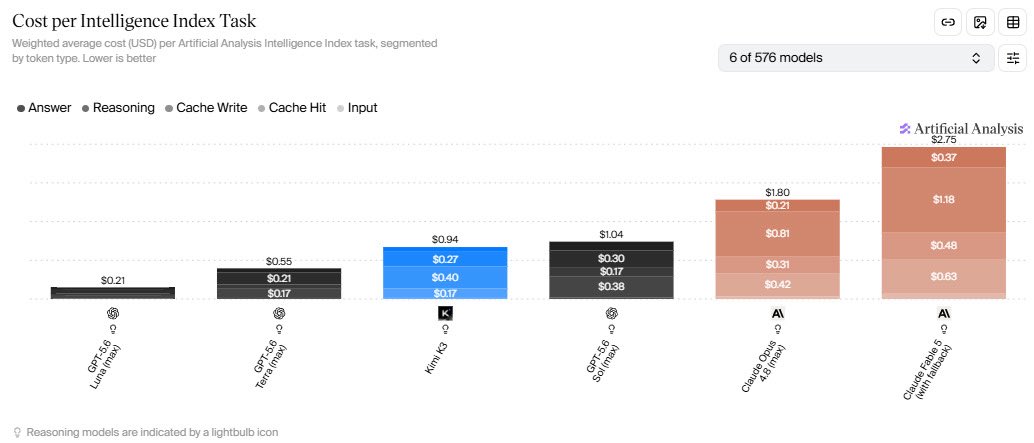
Kimi K3 may be an important inflection point for AI. Potentially negative for Anthropic and OpenAI while being net positive for essentially every other company in the world. I mean that very literally. Although the real “Sputnik moment” would be an open-source frontier model that was also token efficient unlike Kimi K3 which is 50-70% more expensive to run than GPT 5.6 per Artificial Analysis.
Rationale:
A world where there are only 2-3 dominant frontier labs with 90% inference margins is net negative for every other layer while being awesome for those 2-3 labs. Those labs would become monopsonies for power, data centers, semiconductors and hyperscalers and would obviously vertically integrate over time into all those layers while also completely subsuming the application/software layers.
Anything that lowers margins and increases competition at the model layer is good for every other AI layer: power, semiconductors, hyperscalers, neoclouds and yes even software.
This is why Jensen is so supportive of open-source. An open-source model requires the *exact* same amount of compute to run as a closed frontier model of similar size and architecture. Kimi K3 is roughly the same price as GPT 5.6 Terra on a per token basis, which actually suggests that it is less computationally efficient as I am sure that GPT 5.6 is priced to a higher margin than K3. And given that K3 is a token wastrel, i.e. token inefficient, it is significantly more expensive per task than GPT 5.6 and Grok 4.5, which are much more token efficient. Cost per token and token efficiency (i.e. intelligence density per token) are the drivers of intelligence per unit of cost. The winning AI companies will be those that offer the most intelligence per $ over time.
Lower margin % at the model layer = more margin $ at every part of the infrastructure layer and is a godsend for software. This can happen either through open-source models like K3 at the frontier *or* having a vertically integrated model company like Meta, SpaceX or Google at the frontier. Both outcomes result in a lower margin % at the model layer as vertically integrated model companies don’t really care where the margin $ come from. This is why it was so painful for OpenAI and Anthropic when Google was right there with them from a model competitiveness perspective and why Grok 4.5 and Muse 1.1 were just as important as Kimi K3.
The reason Kimi K3 is only *potentially* negative for Anthropic and OpenAI is 1) the @ericvishria point that the Claude and ChatGPT products and harnesses may be more important than their models today and 2) the hypothesis that they have much more advanced model checkpoints internally that are already being used for RSI. In the latter scenario, reaching RSI even a few months ahead of other labs might be enough to cement a permanent lead.
Time will tell on both points. And likely fairly quickly.
Caveat would be that since Kimi K3 is not token efficient and thereby actually more expensive than ChatGPT 5.6, we may need to see a more token efficient open-source model at the frontier or see Grok 5/Composer 4/Muse 2 at multiple points on the Pareto frontier for this potential risk to Anthropic and OpenAI to play out. And I am sure they will both vertically integrate as quickly as possible while continuing the product/harness strength they have shown over the last 8 months.
Stop rebuilding the same AI workflows.
I open-sourced Dify Skills—reusable building blocks for creating better AI agents and workflows in Dify.
Less prompt engineering.
More reusable engineering.
GitHub 👇
https://t.co/B7z7djwtrC
#AI#Dify#OpenSource#LLM#AgenticAI
Months of building and shipping AI systems made me realize - one thing that makes agentic workflows work is good old best devops practices.
If you do not have proper tooling, clean (and also well-defined) processes, and ephemeral environments set up, an AI agent cannot run or help you reliably. Be it agentic SDLC, running evals, phased agent rollouts, circuit breakers, database access, or anything else.
Think about what an agent actually needs to do good work. It needs a safe place to run code, a fast feedback loop to know if something broke, and clear boundaries between development, staging, and production.
Most skip this and go straight to "let the agent write and deploy code." Then they hit weird failures, lose trust in the system (and even AI), and quietly give up on agentic workflows altogether.
The fix is not about AI at all. It is the same old devops discipline that made human engineering teams reliable in the first place.
Good things die hard :)
So I built Analytic Copilot—an open-source exploration of what a real agentic Text-to-SQL pipeline looks like.
Read the deep dive 👇
https://t.co/dohO5OupwT
GitHub ⭐
https://t.co/R91xPyZfZ4
Text-to-SQL is the easy part.
The real challenge in Generative BI is everything around it:
→ Understanding business context
→ Retrieving the right schema
→ Generating reliable SQL
→ Self-correcting failures
→ Turning data into actual insights
You don't have ideas because you don't read.
You can't articulate ideas because you don't write.
You can't leverage ideas because you don't build.
You feel bored, anxious, or overwhelmed because your mind wants ideas to flow but you won't let them.
PRO TIP: Copy this article into Fable 5 and tell it...
"Read this article, review my current workflow, and tell me 5 things I can do to be more productive"
Prompt Engineering tells AI what to do.
Loop Engineering builds systems where AI can plan, execute, verify, and improve without constant prompting.
The future of AI is loops, not prompts.
Read: https://t.co/YnHJZKzmFn
As engineering, product, design, DS, etc. melt into a new kind of role, I was reflecting on what roles might look like in the future. For example, when I look at the Claude Code team I see what I think is five archetypes:
1. Prototyper: comes up with brand new ideas; churns out many ideas, most of which don't ship
2. Builder: quickly turns a prototype/idea into production-grade product/infra
3. Sweeper: cleans up the UI, simplifies the code and system, unships, optimizes performance
4. Grower: takes a product that has been built and iterates on it to improve Product-Market Fit
5. Maintainer: owns a mature system to make it secure, reliable, fast, and efficient as it scales
Many people span across 2 roles, and sometimes 3 roles. I also notice that these roles are not really tied to job function -- eg. across Anthropic, some designers match category 1, some 2, some 3; same for engineers, PM, DS.
A healthy team needs a mix of these, depending on the product:
- A product that is new and pre-PMF needs people that are strong at 1+2+3
- A product that is growing and has found PMF needs 2+3+4 and some 5
- A product that has strong PMF needs 3+4+5 and some 2
Maybe product roles of the future will look more like this, and less like the domain-specific roles of today?
“Loop engineering” is a hot buzzphrase after mentions of it by Boris Cherny (Claude Code’s creator) and Peter Steinberger (OpenClaw's creator) went viral on social media. Loops are now a key part of how we get AI agents to iterate at length to build software. In this letter, I’d like to share my 3 key loops, shown in the image below, for building 0-to-1 products. These loops guide not just how I build software, but also how I decide what software to build.
Agentic coding loop: Given a product specification and optionally a set of evals (that is, a dataset against which to measure performance), we can have an AI agent write code, test its work, and keep iterating until the code is bug-free and meets its specification. This idea of closing the loop took off around the end of last year, and it has been a game changer in enabling coding agents to work longer productively without human intervention. For example, over the weekend, I was building an app for my daughter to practice typing, and my coding agent could easily work for around an hour, using a web browser to check what it had built multiple times before getting back to me, without needing my intervention.
The engineering loop executes quickly. Every few minutes, the coding agent might build and test a new version of the software. I hear frequently from developers who are finding new ways to engineer more effective engineering loops. This is an active area of invention!
Developer feedback loop: In this loop, a developer examines the current product and steers the coding agent to improve it. Last year, a lot of developers (including me) were acting as the QA (quality assurance) function for our coding agents, manually finding bugs and then asking the agent to fix them. But with coding agents much more able to test their own code, the amount of time we need to spend on this function has decreased significantly. This allows us to make higher-level product decisions, such as what key features to offer, where the UI needs improvement, and so on.
The developer-feedback loop operates over time intervals between tens of minutes and hours — that's how frequently a developer might review a product and give feedback. In the case of the typing app, I changed my mind a few times about the visual design, what cat costumes she can unlock as she learns (she loves cats), and the user flow for a grown-up to log in and steer the child's learning experience.
When a developer has a clear vision for what to build, it is still a lot of work to translate that vision into a specification for a coding agent to implement. Further, after the developer has seen an implementation, they might update (or perhaps clarify) the spec to steer it toward what they want. If you find that the system repeatedly runs into certain problems, building a set of evals for the agent becomes useful.
AI-native teams are increasingly using AI to help shape product direction, for example, automating the gathering and analysis of usage data, summarizing written and verbal customer feedback, or carrying out competitive analysis. However, for pretty much all the products I’m involved in, I see humans as having a significant context advantage over current AI systems — we know a lot more than the AI system about the users and the context the product has to operate in — and thus humans play a critical role. Many people describe this human contribution as “taste,” but I prefer to think of it as humans having a context advantage, since that gives us a clearer path to helping AI systems get better. This also speaks to why this step can’t be automated: So long as the human knows something the AI does not, human-in-the-loop is needed to to inject that knowledge into the system.
External feedback loop: This includes a wide range of tactics like asking a few friends for feedback, launching to alpha testers, or putting the code into production with A/B testing. These tactics are usually slow, rarely taking less than hours and sometimes taking days or even weeks. This data informs the developer vision, which in turn continues to drive the detailed product spec, which in turn drives the coding agent.
With coding agents speeding up software development, more engineers are starting to play a partial product management role. For many engineers who are growing into this role, the hardest part is shaping the product vision and striking a balance between building (bridging the gap between vision and spec) and getting user feedback to evolve the vision. It is important to do both!
I will write more about how to do this in future posts, but for now, I find it encouraging that engineers are playing an expanded role (just as product managers and designers now do more engineering).
[Original text: The Batch]
The world’s first sub‑1 nanometer node chip is here.
Delivering 70% greater energy efficiency, this breakthrough powers a new era of computing that’s more capable while using less energy.
Dig into this next-gen tech: https://t.co/NkzAahH49S
We spent four days in Paris and one question ran through every conversation:
"What does it take to move innovation from potential to real, measurable value?"
That's what VivaTech 2026 was about.
Here are a few highlights. 🧵
Prompt Engineering tells AI what to do.
Loop Engineering builds systems where AI can plan, execute, verify, and improve without constant prompting.
The future of AI is loops, not prompts.
Read: https://t.co/YnHJZKzmFn
Autonomous agents are shifting AI from answering questions to taking action.
The next wave isn’t just smarter models, it’s systems that can plan, execute, collaborate, and continuously improve with minimal human intervention.
From copilots to coworkers. 🚀




![AndrewYNg's tweet photo. “Loop engineering” is a hot buzzphrase after mentions of it by Boris Cherny (Claude Code’s creator) and Peter Steinberger (OpenClaw's creator) went viral on social media. Loops are now a key part of how we get AI agents to iterate at length to build software. In this letter, I’d like to share my 3 key loops, shown in the image below, for building 0-to-1 products. These loops guide not just how I build software, but also how I decide what software to build.
Agentic coding loop: Given a product specification and optionally a set of evals (that is, a dataset against which to measure performance), we can have an AI agent write code, test its work, and keep iterating until the code is bug-free and meets its specification. This idea of closing the loop took off around the end of last year, and it has been a game changer in enabling coding agents to work longer productively without human intervention. For example, over the weekend, I was building an app for my daughter to practice typing, and my coding agent could easily work for around an hour, using a web browser to check what it had built multiple times before getting back to me, without needing my intervention.
The engineering loop executes quickly. Every few minutes, the coding agent might build and test a new version of the software. I hear frequently from developers who are finding new ways to engineer more effective engineering loops. This is an active area of invention!
Developer feedback loop: In this loop, a developer examines the current product and steers the coding agent to improve it. Last year, a lot of developers (including me) were acting as the QA (quality assurance) function for our coding agents, manually finding bugs and then asking the agent to fix them. But with coding agents much more able to test their own code, the amount of time we need to spend on this function has decreased significantly. This allows us to make higher-level product decisions, such as what key features to offer, where the UI needs improvement, and so on.
The developer-feedback loop operates over time intervals between tens of minutes and hours — that's how frequently a developer might review a product and give feedback. In the case of the typing app, I changed my mind a few times about the visual design, what cat costumes she can unlock as she learns (she loves cats), and the user flow for a grown-up to log in and steer the child's learning experience.
When a developer has a clear vision for what to build, it is still a lot of work to translate that vision into a specification for a coding agent to implement. Further, after the developer has seen an implementation, they might update (or perhaps clarify) the spec to steer it toward what they want. If you find that the system repeatedly runs into certain problems, building a set of evals for the agent becomes useful.
AI-native teams are increasingly using AI to help shape product direction, for example, automating the gathering and analysis of usage data, summarizing written and verbal customer feedback, or carrying out competitive analysis. However, for pretty much all the products I’m involved in, I see humans as having a significant context advantage over current AI systems — we know a lot more than the AI system about the users and the context the product has to operate in — and thus humans play a critical role. Many people describe this human contribution as “taste,” but I prefer to think of it as humans having a context advantage, since that gives us a clearer path to helping AI systems get better. This also speaks to why this step can’t be automated: So long as the human knows something the AI does not, human-in-the-loop is needed to to inject that knowledge into the system.
External feedback loop: This includes a wide range of tactics like asking a few friends for feedback, launching to alpha testers, or putting the code into production with A/B testing. These tactics are usually slow, rarely taking less than hours and sometimes taking days or even weeks. This data informs the developer vision, which in turn continues to drive the detailed product spec, which in turn drives the coding agent.
With coding agents speeding up software development, more engineers are starting to play a partial product management role. For many engineers who are growing into this role, the hardest part is shaping the product vision and striking a balance between building (bridging the gap between vision and spec) and getting user feedback to evolve the vision. It is important to do both!
I will write more about how to do this in future posts, but for now, I find it encouraging that engineers are playing an expanded role (just as product managers and designers now do more engineering).
[Original text: The Batch]](https://pbs.twimg.com/media/HMEtxp3bsAARJdi.jpg)


