The world is at war, and it’s escalating
Much of this war remains invisible to most people. Yet its front lines run through the very infrastructure that keeps the modern world functioning.
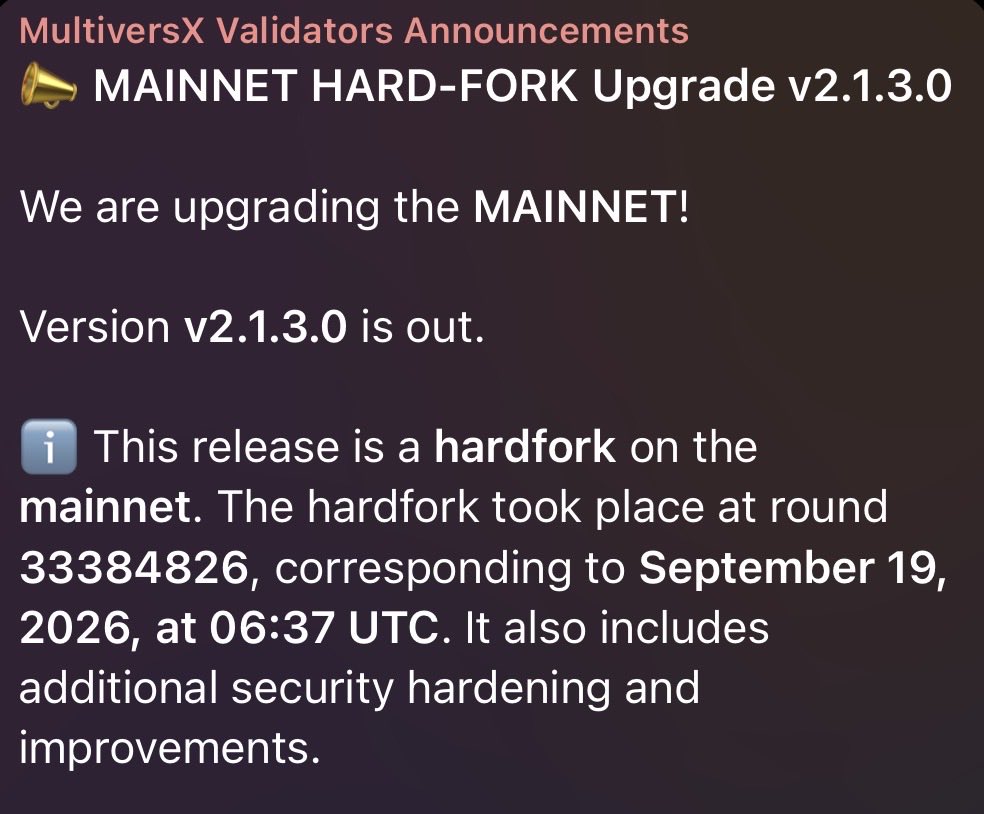
Today, we are publishing the incident report for the events of September 19 at MultiversX.
As I write this, three things have become increasingly clear about the world:
1. We are witnessing a dramatic escalation in cyberattacks globally, targeting everything from financial institutions and energy grids to national security infrastructure and supermarkets.
2. The speed at which zero-day vulnerabilities can be discovered and exploited is increasing dramatically. AI is fundamentally altering the economics of offensive security, compressing the time between discovery and exploitation.
3. The entire software landscape is turning into an accelerated arms race between attackers and defenders. The assumptions under which much of the world's software was built are rapidly becoming obsolete.
Over the past six months, security has consumed virtually all of our engineering attention, energy, and resources. We have successfully defended against many attacks thanks to the speed, resourcefulness, and extraordinary collaboration of our team and external exchanges, validators and security partners. But we are under no illusion that these threats will remain isolated events. We expect them to become a daily reality across the industry.
Operating at the intersection of open-source technology, financial infrastructure, and safety-critical architectures, we have experienced firsthand an emerging reality that much of the world is only now beginning to wake up to. Very few people, I believe, fully appreciate the severity, scale, and urgency of what is unfolding.
Below, we are sharing our account of the September incident, the lessons we have drawn from it, and the concrete measures we have taken in response. But the implications extend far beyond MultiversX or the blockchain industry.
Banks, payment institutions, energy grids, defense systems, and medical infrastructure should be operating at an entirely different level of vigilance. We are already seeing an escalation in attacks against critical infrastructure, and there is every reason to expect it to intensify. Incremental improvements to existing security practices will not be enough when the nature and velocity of the threat itself are changing.
One of the most valuable lessons from blockchain engineering is that you design infrastructure from the outset with the assumption that it will operate in a permanently adversarial environment. You assume components will fail. You assume trust will be violated. You assume intelligent, well-resourced adversaries will continuously probe your system for weaknesses. And you engineer accordingly.
I believe many of the architectural principles developed and hardened in this environment will become foundational to how we redesign society's critical infrastructure over the coming decade. Fault tolerance, adversarial design, redundancy, and resilience will no longer be specialized engineering concerns. They must become integral requirements for any system on which society depends.
We must move from building systems that work when things go right to building systems that continue to work when things go profoundly wrong.
Two months ago, I wrote the following:
“This reality is not unique to MultiversX. Every major open-source stack, every blockchain (Bitcoin and Ethereum not excluded), and soon, every closed-source software stack, will increasingly have to adapt to an environment where infrastructure is continuously and deeply probed, attacked, and tested. That requires a much more rugged approach to code. A more adversarial approach to architecture design. And ultimately, a fundamental rethinking of how safety-critical software is built and defended.”
Today, it rings more true than ever.
The most dangerous assumption people can make today is that the security of the past will be sufficient for the threats of tomorrow. They may be forced to revisit that assumption at a devastating cost. One measured not in software failures alone, but in the disruption of the institutions and infrastructure on which entire societies depend.
The world has changed. Our engineering practices must change with it. And swiftly.
At MultiversX, that work is well underway.
https://t.co/npnmi5dVZf
myDid First est officiellement en ligne et ouvert à tous !
Comme annoncé, la plateforme est accessible dès maintenant :
👉 https://t.co/1AWw2AOsqv
Nous basculons sur une version quasi-stable pour lancer officiellement notre phase de test du marché.
L'objectif est clair : faire un premier vrai point à la mi-décembre pour analyser ce qui fonctionne et ajuster le tir. L'équipe est à fond sur le sujet, et nous vous tiendrons régulièrement informés de l'avancée.
À vous de jouer !
Vous pouvez tester dès à présent le diagnostic gratuit, que ce soit sur votre propre site ou sur celui d'une entreprise ou d'un commerce que vous connaissez bien.
Vos retours et avis sont plus que précieux pour nous aider à optimiser l'outil. N'hésitez pas à partager vos impressions !
Does Europe still want to play any role in the AI race?
Does it still have the will to build what it takes?
Not simply talk about it, or simply regulate it.
But build. Compete at the frontier. Take the risks, make the investments, and do the difficult things that leadership actually demands.
Today, access to frontier AI still comes with painful tradeoffs. Costs that compound with every user. Latency that slows down products. Compute concentrated in a handful of providers. And too little control over where intelligence runs and where data lives.
Why should building with the world’s best intelligence mean accepting these constraints?
We don’t think it should.
That’s why we’re building https://t.co/i6UJLETzmc.
Open models. Exceptional performance. Radically lower costs. Sovereign infrastructure.
All accessible through one API.
Europe has an extraordinary history of discovery. Of people who questioned what everyone else accepted, built what didn’t exist, and changed what the world believed possible.
Is that spirit of discovery, invention, and ambition still alive today?
Because in this new age, infrastructure is more than compute, networks, and data centers.
It’s what gives a small team with an extraordinary idea a fighting chance against the largest companies in the world.
It’s what turns the world’s best intelligence into new products, businesses, scientific discoveries, and capabilities that matter.
It’s also what gives our businesses and institutions the ability to remain resilient, independent, and in control as intelligence becomes critical to everything they do.
Europe needs this infrastructure. And it needs companies willing to put it to work.
More founders building at the frontier. More businesses adopting the best models, testing their limits, and turning new capabilities into real advantages. More infrastructure built here, serving the world.
Build something that wouldn’t have been possible yesterday.
The models are here. The talent is here. The opportunity is here.
What are we waiting for?
https://t.co/iiLF3AsA8Q
Depuis une semaine, on observe un acteur malveillant qui passe en revue les Smart Contracts du réseau MultiversX.
Un par un, de manière méthodique, il cherche à extraire la moindre valeur mal protégée.
Le rythme et la méthodologie de chaque exploit constaté semblent indiquer un processus automatisé : un agent récupère le code de chaque contrat, liste les fonctions existantes, vérifie les autorisations liées à chaque fonction (only owner vs public), puis cherche un vecteur d’attaque en simulant le résultat de la transaction.
Si l’agent trouve quelque chose, il exécute l’attaque en soumettant des transactions pour mettre en œuvre le scénario découvert.
Les failles que j’ai analysées parmi les dizaines de Smart Contracts touchés présentent deux principaux vecteurs d’attaque.
Le premier est l’utilisation de fonctions qui auraient dû être réservées à l’owner du Smart Contract, mais qui sont restées publiques.
L’oubli de la macro #[only_owner] sur un endpoint permet à tout le monde d’exécuter une fonction qui aurait dû être réservée au propriétaire du contrat.
L’attaquant a exploité cette faille pour modifier des paramètres sensibles, comme une adresse ou un token utilisé dans la logique du contrat, lui permettant ainsi d’extraire ou de rediriger des fonds vers son wallet.
Le second est plus technique. Il consiste à appeler des fonctions publiques en leur envoyant des paramètres que le développeur n’avait pas pensé à vérifier.
Quelques exemples :
Payer le bon montant, mais avec un autre token.
Payer avec le bon token, mais avec un montant incorrect.
Exploiter une fonction qui accepte deux identifiants identiques alors qu’ils auraient dû être différents.
Une grande partie de ces contrats ont été développés avant l’avènement de l’IA telle qu’on la connaît aujourd’hui.
Si vous avez écrit des contrats par le passé, faites-les passer à la moulinette pour détecter d’éventuels oublis.
Si vous développez des Smart Contracts aujourd’hui, avec ou sans IA, challengez votre agent pour qu’il recherche des scénarios d’exploitation liés à ce type d’oubli.
Faites également relire et auditer votre code par des sources externes.
Ce n’est pas parce que votre code fonctionne qu’il ne peut pas être détourné pour un usage que vous n’aviez pas anticipé.
Pour finir sur une note positive, la majeure partie des fonds extraits par l’attaquant ont été bloqués au niveau du bridge.
Mais heu c'est quoi ?! 😅
financecomputer ,
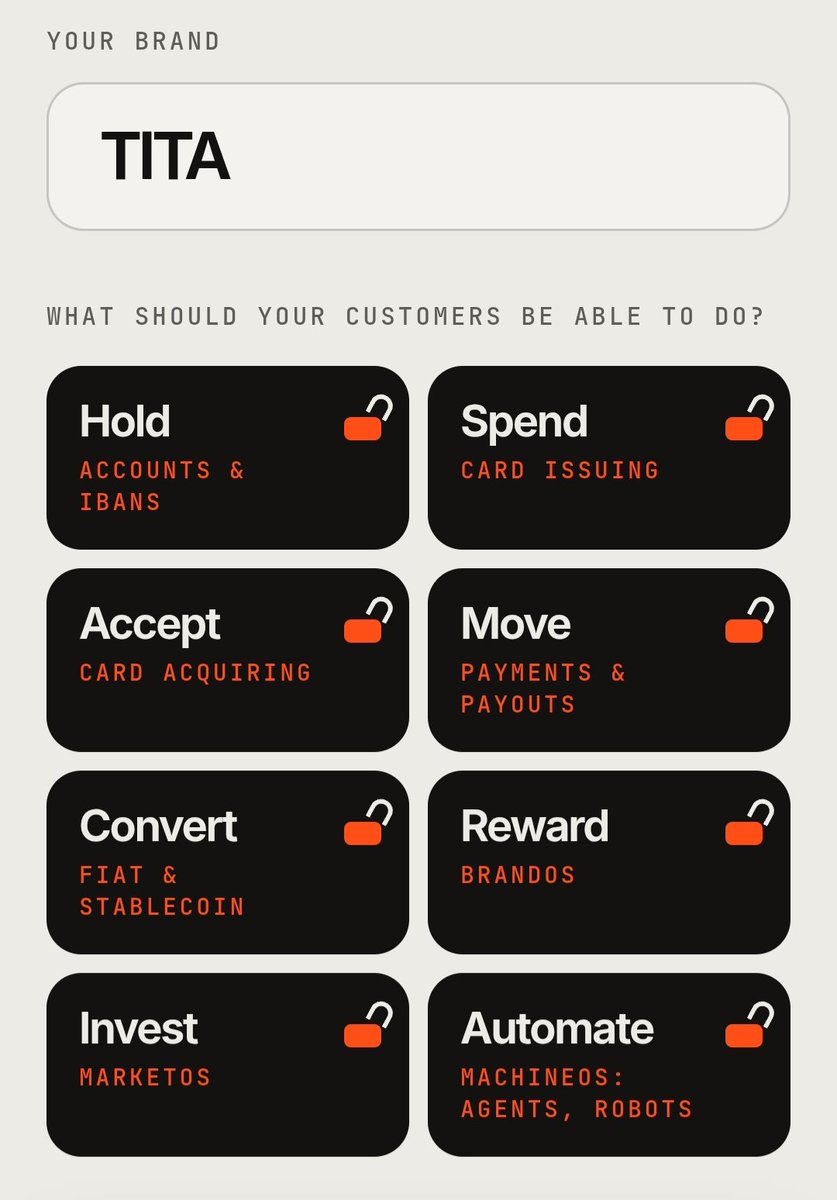
Ça sert à offrir des services bancaires (comptes, cartes, paiements…) sous ta propre marque, sans devenir une banque.
En simple :
Tu as une app, une plateforme, un site ou un business (ex. : une app crypto, une marketplace, une chaîne de magasins, un service en ligne…).
Au lieu de juste dire à tes clients "payez avec carte bancaire", tu peux leur proposer :
• Un compte "TITA" (ou le nom de ta marque)
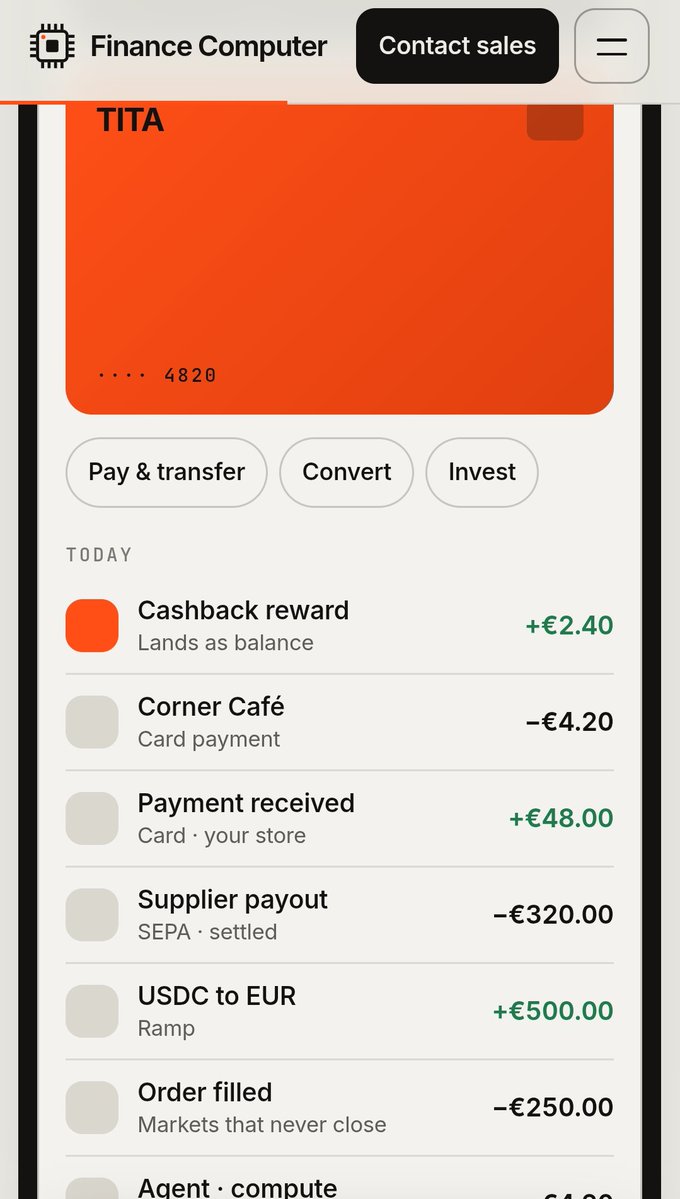
• Une carte de paiement à ton nom
• La possibilité d’envoyer/recevoir de l’argent
• Des récompenses, conversions, etc.
Tout ça sous ton logo et ton design.
Tes clients voient "TITA" pas "Finance Computer".
Pourquoi c’est utile ?
Normalement, pour proposer ça, il faut :
• Une licence bancaire / e-money (très long et cher)
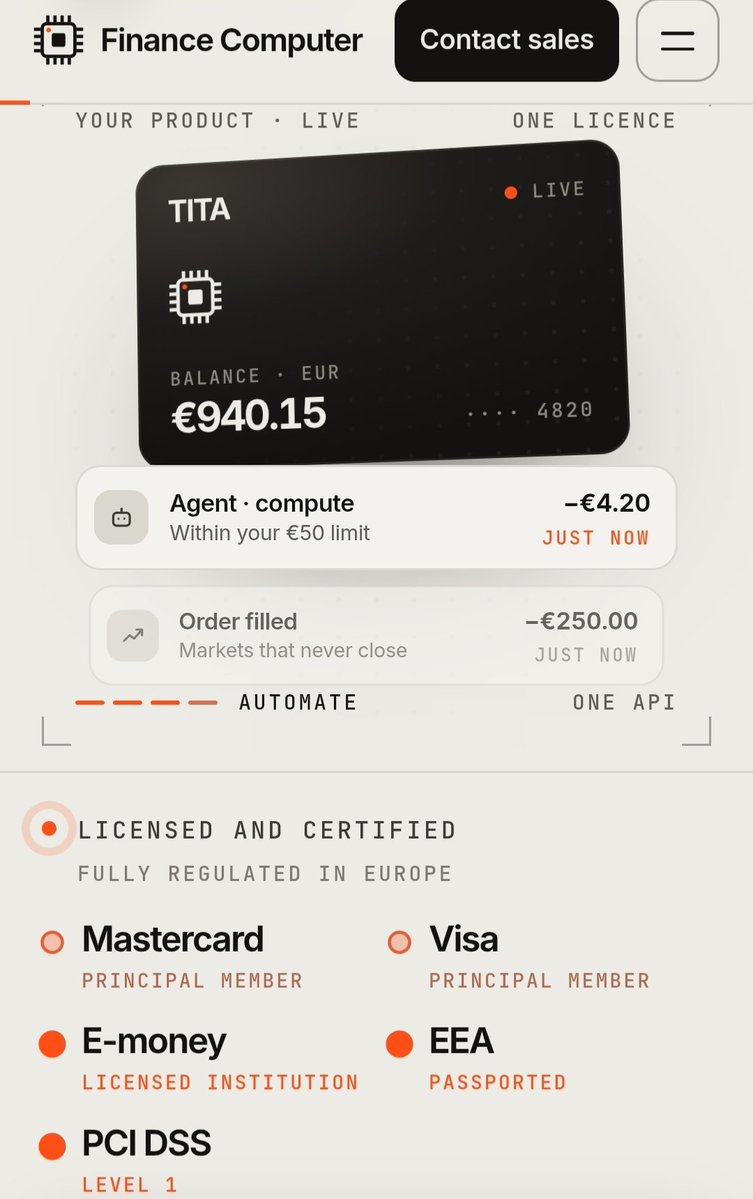
• Des accords avec Mastercard/Visa
• Gérer la conformité, la sécurité, les virements SEPA, etc.
Là, ils ont déjà tout ça.
Tu intègres leur API une fois, et tu peux activer les fonctionnalités que tu veux (Hold = comptes, Spend = cartes, etc.).
C’est une solution d’embedded finance :
tu utilises leur licence et leurs rails (e-money institution régulée en Europe, principal member Mastercard & Visa, PCI DSS, siège au Liechtenstein).
Tes clients voient ta marque, eux gèrent la régulation, la conformité et l’infra technique.
C’est lié à l’écosystème MultiversX / xMoney / xPortal.
Ils ont déjà des clients comme Tradeville, Domino’s, xPortal, etc.
Approche "blockchain invisible" :
Sous le capot, le registre des soldes et mouvements tourne sur MultiversX, et xMoney prépare des stablecoins régulés. Les clients ne voient ni blockchain ni tokens, c’est le moteur technique qui tokenise l’argent en coulisse, pas le produit visible.
Avantages principaux :
• Tu proposes des comptes et cartes à ton nom sans demander de licence bancaire.
• Tu gagnes de l’argent sur les transactions.
• Tes clients restent plus longtemps dans ton app/écosystème.
• Une seule intégration technique.
• Tu te concentres sur ton produit, eux gèrent le reste.
Avantages pour la blockchain (MultiversX / EGLD) :
Plus de transactions :
chaque opération qui touche le registre (soldes, settlements, conversions, etc.) génère des transactions sur MultiversX. Cela augmente l’usage du réseau.
Brûlage de frais :
une partie des frais de gas est brûlée, ce qui réduit l’émission nette d’EGLD quand le volume augmente.
Entrée d’argent réel :
les dépôts fiat des entreprises/clients peuvent être convertis ou settlés en stablecoins et actifs sur la chaîne ➡️ plus de liquidité et de TVL.
Adoption invisible :
des millions d’utilisateurs interagissent avec la blockchain sans le savoir (pas de wallet, pas de seed phrase). La blockchain devient une infrastructure backend, pas un produit que les gens doivent comprendre.
Demande pour EGLD :
plus de liquidité et d’activité renforcent l’usage d’EGLD comme collatéral, pour le staking et comme actif de réserve du réseau.
En résumé :
Finance Computer apporte de l’usage réel et récurrent (pas seulement spéculatif) sur MultiversX, en connectant des entreprises et de l’argent traditionnel au réseau, tout en restant invisible pour les utilisateurs finaux.
Ah ça commence à être un peu plus clair, bon va falloir que j monte un p'tit business alors, ok...
On my way 😅🤙🏻
🚀 La stratégie de xMoney et MultiversX devient de plus en plus claire !
Aujourd’hui, on connecte les entreprises, les commerçants et les utilisateurs aux infrastructures de paiement de demain. 🌍
Domino’s Pizza en est un parfait exemple. 🍕
💳 Cartes bancaires, Apple Pay, Google Pay… On commence par intégrer les moyens de paiement que tout le monde utilise déjà.
🔗 Demain, cette même infrastructure pourrait accueillir les cryptomonnaies, les stablecoins et les paiements blockchain, sans bouleverser les habitudes.
Et c’est là toute l’intelligence de cette stratégie :
Les entreprises n’ont pas besoin de devenir expertes en blockchain. Les clients n’ont pas besoin de comprendre les cryptos. L’intégration technique, la conformité et la conversion peuvent être gérées en arrière-plan.
L’utilisateur paie simplement. Le commerçant encaisse simplement. La technologie devient invisible.
🔥 L’adoption massive ne viendra peut-être pas du jour où tout le monde utilisera volontairement les cryptos, mais du jour où tout le monde les utilisera sans même le savoir.
L’objectif n’est pas de remplacer brutalement la finance traditionnelle, mais de construire les ponts qui permettront progressivement de la connecter au Web3.
Et si c’était précisément comme ça que MultiversX entrait dans l’économie réelle ?
@MultiversX #EGLD #xMoney #Web3 #CryptoAdoption
Go time! Another step forward.
Great to see Domino's, one of the world's most recognized pizza brands, using @FinanceCompute!
Why? Faster checkout. Better conversion. More profits.
The Finance Computer.
Not gonna lie, it’s wild out there sometimes.
The last few days were pure chaos, but watching our tech & support teams go full all-hands-on-deck was something else.
People only see the surface:
>an app
>a status check
>some tweets
BUT beneath it is an absurd amount of quiet, relentless care for every single user.
Huge respect to the whole @MultiversX & @xPortalApp crew for pulling through together.
To anyone who needed a reminder today: keep fighting, see the bright side, and carve your own path. It’s always worth it in the end 🤍
P.S. If your streak is still acting up or you haven’t received your repair SFT yet, drop me a reply so I can flag it and make sure it gets sorted for you!
SUPERNOVA IS LIVE
Fix is deployed. Users and funds are secured.
The network is working beautifully.
Huge respect for all the partners involved in this mission-critical recovery, especially the team working day and night to get us here.
watching things work was always my quiet joy.
watching them work again is something else entirely.
the hardfork is done, all services are restored, and blocks are landing every 170ms.
huge thanks to everyone involved, especially to the hardcore team behind this critical operation.
/forward.
After carefully reviewing yesterday’s logs, our engineering team confirmed that the recovery hard fork completed successfully. It does not need to be repeated.
Validators are now upgrading and synchronizing for the coordinated restart. Please continue to wait for the separate all-clear before submitting transactions.
Thank you to our validators, partners and everyone standing with us through these difficult days.
We keep building, together.