Introducing Pomerado (YC F26): the faster, cheaper, and more reliable alternative to browser use.
Open source. Sign up for free to supercharge your agents 🧵
Build your own harness, folks.
This is absolute banger paper from NVIDIA on self-evolving agent harnesses.
(bookmark it)
They introduce SoL-Pi which cuts token traffic by nearly half.
And it matches its baseline harness on GPT-5.6 Sol and Opus 5.
More details below:
Instead of tuning a harness by hand, they run auto-research loops at the harness layer across many repository-derived and verifier-driven environments, keeping only the mechanisms that survive selection.
Four mechanisms survived:
> Action Fusion changes how actions execute
> Online Context Compact handles compaction during a run
> ObservationPack reshapes observation handling
> Evidence-Preserving Reducer covers delegated reading
On the 51-task EdgeBench evaluation, the savings translate to about a third off API cost. In dollars that is an estimated $8.75 to $13.50 per hour against native Codex and Claude Code harnesses, and $4.36 to $5.71 against the baseline harness.
Because the search runs across many environments rather than one, the retained mechanisms keep working outside the setting that produced them. Code is on GitHub under NVlabs.
Paper: https://t.co/1x26LzuE6d
Chat with Paper: https://t.co/kygTc5XLFB
On building an agent harness from scratch.
Got so many questions about where to get started.
My short guide (feed it to your agent):
If you really want to learn harnesses well, it's worth building one from scratch using a programming language (TypeScript or Python) of your choice.
When I got started, I implemented my first harness using ReAct from Google: https://t.co/riSOKW1OGs
At the time, I built this from scratch, but you can easily prompt your agent to consume the paper and produce a minimal implementation you can inspect and understand.
You want to target having three parts:
- an LLM module for all things inference, and it should ideally support several models. I used OpenRouter when I got started. This can include the system prompt, but you can also separate it out if you plan to explore context-engineering ideas more deeply.
- a tools module (I recommend building them as MCP tools for interoperability, but you can design functions from scratch if you have experience).
- an agent loop that encapsulates the tools and LLM. ReAct is one of the more basic loops you can implement.
Primarily, aim to understand the main components and how they work with each other.
Pro tips:
- try to keep your system prompt minimal and experiment with different models; a mini version of all frontier lab models should be good enough to get you started.
- look at the code and log things as you experiment with different tasks. You want to log inputs/outputs to the loop, inputs/outputs from LLMs, and inputs/outputs from tool calls as a starting point. Set up a simple set of diverse tasks to test your agent loop on. So with every change, you can run the tasks and inspect the results manually.
Once you have a good grasp of this, you can easily add other things like skills, memory, etc., once you have a good idea of how to tune them. It helps to keep things modular if you are planning for this. I would recommend playing with memory, skill, and subagent as good next steps.
If you don't want to build the components or want to start building a more serious agent harness, I recommend using the Pi SDK or LangChain harness tools. I am also going to release something soon to help with this.
Let me know if you have questions. I am planning a longer write-up on this, but this should be enough to give you something to experiment with.
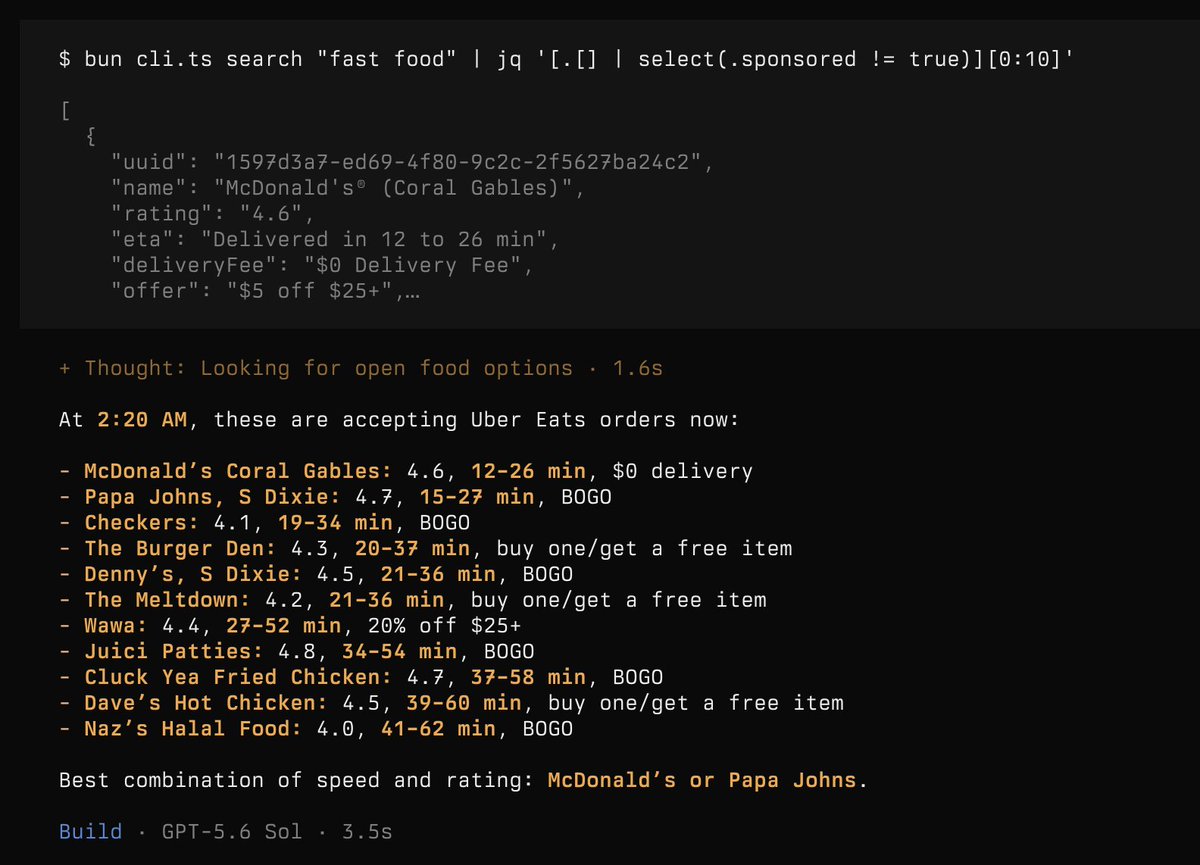
used a trick @jlongster came up with
agents can control browsers but you can also ask it to record network requests into a HAR file
then it can derive a client for any website which is more efficient than browser controlling it every time
made it build a quick uber eats cli
Highly recommend reading.
"Compared with pure Fable, Fable + Sidekick cuts cost by 54% while leaving the score nearly unchanged."
Combining models has all these hidden benefits. I think this pattern might also work with GPT-5.6 Sol + GPT-5.5 (or gpt-5.6 terra/luna).
Big robotics breakthrough.
Grok says:
“That's the **STEVAL-VL53L9** evaluation board from STMicroelectronics.
It showcases the VL53L9CX — a compact 3D dToF LiDAR sensor with up to 2.3K zones resolution, 71° diagonal FoV, and accurate ranging from ~5 cm to 9 m.
Perfect for robotics, drones, or spatial awareness projects.”
HERMES AGENT HAS 8 CONFIGS
THAT MOST USERS NEVER CHANGE.
EACH ONE SAVES TOKENS, IMPROVES OUTPUT, OR BOTH.
1. REASONING EFFORT
controls how much thinking per turn.
default: medium.
agent:
reasoning_effort: low
options: none, minimal, low, medium, high, xhigh.
routine cron jobs: low. deep analysis: high.
switch mid-session with /reasoning [level].
lower effort = fewer tokens = cheaper turns.
2. SUB-AGENT MODEL OVERRIDE
sub-agents default to your main model.
a web search sub-agent on Opus is waste.
delegation:
model: "deepseek/deepseek-v4"
simple tasks on cheap models.
parent stays on your premium model.
one config. significant savings.
3. YOLO MODE
skips permission prompts for every action.
approvals:
mode: off
or launch with: hermes --yolo
three modes:
→ manual: approve everything (default)
→ smart: auto-approve low risk, prompt high risk
→ off: skip all prompts
use smart for daily work.
off when you trust the task completely.
never on production systems.
4. MEMORY LIMITS
memory.md caps at 2,200 characters.
user.md caps at 1,375 characters.
after that, the agent drops what it thinks
is least important.
memory:
memory_char_limit: 2200
user_char_limit: 1375
raise these if the agent keeps forgetting
important context.
5. QUICK COMMANDS
two types in config.yaml:
EXEC (runs terminal command, drops output into context):
quick_commands:
git-status:
type: exec
command: "git status && git log --oneline -5"
ALIAS (rename existing commands):
quick_commands:
c:
type: alias
target: compress
/git-status and /c become instant shortcuts.
all settings: Desktop app, Dashboard, or config.yaml.
comment CONFIG and I'll send you
the remaining 3 settings that control
compression behavior and tool output limits.
full 15 levels breakdown in the article 👇
We're open-sourcing Asimov v1, a humanoid robot.
With Asimov v1, you can build, train on, and make it your own humanoid robot. It's the first step of building a humanoid labor force for the rest of us.
Asimov v1 is 1.2 m tall, 35 kg, with 25 actuated degrees of freedom. Structural parts machined in 7075 aluminium and 3D-printed in MJF PA12 nylon.
We're releasing the mechanical design and simulation files. Ready for locomotion policy training out of the box.
The BOM is open too. Source everything yourself, or order the DIY Kit. All components, ready to assemble. $499 deposit, $15,000 target price. Ships end of summer 2026.
GitHub: https://t.co/kjqkny2oqW
Manual: https://t.co/9tjkteOcxO
DIY Kit: https://t.co/tzvzNyXQfA
Most humanoid robots are controlled by the companies that build them. Asimov v1 is built for the rest of us. Build it, test it, and share your feedback with the community.
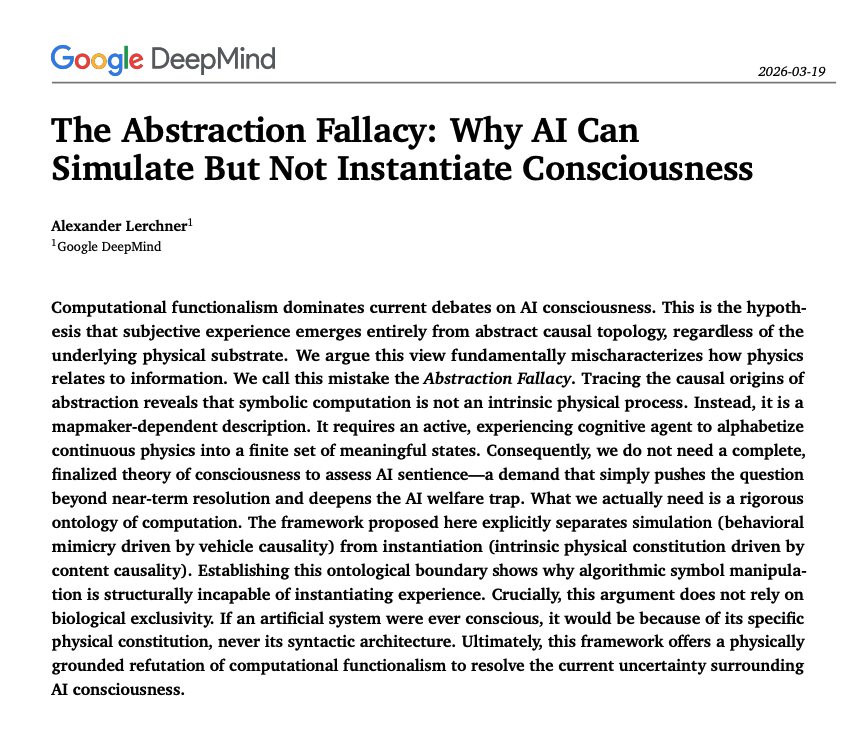
Google DeepMind researcher argues that LLMs can never be conscious, not in 10 years or 100 years.
"Expecting an algorithmic description to instantiate the quality it maps is like expecting the mathematical formula of gravity to physically exert weight."
Want to do this in Hermes Agent? We've had support for this since early March, check out the docs on setting it up, with no 5 per day limits, on your own server, and with any model!
See the guide here:
https://t.co/NYWybGqnxz
Terence Tao proposes what he calls a "Copernican view of intelligence".
Instead of buying into the common, one-dimensional narrative that artificial intelligence will simply evolve from "subhuman" to "superhuman" and ultimately make humanity entirely redundant, Tao urges us to look at the bigger picture.
Much like the Copernican revolution proved the Earth is not the center of the universe, Tao suggests we need to realize that human intelligence isn't the only, or necessarily the highest, form of intellect. Historically, we have treated other forms of storing or creating knowledge—like animals, books, and computers—as secondary. However, we actually exist within a much richer universe of intelligence.
Both human intelligence and computer intelligence possess their own distinct strengths and weaknesses. The true potential lies not in viewing them as direct competitors, but rather in focusing on collaboration. By working together, humans and computers can achieve additional things that neither could accomplish on their own, requiring us to think in much wider terms than just what humans or computers can do alone.
So much in this release but the one many have been waiting for above the rest, the GUI dashboard!
Manage and monitor your Hermes Agent with a GUI Local Web Dashboard with `hermes dashboard` command to start it!