I testify that Jesus is the Christ. That He lives. That He loves each of us and wants the very best for us in the world and throughout eternity. I have listened to the voice of the Spirit bear record to me of this truth and nothing the world has can diminish this knowledge because it is pure light. I love the Lord Jesus. He is my salvation. He is my advocate with the Father. He is my friend.
@avaximalist Zero evidence. 🙄
Maybe zero evidence that you’re willing to accept. That’s ok. Evidence is never going to prove scripture - the Bible or Book of Mormon. That’s my point?💁♂️
I see this type of response often - a request for evidence that a book of scripture is true. Usually, this request comes with an underlying assumption that claims made against the Book of Mormon are automatically true when applied to the Bible.
As if any empirical evidence, such as an an archaeological site, could prove the story of the healing of a blind man in the Bible.
How many Christians answer the question “how do you know the Bible is true” with “history, archaeology, and prophecy”?
From the number of these types of posts, it’s more than I might realize, I guess.
I am deeply grateful that my knowledge of the Book of Mormon’s truthfulness comes not from my own intellect gathering empirical evidence, but from God answering my question directly.
He told me it was true. He knows it and He knows I know it. Who am I to deny God?
@RandomLDS May I ask what evidence there is that the Book Of Mormon is true? I have never seen any. Yet the Bible is supported by history, archaeology and prophecy.
I’ve also noticed the recent algorithm / data that Grok is using has definitely shifted in that regard lately. It used to deliver more nuanced and generally more balanced information. As with everything, it will likely (hopefully) smooth out in the future. I tend to like using Grok for quick sanity checks.
The more interesting point I’ve seen is when people use AI conversations to try to prove a point. AI is awesome at predicting the next word based on probability but it can never replace human reasoning. This built-in ability to anticipate what you want to hear, makes it notoriously easy to manipulate getting the answer you want to receive.
@Hickory54387002 Typical Semi Pro Anti-Mormon behavior.
Anti: Joseph Smith… blah blah blah falsehood
Me: Here’s the facts you failed to mention
Anti: Blah blah blah move the goalpost
Me: Mute
Let’s add back the context that you left out.
This screenshot is an account that was written in the third person as minutes taken during a meeting (recorded by Oliver Cowdery and Warren Parrish). Minutes and notes taken by scribes are notorious for not capturing every context of what’s said in a meeting. It’s also important to note that this did not go through the process Joseph used to record and verify his revelations.
As this isn’t a first-person revelation, we have to go to comments Joseph Smith made afterwards to gain clarity on what he meant.
This is why my OP hits so hard - you guys can’t help but latch onto something and say “look here! See! You’re wrong” without doing even the barest amount of research.
It’s even more hilarious when you guys then make declarations like “you’re brainwashed” and claim we’re the ones that need to do the research 🤣 But I digress…
In later statements, Joseph Smith clarified where the year 1891 came from. In April 1843, he said that he had prayed intensely about the timing of the Second Coming:
"I was once praying very earnestly to know the time of the coming of the Son of Man, when I heard a voice repeat the following: 'Joseph, my son, if thou livest until thou art eighty-five years old, thou shalt see the face of the Son of Man; therefore let this suffice, and trouble me no more on the matter.' I was left to draw my own conclusion concerning this; and I took the liberty to conclude that if I did live till that time He would make His appearance. But I do not say whether He will make His appearance or I shall go where He is." (D&C 130:14–16)
Joseph explicitly noted that he drew his own conclusion from an ambiguous answer, rather than receiving an absolute, fixed revelation date.
Joseph Smith consistently taught that no man knows the exact day or hour of the Second Coming, explicitly criticizing his contemporaries who tried to set precise calendar dates for Christ's return.
It’s also important to note the conditional aspect of this. The statement was explicitly conditional upon Joseph living to be 85 years old. Because Joseph Smith was martyred in 1844 at age 38, the condition ("if thou livest until...") was not met.
Latching onto a single scribal minute while ignoring Joseph's own canonized clarification in D&C 130 misses the full historical picture. But that’s probably intentional on your part.
It’s truly impressive how far the some of our critics will stretch to get an Internet win.
Billions of people lived and died without ever hearing the name of Jesus Christ.
Most churches teach they're lost forever, not for rejecting Christ, but for being born in the wrong place and century.
Does that sound like a loving Father to you? Or like a theology men invented?
I’ve been thinking more about the purpose of Christianity.
Is the ultimate goal to KNOW the correct things about Jesus Christ, or to BECOME the kind of person Jesus Christ wants us to be?
Before someone objects, of course understanding who Jesus is matters. But surely that understanding is supposed to lead somewhere.
Consider the Pharisees.
They studied the scriptures. They debated doctrine. They were deeply concerned about religious correctness.
And yet Jesus repeatedly condemned them.
Why?
Not because knowledge of God was unimportant, but because their religious knowledge had failed to produce the kind of people God wanted them to become.
Jesus didn’t come merely to correct our understanding of God.
He came to reconcile us to God, redeem us from sin, and transform us into something greater than we could ever become on our own.
Paul taught that we are to be “conformed to the image of his Son” (Romans 8:29).
Peter taught that we can become “partakers of the divine nature” (2 Peter 1:4).
John taught that “when he shall appear, we shall be like him” (1 John 3:2).
And Jesus Himself commanded us to be perfect, even as our Father in heaven is perfect (Matthew 5:48).
Do we really appreciate what these passages are telling us?
The purpose of following Christ isn’t merely to learn ABOUT divinity.
It’s to be transformed BY divinity.
To become more loving, more merciful, more forgiving, more holy, and ultimately more like the Savior Himself.
And none of this is possible without His grace.
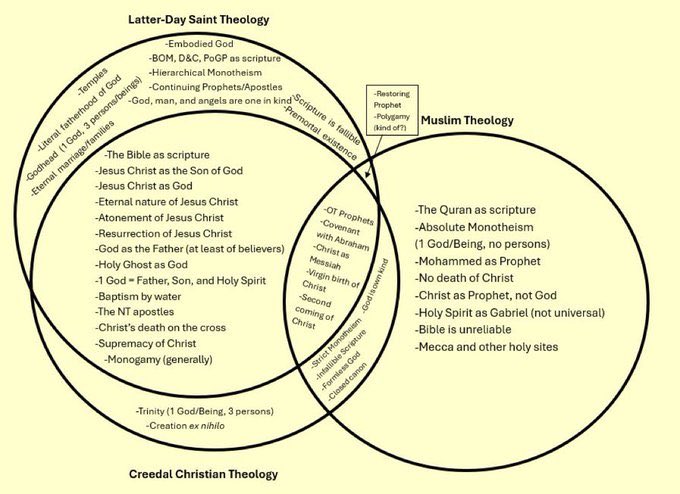
So when someone tells me I follow a “different Jesus” because my theological understanding differs from theirs, I have to wonder whether we’ve lost sight of what discipleship is supposed to accomplish.
Because knowing the correct theological description of Christ, while important, is not the same thing as becoming Christlike.
Even the devils believe in God. (James 2:19)
But discipleship requires more than belief.
It requires allowing Jesus Christ to change who we are.
The ultimate purpose of Christianity isn’t merely to be right about Jesus.
It’s to be made right through Jesus.
And ultimately, to become like Him.
I’m a member of the Church of Jesus Christ of Latter-day Saints. I know God the Eternal Father lives and loves me. His Son, Jesus Christ, is my Savior, and because of what He has accomplished, I can return to live with my Father again.
I am forever grateful to know who I am. As a child of God, I have infinite worth and potential.
It is incomprehensible to my finite mind to to fully grasp at the effort that my God and your God works to tirelessly bring us closer to Him. He wants all of us, all of His children, to return to
His presence and become joint heirs with Christ.
@Primary_Pianist This question perfectly pierces the premise behind the “different Jesus” claim by clarifying the real criteria people use define a Christian.