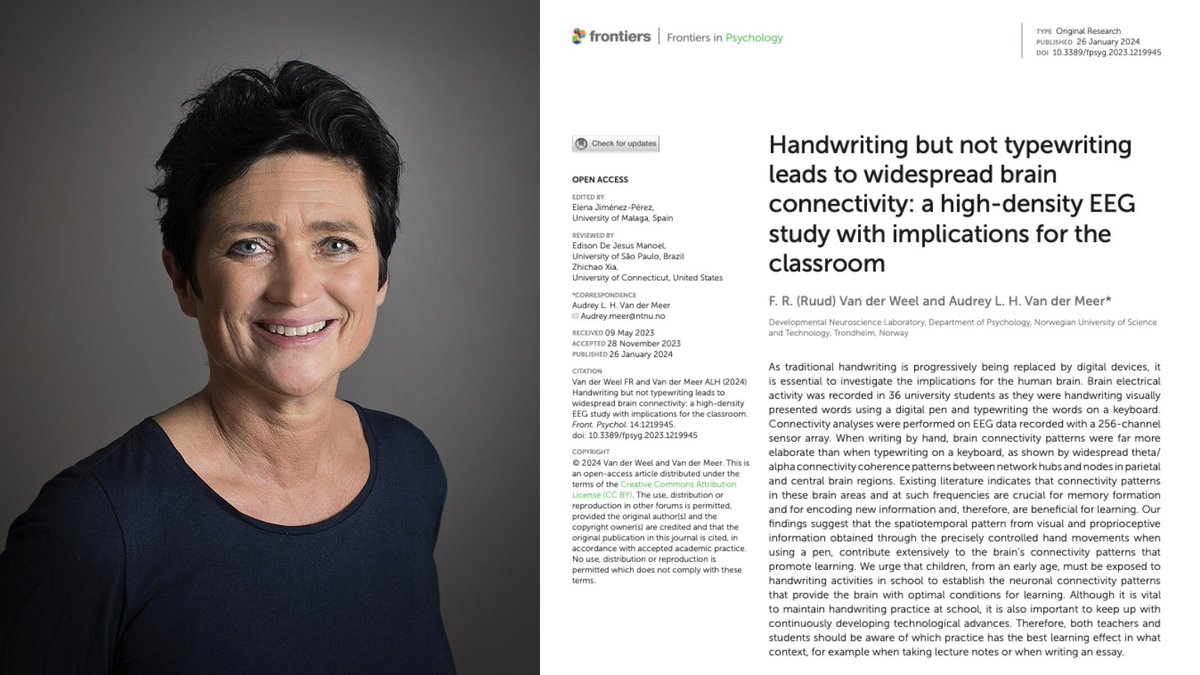
A Norwegian neuroscientist spent 20 years proving that the act of writing by hand changes the human brain in ways typing physically cannot, and almost nobody outside her field has read the paper.
Her name is Audrey van der Meer.
She runs a brain research lab in Trondheim, and the paper that closed the argument was published in 2024 in a journal called Frontiers in Psychology. The finding is brutal enough that it should have changed every classroom on Earth.
The experiment was simple. She recruited 36 university students and put each one in a cap with 256 sensors pressed against their scalp to record brain activity. Words flashed on a screen one at a time.
Sometimes the students wrote the word by hand on a touchscreen using a digital pen, and sometimes they typed the same word on a keyboard. Every neural response was recorded for the full five seconds the word stayed on screen.
Then her team looked at the part of the data most researchers had ignored for years, which is how different parts of the brain were communicating with each other during the task.
When the students wrote by hand, the brain lit up everywhere at once.
The regions responsible for memory, sensory integration, and the encoding of new information were all firing together in a coordinated pattern that spread across the entire cortex. The whole network was awake and connected.
When the same students typed the same word, that pattern collapsed almost completely.
Most of the brain went quiet, and the connections between regions that had been alive seconds earlier were nowhere to be found on the EEG.
Same word, same brain, same person, and two completely different neurological events.
The reason turned out to be something nobody had really paid attention to before her work. Writing by hand is not one motion but a sequence of thousands of tiny micro-movements coordinated with your eyes in real time, where each letter is a different shape that requires the brain to solve a slightly different spatial problem.
Your fingers, wrist, vision, and the parts of your brain that track position in space are all working together to produce one letter, then the next, then the next.
Typing throws all of that away. Every key on a keyboard requires the exact same finger motion regardless of which letter you are pressing, which means the brain has almost nothing to integrate and almost no problem to solve.
Van der Meer said it plainly in her interviews.
Pressing the same key with the same finger over and over does not stimulate the brain in any meaningful way, and she pointed out something that should scare every parent who handed their kid an iPad.
Children who learn to read and write on tablets often cannot tell letters like b and d apart, because they have never physically felt with their bodies what it takes to actually produce those letters on a page.
A decade before her, two researchers at Princeton ran the same fight using a completely different method and ended up at the same answer. Pam Mueller and Daniel Oppenheimer tested 327 students across three experiments, where half took notes on laptops with the internet disabled and half took notes by hand, before testing everyone on what they actually understood from the lectures they had watched.
The handwriting group won by a wide margin on every question that required real understanding rather than surface recall.
The reason was hiding in the transcripts of what the two groups had actually written down.
The laptop students typed almost word for word, capturing more total content but processing almost none of it as they went, while the handwriting students physically could not write fast enough to transcribe a lecture in real time, which forced them to listen carefully, decide what actually mattered, and put it in their own words on the page.
That single act of choosing what to keep was the learning itself, and the keyboard had quietly skipped the choosing and skipped the learning along with it.
Two studies. Two countries. Same answer.
Handwriting makes the brain work. Typing lets it coast.
Every note you have ever typed instead of written went into your brain through a thinner pipe. Every meeting, every book highlight, every idea you captured on your phone instead of on paper was processed at half depth.
You did not forget those things because your memory is bad. You forgot them because typing never woke the part of the brain that would have made them stick.
The fix is the thing your grandmother already knew.
Pick up a pen. Write the thing down. The slower road is the faster one.
Queridos compañeros del gremio docente, os pido que dejémonos a un lado la inercia del corporativismo (mal entendido) y hagamos lo correcto:
⚠️Admitir que estas cosas pasan
⚠️Condenarlas públicamente cuando ocurran
⚠️Rechazar y reportar a nuestros compañeros negligentes
Un análisis de sangre puede predecir el Alzheimer 20 AÑOS antes de que aparezca el primer síntoma. La neurocientífica @SoniaVillapol nos explicará en directo cómo funciona y qué cambia esto para todos nosotros.
https://t.co/QMlnz0gsz6
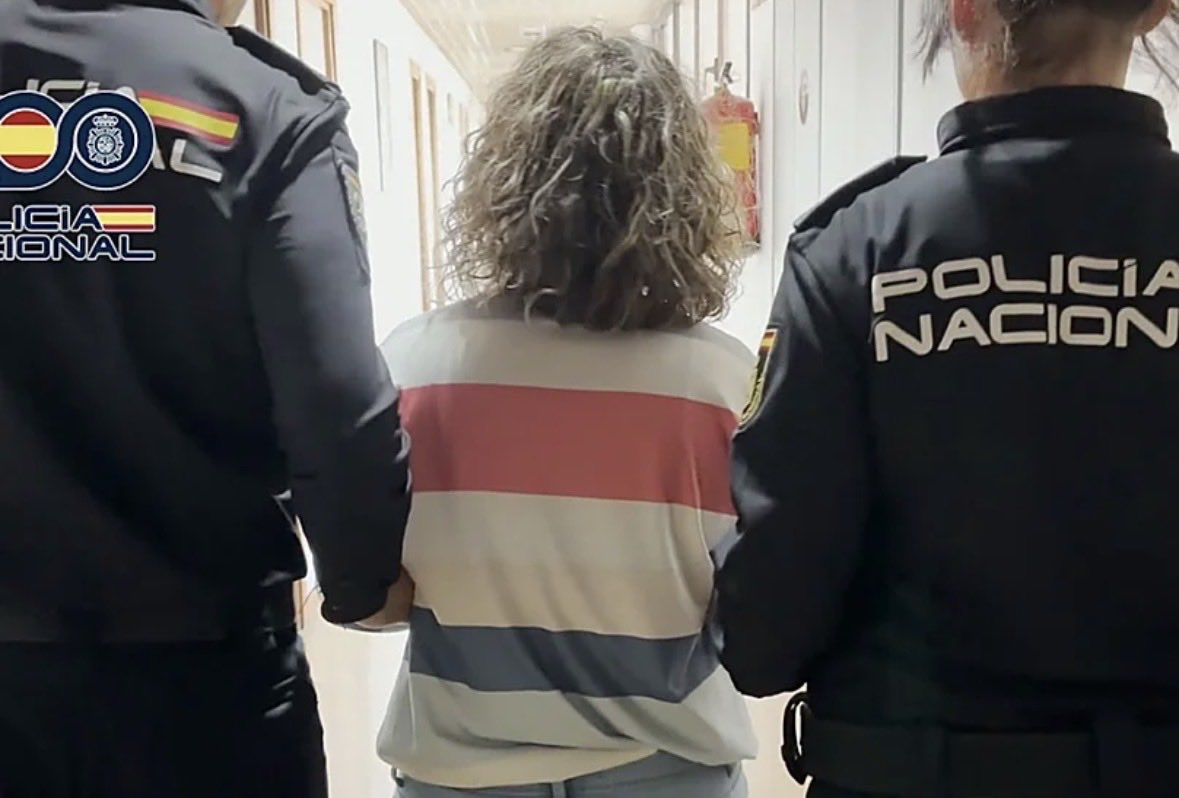
La directora de una residencia de adolescentes 🇪🇸 intercambiaba vídeos de violaciones a niñas
La detenida, de 48 años, estaba a diario en contacto con menores. Comentaba por chats con terceras personas el contenido de las imágenes que se enviaban
👉 https://t.co/aNoU2LpiFn ⛔️
@jmmencia Ir a unas jornadas de puertas abiertas de un instituto y que la Directora diga: aquí seguimos el método tradicional, el profesor explica y el alumno, escucha toma apuntes y estudia, lo otro son inventos modernos que de momento aquí no entran. Pues eso, uno tachado de la lista
La bicicleta forma parte de la solución, ante la actual dependencia energética a los combustibles fósiles.
Se nos abre una oportunidad para crear un sistema de movilidad más resiliente, eficiente y humano
🚲♥️🌼
#MenosPetroleoMásBicis
https://t.co/EtTmUTiqU5
Más sobre el caso de Sandra Peña, la niña de catorce años que se suicidó hace unos meses en Sevilla, por acoso escolar, según todos los indicios... "Sandra tendría que estar aquí si se hubiera activado el protocolo", dice Toñi Moreno. Querida Toñi, como ya hemos dicho en ⬇️
⚖️ Sentencia delTribunal Supremo de 4 de marzo de 2026 confirma la contingencia profesional por daños psicológicos en puestos de moderador de contenidos. https://t.co/ovR1sBz0kV
Lavar el uniforme lleno de sustancias cancerígenas en la misma lavadora en la que lavas la ropa de tus hijos. Es indecente tener así a quien nos salva la vida en los incendios.
https://t.co/kKToTwgmiz
Detrás de esto hubo miles de horas de estudio y trabajo. Un equipo que salvó vidas. Gracias @navedelmisterio@carmenporter_ por la valentía y la plataforma.
Muchos profesores saben exactamente qué necesita cada alumno. Lo ven cada día. Pero no pueden hacer nada porque tienen que rellenar el formulario trimestral de competencias transversales y asistir a la reunión sobre la reunión del plan estratégico.
Hemos burocratizado tanto la educación que hemos olvidado que lo único que debería importar es que tenemos a un adulto frente a un crío que necesita aprender.
Cuando mencionas alta capacidad empiezan a salir individuos para menospreciarte que casualmente no son de alta capacidad intelectual. Creo que les molesta que existamos.
Lag AACC no se diagnostican, se valoran. Y hay que hacerlo con instrumentos psicométricos validados y valoración clínica.
Todo el resto sin impresiones, que valen como impresiones, pero nada más.
@mafizz@vivian_arrojo No suele ser falta de atención, más bien es aburrimiento tremendo. Igual que cuando me meto yo en una clase de baile de nivel muy bajo. Solo miro el reloj para cuando acabe.
@vivian_arrojo Yo era buena alumna, excelente diría yo, y no soy altas capacidades. Mi hijo es un buen alumno, buenas notas y SI es AACC, procesa, resuelve, piensa con una velocidad y de una forma distinta. Ya me supera en algunas cosas, si, señores se ve claramente. No es buen alumno solo.