sharing a recent improvement in my harness customization I built with @pidotdev
this may not be common problem at first, but it appears when your Pi setup starts accumulating a lot of skills, extensions, tools, and instructions
e.g. Ponytail is useful when I’m coding, but not when I’m doing research. subagents are useful (still experimenting), but unnecessary when I only want a summary
this felt particularly wrong in Pi because its minimal core is one of its biggest strengths, while my configuration was slowly moving in the opposite direction
I spent weeks experimenting with Hermes style (or Grok bots style atp) agent profiles. separate configuration directories, separate agents, separate session stores
eventually I realized profiles were the wrong abstraction
Pi already separates global resources from trusted project resources. but its SDK resource loader also lets integrations control resources and instructions for individual sessions
this was useful to create a pool-and-preset architecture where:
- I can keep a large global pool of skills, extensions, and packages to choose from
- I can create presets with only selected items, so a “research preset” can leave behind the coding stuff
- I start each session with a preset that selects the exact global skills and extensions it needs
- each preset also defines its active tools and instructions
- trusted project resources, settings, and AGENTS.md still load normally
- credentials, models, trust, settings, and session history remain shared so i change and inspect them only in one place
- each session stores a snapshot of its preset, so it can resume with the same setup even if the preset later changes or gets deleted
- unused global capabilities stay in the pool instead of entering every session’s active surface
the result has been quite significant for my workflow: some task-specific presets reduced the starting system prompt by more than 35%
more importantly, I can keep expanding my Pi setup without making every session carry all of it
Pi’s own examples already include a simpler preset extension for models, thinking levels, tools, and instructions. the SDK makes it possible to take the same idea deeper into resource loading
this is only a thin layer over infrastructure Pi already exposes, which is exactly why it works so well with its minimal-core and extensible philosophy
sharing here in case anyone with a growing Pi setup is starting to face the same problem and curious about your solution.
>be _SiCk the cat anon
>actually audit DHH's "beautiful, modern & opinionated" Arch rice called Omarchy
>find out his bash installer hooks run as root and plant a literal SUID root shell in your home dir
>any retard can type `rootshell` and get root, it's not even a vuln it's a feature lmao
>post it, tag NetworkChuck because that idiot was shilling this slopware without auditing a single script
>be DHH
>wake up 7 hours later, panic push Omarchy v4.0.1 "Fast-Follow Fixes"
>don't credit the cat who found it, thank your brand new "Omarchy Security Team" instead
>6 randoms you assembled overnight to do damage control after you got caught
>then have the balls to post a thread about "please do RESPONSIBLE DISCLOSURE next time guys :("
>mfw Rails billionaire tries to LARP as distro maintainer but can't write a bash script that doesn't give everyone root
>mfw he thinks slapping a shield emoji and inventing a security team will make anons forget he got mogged by a cat
>tfw no gf and your "opinionated linux" is just Hyprland dotfiles with a built-in privesc
Omarchy slopware gonna slop. DHH is a midwit webdev who should stick to Ruby, classic responsible disclosure lecture AFTER you get publically humiliated and steal credit.
https://t.co/HmiSV7uPeI
Pi lets you register custom slash commands!
Here’s an example of adding a /deploy command. Start with pi.registerCommand(“deploy”) followed by
- description: shows up in the command menu
- getArgumentCompletions: tab-autocomplete
-handler: the code that runs
Docs below
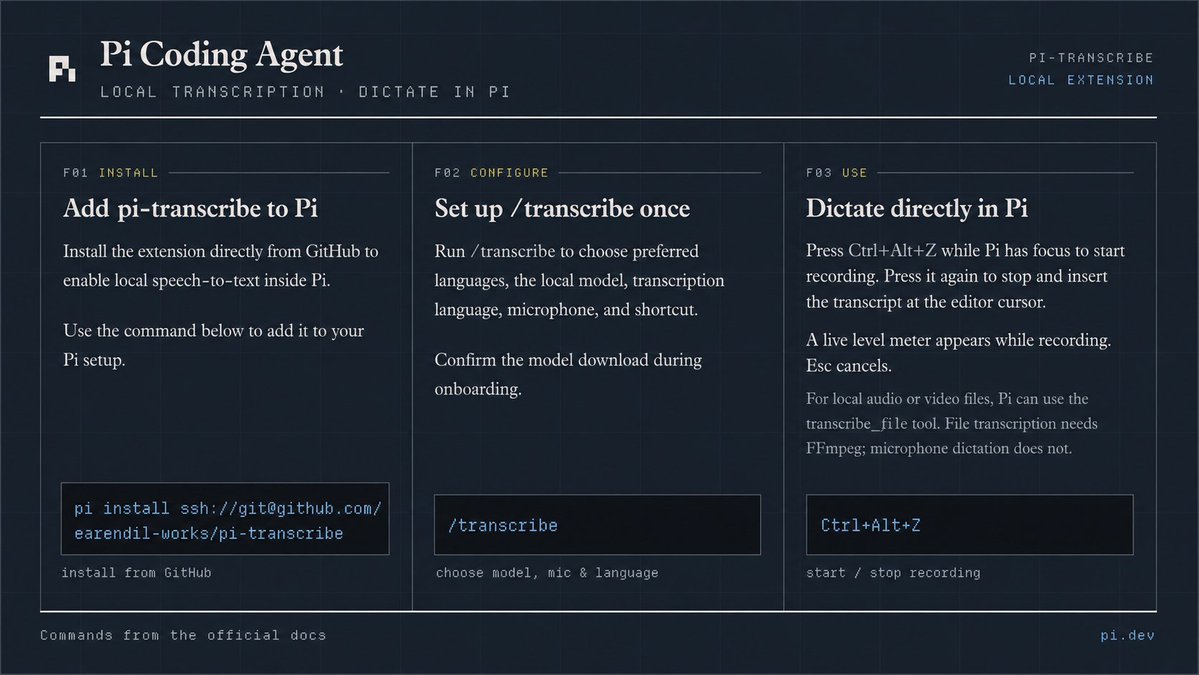
ICYMI, pi-transcribe is our official package for local speech-to-text dictation in Pi🗣️
Once you install it:
- type /transcribe
- select a local model and language
- run CTRL + ALT + Z to start or stop dictation
Are you a typer or a talker?
Don't try to run Qwen 3.8 27B on a DGX Sparks / Mac minis / MacBooks
Qwen 3.8 27B is a Dense model
and those Unified Memory boxes want MoEs
It might fit, but it will be very slow
This model wants those 3090s, 5090s, RTX PRO 6000s, etc
GPUs > Unified Memory for Dense models
This site is a beautiful read. It walks you through an ordinary apartment and lets the past tell you how extraordinary it all still is.
https://t.co/GxLCc5BHlt
I've been using React's <𝚅𝚒𝚎𝚠𝚃𝚛𝚊𝚗𝚜𝚒𝚝𝚒𝚘𝚗> throughout my Next.js SPA series to make the demos smoother and more alive.
Here are the patterns I use most:
1. Suspense reveals
2. Morphing content into place
3. Page transitions
See each pattern, plus the guide and Skill ↓