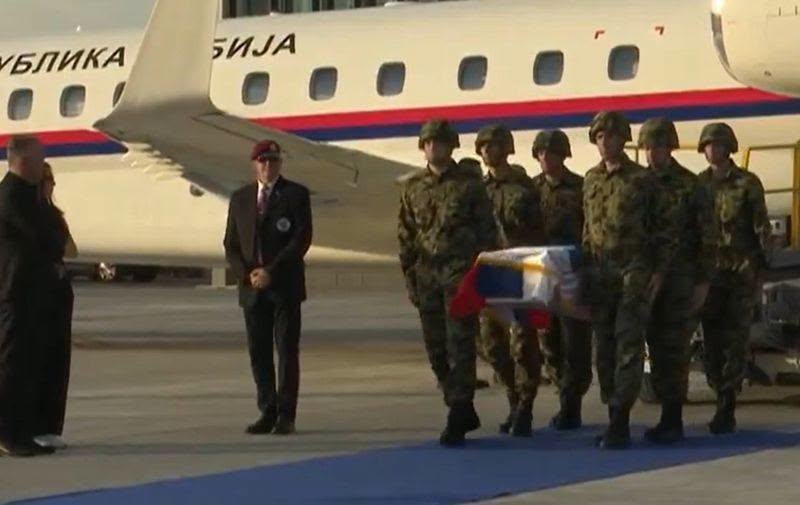
What we are seeing now — and what will effectively be a state funeral for Ratko Mladić next week, whatever it is officially called — is a deliberate political choice by Vučić.
A cold, calculated one.
Vučić is playing the ultranationalist card ahead of elections expected in October. And the Western outrage is part of the calculation, not merely a side effect.
He can’t win over Serbia’s liberal opposition. But he doesn’t need to.
He needs to win back voters from the nationalist-conservative part of the protest movement — a part that is not dominant, but is substantial, and larger than many Western observers appear to recognise.
And this also tells us something about how much influence we in the liberal West — and particularly the EU — have lost in Serbia.
Vučić is willing to pay that price.
Serbia brought the body of convicted war criminal and génocidaire Gen. Mladić to Belgrade.
An odd measure of justice: the criminal returns to the country from which the wars and crimes of ex-Yu were directed.
Never having faced its bloody past, Serbia continues to embrace it
This is an existential moment for the EU’s nearly wholly imploded credibility in the Western Balkans. If real costs are not imposed on Serbia for this grotesque display of genocide glorification, it is a clear signal to every other state in the region that Brussels simply is not serious about confronting renewed Serbian nationalist pretensions against its neighbors.
Excellent thread. Still very much useful for those with an open mind. As someone who lived through the breakup, the “all-sideism” infuriates me no end!
The establishment of Balkan academic specialists in the West played a role in the 1990s wars that was every bit as inglorious as the role of the Western political establishment. This shameful legacy has cast a shadow over former-Yugoslavia studies in the West ever since [thread]
@JamesWathland Agree! He’s very wasteful as a midfielder. The amount of times we suddenly have to defend dangerous counters only seconds after we’ve been in promising situations, all because he’s either too casual, makes the wrong decision, or just passes poorly.
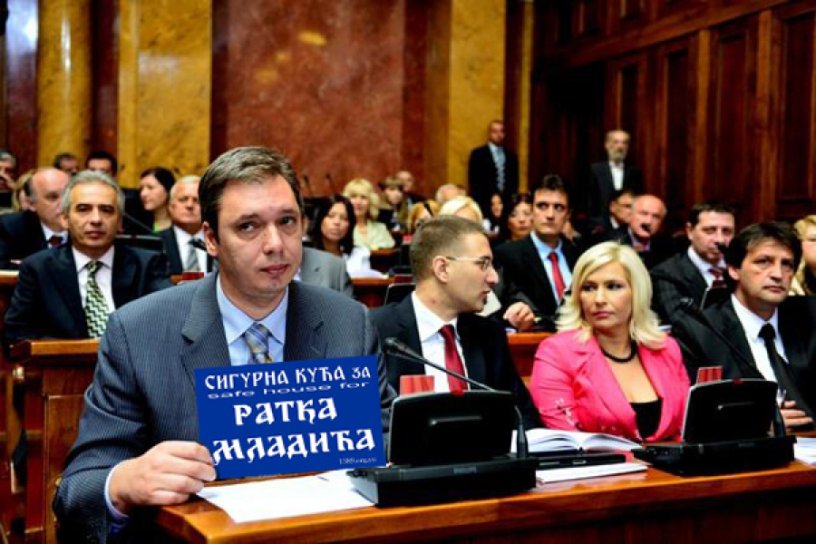
As the genocidaire Mladic's name quietly slips from the global front pages, we must recall that his most steadfast supporter was, and remains, the sitting President of Serbia, Aleksandar Vucic.
On July 20, 1995, as Mladic's forces were still hunting and killing survivors of the Srebrenica Genocide across northeastern Bosnia, Vucic, then an MP in the ultranationalist Radical Party, stood at the podium of the Serbian National Assembly. Incensed, he declared that if the international community dared respond to the bloodbath in Srebrenica, if they struck "Serb positions" in Bosnia, and if even "one Serb is killed" then "we will kill a hundred Muslims!"
And for years after the fact, throughout the 2000s and into the 2010s, he was the chief advocate for Mladic in Serbia. Not because he denied the genocide in Srebrenica, or the broader genocide in Bosnia, but precisely because he glorified it, and because Vucic considered Mladic a Serbian national hero for having conducted the same.
This is not ancient history. These are very recent events. And Aleksandar Vucic remains the dominant figure in Serbian politics today. Mladic is dead but the politics of Serbian ultranationalism remain decidedly, and unfortunately, alive. So, I remind you again of Faulkner: "The past is never dead. It’s not even past."
Coverage of the death of Ratko Mladic, like the previous coverage of him while he was alive, mostly misses a key point: he was not himself a senior architect of the war and genocide in Bosnia that began in 1992. He was initially a relative nobody; a mere colonel at the start of the war in Croatia in 1991. He was handpicked for his role and appointed to it by the actual architects, who were in Belgrade, in particular Branko Kostic, acting President of the Presidency of Yugoslavia; Blagoje Adzic, acting Federal Secretary of People's Defence; Borisav Jovic, Serbia's member of the Presidency of Yugoslavia; and Slobodan Milosevic, President of Serbia. None of these people was convicted of war crimes, and apart from Milosevic, none was indicted. The obsessive focus on the Bosnian Serb leaders Ratko Mladic and Radovan Karadzic has always served to obscure the fact that the war originated with the regime in Belgrade, Serbia.
Serbia’s Justice Minister announces that genocidaire Ratko Mladic will be buried in the country with the highest state honors. It’s good that the Serbian government is doing this, so everyone can finally see the true, monstrous face of the Vucic regime. https://t.co/hRqsJNSalG
@TomRodgers12@MarianaKoceku1 Of course it negates it, but only from the criminal and genocidal point of view. No one expects better. Criminal enterprise, criminal entity.
@TomRodgers12@MarianaKoceku1 He lived a big part of that ‘long and full life’ in excruciating pain aware that his own daughter thought he was a big enough of a piece of shit to make her kill herself! He spent a good part of his ‘full life’ hiding like a cockroach, and his last days in prison, a criminal!
Before Ricky Gervais became a megastar with The Office, he had a short-lived Channel 4 show called Meet Ricky Gervais in 2000.
In this clip from the series, he’s out on the street pretending to gather answers for Family Fortunes. He approaches members of the public with a clipboard and asks them the usual “we surveyed 100 people” style questions, except these are very much not the family-friendly ones you’d hear on the actual game show. 🤣
“The most annoying thing about the French?”
“Something you’d steal from a lonely old woman?”
@BekteshiRamazan I came to congratulate you on the excellent retort to Rama’s tweet, only to discover you deserve an even bigger compliment as the truth you have posted seems to have rattled so many trolls! Chapeau, Sir!
"Kosovo is Serbia",
This is rather flattering for historians: we don't often get asked to adjudicate. It does not, however, follow that any historian would agree, not least because historians do not use this sort of eternal present tense.
History, for the Serbs, started in the early 7th century, when they settled in the Balkans. Their power base was outside Kosovo, which they fully conquered in the early 13th, so the claim that Kosovo was the "cradle" of the Serbs is untrue.
What is true is that they ruled Kosovo for about 250 years, until the final Ottoman takeover in the mid-15th century. Churches and monasteries remain from that period, but there is no more continuity between the medieval Serbian state and today's Serbia than there is between the Byzantine Empire and Greece.
Kosovo remained Ottoman territory until it was conquered by Serbian forces in 1912. Serbs would say "liberated"; but even their own estimates put the Orthodox Serb population at less than 25%. The majority population was Albanian, and did not welcome Serb rule, so "conquered" seems the right word.
But legally, Kosovo was not incorporated into the Serbian kingdom in 1912; it remained occupied territory until some time after 1918. Then, finally, it was incorporated, not into a Serbian state, but into a Yugoslav one. And with one big interruption (the second world war) it remained part of some sort of Yugoslav state until June 2006.
Until the destruction of the old federal Yugoslavia by Milosevic, Kosovo had a dual status. It was called a part of Serbia; but it was also called a unit of the federation. In all practical ways, the latter sense prevailed: Kosovo had its own parliament and government, and was directly represented at the federal level, alongside Serbia. It was, in fact, one of the eight units of the federal system.
Almost all the other units have now become independent states. Historically, the independence of Kosovo just completes that process. Therefore, Kosovo has become an ex-Yugoslav state, as any historian could tell you.
Ukraine spent four years teaching small nations that principles do not depend on power.
On Saturday in Belgrade, one of them learned who the lessons were actually for.
Zelenskyy, asked about Kosovo, answered exactly as Serbia had demanded two days earlier: the unilateral declaration remains unrecognized. Crimea, of course, is Ukraine.
The man who told the world that values are indivisible, that neutrality is a side, and that silence pays the aggressor, divided his own doctrine the moment the useful partner required it.
We were not betrayed. No promise was ever made to Kosovo.
What Saturday clarified is colder.
The sermons were addressed to the nations that could arm him. The silence is for the nations that merely believed him.
A morality that sorts its audience by usefulness was never morality. It was foreign policy all along.
@SergiyKyslytsya@HoxhaFer
https://t.co/frI2vcbzHv