The first trillionaire in human history
- Elon Musk
- Born in South Africa
- Bullied relentlessly as a kid
- Immigrated to North America
- Arrived with a backpack and a dream
- Built Zip2 with his brother
- Sold it 4 years later for $300 million
- Co-founded PayPal with the profits
- Revolutionised digital payments
- Sold PayPal to eBay for $1.5 billion
- Bet everything on Tesla and SpaceX
- Got mocked for electric cars
- Got laughed at for reusable rockets
- Nearly went bankrupt in 2008
- Kept building anyway
- Turned Tesla into the world’s most valuable automaker
- Made EVs mainstream and transformed the automotive industry
- Made reusable rockets a reality
- Reduced the cost of reaching space by 95%
- Sparked the modern commercial space race
- Built Starlink and connected millions around the world to high-speed internet
- Turned SpaceX into the most valuable private company in history
- Bought Twitter for $44 billion
- The world said he overpaid
- He was called reckless, stupid & crazy
- Advertisers fled, media declared it dead
- Critics called it the worst acquisition in tech history
- Renamed it 𝕏
- Rebuilt the platform anyway
- Turned it into one of the most influential platforms on Earth
- Launched xAI and accelerated the global AI race
- Sent astronauts to space
- Is trying to get humans to mars
- Created millions of jobs
- Generated hundreds of billions in value
- Inspired an entire generation of builders
Before:
- Failed repeatedly
- Worked insane hours
- Slept in factories and offices
- Got bullied, laughed at and mocked
- Constantly told “it’s impossible”
- Kept building anyway
- Made it possible
Today:
- Richest person on Earth
- First trillionaire in human history
- Largest IPO in history $1.77 trillion
Most people quit when the world laughs at them.
Elon Musk built the future instead.
Love him or hate him…
Nobody has changed more industries in a single lifetime.
Payments. Cars. Energy. Space. Social Media. Communications. AI.
History won’t remember the people who said it couldn’t be done.
It will remember the people who did it anyway.
Congratulations Elon.
The first trillionaire. 🚀
🚨BREAKING: Another Islamist Massacre of Christians in Ethiopia. At least 50 Christians were slaughtered in a horrific Islamist attack in Ethiopia.
This is yet another targeted massacre of believers, but the mainstream media and global elites remain mostly silent.
Where is the outrage? Christians are under siege worldwide.
since many (~4) asked me about the zcash bug - - - earlier this year I had this convo with a zcash core dev:
zk: it's weird that kaspa is pruning past records
me: why does it need to keep 'em?
zk: the whole point of ledgers is to prove correctness of all state transitions
me: the whole point of ledgers is to provide focal points for the consensus state
zk: the whole point...
me: hmm then why did you come work in zcash? you know the Sprout->Sapling counterfeiting bug
zk: Turnstile guarantees that the counterfeit could have been very limited
me: true but you still cannot prove or even reason about correct state transitions besides the total supply cap
zk: that's actually a good point
----
the most hardcore cryptography coin is shifting away from correctness proofs to practical-enough proofs. I believe this is a step in the right+practical direction, yet the paradigm shift should not go unnoticed - -cryptography is giving way to consensus.
if you came to zcash for cryptographic integrity, reconsider. there are many good reasons to root for zcash prospering. zcash is serving a more important role than bitcoin, whose utility for the original mission is by now blurry. cryptographic integrity is/should not be one of those reasons.
----
BTW the bug should definitely have been exploited. I don't know the personal values of Taylor Hornby, and I shouldn't be required to make the effort to learn them. I only know that if I found such an exploit, it wouldn't take me more than a few minutes to tempt myself into printing a longint amount of ZEC and deciding later what to do with it.
I wouldn't necessarily use it to exit the pool immediately and corrupt the supply, I'd wait to see if some portion of the broken pool does not seem to migrate on time (probably lost funds), in which case I would not think twice before claiming the funds myself.
you could argue that no harm done, and you might be right, but then again you are here -- in zcash / in crypto -- for its consensus dynamics, the ability to coordinate interests and convictions across different trust zones around some shared asset; not for some pristine mathematical integrity.
I was fortunate enough to witness the process behind this upgrade up close.
Half a year ago, the only thing we knew was that Kaspa had to become programmable, ASAP. This notion matured into a surprisingly complete and elegant solution in a very short period of time.
Building a development framework is a massive task, so the first attempts were to harness KIP-16's ZK verification opcodes to tap into existing ZK development frameworks, but we did not find a good enough fit.
One weekend Ori sat down with some leftover tokens, and Silverscript came out the other side.
The project grew quickly, and the compiler now enables a wide range of applications to be written and deployed directly on Kaspa in a high-level language (thanks to KIP-17 and KIP-20).
KIP-21 deserves its own post, but it allows for complex ZK-based applications and is a fundamental component of the full vProgs solution.
Together, all these turn Kaspa into an impressively expressive programmable money layer. From simple vaults, through basic contracts to complex multi-contract applications, alongside privacy apps and scalable batch-proving-based applications.
Toccata is the outcome of pure R&D -- deep research and hardcore development, done fast and in parallel (how fitting).
There’s still much work to be done to make the new capabilities more approachable, but it’s hard to understate the power, elegance, and completeness of what the best money layer in the world will soon allow us to express.
@michaelsuttonil@Max143672@OriNewman@IzioDev - Watching you guys work has been a masterclass. Thank you.
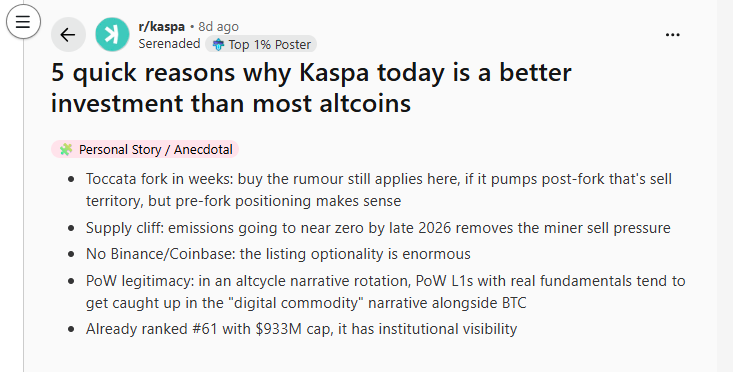
5 quick reasons why #Kaspa today is a better investment than most altcoins
1. Toccata fork in weeks: buy the rumour still applies here, if it pumps post-fork that's sell territory, but pre-fork positioning makes sense
2. Supply cliff: emissions going to near zero by late 2026 removes the miner sell pressure
3. No Binance/Coinbase: the listing optionality is enormous
4. PoW legitimacy: in an altcycle narrative rotation, PoW L1s with real fundamentals tend to get caught up in the "digital commodity" narrative alongside BTC
5. Already ranked #61 with $933M cap, it has institutional visibility
Study $kas
**Official Toccata Release — Mainnet Hardfork Activation Included** (Links in reply)
We’re excited to announce the official Kaspa release containing the **Toccata Hardfork** activation logic.
Toccata is scheduled to activate on mainnet at DAA score `474,165,565`, expected around **June 30, 2026, 16:15 UTC**.
This is a consensus-changing upgrade. All node operators, miners, pools, exchanges, indexers, wallets, and infrastructure providers must upgrade before activation to remain compatible with the network.
Toccata introduces a major expansion of Kaspa L1 capabilities, including:
• **Native L1 covenant support** through transaction introspection, allowing for more expressive contracts, including stateful contracts
• **Covenant IDs**, providing stable covenant lineage across UTXO transitions, so covenant instances can preserve continuity as their state moves from one UTXO to the next
• **ZK proof verification on L1** via `OpZkPrecompile`, enabling to trustlessly offload computation off-chain.
• **Partitioned sequencing commitments**, improving support for based ZK applications by making lane-local proving scale with relevant activity rather than global throughput
Please upgrade as soon as possible and verify your nodes are running the new release well before the activation DAA score.
Thank you to everyone who contributed to designing, implementing, reviewing, and testing Toccata.
Behind this merge and recent annoucement are countless hours of sifting through every code path, tests, retests and head down coding by @michaelsuttonil@Max143672@OriNewman@IzioDev et al. Finally, toccata is merged in master. Releases coming up soon (tm).
Any guesses for the mainnet DAA activation score?
Kaspa Toccata mainnet process update:
Today we plan to publish the v1.3.0 mainnet pre-release, without activation, for 1–2 days of broader network sanity testing.
Assuming everything looks good, the following release will be v2.0.0, with activation planned for June 30, 4 weeks from today
That's a really good question, but it's hard to answer in a single tweet because our mission is quite extensive, and it requires a lot of background knowledge to really understand what sets Kaspa apart.
Currently, a lot of people see Kaspa as “Bitcoin’s crazy little brother” that improves time-to-finality by leveraging the benefits of DAG-based consensus protocols without accepting their traditional drawbacks, such as decreased decentralization or a limited validator set.
This perception is somewhat accurate, but it falls short of conveying the full picture, because Kaspa’s vision extends far beyond just trying to be a better Bitcoin.
Anyone willing to study Kaspa and its broader vision will discover similarities to nearly all major existing DLT designs: from Bitcoin, to Ethereum, to Solana, Sui, Celestia, and beyond.
My personal view is that “research” in the DLT space is approaching a point of convergence. We increasingly understand how to push distributed systems close to the limits of what physics permits. The frontier is no longer only about raw throughput or faster finality. The attention is shifting toward game theory, incentives, sequencing, MEV, alignment, and how to build systems where the economic incentives of users, builders, miners, validators, applications, and infrastructure providers do not work against each other.
That is why debates like based rollups versus arbitrary sequencing, shared sequencing, MEV mitigation, proposer-builder separation, and execution-layer incentives matter so much. These are not niche technical details. They determine whether a network can remain neutral, decentralized, and aligned while scaling to global usage.
And this is where I think Kaspa is pushing the boundaries in a very important way.
Kaspa is not merely trying to be “fast.” The goal is to build an L1 where speed, decentralization, security, and incentives are aligned at the base layer. A system that does not scale by hiding complexity behind trusted committees, privileged sequencers, centralized validator sets, or opaque coordination mechanisms, but instead tries to preserve the spirit of proof-of-work while extending what an L1 can realistically do.
Because Kaspa arrived later than many other major projects, it does not carry the same degree of technological debt. It can absorb lessons from Bitcoin, Ethereum, rollups, modular blockchains, high-throughput monolithic chains, DAG research, MEV research, and the broader history of decentralized systems, and combine those lessons into something more optimal.
To me, that is what Kaspa is building: not just a faster blockchain, but a more incentive-aligned decentralized infrastructure layer.
But this also creates a different challenge.
Kaspa’s biggest problem today is not its technology. It is the lack of centralized coordination around communicating the vision. And because Kaspa is a grass-roots movement, that responsibility does not belong to a marketing department, or a single leadership team. It belongs to the community.
That also means the community has a different role to play.
There will always be holders who are mainly interested in price, and that is completely fine. But there also need to be people who are here because they want to use the technology to build a different future. People who care about the architecture, the incentives, the open questions, the trade-offs, and the long-term trajectory of decentralized infrastructure.
I am one of those people.
I am not interested in DLTs merely as a way to generate wealth. I am interested in them because I believe they can change the trajectory of humanity as a whole.
For that reason, I want to use this opportunity to announce a regular community hangout where we discuss the current state of development, the open questions, and where we can align our vision together.
The first session will be on Tuesday, June 9th, 2026.
We will talk about the vProgs framework, how the codebase works, what sets Kaspa apart, where we improve on existing solutions, and what still needs to be done. The goal is for this to become a regular, possibly bi-weekly, event where we as a community come together to discuss the future and understand the technology.
Eventually, we can invite people from other projects as well, but the main focus at the beginning will be explaining and communicating how things work under the hood.
There is still a lot of work to be done, and I do not want to waste precious time. So the first sessions may feel a little improvised, but we can improve as we go.
The important thing is that we start.
So mark the date: Tuesday, June 9th, 2026.
Yes of course my Pal !
This is a 10ft ethernet cable which connected RustForce1 to the world :)
RustForce1 is a high end gaming machine spec tower I built as a DEV machine so @michaelsuttonil could compile and test all versions up to and including the RUST main net release.
A WAN IP, loaded RAM and flagship @intel CPU offered faster more efficient software development environment than laptops.
After release of RUSTY $KAS , I rearranged all of the machines in my office and it struck me that 'all of the 1's and 0's IN RUST passed through this cable BEFORE it took over the World" - therefore Sir Sutton might want to hang onto it as a Lifetime Story Souvenir!!
why I’m personally excited about Kaspa’s upcoming Toccata covenants
- for the first time, I can build creative, complex apps directly over infrastructure I helped design and build
- we designed under architectural constraints, but the result came out surprisingly expressive and powerful
- Silverscript is cool as hell
- I can literally open a *.sil file and write a complex contract that will be fully verified on Kaspa L1
- (nottoself: create a 10-minute video showing the building of such an app e2e)
- I can design my own vaults and safeguards, and manage funds securely without risking a heart attack each time I touch a wallet
- covenant ids, contract templates, and inter-covenant communication (ICC) feel like a new set of axioms, or a new algebra to work with and discover
- sig verify from stack / sighash anyone-can-pay + covenant ids can allow interesting shared-state covenants (requires a non-consensus miner policy; kudos to @maxibitcat for pushing this line of thinking)
- complex contract systems can be deployed in one spk hash. no storage rent, no deployment tax; users pay only the transient mass for tx data as they use it
- as I’ve mentioned in the past, this becomes especially interesting for AI/agentic environments, where bots could cheaply create one-time agreements between themselves
- I didn’t even mention based apps yet. That’s a whole vertical that isn’t ready for exploration yet, but will be very soon
https://t.co/n1qOT2qd7m has been refreshed.
Kaspa has a lot going on, but the main site does not need to put it all at the front door. Its first job is simple: help someone arrive, understand what Kaspa is, and know where to go next.
The previous site accumulated more over time. Pages, explanations, resources, and audiences were added. This version starts smaller, so it can grow with Kaspa from here.
The refresh is not just visual. The wording, structure, and narrative direction all needed attention IMO.
The content traces back to @hashdag’s writing, simplified for a first read. Kaspa is already deep enough. The first read should not make people work harder than necessary.
There are many true ways to talk about Kaspa, but https://t.co/n1qOT2qd7m cannot carry twenty narratives at once. For this version, the strongest one to unify around is real-time decentralisation.
Part of the refresh was also about making the builder path easier to follow. https://t.co/n1qOT2qd7m gives people the overview of what exists, why it matters, and where to go next. https://t.co/FrgQZdNMey gives builders the deeper material, with room for examples, detail, and ongoing improvement.
https://t.co/FrgQZdNMey starts with @IzioDev's work and has the broader goal of bringing important Kaspa L1 builder documentation into one place.
Both repos are public. Pages will be added, wording will change, gaps will be filled, and the work can happen in the open.
Big shoutout to @kasmediadotcom for their support in helping bring this refresh together.
Have a look around. If you see something that can be better, please open an issue or PR.
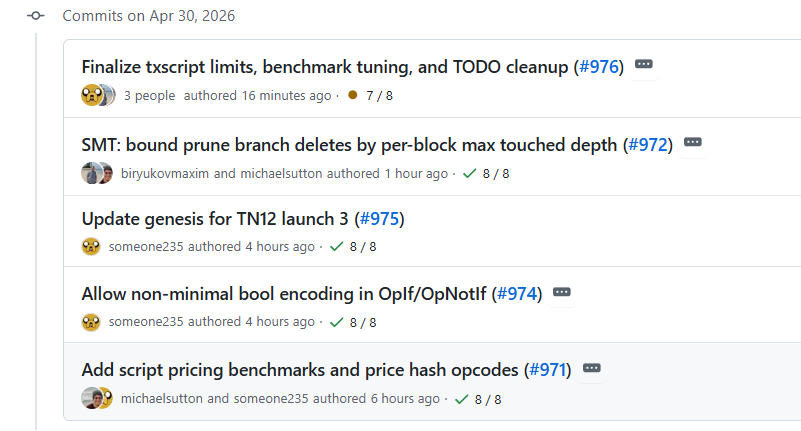
Toccata consensus feature freeze is finally here after a heroic last-mile push by kas core devs.
Aiming to reset TN12 tonight, or tomorrow at the latest.
Genesis update:
+ 0x6b617370612d746573746e6574 // kaspa-testnet
- 12, 2 // TN12, Launch 2
+ 0x544f4343415441 // TOCCATA
+ 12, 3 // TN12, Launch 3
I wrote a PoC token contract in Silverscript, currently called DOG20 (better name ideas are welcome).
It supports token ownership by 3 kinds of entities:
1. Public keys — like any regular Kaspa address.
2. P2SH addresses — which means ownership by a stateless contract, e.g. multisig.
3. Covenant IDs — which means ownership by a stateful contract.
The third option is the interesting one, and it's a demonstration of a broader concept (that might be familiar to whoever watched the webinar by @IzioDev and @michaelsuttonil), called inter-covenant-communication (ICC).
In this context, it means you can put arbitrary stateful rules around token control. For example:
- “after the first 10 spends, wait a year before spending again”
- zk-rollups can manage their L1 tokens using a stateful bridge.
DOG20 also supports minters that are allowed to mint indefinitely — but that does not mean the supply must be unbounded.
Let's say you want to publish a token and allow to issue only 100 new tokens each month. DOG20 doesn't support it natively, but you can achieve that by making the only minting entity a covenant. That covenant will store in its state `nextIssuance`, and will allow spends of 100 tokens only if `time > nextIssuance`, and will set `nextIssuance = nextIssuance + 30 days` each time it's used.
I hope to explain about it a bit more in the future, but in the meantime, feel free to look at the examples linked in the next comment.