This is what’s suppressing oil prices. SPR releases.
What happens when these stockpiles get zeroed?
I don’t understand why no one talks about this.
It’s basically weeks away.
Whistling by the graveyard 🪦
US crude exports averaged 5.6 million b/d in May or +2.1 million b/d y-o-y.
By the end of July, SPR release will be gone and US will be at operational minimum for commercial crude storage.
In order to balance US commercial crude inventories, crude exports have to fall to 3.3 million b/d or -2.3 million b/d from the May level.
Global crude exports will be down ~10 million b/d.
China would have to decrease seaborne crude imports to 1 million b/d (from 6.5 million b/d today, or another -5.5 million b/d) to balance the crude market. Unrealistic as this would drain onshore crude inventories at 270 million bbls a month.
Clearly, you can see how unsustainable this situation is.
Pope Leo XIV on war in Iran:
"I think this has already been made very clear: the notion of a just war no longer applies. The problem is that just war theory developed in centuries when no one could have imagined the weapons we have today or humanity's capacity for destruction."
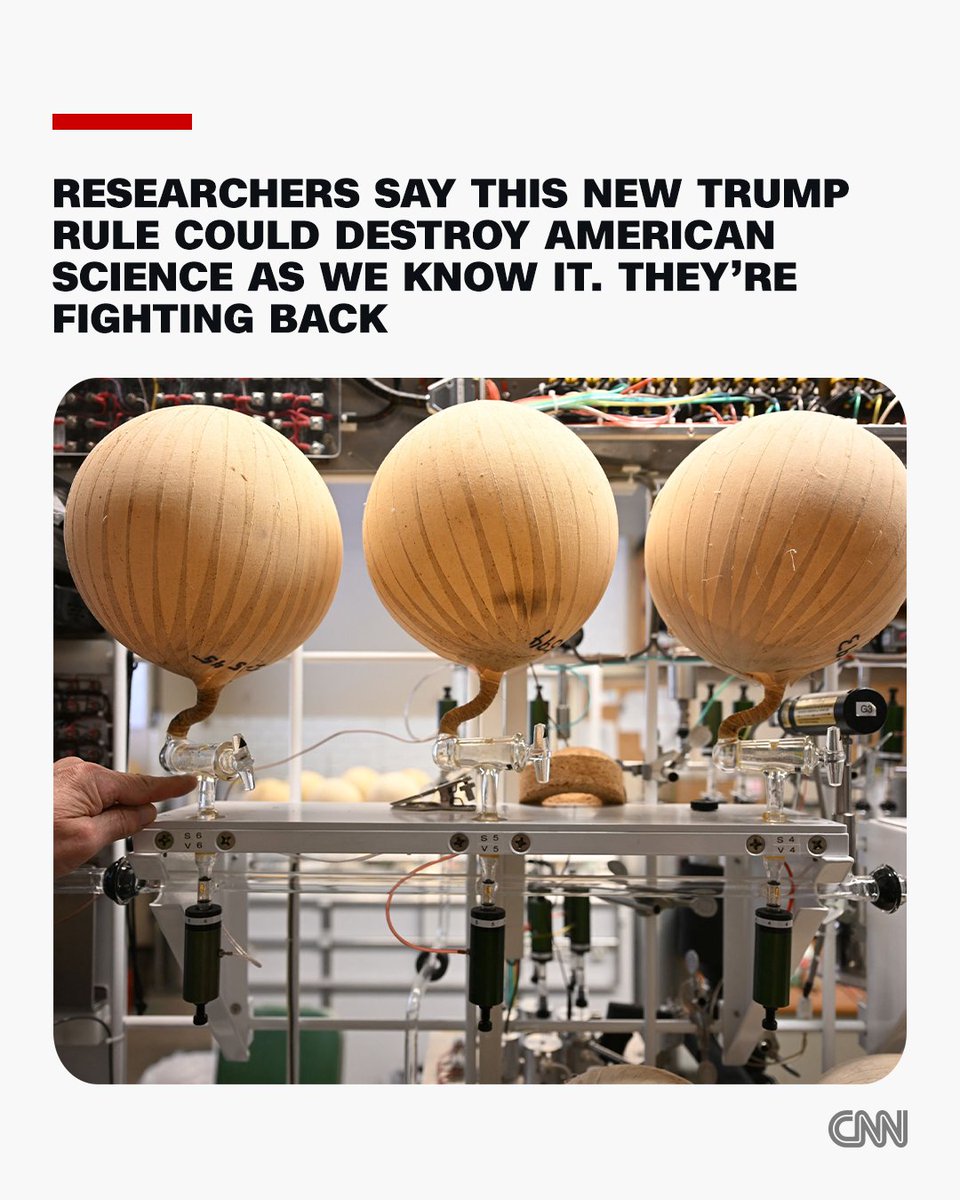
Scientists across multiple disciplines are sounding the alarm after the White House proposed taking greater control over how scientific research gets funded and allowing political appointees to decide whether to approve scientific grants. https://t.co/WooyjH1H9S
Alguien robó la famosa bandera gigante del Mirador de Guajataca, en Quebradillas y dañó el asta. ¿ A quién en la vida podría molestarle una bandera puertorriqueña gigante? Ah bueno…
https://t.co/5qMX2IHeaE
Aquí la versión digital de mi columna de hoy donde expongo los factores que permiten que los hijos estén mejor económicamente que sus padres, y el rol de la UPR
https://t.co/L3U7RAY4iR
Big Oil sees shortages coming
Exxon: We're nearing inventory levels that are truly unprecedentedly low.
ConocoPhillips: critical shortages of oil on the horizon.
Chevron: shortages in oil supply will begin appearing.
Saudi Aramco: fuel stocks are heading for critically low levels.
Meanwhile, markets are hitting all-time highs...
Apparently shortages don't matter until they do.
Just to say this: if you think that ‘progress’ in advanced capitalist economies takes the shape of more hours worked over time resulting in an increasingly k-shaped income pattern with wildly inferior social outcomes, greater deindustrialisation and accelerating political disintegration and that all of this indicates an increase in living standards, then you’re either beyond the pale or you’re expressing a revealed preference for that kind of society. In which case: thank you for being candid. But also: this has nothing substantively to do with what we were discussing.
And it bears repeating: fewer hours worked in Europe are both the outcome of and an input into sustained productivity growth. There are also few statutory regulation in the US to put a lid on working hours. Personally I don’t think we should hate ourself to much to think this is desirable.
Hormuz tanker traffic has collapsed.
• Pre-war average: 138 transits/day
• April: 4/day
• May: 2/day
• Week ending June 1: just 1.3/day
Markets keep pricing a return to normal.
Actual shipping data says normal is disappearing in the rearview mirror.
#OilMarkets#Hormuz #EnergyCrisis #Shipping #OilPrices #Geopolitics
Chinese seaborne crude imports now down ~50% from pre-war levels, according to latest Kpler tracking.
Beijing doing more to balance the Hormuz-starved oil market than the rest of the world combined and no one knows exactly how long they can—or are willing to—keep it up.
US commercial petroleum inventory declines slowed last week, falling only 2.6 MMbbl as some much-needed builds in gasoline and diesel offset accelerating declines in crude stocks, which fell 8 MMbbl commercially and 16 MMbbl total (including a 8 MMbbl decline in SPR stocks)
What is at issue is what series works for long-run cross-country comparisons. This what the entire debate is about.
The constant series is ideal for looking at trends within single countries while the others are not; the chained series was specially made to avoid the problems that come in a cross-country context.
And importantly: it uses national accounts data too. RGDPo uses the same national accounts deflators to construct within-country volume estimates and within-country price trends between ICP benchmarks, but the cross-country comparison at every year is anchored to ICP price data from surrounding benchmarks. This is done in response to long running observation that national inflation rates were irreconcilable with observed prices at benchmarks.
The only thing that makes the constant series stand out is that it has only one anchor: this is actually welcome for single country growth and productivity series but becomes conceptual nonsense for comparisons. And for static analyses, including comparative ones, the current one is obviously the one that makes most sense.
So you cannot infer from one context which series is ideal for the others. This is what you just did and it sidesteps the entire substance of a long debate that goes back to the early 1990s. These are different series for answering different questions in different contexts.
Cómo quebrar un negocio: el libreto gubernamental.
- Cierra la plaza donde opera durante casi un año para hacer mejoras.
- Cuando reabra, impídele recrear el ambiente que lo hizo exitoso por más de 30 años.
Después nos preguntamos por qué desaparecen los negocios dep VSJ.
En octubre/2025 propuse que el gobierno baje el IVU temporeramente y compense esa reducción en recaudos con los aranceles. La @FOMBPR se pasa de lista al utilizar esos nuevos recaudos para pagar bonificaciones a acreedores (ej, CVI) en vez de permitir una reducción en impuestos