3) This is a collaborative project with the @meshorer1 lab, and the @RauscherLab lab.
Talking about @RauscherLab, they have recently presented an elaborate MD-based model of the effects of PEG on the FP mCherry, a work we took part in (see https://t.co/pUFSi5xryT).
It is almost happening - #BPS2025 - and we are happy to attend and present our research.
A thread.
1) I will give a talk Saturday morning @ Biological Fluorescence subgroup, presenting the work spearheaded by the PhD student Khalil Joron, about
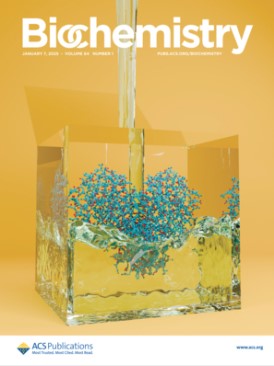
We are excited to share our recent simulation study by PhD student Ethan Lee describing the conformational states of the active site loops of the main protease (MPro) of SARS-CoV-2, featured on the cover of Biochemistry --
New issue! 📣
Read up on biased signaling, RNA editing, gut microbes, antibiotics and more!
https://t.co/i9Qi7EhtJQ
Cover art: Lee & Rauscher @UofT explore flexible loops in the main protease of SARS-CoV-2, with implications for drug discovery.
https://t.co/DLJy7Fw0Wb
In this work, we use all-atom MD simulations to investigate the molecular basis for the difference between human and rhesus TRIM5α in their ability to restrict HIV. See our manuscript by Liam Haas-Neill, Deniz Meneksedag-Erol & Ibraheem Andeejani --
Our simulations study describing the conformational states of the active site loops of the main protease (MPro) of SARS-CoV-2 is now published in Biochemistry --
https://t.co/03cGhbhzOx
We have an open position for studying two-pore domain potassium channels using MD simulations and single-particle Cryo-EM. Please help us spread the word: https://t.co/u0mN2zAmF3
The Department of Physics at the University of Toronto is recruiting candidates in Theoretical Biological Physics for a tenure track Assistant, Associate or Full Professor.
UofT has a vibrant biophysics community -- please join us!
https://t.co/yHhdKosaR9
If you want to see what a comprehensive computational analysis of SH2 domain structure and dynamics in an oncoprotein looks like, with a little HDX thrown in on the side, then this here @RauscherLab paper is for you!
Please join us in congratulating the first PhD graduate from the Rauscher lab, Dr. Eugene Klyshko @klyshko_to! We took a moment this week to celebrate his successful PhD defense.
Sharing our preprint - an investigation into the effects of an oncogenic driver mutation on the structure and dynamics of an SH2 domain. We tested our simulation predictions using HDX-MS experiments in collaboration with Derek Wilson at York University. @dkwilson2
The Conformational Space of the SARS-CoV-2 Main Protease Active Site Loops is Determined by Ligand Binding and Interprotomer Allostery https://t.co/7sd7XEbiZO #biorxiv_biophys
📜 Just published online... 🎉- Single-particle #CryoEM and MD #simulations: A perfect match - by Lars @Pogoscience, Maxim @maxotubule and Helmut. https://t.co/XyvtZTJe4V Happy reading!
A recent manuscript, “PEG-mCherry interactions beyond classical macromolecular crowding,” by Liam Haas-Neill from our lab and Khalil Joron from the lab of
@eitan_lerner
is out, preprint on bioRxiv:
https://t.co/hclyzC01KZ
At high concentrations of PEG, we find that mCherry molecules associate to form large aggregates. By carrying out experiments with a bulkier crowder, dextran, we show that the effects of crowder-protein interactions depend on the crowder's chemical features and its bulkiness.
We find that PEG-wrapping around the side chains of lysine residues is prevalent, occurring in at least 20% of all crystal structures containing PEG, which corresponds to approximately 0.4% of all structures in the PDB.