Private Swap in action on @FlutonIO
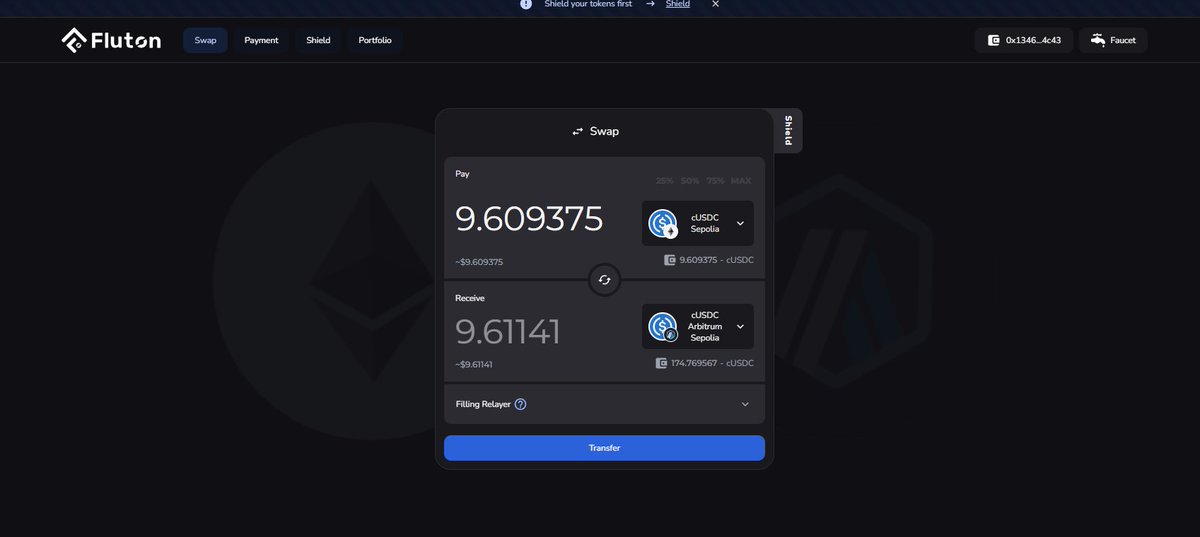
Just tested a seamless cUSDC swap across Sepolia- Arbitrum Sepolia, and the experience feels incredibly smooth.
No friction. No extra steps.
Privacy handled by default.
Even during deeper testnet flows
This is how Private DeFi should feel.
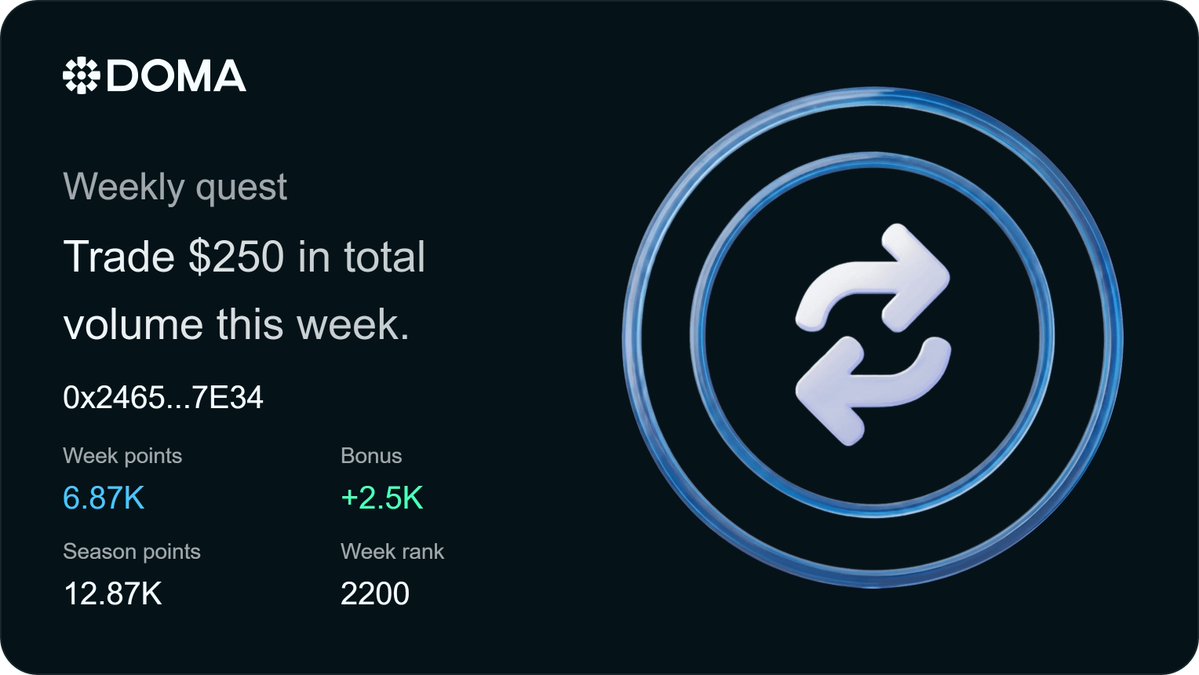
Just completed the “Trade $25 of $APPLICATIONS.COM today” quest on @domaprotocol
And the timing is perfect $APPLICATIONS.COM launched today.
I’m also holding some $APPLICATIONS.COM so I’m excited to see how this one develops.
https://t.co/Vuc1BKp8oZ represents the growing application economy from software and mobile apps to the AI agents of tomorrow.
With Doma, domains are becoming more than just web addresses. They can become onchain, tradable assets within the DomainFi economy.
Quest completed
Token launched
And I’m holding 👀
Let’s see where $APPLICATIONS.COM goes from here.
@D3inc@SDMikeCM
https://t.co/p35ImIztND is live 🖥️
The category-defining domain for the entire software economy, from the first desktop application to the latest AI agent, is tradeable for the first time.
One domain. Every application. Trade now ↓
https://t.co/qo1MjcpY6J
1/9
I think BigD has a problem.
It’s way too easy to underestimate.
At first glance, you see a ridiculous character in a cap and red sneakers.
Then you look closer and realize there’s a whole universe being built around him.
So I went down the BigD rabbit hole. :thread::point_down:
2/9
First, the character.
BigD isn't trying to be the smartest guy in the room.
He's the guy who walks into the room, makes everything chaotic, somehow becomes the main character, and leaves.
The website describes him as:
a meme.
a character.
a movement.
And honestly, that explains the whole vibe.
3/9
What I like most is that the personality doesn't stay inside one NFT.
You can make BigD:
:sunglasses: confident
:sob: heartbroken
:sleeping: half asleep
:thinking: confused
:heart: in love
:computer: pretending to work
Same character.
Different situations.
That's where a recognizable character starts becoming something bigger than a collection.
The community can keep adding to the story.
4/9
And the foundation is pretty straightforward:
6,969 Genesis BigD.
The collection isn't presented as the final destination.
It's supposed to be the beginning of the BigD universe — with the story being told through the art and the community around it.
That's an important distinction.
5/9
Then comes $BIGD.
The roadmap moves from:
Community → Genesis → $BIGD economy → Ecosystem → ???
Phase 03 introduces the $BIGD economy, liquidity preparation and trading activation, while connecting the NFTs, memes and wider BigD universe.
So the meme isn't meant to exist in isolation.
6/9
And Phase 04 is where things get more interesting.
The plan is to expand the $BIGD ecosystem through:
→ New integrations
→ Community-driven experiments
→ More ways for the universe to evolve
Which makes sense for a project whose biggest asset isn't just the NFT...
it's the character.
7/9
But here's my take:
The real test for BigD isn't whether it can make people laugh for a few weeks.
Memes come and go.
The interesting question is:
Can BigD become a character people actually want to keep building around?
Because once a community starts creating its own lore, jokes, art and inside references...
the project starts developing a culture of its own.
8/9
And that's probably my favourite part of BigD.
You don't have to wait for the team to tell you what BigD is.
You can make your own version of him.
I started with these:
sleepy BigD.
romantic BigD.
heartbroken BigD.
work-mode BigD.
chaos BigD.
And somehow...
they're all still BigD.
9/9
The website says:
“The internet doesn't need another project.
It needs a legend.”
Big claim?
Absolutely.
But that's also what makes this interesting.
Now let's see how far the community can take the character.
BigD isn't finished.
We're just getting started.
$BIGD @BigD_team
https://t.co/Vuc1BKp8oZ is almost here.
Just 2 days to go until a domain built for the entire application economy goes live on Doma.
From desktop software and mobile apps to the AI agents shaping what comes next, applications are becoming a bigger part of how we use the internet.
Now, they have a domain that brings the whole category together.
📅 August 12
⏰ 10 AM UTC
Get set up now so you're ready at launch:
1️⃣ create your wallet → https://t.co/tVkJUtLbX5
2️⃣ bridge your funds → https://t.co/dpO7Xs0qP1
3️⃣ add to your calendar → https://t.co/9XQWdrb062
@domaprotocol@D3inc@SDMikeCM
Less than 48 hours until https://t.co/q7BkOF5gDQ goes live 📲
The home for every application on the internet launches on Doma August 12, 10am UTC.
Are you ready to deploy?
https://t.co/0nrIAcM8di
Gdoma Everyone!!
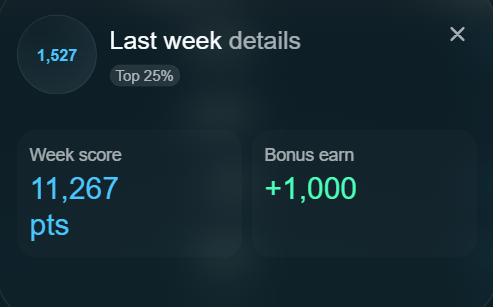
This is my first week on @domaprotocol and i got 1527 rank on doma. I completed the "Trade $250+ in total volume this week." quest on domaprotocol Join the DomainFi economy and start earning.
Most people see domains as simple website addresses.
But technically, domains are one of the largest digital asset systems on the internet.
The problem?
They were never designed to be programmable, composable or liquid across blockchains.
That’s where @domaprotocol comes in.
Here’s how I understand Doma 🤔
1))
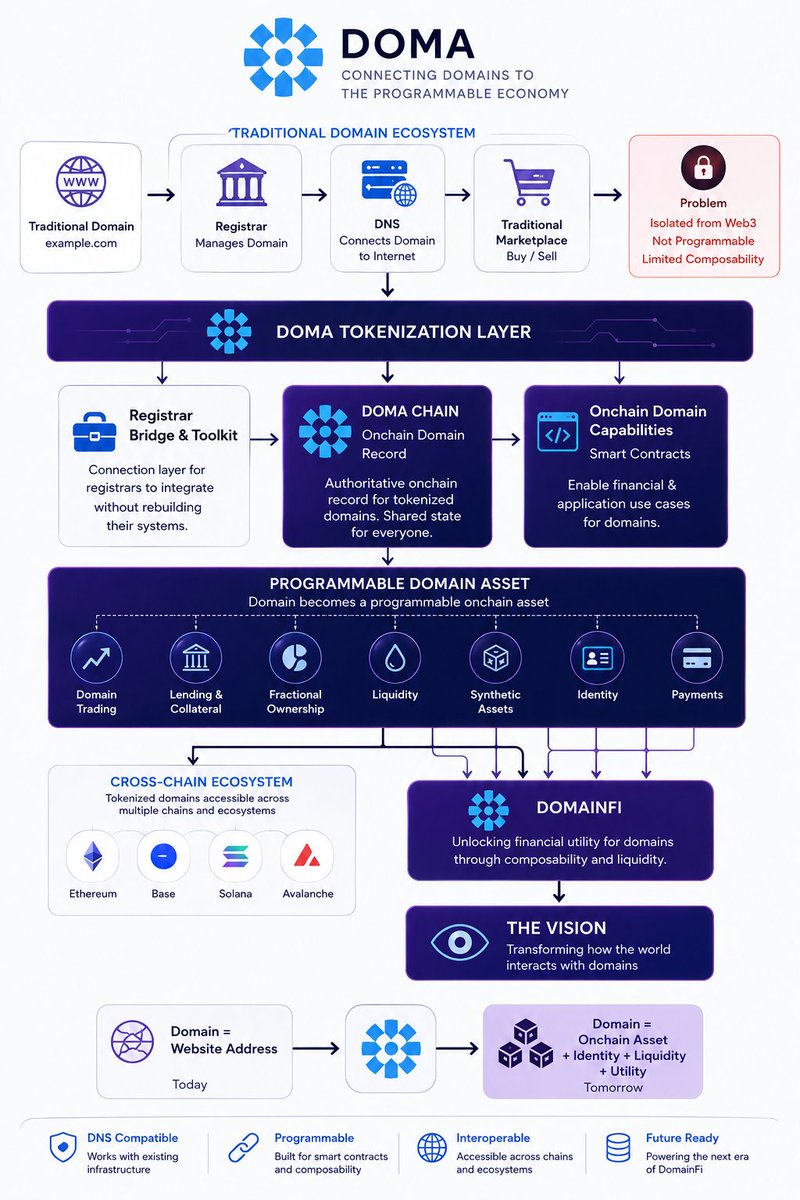
Doma is building infrastructure to bring traditional domains onchain.
Not by replacing DNS.
Not by creating another isolated naming system.
But by connecting the existing domain ecosystem with blockchain infrastructure.
That distinction is important.
2/
Think about a traditional domain.
You register https://t.co/CcHV6I1fQe.
A registrar manages it.
DNS tells the internet where it points.
A marketplace can help you sell it.
But these systems are mostly separate from Web3.
Doma adds an onchain ownership and programmability layer.
3/
The core idea is tokenization.
A traditional domain can be represented as an onchain asset.
That creates something very different from a normal domain record.
The asset can now interact with smart contracts.
And once something is programmable, developers can build financial and application-level functionality around it.
4/
This is where Doma's architecture becomes interesting.
The protocol connects:
Traditional domain infrastructure
↓
Doma
↓
Onchain applications
Registrars don't need to completely rebuild their existing systems.
Doma provides infrastructure for bringing their domain inventory into the onchain economy.
5/
One important component is the Registrar Bridge & Toolkit.
Think of it as the connection layer between existing registrar infrastructure and Doma.
It allows registrars to integrate with the protocol while continuing to operate the parts of the domain system they already manage.
That makes adoption much more practical.
6/
Then you have the Doma Chain.
This provides an authoritative onchain record for tokenized domains.
Instead of ownership and domain activity being locked inside separate platforms, blockchain infrastructure can provide a shared state that applications can interact with.
This is what makes composability possible.
7/
And composability is the real unlock.
Once a domain exists as an onchain asset, developers can build around it.
For example:
→ Domain trading
→ Lending
→ Collateralization
→ Fractional ownership
→ Liquidity
→ Synthetic assets
→ Identity applications
→ Payment applications
The domain becomes programmable infrastructure.
8/
This leads to Doma's bigger concept:
DomainFi.
The idea is simple:
Why should a valuable domain just sit inside a registrar account?
If domains are assets with real economic value, they should be able to participate in financial markets too.
Doma is building the rails for that.
9/
Another important part is interoperability.
Doma isn't trying to make domains useful on only one blockchain.
The goal is to make tokenized domains accessible across different ecosystems.
That means developers can build applications without forcing every domain user into the same chain.
More distribution.
More liquidity.
More composability.
10/
There is also an interesting economic angle.
The existing domain market already has enormous scale.
Millions of domains are registered and traded every year.
But most of that value exists outside programmable financial infrastructure.
Doma is essentially asking:
What happens when this existing asset class becomes onchain?
That's the bigger opportunity.
11/
And this is why I don't see Doma as simply another Web3 domain project.
The interesting part isn't creating a new .something domain.
The interesting part is taking the domains people already use on the internet and connecting them to blockchain infrastructure.
Existing DNS compatibility + tokenization + smart contracts + cross-chain distribution.
That's a much harder problem.
12/
The simplest mental model for Doma:
Traditional domain
→ registered through existing infrastructure
→ works with DNS
→ has ownership/value
Doma
→ brings that domain onchain
→ makes ownership programmable
→ enables composability
→ opens the door to DomainFi
13/
If Doma succeeds, the domain could evolve from:
“an address for your website”
into:
“an onchain asset that happens to power your website.”
That's the part I find most interesting.
The domain industry already exists.
Doma is trying to connect it to the programmable economy.
@D3inc
Most people see domains as websites.
After reading Doma's conversation with Inder Singh, I started seeing them as one of the biggest untapped asset classes on the internet.
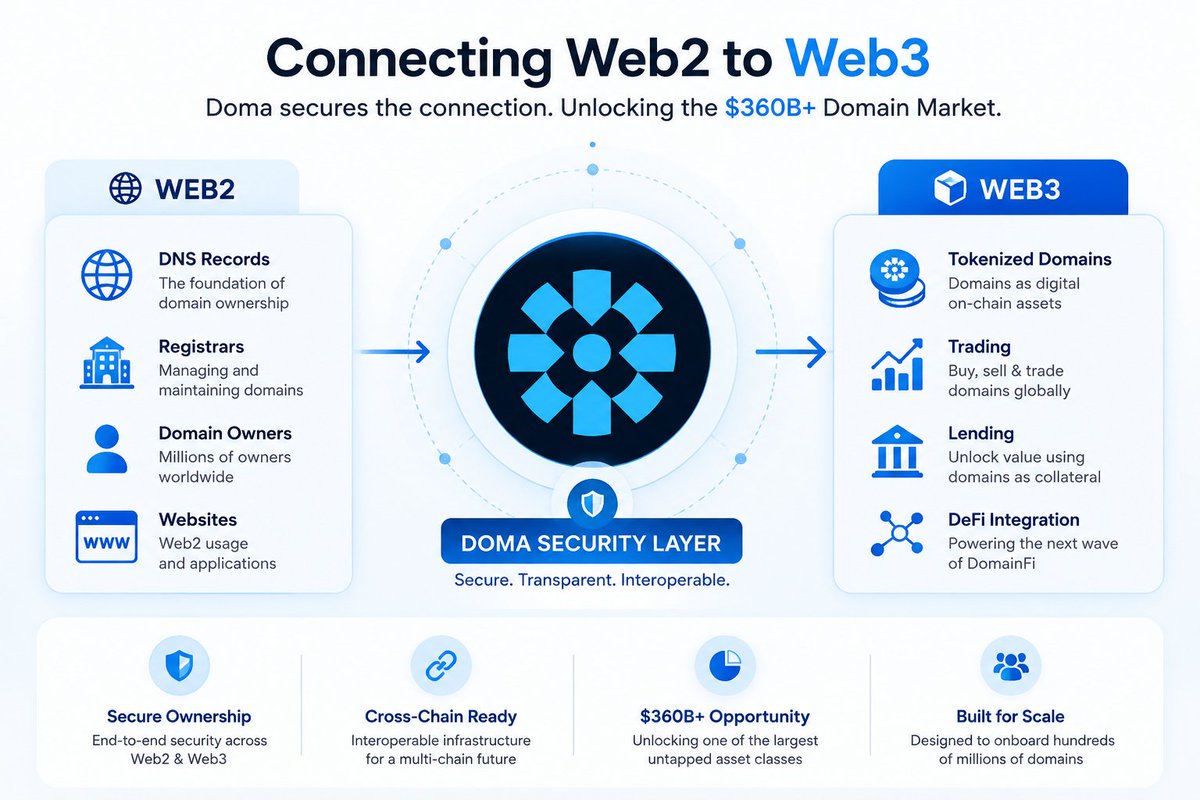
There are hundreds of millions of domains, worth an estimated $360B+ but most of them just sit there.
The interesting part isn't only bringing them onchain. It's making sure they stay secure while connecting Web2 ownership with Web3.
That's a much harder problem than it sounds.
A single weakness in DNS, registrars, smart contracts, or cross-chain infrastructure could break trust completely.
That's why I like @domaprotocol approach.
Instead of rushing to tokenize everything, they're building the security layer first. Every part of the system is designed to protect ownership before unlocking new use cases like trading, lending, and using domains as real onchain assets.
For DomainFi to become mainstream, security can't be an afterthought.
It has to be the foundation.
And after reading this, I think that's exactly what Doma is trying to build.
@D3inc@SDMikeCM@nikkoweb3