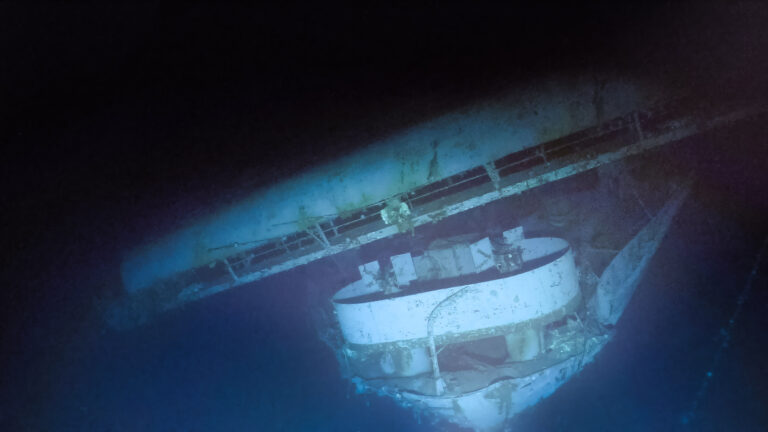
Yorktown should not have been at Midway at all. A month earlier at Coral Sea, a Japanese bomb had torn through her decks, and the estimate to fix her ran to 90 days. Japan crossed her off as sunk. Admiral Nimitz gave Pearl Harbor's shipyard 72 hours. Some 1,400 workers swarmed her around the clock, welders still aboard as she steamed out to the ambush. Her presence at Midway was itself a kind of resurrection. She would need two more.
On the morning of June 4, her air group earned its keep: her dive bombers destroyed Soryu, and her torpedo squadron's sacrifice helped pull the Japanese fighters out of position for the killing blow. But by midday, one Japanese carrier was left alive. Hiryu, under the ferocious Admiral Yamaguchi, found Yorktown first.
The first strike came around noon: dive bombers, eighteen launched, most shot down on the way in, but three bombs got through. One burst near the island, one went down the smokestack and knocked out five of her nine boilers, one punched through the flight deck. Dead in the water and burning, she should have been finished.
She wasn't. Her damage control crews patched the deck with timbers and steel plate, relit the boilers, and within two hours she was making 19 knots and refueling fighters. The repair was so complete that when Hiryu's second strike arrived, the Japanese pilots reported attacking a different, undamaged carrier. Japan would end the battle believing it had knocked out two American carriers. It had hit the same unkillable ship twice.
That second strike was led by Lt. Joichi Tomonaga, whose plane's left fuel tank had been shot through that morning over Midway and could not be refilled. He led the mission anyway, knowing it was one way. His torpedo bombers bored in through everything Yorktown's escorts could throw at them, and two torpedoes slammed into her port side, jamming the rudder and cutting all power. Tomonaga did not return. Yorktown rolled into a 26-degree list, and with capsizing looking imminent, Captain Elliott Buckmaster gave the order no captain wants to give. The crew went over the side in good order. American doctrine, unlike the Japanese tradition that kept captains on burning bridges, expected Buckmaster to live; he left the ship last, sliding down a line into the sea.
And still she floated. All night, all the next day, the list never worsened. So on June 6 Buckmaster came back with a hand-picked salvage crew, the destroyer Hammann lashed alongside providing power, and they began to win: fires out, the list reducing, a tow rigged. Yorktown was coming home a third time.
Then, that afternoon, the Japanese submarine I-168, having slipped through the destroyer screen after a patient day-long approach, fired four torpedoes from inside the escort ring. One broke Hammann in half; she sank in four minutes, and as she went down her own depth charges detonated, killing men in the water. About 80 of her crew died. Two more torpedoes hit Yorktown.
Even then she refused to go quickly. She lingered through the night, and at dawn on June 7 the men on the surrounding destroyers stood at attention, ships' flags at half mast, as she rolled onto her port side and sank into three miles of water. The battle had ended days of fighting with a strange symmetry: four Japanese carriers and one American, all on the same patch of ocean floor.
In May 1998, Robert Ballard, the man who found the Titanic, found her: upright, intact, her guns still trained skyward, her hull number still visible, three miles down and almost untouched by time.
Nine years ago on Memorial Day:
President Trump met Christian Jacobs at Arlington National Cemetery, where Christian honored his father, Christopher, who gave his life in service.
“Then Jesus said to His disciples, ‘If anyone desires to come after Me, let him deny himself, and take up his cross, and follow Me. For whoever desires to save his life will lose it, but whoever loses his life for My sake will find it. For what profit is it to a man if he gains the whole world, and loses his own soul? Or what will a man give in exchange for his soul?’” (Matthew 16:24-26)
U.S. Marine Corps MV-22B “Osprey” Military Tilitrotor Aircraft, assigned to the “Thunder Chickens” of Marine Medium Tiltrotor Squadron 263 (VMM-263), currently deployed with the Iwo Jima Amphibious Ready Group, seen landing in a parking lot inside the U.S. Embassy Compound in Caracas, Venezuela. The Ospreys, carrying Marines and other military personnel, are part of a military response exercise taking place today in the Venezuelan capital between the U.S. Department of Defense and State Department.