A recent study on the ultraluminous X-ray pulsar (ULXP) RX J0209.6-7427 estimated its surface magnetic field strength to be between 2.4 and 4 × 10^13 Gauss.
➡️: https://t.co/HVcaqAjxy4
Jocelyn Bell Burnell discovered pulsars (manifesting as periodic “scruff” on the chart records) nearly six decades ago (28th Nov 1967) as a graduate student in radio astronomy at Cambridge.
https://t.co/MypuFbfCl4
Formation of twin compact stars in low-mass X-ray binaries: Implications on eccentric and isolated millisecond pulsar populations. https://t.co/Sqx1wZawBy
#OTD in 1967, Jocelyn Bell Burnell discovered pulsars, the rapidly spinning cores of dead stars that emit pulses of light with ultraprecise timing. Decades later, we’re still learning about what matter is like under such extreme conditions: https://t.co/DvG9lWTzGP
Oxford Professor Dame Jocelyn Bell-Burnell discovered the first pulsar in 1967 - a discovery so important in our understanding of the universe that it would earn a Nobel Prize.
Watch her story here: https://t.co/zhU0nGi444
[2301.10678] Amar Deo Chandra, Jayashree Roy, P. C. Agrawal: AstroSat observations of the Be/X-ray binary XTE J1946+274 during 2018 and 2021 outbursts https://t.co/pmbwNaN4V4 https://t.co/6LaTdWW586 #astro_ph_HE
Jocelyn Bell Burnell discovered pulsars (manifesting as periodic “scruff” on the chart records) in 1967 as a graduate student in radio astronomy at Cambridge. Discovery of pulsars is one of the most exciting astronomical discoveries of the 20th century!
Today, in 1967, the first pulsating radio source (pulsar) was detected by an alert graduate student, Jocelyn Bell, then working under the direction of Prof. Anthony Hewish at the Mullard Radio Astronomy Observatory, Cambridge, England.
[2211.09491] Birendra Chhotaray, Gaurava K. Jaisawal, Neeraj Kumari et al.: Optical and X-ray studies of Be/X-ray binary 1A 0535+262 during its 2020 giant outburst https://t.co/9cOUIKvW7D https://t.co/OjPBfYcRYE #astro_ph_HE
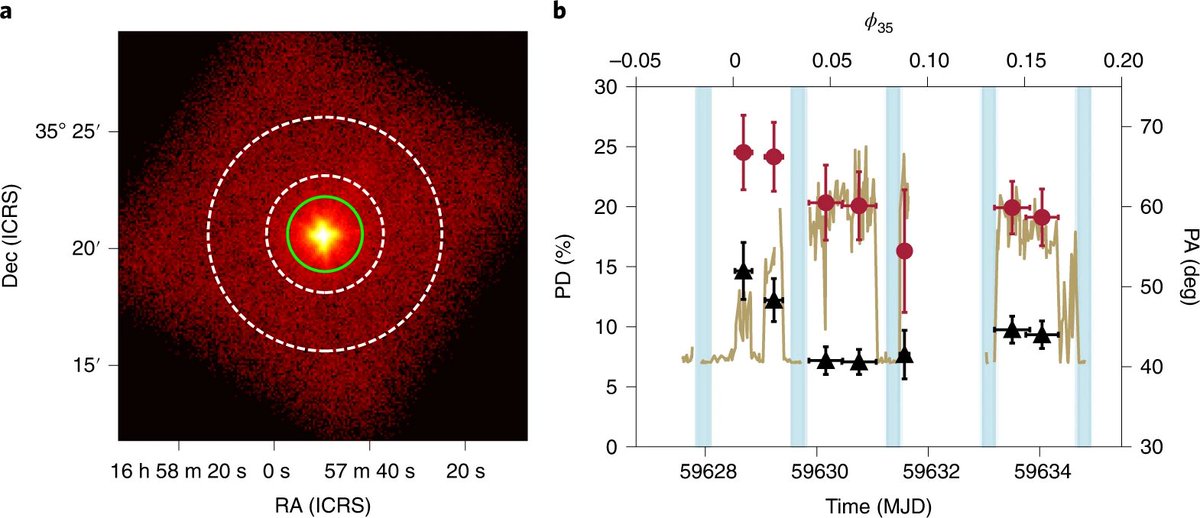
Initial results from IXPE (NASA/ASI mission) leverage the power of X-ray polarimetry to constrain the accretion geometry in X-ray pulsar Her X-1. The results also indicate a misalignment of the spin, magnetic & orbital axes. @doroshv3, Poutanen et al.: https://t.co/o3PjXyvp2B





![PRXI's tweet photo. Exploring the magnetic field of the ultraluminous X-ray pulsar NGC 4631 X-8
Amar Deo Chandra
https://t.co/QoJRxiUmNX [𝚊𝚜𝚝𝚛𝚘-𝚙𝚑.𝙷𝙴] https://t.co/G9qnT4ppHr](https://pbs.twimg.com/media/HBrIlPkWMAACfHb.png)


![arXiver's tweet photo. The unaltered pulsar: GRO J1750-27, a super-critical X-ray neutron star that does not blink an eye [HEAP] https://t.co/crUeeI4cnb https://t.co/tej7QIcoR8](https://pbs.twimg.com/media/FhfsIddaAAAjlav.jpg)
![arXiver's tweet photo. Monte-Carlo simulations on possible collimation effects of outflows to fan-beamed emission of... [HEAP] https://t.co/4eLY5VrMTO https://t.co/zbipDqifYJ](https://pbs.twimg.com/media/Fhp_sCQUYAEZjOM.jpg)
![arXiver's tweet photo. Bright X-ray Pulsars: how outflows influence beaming, pulsations and pulse phase lags [HEAP] https://t.co/aqbD1d3yRw https://t.co/BZvUZFwfxt](https://pbs.twimg.com/media/FhvFhTJaYAMGOAi.jpg)
![arXiver's tweet photo. Spectral properties of the Be/X-ray pulsar 2S 1553-542 during Type II outbursts [HEAP] https://t.co/h6aCsnkxtf https://t.co/wM0LWnD9ay](https://pbs.twimg.com/media/FhvJ5UEacAEAvXB.jpg)