A new article was published in Advanced Science by our trainees Runhao Wang, Mei Luo, Yamei Chen, Chengxuan Chen, and the cancer center’s Yuan Liu, PhD, Yong Zang, PhD, Leng Han, PhD, and colleagues. Learn more: https://t.co/1IYLcDqJlQ. #ResearchCuresCancer#NCIcomprehensive
Thrilled to join #ASHG2025 to share our latest insights into the non-coding RNA landscape shaping pharmacogenomic responses and cancer immunology! Stop by our poster (Board 9020F) — happy to connect and chat!
#ncRNA#Pharmacogenomic#immunotherapy#cancer
I'm honored to be inducted as a fellow into the American Institute for Medical and Biological Engineering @aimbe. Thanks very much for my mentors, lab members, collaborators, friends and family for all the support! @IUIndianapolis@IUCancerCenter
Thrilled to share our latest work on the pharmacogenomic and immune landscape of snoRNAs in human cancers! Huge thanks to my research advisor @lenghan_bioinfo and amazing team for making this possible!
CODA day!
The CODA team at @JohnsHopkins maps pancreatic precursor lesions in 3D and at single-cell level. First 3D spatial genomic maps of large tissue samples. A human pancreas contains a staggering ~1000 lesions, some showing multifocality.
Here: https://t.co/RsB0RYoPIy
Happy to share an updated eQTL data resource PancanQTLv2.0: a comprehensive resource for expression quantitative trait loci across human cancers https://t.co/UQGXs323vl, led by @ChengxuanChen@HereYuan. Thanks for the support from @IUPUI@IUCancerCenter! @NAR_Open
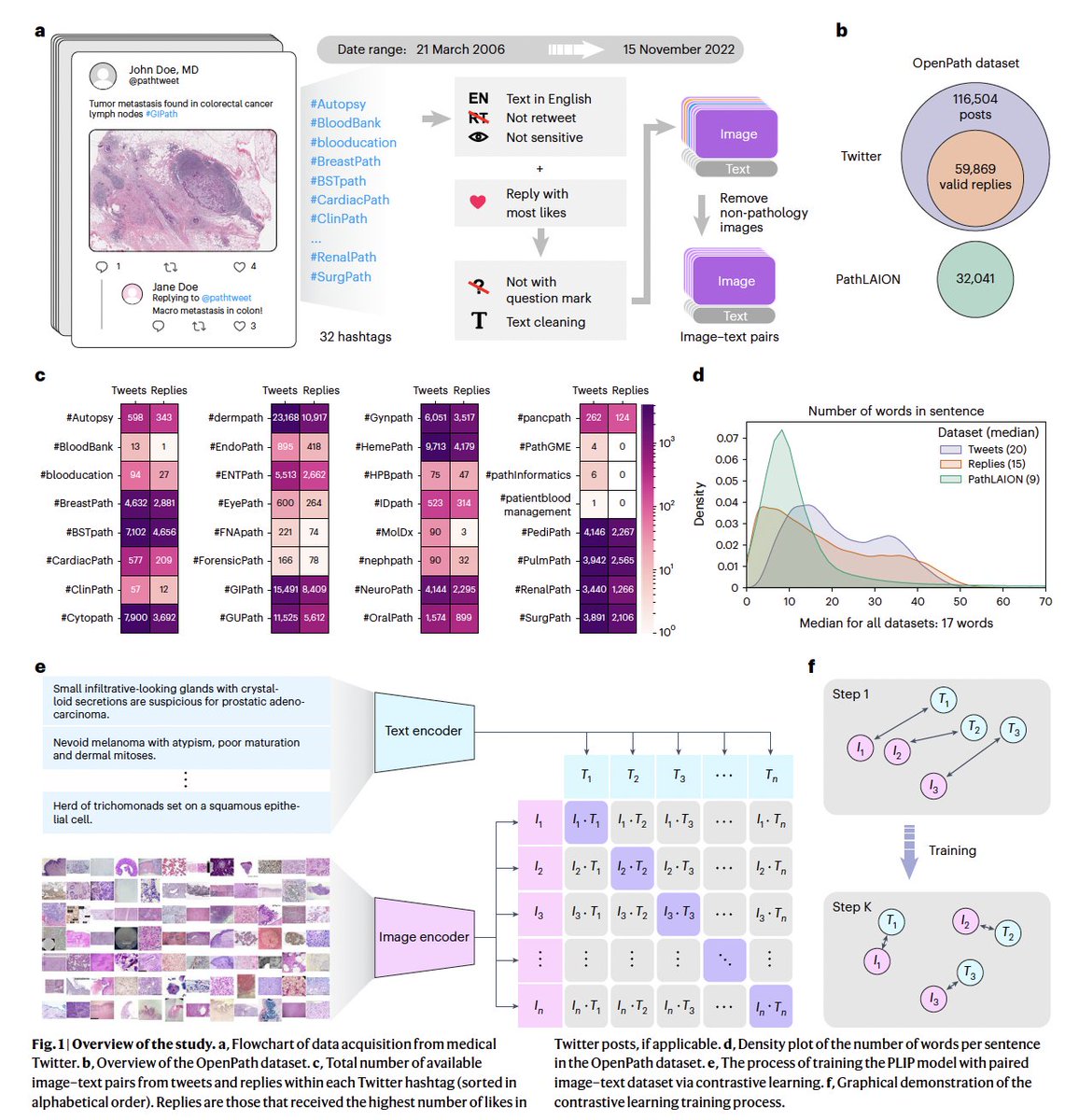
⚡️Excited to share our new @NatureMedicine paper where we used Twitter to build a vision-language foundation #AI for #pathology https://t.co/1DQJ1zzDwh
We curated >100K public Twitter threads w/ medical images+text to create PLIP for semantic search and 0-shot pred.
All our data (OpenPath): https://t.co/J5x8gxx5QC
Open source PLIP: https://t.co/feIxSan7nv
Getting sufficient data is a key bottleneck for medical AI. This work shows how we can harness the tremendous medical knowledge openly shared on social media to develop models. We used multiple filters to improve Twitter data quality. PLIP performs well for 0-shot classifications, fine-tuning, and image and text-based retrievals.
Great work by @ZhiHuangPhD@federicobianchy@mertyuksekgonul and Tom Montine 👏 And thanks to support from @StanfordHAI@StanfordMed!