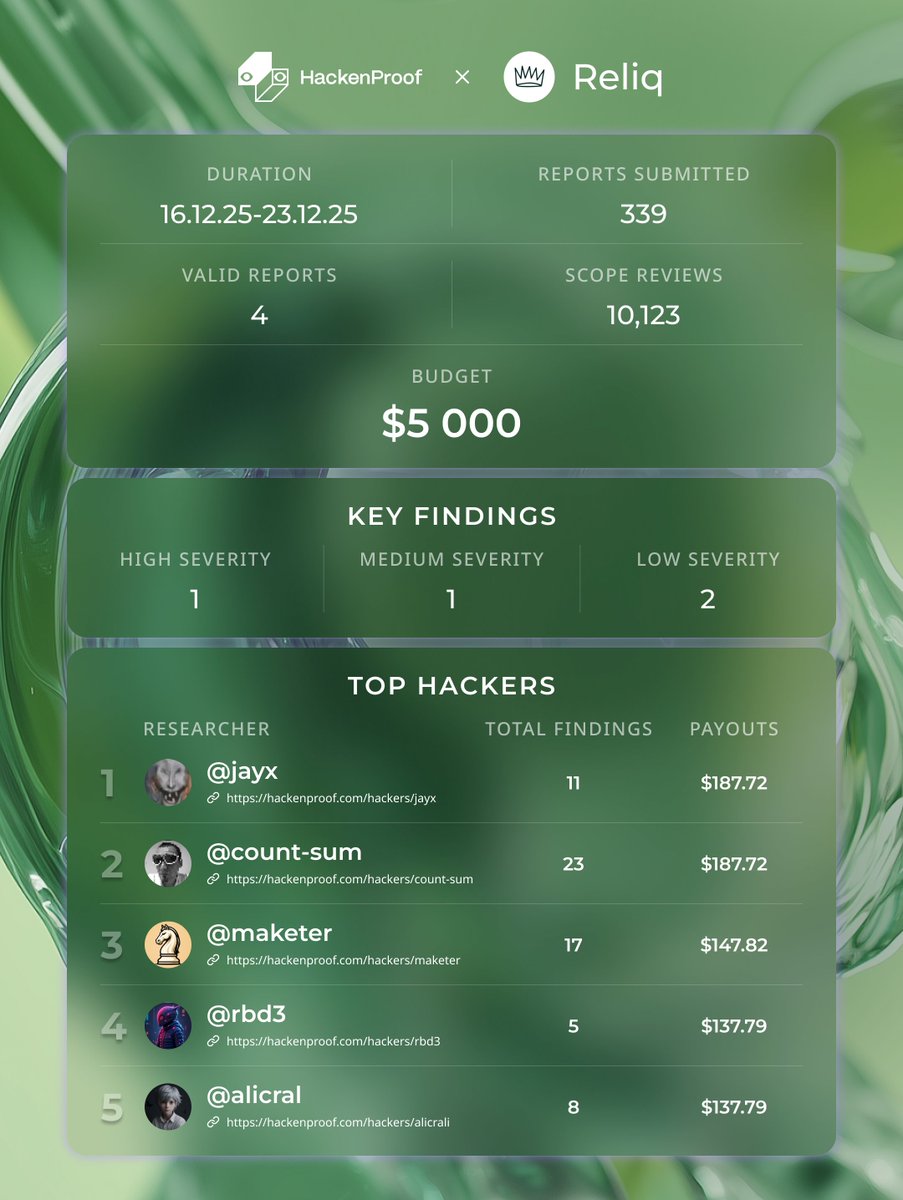
BOOM💥 The winners are here!
Massive congratulations to the top performers on the Reliq Finance audit contest leaderboard.
🏅@j4ycked
🏅count-sum
🏅@keterka
🏅@Rbd30
🏅@Alicrali333
Keep it up!
The @0xfluid Fluid DEX v2 Bug Bounty Contest is now live!
30-day contest ending on February 18th, 2026.
$200,000 USDC in rewards if at least 1 High / Critical is found!
Time to get to work, auditors.
BOOM💥 The winners are here!
Massive congratulations to the top performers on the Reliq Finance audit contest leaderboard.
🏅@j4ycked
🏅count-sum
🏅@keterka
🏅@Rbd30
🏅@Alicrali333
Keep it up!
1/ Introducing The Mentorship Series
https://t.co/EavHXaNBXT
I’m personally mentoring a small, hand-picked group of auditors in 2026. 1st announced tmr.
3 months of 1-on-1 mentoring with me each.
Targets:
0 → 4 figures
4 → 5 figures
Step 1: Like and repost this post.
We’ve partnered with @rippleXDev to launch a $200,000 Attackathon helping secure the proposed XRPL Lending Protocol.
This is a time-boxed, adversarial competition to identify vulnerabilities before the protocol reaches production.
We are attaching an unprecedented opportunity to the @centrifuge contest starting October 20th.
For the first time, the winner of a Sherlock audit contest will earn an immediate invitation to join Blackthorn, regardless of their current ranking on Sherlock's leaderboard.
This is a unique chance to join the most elite group of security researchers in the world.
Many beginners in Web3 say, “This is hard, I don’t get it.”
Truth is, everyone feels that way at first.
Great auditors didn’t quit - they showed up daily, stayed consistent, and kept learning.
It’s not just hard for you. It’s hard for everyone.
Keep going.
You don’t need a mentor.
Newcomers often ask me if I can mentor them, if they actually need a mentor, or how to avoid the common pitfalls.
Here’s my view: what you really need is an Advisor.
I’ve tried (and still do) helping a few people fully switch into Web3 and grow properly. The clear pattern I see: only the ones putting in the hours actually succeed.
They don’t ask me about every tiny step. They try, they get stuck, and when they’re at a dead end - that’s when I step in. Sometimes a single sentence from me saves them days.
In all other cases, you need to hold yourself accountable, keep working for your future, and believe in yourself.
I saw the same thing years ago when I was helping people break into Web2 - friends, people from groups, etc. It always came down to this: if you’re not putting in the hours and truly pushing for it, you won’t make it.
If you want to progress faster, you need to shorten the feedback loop.
Just by reflecting on your work and asking why you did/didn't do what you did, you will learn a ton.
Your growth is on the other side of your ego.
When I first began participating in public competitions in early 2025, I, like many beginners, would simply ask an LLM what mistakes and vulnerabilities it saw in a particular function or contract. This is fundamentally the wrong way to use an LLM.
LLMs very often hallucinate when you ask them to draw conclusions or analyze code for vulnerabilities. Any answers that involve reasoning and analysis should be treated with skepticism. In the vast majority of cases, such answers will be incorrect.
I remember an LLM claiming that if, in some function, we transfer tokens to an external address but later during the function’s execution a revert occurs, then the transferred tokens would get stuck in the external contract. Of course, if you already have some experience and understand that a function does not execute in parts and that if a revert happens no changes are applied, no tokens are transferred, and nothing gets stuck, then you can see that the LLM is hallucinating.
But you need to already have some experience in how the blockchain works and at least a basic understanding of Web3 security to work with LLMs.
Use them as a sort of protocol developer, because they do a good job understanding what code does.
And don’t use them as security researchers, because they have a limited grasp of smart contract security and can only find the most obvious vulnerabilities (at least given the current state of LLM development).