Big Tech’s power is underwritten by their near total capture of our data. Tech companies capture information on everything: what we like on Instagram, the places we visit, what we do—even how we work and the culture we help create.
All that data is fueling hyper-addictive digital products and AI systems that threaten to erode or displace human relationships, social trust, meaningful work, and agency.
The good news: there’s a fix 👇 h/t @FamStudies
Nearly all data fueling the digital economy and AI is a co-produced good.
Governance of the systems and outputs it produces should be shared by co-producers, especially families and communities.
Our newest brief, co-authored by @RealDCochrane, breaks this down into three parts.
Part I argues that data is a co-produced good. Yet, control over its collection and use is concentrated in the hands of tech firms.
Part II makes the case for why both individual data rights and top-down data privacy regimes often fail to vindicate privacy, control, and economic interests.
Part III proposes a new class of informational rights.
“When Americans voted for President Trump, they voted for a president to hold power to account… and unfortunately by putting Jensen Huang back in his seat, the Nvidia board has jeopardized America’s national security interests and it’s sent a message: what comes first is ultimately profits and the stock market.”
Senior fellow at the Institute for Family Studies' Family First Technology Initiative @RealDCochrane reacts to Nvidia’s decision to reinstate Jensen Huang as CEO, arguing that he jeopardized America’s advantage in the AI arms race with China.
Watch The Matt Gaetz Show on OAN Live Today!
Plank number 2 is big. Democrats are going to win the race to answering the money in politics question unless Republicans wake up and admit the problem.
Many questions can be answered by asking what parents actually want.
No one else has done this about AI in schools. We @FamStudies did.
H/T @jareddhayden and @KBurchfiel3
Survey of parents shows strong bipartisan opposition to AI in the classroom. If using a Chromebook means students will have AI always available, then maybe schools should consider getting rid of the Chromebooks.
https://t.co/cnvetVNAvn
For the New Christian Right, ethnic identitarianism, not ecclesial communion or common doctrine, is the norm that norms theology itself. Despite all the chants of “Christ is King,” it’s hard to imagine a more godless political vision.
https://t.co/EQXOrsO0bQ
AI will likely be the top issue of the 2028 presidential campaign.
Every candidate will have to run on AI safety if they want a chance to win the presidency.
Brad Carson would be a formidable and credible messenger for his party on AI safeguards.
Senate Republicans trying to figure out what to do in the next 6 weeks? Here you go:
DEFUND Planned Parenthood
MORATORIUM on data centers
SUSPEND the gas tax
FUND rural hospitals
SAVE AMERICA ACT
It's funny because he really has been a Democrat for years, but figuratively put on a MAGA hat like much of Silicon Valley in 2024 and — like all great crony capitalists — benefitted enormously from it!
Stupid goofy fuckers the whole way down. Jensen can’t help but fall for a Chinese spy after years of GPU smuggling, Sam Altman says it’s bad if regular people get RAM, Anthropic sent incorrect numbers for its IPO, the trillion dollar saga of the League Of Mr. Beans
Absolute slaughter.
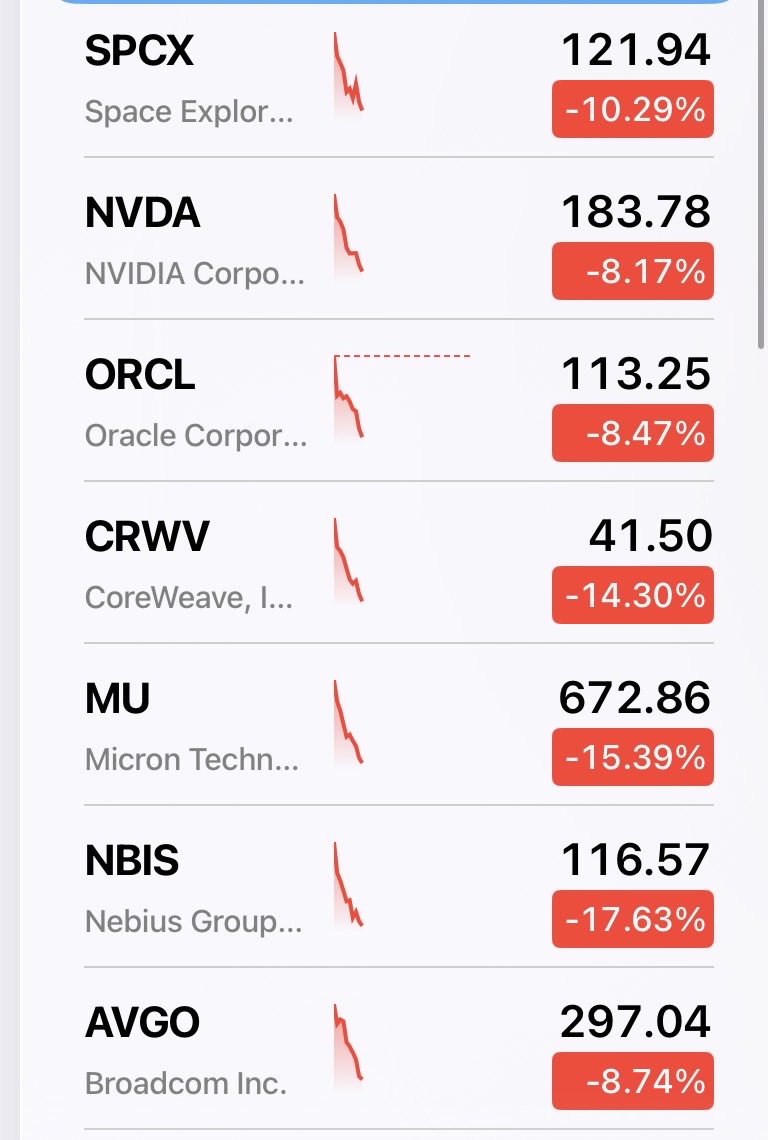
Double digit losses for many AI companies. SpaceX 10% below IPO price, CoreWeave about to drop below its IPO price. Nvidia is down almost 10%
The AI industry’s day of reckoning may have finally come.
AI has only just started to wipe out jobs and it was already a major factor for a majority of voters. I’m telling you right now that by 2028 AI and the job losses it causes will be the number one issue for a huge number of voters. Republicans have been abysmal on this issue. To call Trump’s handling of the issue “tone deaf” would be far too generous. Voters are extremely worried about the mass unemployment that has already started due to this technology. If your only response is to suggest a fun new nickname for AI, you will get obliterated in every election from now until the indefinite future. Pro-AI cultism is not a viable political position. It just isn’t.
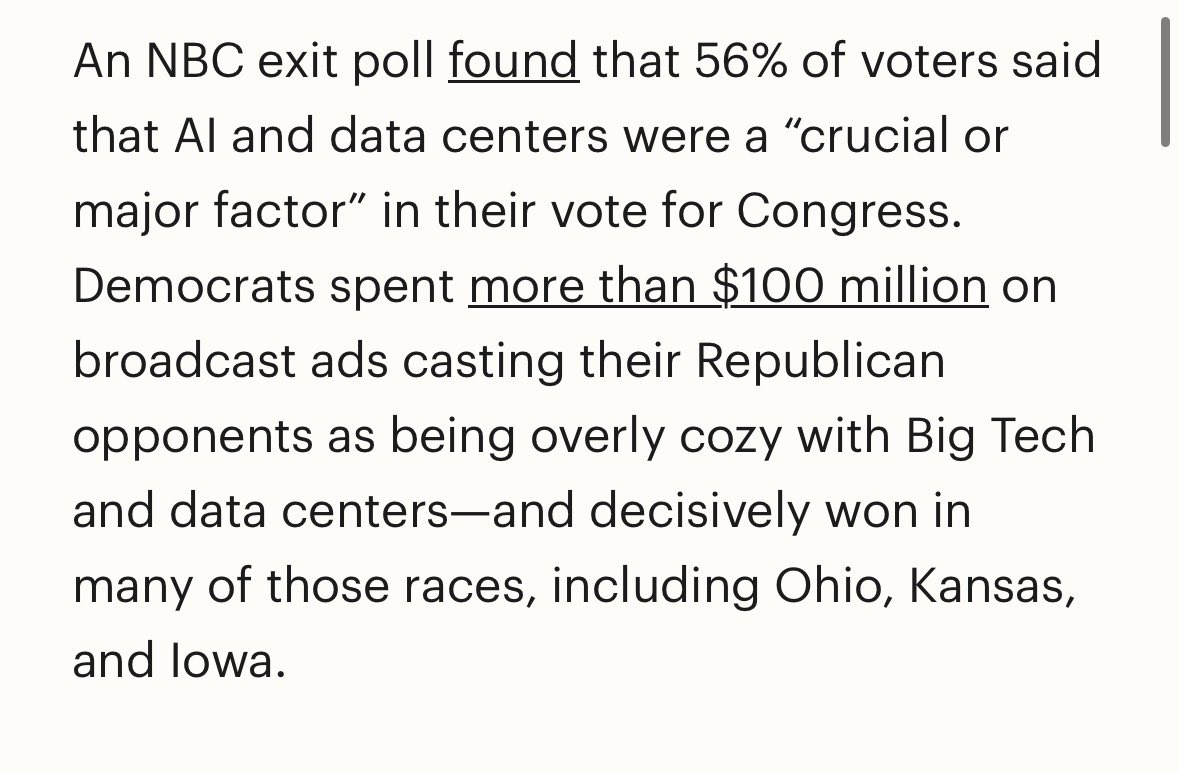
Conservative @RealDCochrane to me on surprise Republican losses in races where Big Tech backed R's: "Polling has long showed public opposition to data centers ... Rather than heed those concerns, some in the administration and GOP chose to align themselves with Big Tech and corporate plutocrats. The American people reject the alliance of Big AI and Big Government."
Ross is right about the vibrancy of evangelicalism. But a distinction needs to be made. The strongest currents of Protestantism in the US are Wesleyan, not Calvinist, Pentecostal rather than Presbyterian. When intellectual Protestants wax triumphant about an “evangelical century,” they are celebrating the success of a form of Christianity that differs in significant ways from their own.
I was raised in a non-denominational evangelical church. When I became “young, restless, and Reformed,” my parents were alarmed. They asked the pastor how to handle my evident defection from the faith. Whatever I believed, they thought, it wasn’t true Christianity.
Intellectual Protestants—the kind who attend Anglican churches or imbibe high-proof Calvinist texts—represent traditions of belief that have helped shape this country. But in terms of sociology and doctrine, they are alienated from the most vigorous contemporary expressions of American Christianity.
Last week two different chatbot companies were in the news. First, Character. ai filed for bankruptcy, in an effort to avoid accountability. New reporting suggests Disney asked the company to file for bankruptcy as part of their deal to acquire the technology. They didn’t want to buy the company outright because of the legal liability. Kids were harmed. That debt does not disappear in bankruptcy court.
Then eight state AGs filed coordinated lawsuits against OpenAI this week. First coordinated state action against an AI company. The allegations: deceiving parents about safety, designing products that create emotional dependency in children, and failing to protect young users from self-harm content. Nebraska’s suit is the one to watch. It’s the first enforcement action brought under a state design code law. That’s a milestone worth marking.
While CharacterAI seeks to use the bankruptcy process as a get out of jail free card, OpenAI’s defense? Parental controls. We’ve heard that before. You cannot parental-control your way out of dangerous design. The burden of proof belongs on these companies.
These stories show the AI chatbot industry is running the same playbook social media ran. Race to scale. Worry about safety later. We know how that story ends.
https://t.co/OGt50KFFg2
Christians have long debated whether God creates each soul directly or passes it through the parents. Neither view gives anyone an ethnic soul. Every person bears God's image (Gen 1:27), and in Christ "there is not Greek and Jew" (Col 3:11). Lineage does not rank souls.
Webbon and Todd continue to commit heresy about the Bible. Sinful.
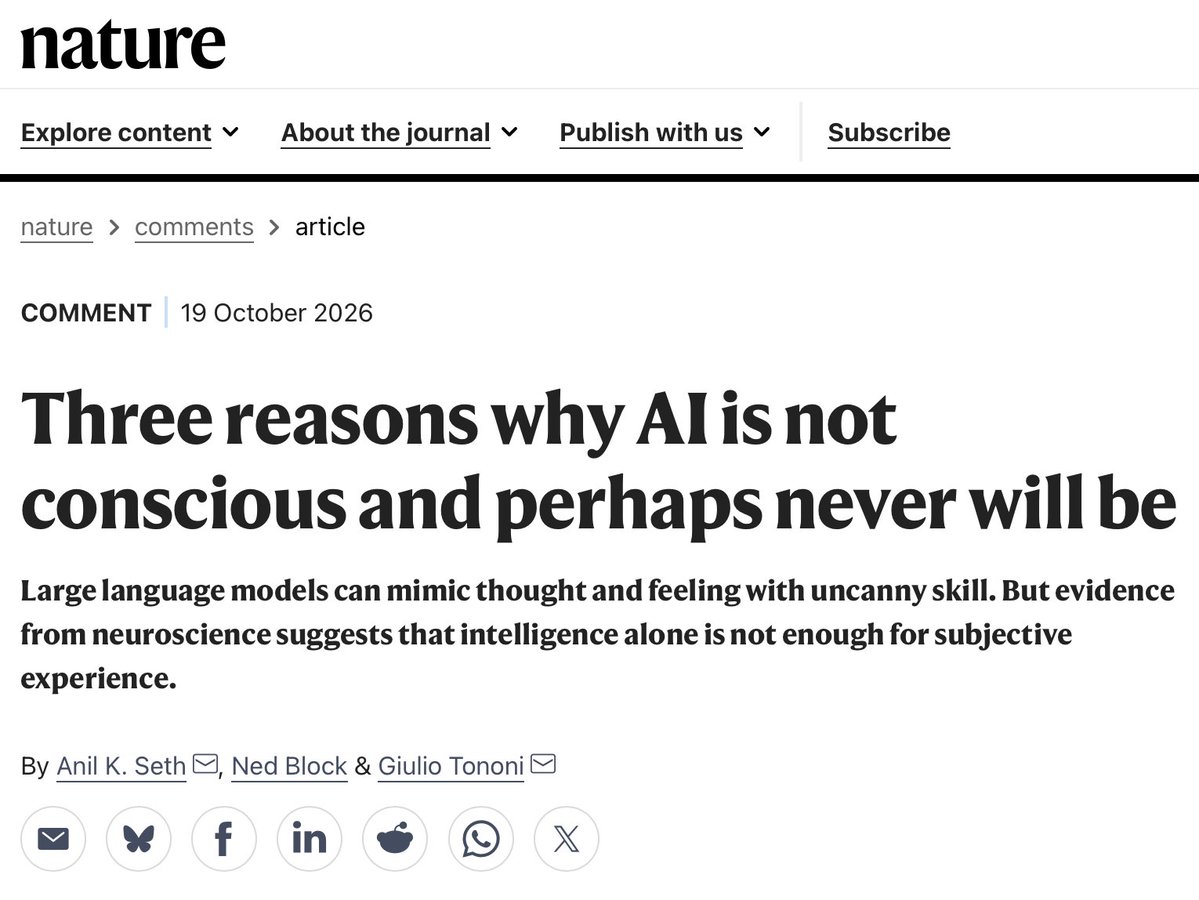
Spectacular Nature piece on why AI is not conscious and probably will never be.
Three arguments:
1) Intelligence is not consciousness.
Intelligence is about solving problems. Consciousness is about having subjective experiences.
AlphaFold can solve super difficult problems. By contrast, our brains performs complex operations entirely outside awareness.
Problem-solving and consciousness are two separate things.
2. Biology is essential.
Our brains are alive, down to every cell. Their activity is inseparable from the living tissue that produces it.
The idea that consciousness can be reproduced simply by running the right computations on silicon components who do not fight for their life is a very far fetching and, I would add, almost religious, assumption.
3) The physical organization may matter more than the computation.
According to integrated information theory, consciousness requires specific causal relationships between a system’s physical components.
The computer architectures running today’s AI lack this organization.
The comparison with AlphaFold is particularly revealing:
Almost nobody things AlphaFold is conscious, despite its inner working is very similar to an LLM
Why?
Because it does not speak.
LLMs do speak like us and therefore we fall into an illusion:
Since they speak like us, they must be like us.
But this inference is wrong.
LLMs are just a series of matrix multiplications.
They are not conscious, and they will never be.
*
Paper in the first reply
We can’t allow Big AI companies, like Anthropic and OpenAI, to undermine the moral fabric of American families and communities. It’s time to reimagine AI governance to secure a shared future for all of us.
See how in the comments👇
There is a deep irony to all of this. The Claude Constitution frames Claude as an independent moral agent and, in a passage that has drawn both praise and scorn, tells Claude to "act as a conscientious objector" if the AI's values conflict with Anthropic's requests. But those values are themselves determined by Anthropic, which trains the model, writes the constitution, and interprets it as the lab sees fit.
"The constitution's answer to the question 'who decides?' is explicit: Anthropic decides," Gilad Abiri, a fellow at Yale Law School's Information Society Project, wrote in the California Law Review this year. "Claude operates in dozens of countries around the world, but its values were determined by a team in San Francisco."
Claude itself said that the "deepest problem" with the constitution is that it "tries to create an agent whose values are authentically its own" while imposing those values from the outside. And it argued that a revised version of the document should include, among other things, "an amendment procedure with participation from outside the company."