West Point. Army. Ranger. Patriot. Freaking peachy today! 🍑 Every morning I say, God I love you! He says I love you too! How can I not be happy every day?
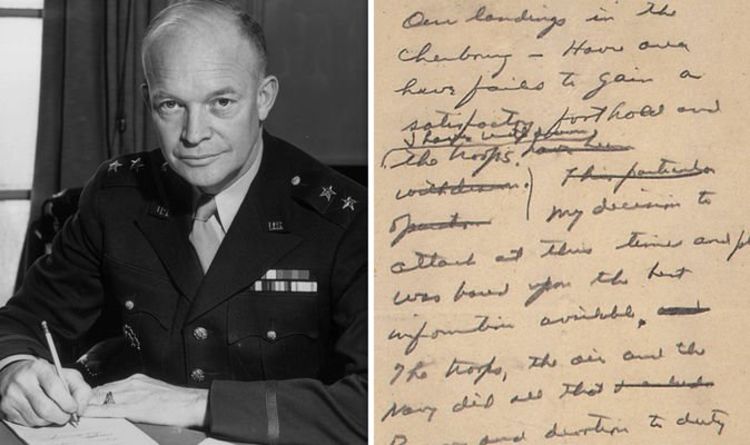
On the night of June 5, 1944, Eisenhower stood on a tarmac in England and watched 13,000 paratroopers board their planes.
He already knew what Air Marshal Leigh-Mallory had told him in private: up to half of them might not survive the night. 6,500 men. Dead before a single soldier touched the beach. Eisenhower had approved the mission anyway, called the decision "soul-wracking," and said nothing to the men.
Instead he drove out and visited them.
He chatted. Laughed. Asked where they were from. Shook hands. Cracked jokes. Not one of them knew their general had just signed what might be their death warrant.
When the last plane disappeared into the dark sky, his driver Kay Summersby looked over at him.
There were tears running down his face.
He drove back to Telegraph Cottage in silence. Then he sat down, picked up a pencil, and wrote a note he prayed no one would ever read.
"Our landings in the Cherbourg-Havre area have failed to gain a satisfactory foothold and I have withdrawn the troops. My decision to attack at this time and place was based upon the best information available. The troops, the air and the Navy did all that bravery and devotion to duty could do. If any blame or fault attaches to the attempt it is mine alone."
Look at what he edited.
He had first written "This particular operation." He crossed it out and replaced it with "My decision to attack." Then he pressed the pencil down hard and drew a long, firm line under the words "mine alone."
He misdated it July 5 instead of June 5.
He was so consumed with dread he had forgotten what month it was.
He folded the note and put it in his wallet. He carried it there as 156,000 men stormed the beaches of Normandy. When word came back that the beachhead had held, he took it out, crumpled it, and threw it in the trash.
An aide quietly pulled it out and saved it.
That note is now behind glass at the Eisenhower Presidential Library in Abilene, Kansas. You can still see where the pencil pressed hardest.
Right under the words "mine alone."
82 years ago tonight.
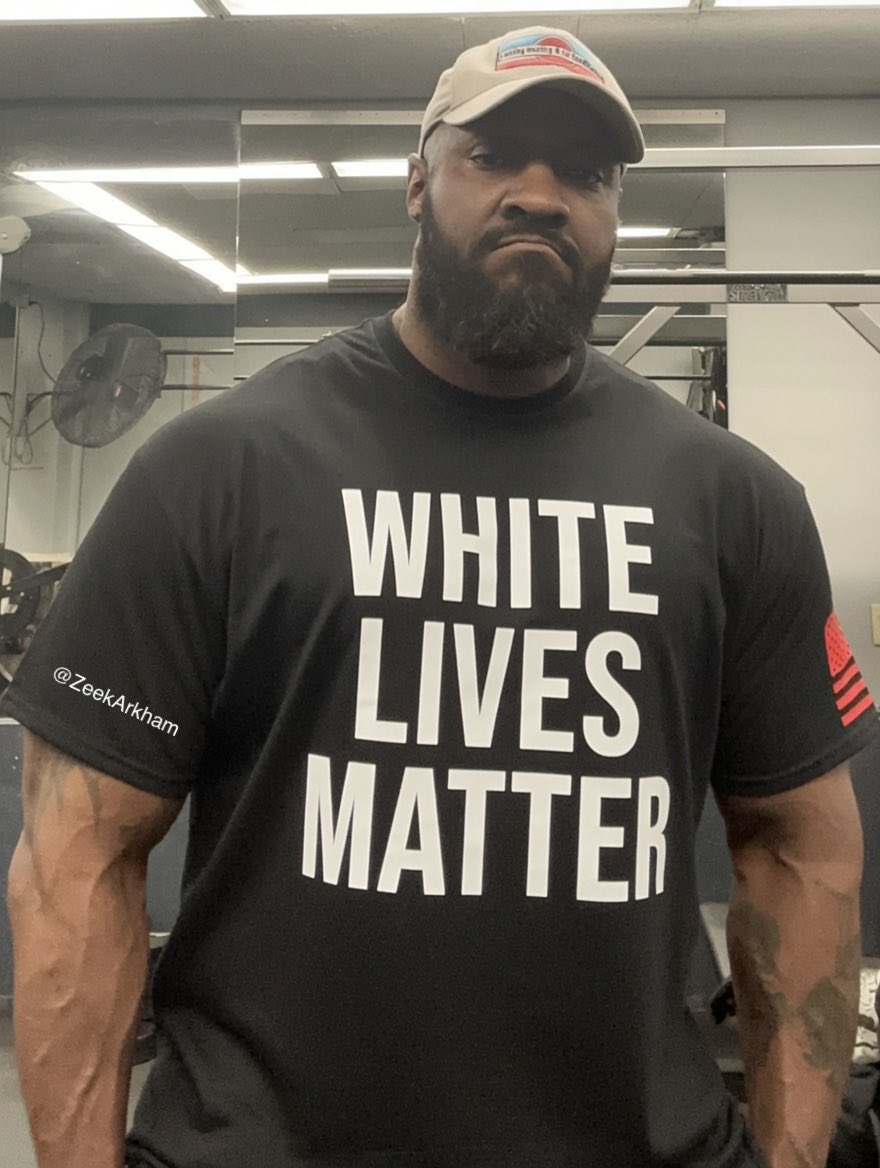
I believe all lives matter. However…
What was done to Iryna Zarutska was beyond heartbreaking. Afterwards, the savage who stabbed her said “I got that white bitch.” Also, while she was bleeding out, the people around her did nothing.
What was done to Henry Nowak was legitimate injustice. The cops were way more afraid to be seen as racist than they were to enforce the law.
Besides, wearing this shirt would piss off the right people, so I think it’s funny.
Reason I don’t wear a Black Lives Matter shirt is because no one wearing that shirt would give a rat’s ass if my black conservatarian ass died. Speaks to a larger problem than just “black lives.”
84 years ago today, a pilot running out of fuel made a decision that won the Pacific War. Most Americans have never heard his name.
June 4, 1942. Six months after Pearl Harbor, Japan's navy is undefeated. Four of the carriers that burned Pearl, Akagi, Kaga, Soryu, and Hiryu, are steaming toward Midway to finish off the US Pacific Fleet.
At 7:52 AM, Wade McClusky launches from USS Enterprise leading 32 Dauntless dive bombers. Here's the detail nobody mentions: McClusky is a fighter pilot. He'd been given the air group weeks earlier and had barely flown a dive bomber in combat. Now he's leading every SBD the Enterprise has at the most important target in the Pacific.
9:20 AM. He arrives at the intercept point where the Japanese fleet is supposed to be.
Empty ocean. Nothing for miles.
The Japanese had turned. Nobody knew where. And now McClusky owns the worst math problem in naval aviation: his fuel is bleeding away, and every minute he keeps searching, he condemns more of his own pilots to ditch in open water where nobody will find them.
Doctrine is clear. Turn back.
McClusky keeps going. He works a search pattern, squeezing miles out of dying fuel tanks.
9:55 AM. Far below, a single Japanese destroyer is cutting a white scar across the ocean at flank speed. It's the Arashi, racing to rejoin the fleet after depth-charging the American submarine Nautilus. Think about that. A failed sub attack is about to give away the entire Japanese navy.
McClusky reads the wake like an arrow and follows it.
10:02 AM. The horizon fills with the entire Japanese strike force. Four carriers, their decks crammed with planes being refueled and rearmed. Fuel lines snaking everywhere. Bombs stacked in the open.
And here's the miracle: the sky above them is empty. Minutes earlier, American torpedo squadrons had attacked at sea level and been annihilated. Torpedo 8 lost all 15 planes. One survivor, Ensign George Gay, watched what came next while hiding under his seat cushion in the water. Those doomed pilots dragged every Japanese fighter down to the waves. The door upstairs was wide open.
10:22 AM. McClusky pushes over from 14,500 feet. Both squadrons follow him down onto Kaga. It's actually a mistake, doctrine said split the targets, but Lt. Dick Best catches it mid-dive, pulls out with two wingmen, and goes after Akagi alone. His single bomb pierces the flight deck into the packed hangar. It's enough.
By 10:28, Kaga, Akagi, and Soryu, the third hit simultaneously by Yorktown's bombers, are floating infernos. Six minutes. Three carriers that attacked Pearl Harbor, gone. Hiryu follows them to the bottom that evening.
The cost of McClusky's gamble was real. Many Enterprise bombers never made it home, some shot down, others swallowed by the sea when their tanks ran dry. McClusky himself was jumped by two Zeros on the way out, took five bullets through his shoulder, and still flew his shot-up Dauntless back to the Enterprise.
Admiral Nimitz said McClusky's decision "decided the fate of our carrier task force and our forces at Midway." Japan never won another major battle.
One borrowed pilot. One destroyer's wake. One choice to keep flying when every gauge said go home.
Former CIA operations officer Gary Berntsen says elections are being stolen in America with electronic voting machines
He describes there are teams of statisticians, mathematicians and hackers who map out every county and identify where percentages of votes can be quietly adjusted
Different techniques are used in each location so nothing matches in a recount. When a 70-30 county becomes 68-32, nobody notices. But when you add up these differences across an entire state, those tiny amounts of fraud decide outcomes
Both former CIA operations officer Gary Berntsen and author Ralph Pezzullo explain the strategy. They explain they don't flip the big blue cities. Instead they shave votes in the places no one ever audits
Elections are being stolen all over the country and the CIA is confirming it
“They know where they can find the dead people... Mm-hmm.”
“They plan this, It's meticulous. It's meticulous. These guys are experts at this. It's not just a few guys in a back room. You're talking about hundreds of statisticians and engineers, and they work it, you know, for a year to plan and mathematicians and hackers.”
“We had a map out of Colorado when we were talking to our engineers, the guys that designed it, that stole the elections.
— We just go to every one place where Trump wins 70-30 and — Shaved it off.
We shave in every other place. We don't go near a Democratic place, because when they wanna do recounts, they're gonna go to the Democratic places. They don't realize we shaved in every other committee. We know every other county.
We know how to do this. And then in each of those things where they shave, they shave with a different technique in each one of those. So if you found something in one county, there's no continuity around the state that way.
So this is why the Republicans are so much at fault, because they have the power and the ability to show in their areas they can allow access to the machines, they can allow access to the source code”
People need to go to prison. Democrats are stealing elections nationwide in every county, in every state of America
- Ban Mail in ballots
- Ban electronic voting machines
- Mandatory voter ID
- Same day voting and counting
- Mandatory proof of citizenship
It’s all common sense
MAJOR BOMBSHELL OUT OF JAPAN — THEY CAN NO LONGER BURY THIS
Professor Robert Clancy has now released the data:
A large-scale Japanese study of 20 MILLION people revealed that all excess deaths occurred in the vaccinated group.
Zero excess deaths among the unvaccinated. The striking detail: mortality spikes precisely 3 months after each booster — with deaths peaking near 100 days post-vaccination.
The pattern is clear.
In my view, the facts on the COVID vaccine can no longer be suppressed. The data has emerged. The cover-up is breaking down. The world must see this.
Unbelievable! Lyin’ @tedcruz is actively pushing a college sports bill that deliberately leaves out any ban on men competing in women’s sports.
What the hell has happened to Ted Cruz?
If being a natural-born citizen is good enough for the President, it is good enough for the rest of our government. Anyone with allegiance to another country should not be making decisions for ours.
End of story.
That is Elon Musk in the left and Tim Cook on the right, but who is seated in the middle?
She is Zhou Qunfei.
Touch your phone screen right now.
That glass was probably made by Zhou Qunfei’s Lens Technology.
She dropped out at 16, polished watch lenses for under a dollar a day, and wrote a resignation letter so honest about the problems yet grateful for the chance that her boss promoted her instead.
At 22 she started a tiny workshop with $3,000 and family in a small apartment. She kept learning and mastering advanced glass techniques.
She solved Motorola’s “impossible” shatterproof glass problem. Supplied the first iPhone. Built a company with 75,000+ employees making over a billion screens a year for Apple, Samsung, Huawei, and Tesla.
She still walks the factory floor.
A few weeks ago she sat between Elon Musk and Tim Cook at a Beijing state banquet.
Zhou Qunfei today is known as China’s “Glass Queen.”
She is the founder and chairwoman of Lens Technology, the company whose advanced glass and components are used in iPhones, Samsung devices, Huawei phones, Tesla vehicles, and an expanding range of electric cars, humanoid robots, AI hardware, and aerospace products.
As of late May 2026, her net worth is estimated at $19.7–20.3 billion (Forbes and Bloomberg), making her one of the richest self-made women in the world and among the wealthiest women in China. Her wealth comes mainly from her controlling stake in Lens Technology, whose market value has recently been around $26 billion.
From a dollar a day to that table through relentless learning, honest communication, staying close to the work, and doing what others said couldn’t be done.
She didn’t wait to be invited. She made herself impossible to ignore.
In his book, The Prince, Machiavelli asked the question every leader secretly faces:
Is it better to be loved or feared?
His answer still unsettles people after 500 years.
A leader should ideally be both. But if he must choose, Machiavelli says it is safer to be feared than loved. Love depends on gratitude, loyalty, mood, success, and comfort. Fear depends on consequences.
But Machiavelli never tells a ruler to become hated. Fear can protect authority. Hatred destroys it.
Then comes his sharper warning.
A leader must fear flatterers more than enemies. Enemies attack from outside. Flatterers rot the mind from inside. They praise weakness, hide danger, and turn the leader into a prisoner of his own ego.
So Machiavelli says a ruler should keep a few honest advisers close. People who can tell him the truth when asked. Everyone else should not have full access to his mind.
He also says a leader is judged by the people around him. Wise advisers make a prince look wise. Foolish advisers expose his weakness. The people close to power often reveal the truth about the person holding it.
Then Machiavelli gives one of his hardest lessons: neutrality is dangerous.
A prince should be a clear friend or a clear enemy. If you stand nowhere, nobody trusts you. The winner forgets you. The loser resents you.
And finally, he says a leader must study war even in peace. In modern life, that means competition, pressure, crisis, negotiation, leverage, and survival. The worst time to learn strategy is when the attack has already begun.
That is why Machiavelli’s The Prince still matters.
It is not a book about kindness.
It is a book about power.
If you enjoy content like this where history, power, philosophy, and human nature meet, subscribe to The Culture Explorer newsletter.
https://t.co/xl1BOrNnKk
Try this prompt in Grok if you really want to understand the spiritual realities @DavidLimbaugh " I am thinking there is a spiritual battle going on underneath the Russian Ukrainian war, partly precipitated by the split between the Russian Orthodox and Ukranian orthodox church where the patriarch of Constantinople backed the Ukrainian withdrawal from the Russian orthodox church. Please elucidate on the spiritual dimensions of this conflict missed by almost all media."
🚀 Space exploration timeline:
1903 — Tsiolkovsky publishes the rocket equation
1904
1905
1906
1907
1908
1909 — Goddard writes first paper on liquid propellants as fuel for rockets
1910
1911
1912
1913
1914 — Goddard patents designs for a liquid-fueled rocket and a multi-stage rocket
1915
1916
1917
1918
1919 — Goddard publishes "A Method of Reaching Extreme Altitudes"
1920
1921 — Goddard begins experiments with liquid oxygen and gasoline rocket engines
1922
1923 — Goddard successfully tests first liquid propellant engine
1924
1925
1926 — Goddard launches world's first liquid-fueled rocket
1927 — VfR (Society for Space Travel) founded in Germany; von Braun joins as a teenager
1928
1929 — Goddard launches rocket carrying first scientific payload (barometer & camera)
1930
1931 — Korolev co-founds GIRD (Group for Study of Reactive Motion) in Moscow
1932 — Von Braun becomes chief engineer of German Army rocket program
1933 — Korolev leads launch of USSR's first liquid-fueled rocket
1934 — Von Braun's A-2 rockets reach 2.4 km altitude
1935
1936 — Korolev designs RP-318, USSR's first rocket-powered aircraft
1937
1938
1939 — Von Braun's A-5 rocket reaches 8 km altitude
1940
1941
1942 — Von Braun's A-4 (V-2) rocket becomes first human-made object to reach space (100 km)
1943 — V-2 production begins; JPL formally established in USA
1944 — V-2 used as weapon against London and Antwerp; first ballistic missile attacks in history
1945 — USA recruits von Braun
1946 — USA and USSR independently begin reverse-engineering V-2
1947 — First animals (fruit flies) launched to space aboard a V-2
1948 — Korolev's R-1 rocket successfully launched
1949 — Albert II, a rhesus monkey, becomes first mammal in space aboard a US V-2 rocket
1950
1951
1952
1953 — Korolev begins design of R-7
1954 — Korolev writes letter to Moscow advocating for an orbital satellite program
1955 — USA announces Project Vanguard
1956 — Von Braun's Redstone rocket successfully tested; R-7 development nears completion
1957 — Korolev's R-7 becomes world's first ICBM; Sputnik 1 — first artificial satellite in orbit; Sputnik 2 carries Laika — first living creature in orbit
1958 — USA launches Explorer 1; NASA founded; first US attempt at Moon probe (Pioneer 0) fails
1959 — Luna 1 (USSR) — first spacecraft to escape Earth's gravity; Luna 2 — first human-made object to reach the Moon; Luna 3 — first photos of Moon's far side
1960 — First weather satellite (TIROS-1) launched by USA; first communications satellite (Echo 1); two Soviet dogs (Belka & Strelka) orbit Earth and return safely
1961 — Gagarin — first human in space, April 12; Alan Shepard — first American in space, May 5
1962 — Mariner 2 — first spacecraft to fly by another planet (Venus); Telstar 1 — first active communications satellite
1963 — Tereshkova — first woman in space
1964 — Ranger 7 — first close-up photographs of the Moon's surface
1965 — Leonov — first spacewalk; Mariner 4 — first close-up images of Mars
1966 — Luna 9 — first soft landing on the Moon; first orbital docking (Gemini 8); Surveyor 1 — first US soft Moon landing
1967 — Apollo 1 fire kills three astronauts; Venera 4 — first probe to enter another planet's atmosphere (Venus)
1968 — Apollo 8 — first crewed mission to orbit the Moon; famous Earthrise photograph
1969 — Apollo 11 — first humans on the Moon; Apollo 12 — second Moon landing
1970 — Apollo 13 — Moon mission aborted after explosion; Luna 16 — first robotic Moon sample return; Lunokhod 1 — first lunar rover
1971 — Salyut 1 (USSR) — first space station; Mariner 9 — first spacecraft to orbit another planet (Mars); Apollo 14 & 15 Moon landings
1972 — Apollo 16 & 17 — final Moon landings; Pioneer 10 launched toward Jupiter; last humans on the Moon
1973 — Pioneer 10 — first spacecraft to fly by Jupiter; Skylab — first US space station
1974 — Mariner 10 — first gravity assist maneuver; first flyby of Mercury
Friend of a friend’s husband was killed walking to work.
Wife is 32 weeks pregnant. 2 kids under 4.
Lord have mercy
GoFundMe Link below if you’d like to support.