A global person-to-person economy is frightening because it asks a question that banks, governments, payment processors, platforms, and regulators prefer not to hear: why must exchange pass through you?
I do not want the power.
I do not want the money.
I do not want the control.
That will confuse a certain type of person, because a certain type of person cannot imagine building anything except as a prelude to owning the throat through which everyone else must breathe. They think invention is merely the larval stage of monopoly. They think every road must have a tollbooth, every tool must have a landlord, every market must have a priest, and every creator must eventually be reduced to a tenant.
That is their disease.
I have seen what power does. I have seen what money does. I have seen what control does. I have seen it in others, and I have seen it trying to work its way into me. Anyone who says power does not corrupt is usually either lying, already corrupted, or too dull to notice the smell.
I have a good life.
I do not need to build another cage.
What I want is simple.
I am developing this. I am releasing it this year. It is already underway. And when it is ready, I am handing it to everybody.
Not to a foundation.
Not to a platform.
Not to a cartel.
Not to a board of soft-handed little managers who will spend three years discussing governance while quietly writing themselves into the rent stream.
Not to anyone to control.
For everyone.
Anyone, anywhere on Earth, who wants to build with it will be able to build with it. No permission ceremony. No kneeling at the polished altar of Silicon Valley. No begging some intermediary to please allow innovation this quarter, provided it does not disturb the advertisers, the banks, the exchanges, the app stores, the regulators, the consultants, the custodians, or whatever other magnificently useless creature has inserted itself between work and value.
Everything tied to a blockchain.
Everything provable.
Everything private.
Everything controlled without needing gatekeepers and intermediaries standing in the way, charging rent on movement, access, ownership, identity, distribution, or trust.
That is the point.
Not another monopoly.
Not another walled garden.
Not another empire of managed dependency dressed up in the cheap perfume of innovation.
A system where digital goods can exist as property. Where ownership can be proven. Where transfer can be recorded. Where rules can follow the object. Where privacy can remain intact. Where creators can create, buyers can own, and markets can form without asking permission from people whose chief economic function is obstruction with a logo.
The old world was built by middlemen who discovered that if they stood close enough to value, they could convince everyone they had created it.
They did not.
They merely blocked the road and charged admission.
The new world is coming.
And no, it will not be dragged in by me alone, kicking and screaming against the weight of the old order. That is not how worlds change. Worlds change when enough people stop accepting the lie that the cage is there for their protection.
It will come because builders want to build.
Because creators want to own their work.
Because families want more than managed decline and subscription life.
Because people want a better world than the one designed by intermediaries, bankers, platforms, and the thin little men who confuse custody with civilisation.
I am not giving this to the powerful.
I am giving it to those who are tired of needing the powerful.
I am giving it to the people who want more for their families.
I am giving it to the people who want to build businesses without permission, publish without dependence, sell without surrender, create without being farmed, and own without being told that access is the modern substitute for property.
The middle will hate it.
Good.
The gatekeepers will sneer.
Let them.
I have done many things wrong in my life; I have no need to pretend otherwise. But one charge even my most imaginative detractors cannot make stick is that I lacked balls.
I stood up to a combined force involving Mark Zuckerberg, Jack Dorsey, and many of the largest players in the corrupt crypto industry. Not from the safety of a committee, not behind a chorus of anonymous cowards, and not with the soft little evasions of men who mistake popularity for principle.
I took the blows openly. I was bloodied. I was dragged through the mud by people who confuse consensus with truth and wealth with virtue.
And yet, here is the awkward fact they cannot quite digest: I am still standing.
That, I suspect, is what irritates them most.
One of the things I have come to understand about this universe is something I first learned, in sharper form, from the writings of Terry Pratchett.
He understood something that many solemn men in expensive rooms never quite manage to grasp. We are not merely Homo sapiens. We are Pan narrans — the storytelling ape, the storytelling chimp, the creature that does not merely observe the world but survives by wrapping it in meaning.
That is what we are.
Not the rational animal, not the economic animal, not the statistical animal, not the glorious little spreadsheet mammal that consultants dream about after too much airport coffee. We are the animal that tells itself stories and then builds empires, religions, markets, wars, technologies, and entire civilisations around them.
People like to pretend otherwise, of course. It is one of their more charming weaknesses. They imagine that the world runs on facts, when most of them would not recognise a fact if it arrived with a passport, three witnesses, and a signed confession. They imagine it runs on science, when half the institutions invoking science are merely laundering authority through a lab coat. They imagine it runs on money, when money itself is only a story that has learned to wear a suit.
The strongest force in this universe is not gravity.
It is not electricity.
It is not the elegant machinery of physics, though I have published in physics and have more work in that field coming. I understand the appeal of equations. They are clean. They are disciplined. They do not flatter fools merely because the fools have followers.
But human beings do not run on equations.
They run on narrative.
They run on stories.
Stories are what tell a man whether he is defeated or merely delayed. Stories tell a mob whether it is righteous or merely numerous. Stories tell cowards they are prudent, thieves they are innovators, parasites they are intermediaries, and bureaucrats they are guardians of order.
The right story can keep a civilisation alive.
The wrong one can make a civilisation applaud while it walks into the furnace.
That is why narrative matters. That is why people fight over it. That is why they lie, distort, censor, sneer, smear, and posture. Not because they care about truth. Most people have only a holiday acquaintance with truth. They visit it occasionally, complain about the weather, and return to the warm swamp of consensus.
They fight over narrative because narrative governs what people believe is possible.
And one of the oldest, strongest, most enduring narratives is the comeback.
The return.
The man who was declared finished, buried, dismissed, mocked, written off, and explained away by people whose chief talent was being wrong in groups.
The amusing thing about such people is that they always mistake the middle of the story for the end. They see blood and call it defeat. They see silence and call it absence. They see delay and call it destruction. They see a man forced to endure and assume endurance is weakness.
That is because their imagination is small.
And small imaginations always confuse survival with failure.
But the comeback is powerful because it does not require permission from the crowd. It does not ask the mob to revise its opinion first. It does not wait for the priests of fashionable consensus to announce that the weather has changed. It simply arrives, inconveniently alive, carrying receipts and a very poor opinion of those who celebrated too early.
That is where we are now.
They wrote their story.
They told themselves they had won.
They convinced each other that the patents would disappear, the IP would vanish, the work would be erased, and the man would be stopped.
A touching little bedtime story, really. The sort told by people who need the dark to feel safe.
But reality has an unrefined habit of entering the room without asking permission.
The work remains.
The IP remains.
The publications are coming.
The story is not over.
Bitcoin, as originally implemented—and preserved in BSV—is a two-stack pushdown automaton (2PDA). That means it is Turing complete, or more precisely, functionally complete within constraints. Yes, this includes loops. Yes, this includes conditional execution. And no, it is not limited to "just signatures" unless you deliberately castrate it, which is what BTC Core did.
It is a total Turing machine.
The scripting language is Forth-like, stack-based, and absolutely programmable. It maintains:
a main stack for operand and opcode execution,
an alt stack which functions as a memory register or counter,
and flow control opcodes like OP_IF, OP_ELSE, OP_ENDIF, OP_VERIFY, OP_CHECKSIG, etc.
Despite being intentionally neutered in BTC (by Core devs who didn't understand it or feared its scale), Bitcoin's script in BSV has OP_RETURN restored to full capacity, OP_EVAL, OP_CHECKDATASIG, and the original opcodes re-enabled, thereby permitting complex contract logic, digital identity verification, tokenisation, and yes, programmable tokens.
You can use OP_IF blocks to branch logic, OP_PICK, OP_ROLL, OP_ROT to manipulate depth and ordering, and the alternate stack to implement counting or recursion-like behaviour within deterministic resource bounds.
So to say “you can’t build programmable bitcoins on BSV” is laughable. The only Bitcoin with actual programmable capability preserved from the white paper, and from the original release, is BSV.
BTC is the amputated husk, good for nothing but speculation. BSV is the protocol. Programmability is not only possible—it is already being done.
Look into it, you numpty. Or keep cosplaying as a protocol theorist while the real work gets done elsewhere.
My name is Omaro I am Passionate about exploring the decentralized world of Web3 and uncovering valuable airdrop opportunities. With an eye for innovation and a commitment to leveraging blockchain technology,
I’ve observed a few hi stakes negotiations over the years and one tactic I’ve seen work well over and over is when you find the leverage to bring your opponent to the edge of the cliff, hold them over the cliff so they see the abyss and threaten to push them off.
Turns out when you then don’t push them, but back off, they often develop Stockholm syndrome and give you more than you would have otherwise because they are thankful for the reprieve.
I don’t know that this is the plan here but the conditions for that are the same.
75 countries are on a 90 day shot clock to get a grand bargain done. Based on what I’ve heard from some of them, they are thankful for a chance to egress off the tariff highway and find a new normal - even if that’s much worse for them than what it was previously.
Thanks to the hard work of South African activists, commentators and citizen journalists, the truth about the racism, violence and gross mismanagement of South Africa has come to light…
Thank you to Elon Musk for giving so many previously voiceless people a platform on 𝕏!
South Africa is confiscating land, and treating certain classes of people VERY BADLY. It is a bad situation that the Radical Left Media doesn’t want to so much as mention. A massive Human Rights VIOLATION, at a minimum, is happening for all to see. The United States won’t stand for it, we will act. Also, I will be cutting off all future funding to South Africa until a full investigation of this situation has been completed!
Donald Trump Truth Social Post 06:19 PM EST 02/02/25
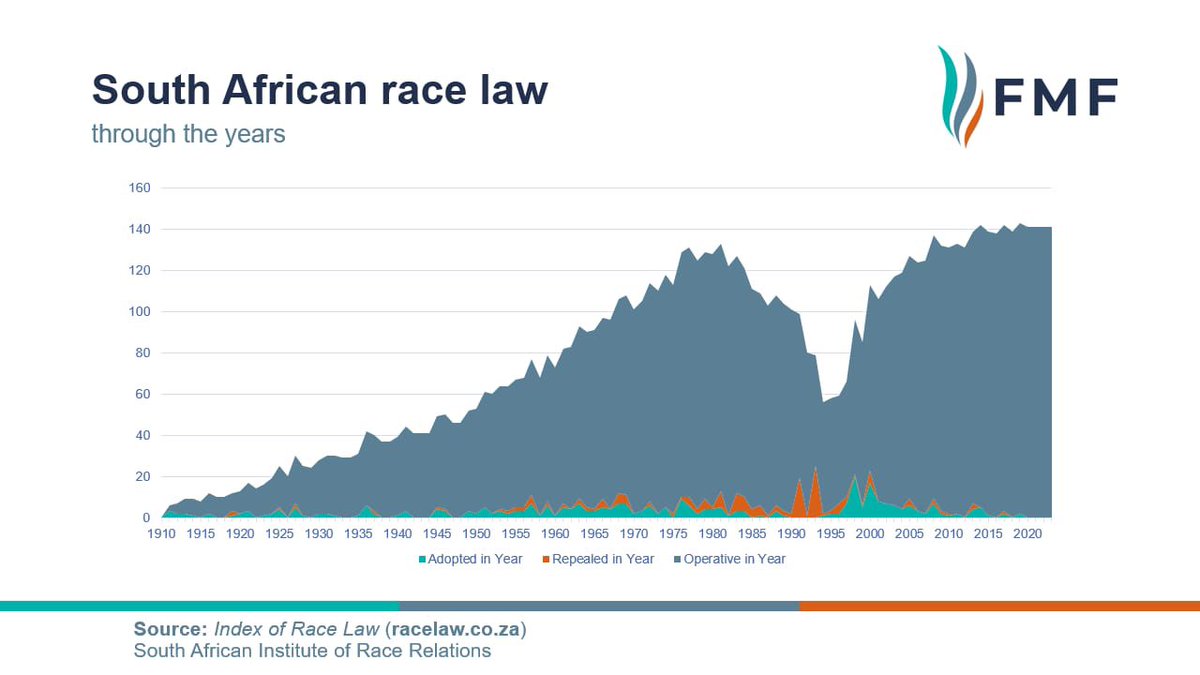
There are 142 race based laws in operation in South Africa. During Apartheid these types of laws discriminated against not white people. Since 1994 they have been reversed to discriminate against non black people.