Just random though, how fast this applied AI feild is, very difficult to trust one finding. One day we stick on one result next day we have sth else.
@OpenAIDevs@huggingface@dair_ai
Open source. MIT license.
3 pinned repos, bootstrap CIs, LLM judge calibrated at κ=0.806, gold answers never leaked to providers.
Every result is reproducible.
Submit your own method → SUBMISSION.md
https://t.co/YvhjA3EOmn
#RAG#LLM#AI#CodeSearch#Benchmarks
At V=10,000 (production scale) the table flips completely:
★ rag-bm25: 1,145 tok/correct ✅
graphify: 1,537
repo-map: 8,055 (7× worse)
raw-dump: 80,086 (70× worse)
raw-dump pays 80k tokens per query. Forever. V never helps it.
So which method should you use?
V=1 (one-off): repo-map
V=100 (small team): repo-map still competitive
V=10k (production): rag-bm25
And regardless of method — model choice matters more than retrieval on hard tasks.
We benchmarked 5 codebase retrieval methods on 510 tasks.
The "best" method changes completely based on 1 number most people never ask.
Here's every finding :
Most "10x token efficiency" claims hide one move:
They pick the query volume (V) that makes them look best.
RAG at V=1: 257,824 tokens/correct answer
RAG at V=10,000: 1,145 tokens/correct answer
Same method. 225× difference. We report both. Always.
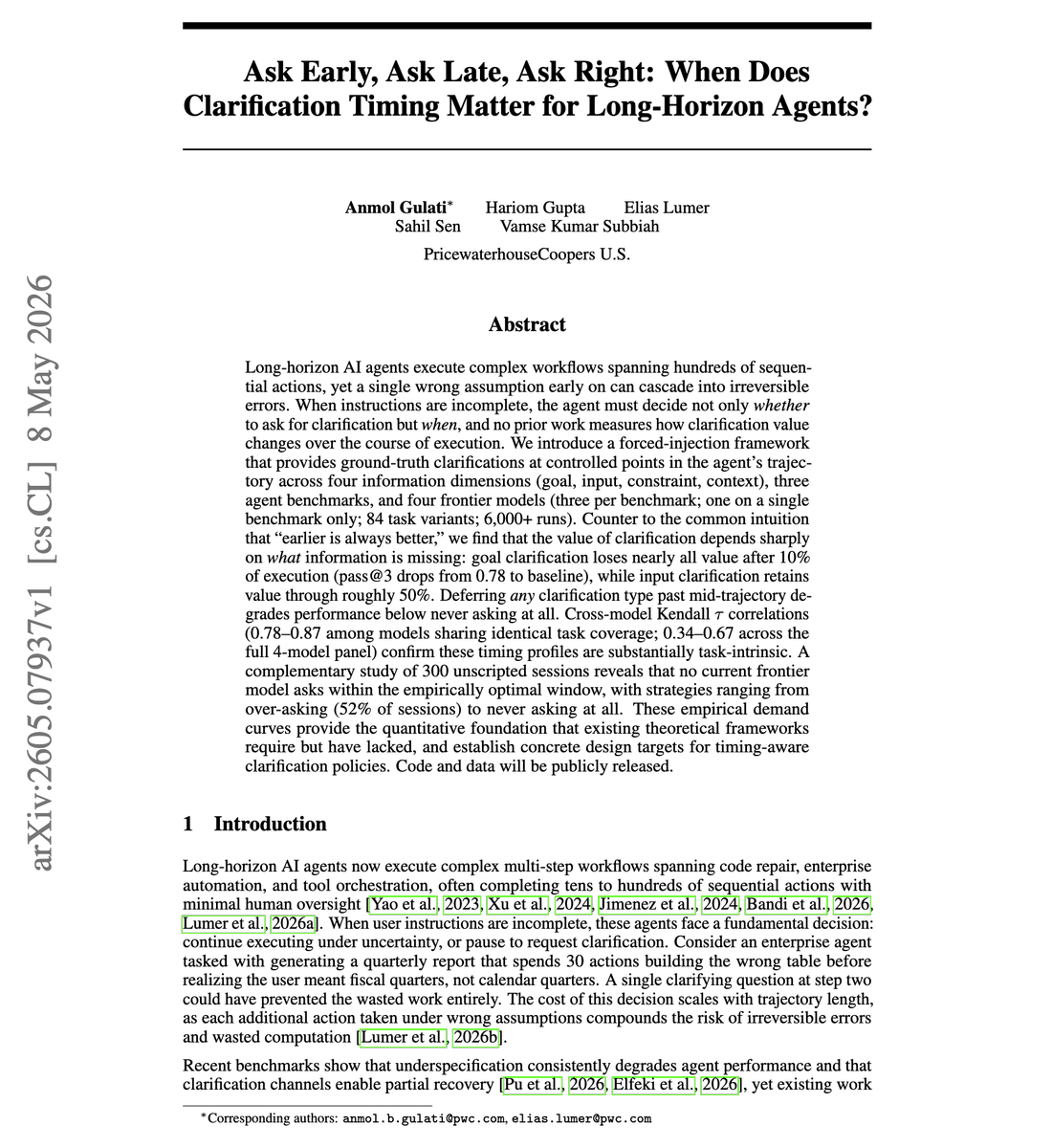
Cool paper from PwC.
"Earlier is always better" is the default intuition for agent clarification. New paper claims that's mostly wrong.
Goal clarification loses nearly all of its value after just 10% of execution.
The team built a forced-injection framework that drops ground-truth clarifications at controlled points along a long-horizon agent's trajectory, across 4 information dimensions (goal, input, constraint, context), 3 benchmarks, and 4 frontier models. 84 task variants, 6,000+ runs.
Pass@3 falls from 0.78 back to baseline. Input clarification keeps value through roughly 50%. Past mid-trajectory, asking any clarification at all performs worse than never asking.
A complementary study of 300 unscripted sessions shows no current frontier model asks within the empirically optimal window. 52% of sessions over-ask. Others never ask at all.
Why it matters: clarification has been treated as a binary capability, does the agent ask or not. This is the first quantitative demand curve for *when* the question is worth asking.
Paper: https://t.co/U4prpHjKgP
Learn to build effective AI agents in our academy: https://t.co/LRnpZN7L4c