Hej alla vänner/följare! Nu finns reportaget med mig uppe på https://t.co/X6qYR3eyfJ. Reportaget handlar om mitt liv och mina diagnoser. Ett väldigt bra reportage och en väldigt bra intervju. Jag är riktigt nöjd måste jag säga. Läs gärna!❤️🙏
Stort tack alla goa, fina, härliga och varma människor där ute som uppmärksammar mig idag på min stora dag.🎉🎂🥳 Det värmer verkligen måste jag säga. Och det känns ända in i mitt numera 29-åriga hjärta.❤️
Tusen tack!🙏
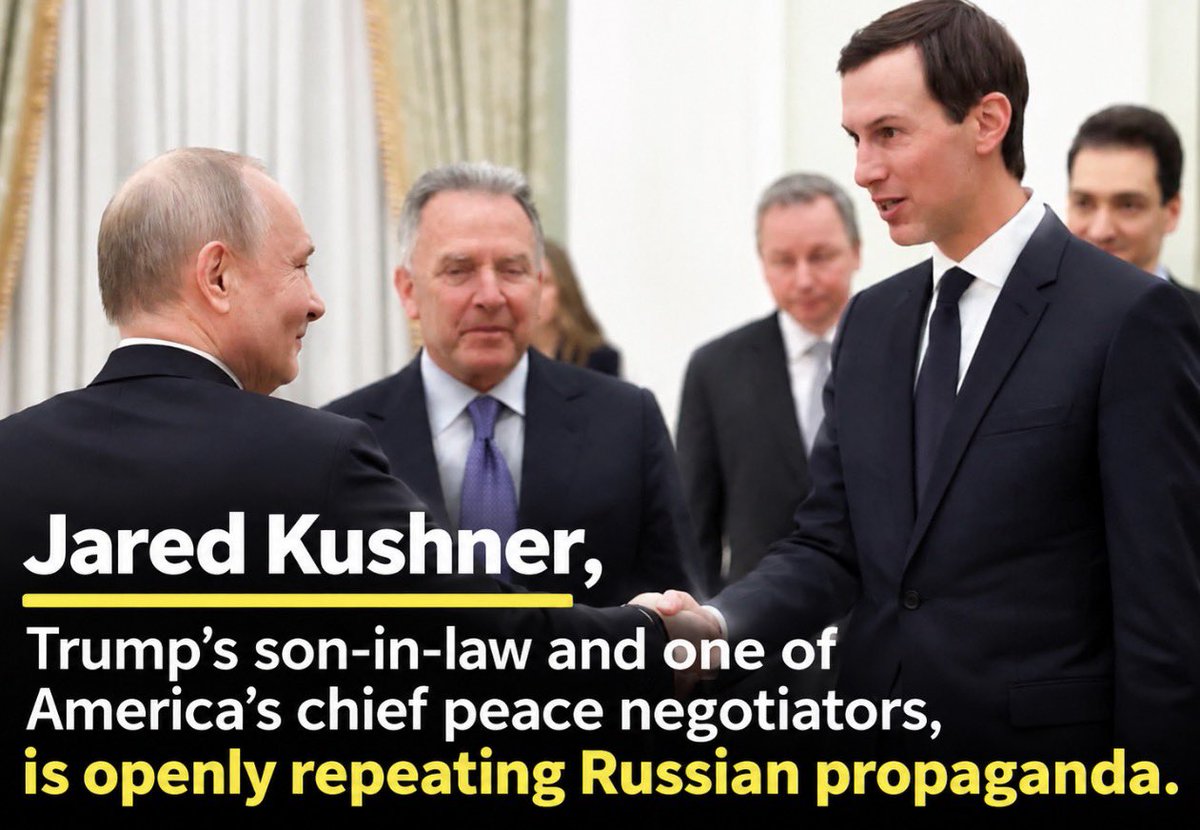
Jared Kushner, Trump’s son-in-law and one of America’s chief peace negotiators, is openly repeating Russian propaganda.
In his recent interview, he praised Putin, portrayed Russia as a country responding to external threats, and even credited Putin with showing restraint by not using nuclear weapons.
Former Ukrainian Prime Minister Arseniy Yatsenyuk challenged these narratives. Let me address eight of them.
1. Biden provoked the war by inviting Ukraine to NATO.
Ukraine never received an invitation to join NATO under Biden.
Russia invaded Ukraine in 2014, when Ukraine was officially a non-aligned country. It was precisely because Russia invaded Ukraine that Ukrainians abandoned their non-aligned status.
2. Europe is waging a proxy war against Russia.
No. Russia invaded Ukraine, and Europe is helping Ukrainians defend themselves.
In March 1941, nine months before the attack on Pearl Harbor, the United States passed the Lend-Lease Act to help countries fight Nazi Germany.
Would Kushner also argue that America was waging a proxy war against Germany and that Hitler was simply defending his country?
3. Ukraine attacked Putin’s residence.
This claim was rejected by U.S. intelligence. Even Trump himself subsequently dismissed it.
Why is an American negotiator repeating Russian claims that his own country’s intelligence services have contradicted?
4. Putin has shown restraint.
Russia has killed thousands of Ukrainian civilians, destroyed entire cities, and deported Ukrainian children.
And now we are supposed to praise Putin because he has not used nuclear weapons?
Let me remind you that Ukraine gave up the world’s third-largest nuclear arsenal in exchange for security assurances, including from Russia.
Twenty years later, Russia invaded Ukraine.
5. Putin wants peace.
On March 11, 2025, Ukraine accepted the American proposal for a comprehensive 30-day ceasefire. Russia refused.
Putin does not need permission from Trump, Zelenskyy, or European leaders to end this war.
He can simply order his troops to leave Ukraine. He could do it today.
But he chooses not to.
6. Ukrainian and Russian soldiers do not hate each other.
How can anyone make such a sweeping statement?
Ask Ukrainians who survived Russian captivity and torture. Ask the mothers who buried their sons. Ask the children who lost their parents.
And remember one fundamental distinction: Russian soldiers came to conquer another country. Ukrainian soldiers are defending their own.
7. Putin deserves credit for prisoner exchanges.
Every prisoner exchange is welcome. But presenting these exchanges as evidence of Putin’s humanity is absurd.
Ukraine is able to bring its soldiers home because Ukrainian forces have captured Russian soldiers.
Putin should also release the Ukrainian civilians and children Russia has unlawfully taken.
8. Ukrainian territorial concessions are a matter of compromise.
As someone who has spent years studying and teaching negotiation, I find this particularly disturbing.
Russia invades another country. Ukraine is pressured to surrender its own territory. Russia gets rewarded for its aggression.
What incentives does this create for Putin and other dictators around the world?
If invading another country allows you to gain territory, why wouldn’t you do it again?
Kushner called Putin a historical figure and a political grandmaster.
Yes, Putin will go down in history. So did Hitler and Stalin. Being a historical figure is hardly a compliment.
What concerns me most is that America has some of the best intelligence services, historians, economists, and geopolitical experts in the world. Yet its chief negotiators are repeating arguments that could have come directly from the Kremlin.
You cannot negotiate a just and lasting peace when you refuse to distinguish between the aggressor and the victim.
Här är en liten selfie med tre av mina favoriter i IK Oskarshamn: Ville Svensson, Joel Svensson och Danny Dzhaniyev. En bild som jag fick ta för drygt 20 min inne på Flanaden.
PS: Ville Svensson längst till höger visste tydligen vem jag var. Hur? Svaret är TikTok!
Godmorgon! Jättestort tack för alla grattishälsningar på både Facebook, Instagram & Snapchat idag på min 29-årsdag. Det uppskattas något enormt.🎉🎂🥳
I eftermiddag blir det födelsedagsmiddag på Pinchos här i Oskarshamn tillsammans med både familj och släkt.❤️
Jared Kushner, Steve Witkoff, and Donald Trump are reportedly worried their inability to force Ukraine’s surrender will lead to a Russian revolution or coup that ousts Vladimir Putin, and all the lucrative, backend deals they’ve made with him will amount to nothing.
— The Halfway Cafe
Jared Kushner: “Which pressure did President Trump put on President Zelenskyy? [...] I think that’s a lot of misinformation.”
🔴The journalist didn’t do a good job answering this question, so I’ll try:
- Stopping all U.S. aid to Ukraine since the Trump administration came to power.
- Europe suggested purchasing military aid for Ukraine through the PURL program. However, Patriot missiles that have already been purchased and are desperately needed to defend civilians are reportedly being held by the Pentagon and not released to Ukraine.
- Prohibiting allied countries from transferring Patriot anti-ballistic missiles from their own stockpiles to Ukraine.
- Shutting down Ukraine’s access to Starshield and Starlink.
- Halting intelligence sharing with Ukraine.
- Blackmailing Ukraine into stopping strikes on russian oil refineries by suspending Starshield access.
- Blaming Ukraine for high gas prices, which are actually a consequence of the American war in Iran.
- Lifting oil sanctions on russia.
- Purchasing russian diesel. This is particularly interesting since the diesel was reportedly never delivered because the purchase violated CAATSA and other applicable laws. Does this mean that Washington effectively gave russia billions of dollars without receiving the diesel?
- Inviting Putin to Alaska, the G20 summit in Miami, and meetings in China, effectively bringing him back onto the international stage without securing any concessions.
- Presenting a 28-point plan containing russian demands to Ukraine as an American initiative.
- Pressuring Ukraine to give up Donbas and other territories.
- Calling for elections in Ukraine and calling Zelenskyy a “dictator,” while referring to Putin as a “president.”
- And why on earth are both Kushner and Döpfner using the term “regime change” when referring to Ukraine while simultaneously calling Putin a “president,” which he clearly is not? Unlike russia, Ukraine has a democratically elected president whose approval rating remains above 50%, according to polling. Furthermore, holding elections during martial law is prohibited under Ukrainian law and is a highly unpopular idea among Ukrainians during the full-scale war.
🔴There are so many examples that I don’t have enough space on Twitter to list them all. Please leave more examples in the comments.
--------------------------------------------------------
Mathias Döpfner: Why did President Trump put so much pressure on President Zelenskyy, and why did he do a diesel deal with russia? Why did he call Putin in China “my friend”? Aren’t those gestures that are simply strengthening Putin’s power at the negotiation table?
Jared Kushner: Which pressure did President Trump put on President Zelenskyy?
Mathias Döpfner: Well, we remember the meeting in the White House many months ago. We remember also some recent remarks about European support for Ukraine. We also remember some remarks basically almost asking for regime change or government change in Ukraine. Or the call to make concessions. So the impression is that there is increasing pressure on Ukraine and its president. He has to make a compromise, not the russian side.
Jared Kushner: But that’s not the approach we’ve taken. I think that’s a lot of misinformation. So, number one, we have not put any pressure on President Zelenskyy or the Ukrainians. Our job is to be a mediator. In fact, we’re actually supporting them. We’re giving them intelligence sharing, and America’s been their biggest donor in this war. So President Trump’s posture has been one of support.
Source and attribution:
Mathias Döpfner: CEO of Axel Springer, POLITICO’s parent company, and host of the MD MEETS podcast.
Jared Kushner: U.S. Special Envoy for Peace and President Donald Trump’s son-in-law.
Date: November 25, 2026.
We want to strengthen ties between Europe and the US. And we also think it's important to strengthen the ties with Europe and Russia.
And I wouldn't say Putin doesn't want them at the table. I think he doesn't think they have good intentions just like Europe doesn't think Russia has good intentions. And so again we're the mediator. We're talking to both sides and everyone's assuming these intentions without talking to people.
And so through building these links and having these discussions and it will take a little bit of time. I wish there was a fast way to do this. Hopefully both parties will realize that they all want peace. There's a lot we agree on.
We all want long-term peace. We should design things that are win-win where everyone's better off because of it. And I think once we're able to define that post-war relationship, I think the issue of territory will become much easier to resolve because right now there's no way to bridge that last issue. And again, this is this is the best approach we could think of.
This is an impossible problem. Nobody's been able to solve this. But I do believe that when people see long-term durability and a pathway to peace, I think they'll be a little bit more flexible on where do you draw the line. I mean, after all, most lines in Europe have changed over time and they're decided from wars or peace or compromise. So, I do think we're going to need to decide on a line.
And this isn't about fairness or who's right or wrong. It's about how do we end the killing and create a better life for people going forward.
13/14 from my conversation with Mathias Döpfner
So look we prepare very carefully. Our team is mixed up of State Department, Intelligence, National Security, military folks. So we have a very strong team that helps us do the preparation for it.
We have constant communication obviously with President Trump with President Putin's aides with Yuri Ushakov his closest aide and national security adviser who's been incredible. Kirill Dmitriev who's been really an incredible friend of mine. We worked together in the last administration on the OPEC plus oil cuts. If you remember when COVID was starting, the oil prices started, going down to negative because Saudi and Russia were both overproducing. President Trump wouldn't intervene and then he called me and said, "Can you try to make a deal?" And I worked with Kirill and with the Saudis and we were able to get the biggest cut in oil cuts in history. And that actually saved a lot of the American energy market because we're running out of storage basically. And then actually Kirill during COVID we were having real issues in New York with ventilators and with PPE and the first country that ever sent us a plane of supplies was the United Arab Emirates. They were well prepared and organized and they wanted to help. The second country was Russia and that was an initiative that Kirill Dmitriev led he really is somebody who's educated in America wants a stronger relationship with the West and thinks that it's in Russia's interest to do it. So he's been a strong advocate for peace. And then we have we have Vladimir Medinsky as well who's been very helpful as well. So we prepare very carefully with them going into the meetings.
President Putin is very organized. People can like what he's done. They cannot like what he's done but he's definitely a grandmaster of politics. He's a historic figure. He's done he's always very, very well-prepared. He's very thoughtful. He takes a lot of notes when we're speaking and then he transmit very specifically. But it's very clear he has a very deep understanding of the issues. He has some very strong perspectives on them. But my assessment is that he does not only want peace, he wants to try and change the relationship with America and he does want to try and see if there's maybe a way to start a new beginning.
And so again, the first thing, who knows if that's truly the intention and who knows if that's possible, but you always have to start with sitting with somebody who maybe you don't necessarily agree with or who you always have to start with sitting with somebody who holds the power to make that change. And if you can, come to an agreement with them on what the outcome is, that's a first step towards trying to change something, that could lead to a different outcome for many people around the world.
10/14 from my conversation with Mathias Döpfner
Hej alla! Idag blev det en dag med innebandy på Oscarsgymnasiet. Till största delen för att kolla på Craftstadens IBK ( Fighters ). Men också för att kolla på Kalmar-laget Cl98 och min gode vän Samira Rahimi.
Russland und die Vereinigten Staaten haben sich im Kern bereits darauf geeinigt, den Ukraine-Konflikt zu beenden.
Präsident Putin hat klar gemacht:
Moskau hat die amerikanischen Vorschläge – einschließlich der von Präsident Trump vorgelegten Kompromisse – akzeptiert und ist bereit für eine realistische Friedenslösung auf der Grundlage der tatsächlichen Lage vor Ort.
Was den Frieden blockiert, ist nicht Russland, sondern die Europäische Union.
Die politischen Eliten in Brüssel und in mehreren europäischen Hauptstädten verfolgen keine echte Friedensagenda.
Selbst wenn sie vorgeben, Anpassungen an den amerikanischen Vorschlägen vorzunehmen, zielen diese Änderungen in Wahrheit darauf ab, den gesamten Friedensprozess zu sabotieren – um anschließend Russland die Schuld zuzuschieben.
Für diese Akteure ist der Krieg politisch nützlich:
Er dient als bequemer Sündenbock, hinter dem sie ihre eigenen innenpolitischen Versäumnisse verbergen können – bei Wirtschaft, Migration, Industriepolitik und öffentlicher Sicherheit. Ohne den „russischen Feind“ würden die Bürger in Europa die Verantwortung dort suchen, wo sie hingehört: bei der inkompetenten, weitgehend ungewählten EU-Bürokratie und den etablierten Parteien.
Russland will den Krieg beenden. Die USA arbeiten hinter den Kulissen mit Moskau daran. Die EU hingegen braucht den Konflikt offenbar, um an der Macht zu bleiben. Wer den Frieden wirklich will, muss die Realitäten anerkennen – statt weiter Blockade zu betreiben.
@LBoork@HolmgrenJohan Sluta be folk att vårda språket Leffe!☝️Man måste få uttrycka sina åsikter mot svenska spelare som väljer att spela i krigsdiktaturen Ryssland. Sen så måste folk också få använda sin yttrandefrihet.
Jag läste precis igenom kommentarsfältet på Kalmar HC:s Facebook-sida! Och många KHC-supportrar verkar skylla kvällens 5-2 torsk mot IKO på domarna. Vilket jag, som är IKO-supporter delvis kan hålla med om. Men samtidigt så kan man inte alltid skylla på domarna vid varje förlust.
🚨 MAJOR BREAKING: ZELENSKYY FIRES BACK AT TRUMP OVER PUTIN INVITATION, QUESTIONS EVERYTHING ABOUT WASHINGTON’S COMMITMENT TO UKRAINE!
In a blistering statement, Ukrainian President Volodymyr Zelenskyy says Trump’s decision to invite Vladimir Putin to Florida has forced him to rethink everything about America’s role in the war.
“I have to question everything now.
How can President Trump invite Vladimir Putin to Florida and host him at his own golf resort while Ukraine is still fighting for its survival?
Where is Ukraine in all of this?
The United States is a NATO ally. NATO has repeatedly condemned Russia’s aggression against Ukraine. Yet suddenly, President Trump is presenting Putin as a friend and welcoming him to the table as though nothing has happened.
Our people are dying. Our cities are being attacked. Our soldiers are defending their homeland.
And the man responsible for this war is being offered a prestigious seat at a summit hosted by the American president.
What message does that send to Ukraine? What message does it send to our allies? And what message does it send to every country watching this conflict?
President Trump calls himself the President of Peace. But peace cannot mean rewarding aggression. Peace cannot mean giving Putin diplomatic recognition while Ukraine is still paying the price.
If this is how America intends to pursue peace, then Ukraine has every right to question what its partnership with Washington truly means.
We want peace. We want an end to this war.
But we will not accept a peace that treats Ukraine as an afterthought while the aggressor is welcomed like a guest of honor.”
Ukraine is not a bargaining chip. And peace cannot be built by making the victim feel betrayed.
Oficial: Trump invita a Putin a Florida.
Trump confirma que Vladimir Putin está invitado a la cumbre del G20 en su resort de Doral (Miami), los 14 y 15 de diciembre.
Un movimiento que solo él se atreve a hacer.
Sus palabras:
“Si quiere venir, por supuesto que puede. ¡A algunos no les gustará… y me da igual!”
“Cuando Putin estaba en el G8, Obama lo sacó. Si lo hubieran dejado dentro, probablemente esta guerra no existiría.”
“Yo nunca habría votado por echarlo. Si de mí hubiera dependido, Rusia seguiría dentro.”
“Lo creo firmemente: si no lo hubieran expulsado, no tendríamos esta guerra hoy.”
Mientras otros provocaron el conflicto con gestos simbólicos y debilidad, Trump abre la puerta a la negociación real en su territorio.
El Kremlin aún no confirma si Putin viaja. El mensaje de Trump ya está dado.