@anymanfitness@WellBuiltStyle Can I talk you into coming to STL to try out the QuickHIT Pinnacle, which is a robotic resistance machine that allows for perfect execution of all of your points above (except the last two since you only need one set on each movement to get you to momentary muscle failure)?
@AndyMasley My favorite is when I’m in a conversation with someone talking about a movie or series based on a book or book series and someone says “the book is better”, I respond with “I didn’t know they made that into a book”.
@luke_broyles I directionally agree. But taken to its logical conclusion, that drives the cost of labor (and land) to zero, which makes the cost of living zero since every good or service we require is simply a function of the sum of all required labor to produce said good.
This is a great conversation @RayDalio and @elonmusk!
Is there room for the US to re-shore manufacturing? Absolutely!
Will it take the proper incentives to make that happen? Also yes.
But if viewed through a output/capita lens…not so bad.
https://t.co/VkwI6Xx28h
Thanks for the correction, @elonmusk. It’s great that we can have a good exchange about such economic things. When I said Chinese manufacturing production is greater than that of the US, Europe, and Japan, I meant to say that it is greater than the US, Germany, and Japan combined. (I was talking too fast and was a bit sloppy.) But the numbers in Grok are right and still striking, so the point remains the same, which is that China is the dominant player in global manufacturing. Your numbers and my numbers both show that China manufactures ~30%, the US manufactures ~15%, Germany manufactures ~5%, and Japan manufactures ~6% (total of ~26% vs. China’s 30%). If you adjusted these numbers to reflect that the Chinese typically sell comparable items cheaper, the magnitude of Chinese manufacturing would be even more striking. (By the way, I thought Grok’s answer and analysis on this were great.)
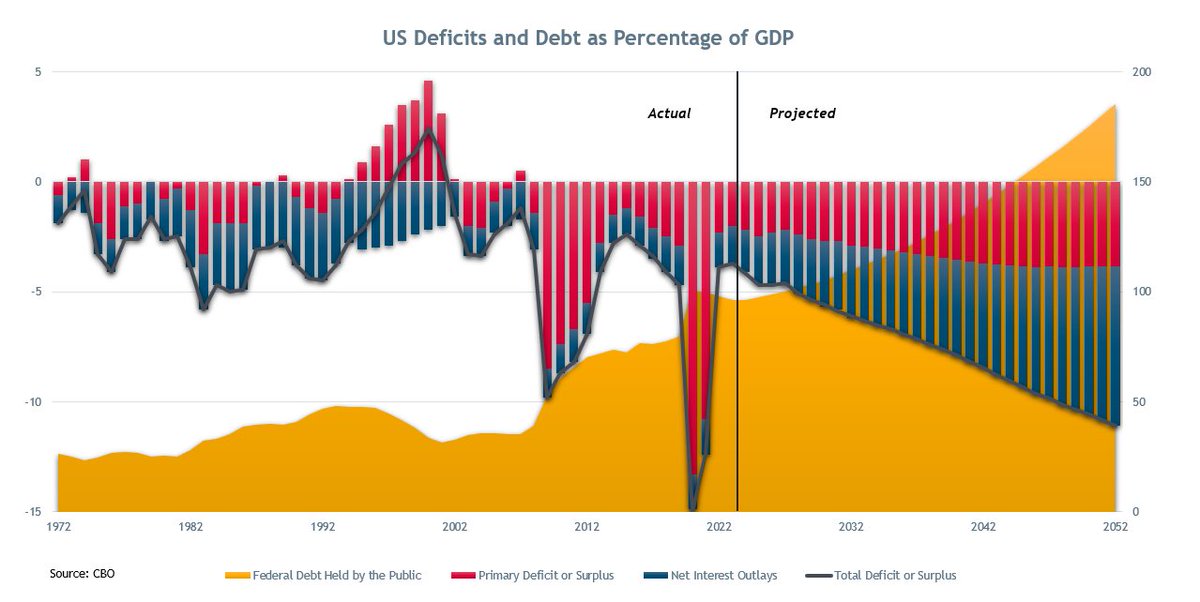
While we’re exchanging thoughts, I think that if we don’t get the US budget deficit down to about 3% of GDP, there will be too much supply of US bonds relative to the demand for them, which will produce real problems. What do you think? Here’s my more in depth view: https://t.co/UZxHa1YYEj
@jameslavish Totally agree, keep stacking. But not sure what that has to do with eggs and corn. Eggs are simply a function of corn, soymeal meal and some overhead/conversion costs. So if corn and soymeal are very cheap (they are) why are eggs so expensive? Hint: it’s not monetary supply.
@anymanfitness This is all great and I agree with almost all of the thread. Though, I’m surprised you mention oats over potatoes based on previous posts.
And what about eggs? Not a super efficient source of protein but many micros and quite satiating.
@MartyBent Both of those are possible. Unfortunately, neither would surprise me. But, it could also be that derailments happen all the time…an average of ~1700/year from 1990 to 2021.