You're jumping from "People don't understand everything" to "Therefore they shouldn't participate in governance."
Those are not the same claim.
You nailed the underlying issue: As societies become more technologically and institutionally complex, the average citizen understands a smaller percentage of the systems that govern their lives.
But even experts understand a mere sliver of their respective fields. The pages of history are littered with examples of smart people taking us down catastrophic roads:
- 2008 Financial Crisis
- Iraq War
- 2020 Pandemic
So the first question is about Democracy itself. Is it a method for selecting correct policies or is it a mechanism for peaceful legitimacy?
If Democracy is a mechanism for selecting correct policies, then your post has teeth.
If voting is fundamentally an engineering problem, then why ask a truck driver, teacher, bartender, or pilot how monetary policy should work?
We don't vote on engine design. We don't vote on bridge construction. We don't vote on heart surgery techniques.
The logical conclusion is rule by experts.
But Democracy is not primarily a truth-finding machine. It is a violence-reduction machine.
Its purpose is to answer: "Who gets to wield power over everyone else?"
In that framework, the question is not:
"Who is smartest?" but "Who must live under the consequences?"
A farmer may know nothing about bond markets, but if tax policy affects his life, there is a strong argument that he deserves some say in who governs him.
And as I pointed out above, intelligence alone is unreliable. The failures behind those events wasn't stupidity. It was incentives, ideology, overconfidence, information problems, and groupthink.
A brilliant bureaucrat can still seek power. A brilliant politician can still chase reelection. A brilliant economist can still defend a bad model.
So I think the deeper issue you're hinting at is knowledge versus values.
Imagine we could identify the 10 smartest Americans.
Now ask:
Should taxes be higher or lower?
Should we intervene in foreign wars?
Should abortion be legal?
Should Social Security exist?
These are not IQ questions. They are value questions.
Even perfect knowledge does not produce a single answer. That's why Plato's philosopher-king has always been harder to implement than it sounds.
The problem isn't merely finding the wise ruler. It's that reasonable people disagree about the definition of wisdom itself.
The core problem is epistemic mismatch.
Modern governments make decisions about systems that almost nobody understands. This means that citizens must rely heavily on trust.
The average person cannot independently verify:
- central banking
- pharmaceutical research
- climate models
- software security
- military strategy
So politics increasingly becomes a battle over which experts to trust rather than a battle over facts.
The average voter isn't necessarily too stupid to understand. They're trying to navigate a system whose complexity exceeds any individual's capacity.
@BlueCheckSRM@ChiefEngineerCE If this only occurred at the Federal level I would agree with you, but it is no different at lower jurisdictions. Winner-take-all and first-past-the-post are detrimental to accurate voter representation.
@BlueCheckSRM@ChiefEngineerCE I'm not sure that's the correct policy, nor do I believe it would work. Not because you wouldn't see a change in politicians, but because there's no incentive for voters to change.
The system in which we vote must change first or we'll always get the same idiots.
@StealthVenom33@TNFreedom21 For years I gave people bad advice until I heard a presentation from @TennFirearms. Who knew Tennessee's firearm laws were so grotesque?!
@troubleshootr6@JohnRoseforTN Not every portion of every interstate needs 8 lanes. Not every portion of major highways need 4 lanes. This is a blind reaction to get votes, not an efficient use of scarce resources.
The money used to unnecessarily expand these roads could be used in other, more useful areas.
@JohnRoseforTN By doing what, exactly?
This is a trend across the United States and is, among other things, a direct result of unsound monetary policy and out of control spending.
That's because they essentially didn't exist yet. This would be like saying the average person today can't afford interplanetary travel or a robot butler.
I agree that homes tend to be larger so compared on a sq-ft metric there's not much change, but the price to participate has undoubtedly increased. Not merely in absolute terms, but in relative terms as well.
@Gnome4308 The only solution is to change the way we vote at the system level.
Winner-take-all and first-past-the-post incentivizes a two-party stranglehold on politics and disincentivizes voters from choosing independent and/or third-party candidates.
@Sarah4Texas@Unregul8ed@baylisswagner@lomikriel@RLCofTX Welcome to the club.
Sadly, Texas is just like Tennessee wherein we have no ballot initiative process to force them to change the way we vote.
Look into proportional representation. I think it's the only way forward.
It's pretty insane how reliant on technology we've become.
Have you ever gotten locked out of your email or social media accounts? Pretty frustrating, right?
I thought I was pretty slick with my account access limitations until I suddenly found myself locked out of everything.
Email. Bank. Social media.
Everything!
We went to see my niece graduate HS and stayed at a hotel with a pool. My kids are in that weird transition where they almost know how to swim. Almost.
So, the little guy starts having trouble and I jump into the pool to make sure he's okay.
Phone in my pocket.
In the past, I exclusively used the Samsung Galaxy. Great phone. Totally waterproof.
My wife is a fantastic photographer and her pictures would always come out better than mine. Most recently she used a Pixel, so I got one too, thinking that my pictures would also look great. (Spoiler alert: it's not the camera.)
In any case, I assumed this one was waterproof too. It is merely water "resistant." So of course it stops working.
No biggie, I think, I'll just let it dry out for 24 hours and it'll be fine.
48 hours later and it was still not fine.
Bag of rice, maybe?
Another 48 hours (great movie) and now I can see condensation inside the camera lens.
Good grief.
Long story short, my phone is still out of commission and I only now gained access to X and one email account. Not even a good one.
Still no bank access (though admittedly I could probably call them to get access).
Still no primary email access.
Still no social media access.
No way to conduct 2FA to get access to anything.
Talk about a weak link!
Moral of the story: Do NOT make your phone the epicenter of your online security regime.
@ProtonPrivacy makes an authenticator that you can sync between your phone and computer.
Consider cross-account access, too.
Anyone else have any recommendations?
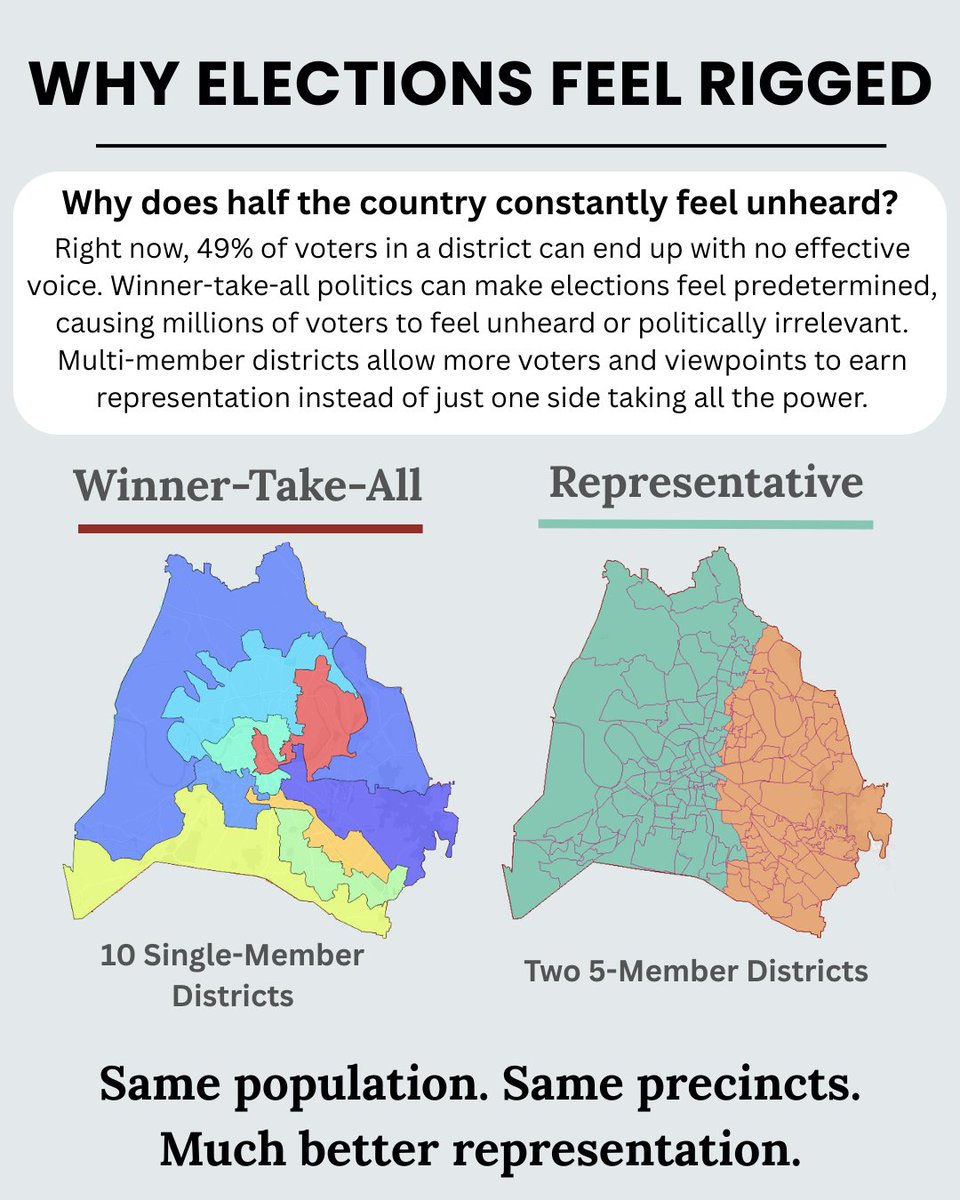
A lot of Americans—left, right, and independent—feel like their vote no longer matters unless they fall perfectly in line with one of two political machines.
That feeling isn’t irrational and it isn't rare.
Our winner-take-all politics means entire viewpoints can effectively disappear from representation, even when millions of people support them.
Maybe the problem isn’t just the candidates.
Or the maps.
Or the funding.
Maybe it’s the system itself.
Neither the Constitution nor the WPA gives the Executive the authority to go to war for 60 days for whatever reason they claim.
Please stop making false statements like: "Per the 1973 War Powers Resolution, the President must withdraw forces or obtain Congressional authorization within sixty days of starting combat."
This is merely the REPORTING requirement AFTER having authorization to introduce US forces into hostilities.
The reason everyone gets stuck on this 60-day timeline is because Congress is filled with a bunch of spineless politicians who are more concerned about doing the bidding of their party leaders than actually representing the best interests of the people or, God forbid, following the Constitution.