Joshua Haldeman, Elon Musk's Canadian grandfather, once gave an address over the CBC in 1948 entitled "Social Credit vs. Communism" where he argued that "Social Credit offers the only practical solution for opposing communism." That remains true today. https://t.co/wfOe5PvQQp
The state does not set prices; there are no price controls in DSC.
As for dividends, "dividend" is a capitalist concept. Are you opposed to the principle of profit and to dividends? How Marxist of you!
The DSC dividend is simply a measure of what people should be receiving in debt-free income if the financial system accurately reflected the physical facts.
There is no arbitrary intervention in DSC; it's the same type of intervention as a government regulating weights and measures so that they are standard throughout the economy and honest business can occur. Do you object to honest business also?
Do you think you have free market in the United States now? All rhetoric to the contrary, you are very far from that ideal. In fact, a DSC economy would be further to the right, in conventional terms, than any existing economy in the entire world, further to the laissez-faire ideal than any existing economy.
Put that in your pipe and smoke it: https://t.co/zCxriEeFk5
@RealSocred@OldDragon76 The state setting prices and government dividends are not free market concepts, full stop
Like all interventions, this one will fail, if anyone is silly enough to actually try it
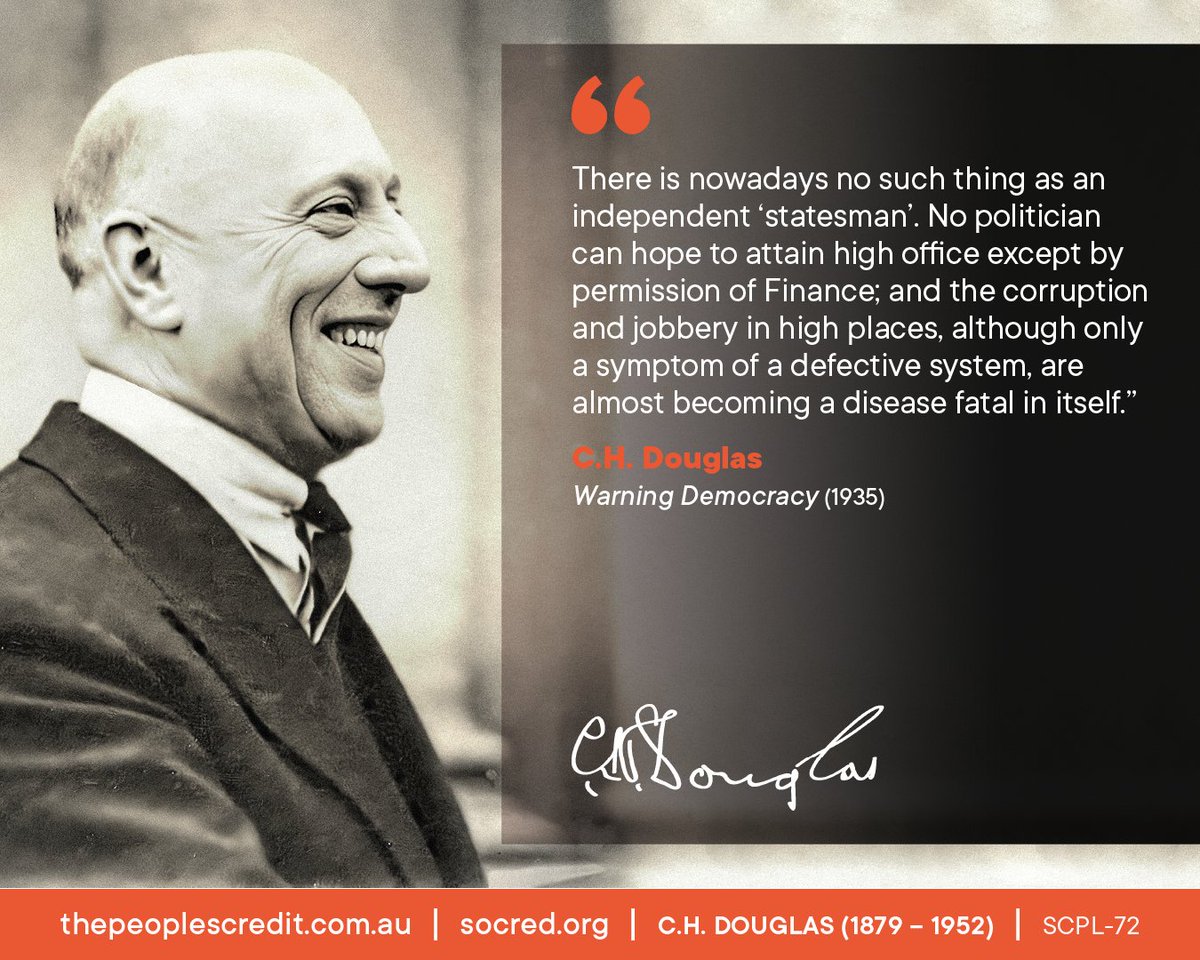
The monopoly on credit creation is the true ring of power. International finance provides the most consequential form of governance. They control our politicians like puppets.
Once you see it, you can’t unsee it. Douglas Social Credit is the antidote.
So, what is Douglas Social Credit?
Douglas was opposed to property taxes ... why? Well, just because you own a home or some land doesn't mean you have the purchasing power to pay the property tax. No one should lose their property because they don't have enough money to pay a tax. Property rights should be secure. https://t.co/xlzGDga1Ry
Government expansion and increased borrowing, and business expansion and increased borrowing, are, together with increased consumer borrowing (all money created by the banking system), some of the main ways in which the current financial system compensates for the recurring price-income gap: https://t.co/5LkoWxdxP3
The minute there is no longer any deficit-spending the gap will become painfully obvious. This is what happens whenever austerity measures are introduced and businesses then become unable to sell because purchasing power is lacking. Public debt is not irrelevant to the gap; it is one of the ways the gap is temporarily filled when private borrowing slows.
Now your objection assumes that a continuously rising private-debt-to-GDP ratio is the relevant test, but that is not what the DSC position requires.
Private debt as a share of GDP has risen over long stretches and fallen over others (especially after major deleveraging episodes). However the overall stock of societal debt—public at every level plus private—has continued to expand in absolute terms far faster than either population or the consumer market that it must clear.
In a self-liquidating system, where incomes already matched the prices of goods offered for sale, total debt would be expected to grow only in line with population and real capacity, which is on the order of about 1 percent a year.
Instead, total nonfinancial debt has compounded at roughly 7 percent a year for decades. That differential is the quantitative signature of the structural gap; private debt alone does not have to rise every year as a percentage of GDP for that observation to hold. Something like 7% as opposed to 1% (in line with real factors like population growth) is what we would expect if the financial system is not self-liquidating (as you assume it to be).
From Grok:
"Over the postwar period total nonfinancial debt rose from roughly $0.35 trillion in 1945 to about $84 trillion today—a 240-fold increase—while the consumer market (nominal personal consumption expenditures) rose from roughly $0.15 trillion to about $21 trillion, a 140-fold increase. Even though the compound annual rates look close (about 7 percent for debt versus 6.4 percent for consumer spending), the absolute dollar expansion of the debt stock has been roughly four times larger than the absolute expansion of the consumer market it is used to clear."
Also from Grok:
"In a self-liquidating system the absolute stock of debt would expand at the same rate as the consumer market it clears, so the two would grow in parallel; the observed fourfold larger absolute expansion of total nonfinancial debt relative to consumer spending is direct evidence that the system has not been self-liquidating and that continuous net debt creation has been required to bridge the gap."
"Whatever the deeper causes, the long-run record shows total societal debt expanding in absolute terms substantially faster than the consumer market it is required to clear, which is the core quantitative claim of Douglas’s analysis."
https://t.co/alYc5JFgVt
It is nothing short of tragic how susceptible we are, en masse, to manipulation. There was a time when I believed that becoming the 51st state was Canada’s best option. I thought then that Trump was standing against international finance, globalization and the powers that be. I was wrong. It is becoming increasingly clear, to those paying attention, that we are being herded toward centralized control. Trump did not drain the swamp; he is soaking in it. Much of what was MAGA has realized this, however there is a large group of Canadians that now believe Trump is our savior. Wake up, people. Carney and Trump both represent oligarchical interests, not their constituents.
@ThevoiceAlexa@RebelNewsOnline Meanwhile 91% of Carney's personal investments .... are in the United States. Judge politicians by what they do, not by what they say. https://t.co/TykBFxqgdc
It is nothing short of tragic how susceptible we are, en masse, to manipulation. There was a time when I believed that becoming the 51st state was Canada’s best option. I thought then that Trump was standing against international finance, globalization and the powers that be. I was wrong. It is becoming increasingly clear, to those paying attention, that we are being herded toward centralized control. Trump did not drain the swamp; he is soaking in it. Much of what was MAGA has realized this, however there is a large group of Canadians that now believe Trump is our savior. Wake up, people. Carney and Trump both represent oligarchical interests, not their constituents.
If you have to produce more stuff in order to distribute income so that you can purchase what you have already produced, the extra production is not in any absolute sense necessary. It's only financially necessary because of the dysfunctionality of the existing system.
See the Profit and Loss Account that was prepared for the USA:
https://t.co/ry5a9GQVGY
All the answers for the mass migration crisis and all our other social problems can be found in the anti-socialist, anti-totalitarian set of proposals for monetary reform in the common interest of the citizens known as Douglas Social Credit. It was a big deal in Canada just a few decades ago, but has since been sent down the Orwellian memory hole: https://t.co/sg927fB05W
Central banking parasite Mark Carney has just announced his plans to increase immigration into Canada. Despite, the electorate being VERY opposed.
I hear many organizations being critical of mass migration, oddly enough though, not one of these groups focus on the primary causational factor.