Assistant Prof at USNWC studying nuke deterrence. Formerly @AF_Academy. Ph. D. grad in Poli Sci @Yale. @NotreDame grad. Sports nerd. All views are my own.
How do nuclear weapons affect conventional conflict? In a new article published today in the Texas National Security Review, I explore this question by examining whether and how threats of conventional military victory can coerce nuclear adversaries https://t.co/Nhq5YZqUTp 1/
Meaning that the US should also invest in strengthening its nuclear industrial enterprise should a new nuclear arms race prove unavoidable. I hope you enjoy reading the article and I hope it contributes to the conversation on new directions in US nuke strategy! 4/4
In a new commentary for @WarOnTheRocks, I argue that the US should approach a tripolar nuclear world with a degree of self-restraint https://t.co/Xi5phAxFuz 1/4
This could support the pursuit of a new trilateral strategic nuclear arms control framework and perhaps avoid an arms race for which the US is ill-prepared. Of course, such restraint may not be reciprocated by China or Russia 3/4
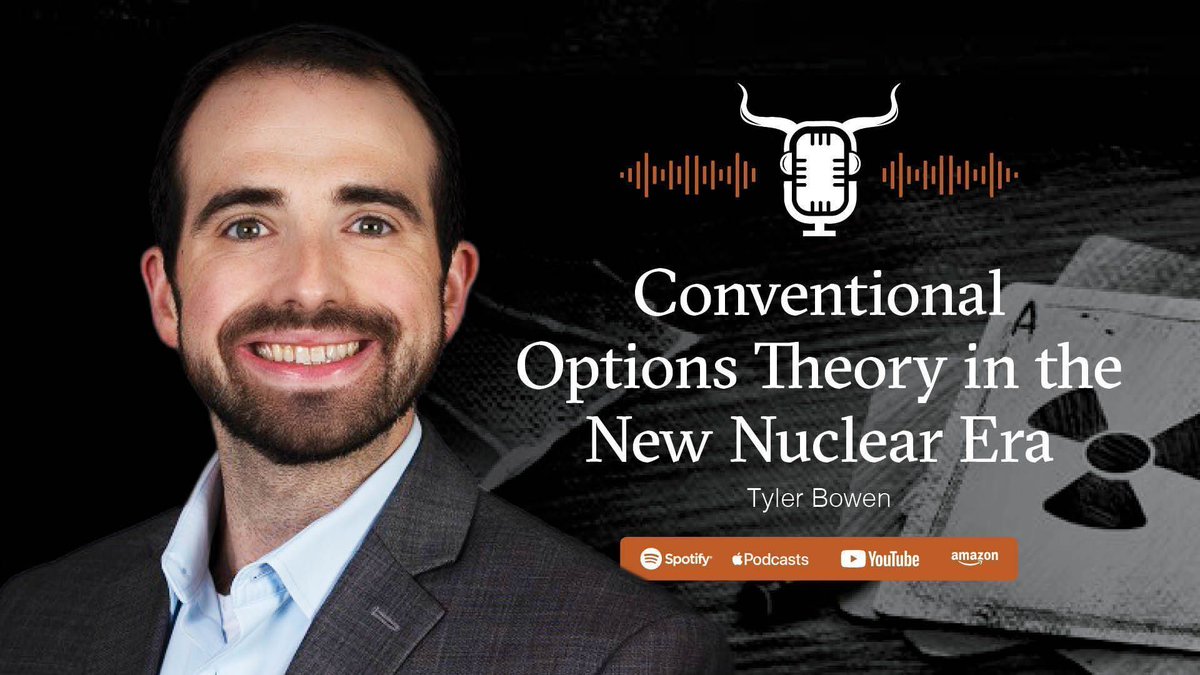
Check out the latest Horns of a Dilemma podcast where I discuss my research on whether and how nuclear powers can use the threat of achieving conventional military success to coerce their nuclear rivals. It also includes some discussion of current nuclear challe nges and debates!
How can states use conventional military force effectively against a nuclear-armed adversary? By striking a balance between operational success and escalatory restraint. Tyler Bowen (@RealTylerBowen) joins us to discuss.
https://t.co/JqKgNvo6oZ
#NuclearDeterrence#NatSec
Improvisation in a nuclear crisis is a recipe for disaster.
In our latest, Tyler Bowen (@RealTylerBowen) argues that avoiding escalation requires preparation. Leaders must define "limited" conventional options—like specific geographic boundaries—long before the shooting starts.
There are so many ppl to thank that I can't shout them all out here, but suffice to say I am grateful for the consistent support of mentors and colleagues in conducting this research. If you want to read more, click on the link here. Read it, cite it, love it.
How do nuclear weapons affect conventional conflict? In a new article published today in the Texas National Security Review, I explore this question by examining whether and how threats of conventional military victory can coerce nuclear adversaries https://t.co/Nhq5YZqUTp 1/
They also need a strong nuclear retaliatory capability. Together, these two conditions persuade an adversary to concede to a state's demands rather than escalate. Conventional coercion is thus possible, but requires a state to thread a fine needle. 4/
Oklahoma City. City of champions. It has been intoxicating to watch a team be this unequivocally awesome all season long. And they bring it home. #ThunderUp
We won't know the outcome of these strikes on Iranian nuclear facilities for a long time. But I keep coming back to one thought. Many states use military force thinking that it will be limited. Many have been wrong.
@fahdhumayun Not to mention that in the Kargil War and Operation Parakram, the US was engaged in extensive diplomacy to mediate between the two sides. And something tells me that the US will not be so active this time
just saw someone say baseball is boring and it brings me no pleasure to report that no it is not. it is actually very fun to sit there and drink a beer and eat a hot dog and yell at guys who are far away
Me: Got in 8,000. Feeling content
My coworker, rubbing a banana peel on his face, hasn't said a word all meeting: "so looking at it bro we gotta get in at least 10,000"