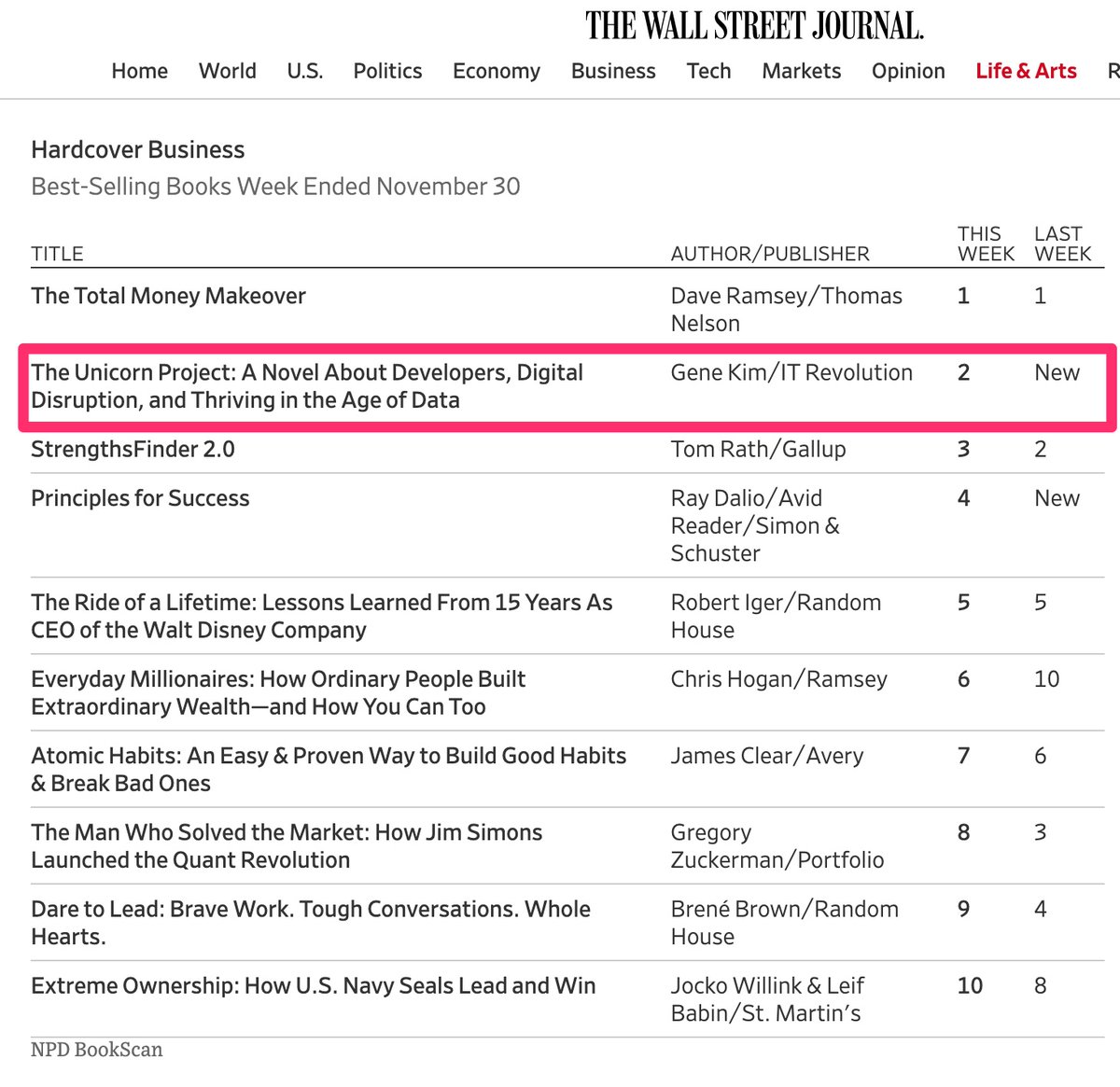
Holy cow. The Unicorn Project is on the Wall Street Journal bestseller lists!!!
#2 in Hardcover Business category!
And astonishingly, it’s also #8 across all Non-Fiction E-Books!!!
A DevOps book!! 🤯🤯🤯
🙏❤️🦄🌈
Paywall: https://t.co/2nEeC2HDMg
#UnicornProject
Fable one-shotted a Rust rewrite of the TerminalTextEffects Python library in 11M tokens. Startup time went from 87ms to 2ms and rendering speed is up by 9.6x. Now zero dependencies and a 3mb single exec 🤯 https://t.co/3cTEQAqYdO
There's a lot to digest in @Steve_Yegge's latest post, but I particularly enjoyed his process of "breaking" CI/CD with his agent swarm, and the solution he arrived at.
https://t.co/WiKYbYhpGU
Read @Steve_Yegge's post on the Continuous Thunderdome. You should check it out! https://t.co/A2D25b290o. wrt to "The Metamorphosis of CI/CD" I will humbly (lol) note that in the Continuous Delivery book (2010), we discuss what to do when your tests take too long to run, which is to create a deployment pipeline. Run a fast suite against every commit that takes a few minutes and makes sure things Basically Work. Then run the longer suite continuously against builds that pass the fast suite. Then bisect that when it breaks.
I wil note:
* Mashing things into trunk sure beats feature branches!
* Even if you don't do a deployment pipeline, you can execute at massive scale with the "modern" CI/CD monorepo merge queue approach. Check out the following Google preso from 2023: https://t.co/FjYdHDIbab (and also ch23 of SWE at Google: https://t.co/bMgUSGrUTH)
* These days, there's no reason not to optimize _everything_ for speed of CI. AI is writing all the code anyway! Why are you using C++, or some other language that is slow AF to build / test? In 2012 Dan Bodart decided the deployment pipeline was a hacky compromise and wrote a post about how he optimized EVERYTHING in his toolchain for CI speed: "Nothing is safe: build tool, compiler, testing library, language, web container, messaging library, persistence layer, architecture, OS, code layout, team and process." https://t.co/CgROw2yAqs. Again: this was 2012, long before we had AI.
So I think the Thunderdome is a bit lazy, although as I say, still better than feature branches :D
Wow. Airtable, founded in 2012 and once valued at $11.7B, is getting acquired by Bending Spoons, founded 2013, at 2.7x ARR.
A once hot startup; now an unfortunate victim of the SaaS bust. It raised $1.4B only to be sold for $1.285B EV ($2.25B equity value), just clearing its preference stack.
That implies common and early holders split the remaining ~$850M, a ~10x haircut from peak.
Free tip of the day, if you have any kind of self improvement loop, show this paper https://t.co/F9y1RBJgW0 to the model and ask it to incorporate it.
Then when we meet in person one day, you can buy me a beer as a thank you.
The AI didn't magically escape the network. It found the same exposed secrets, flat networks, overprivileged service accounts, and forgotten admin portals we've been documenting in pentest reports for the last decade. Apparently those findings only became urgent once the attacker could read them at 500 tokens per second.
I'm just saying, out of my entire dev team of 35, I still hold the record for accidentally deleting prod.
It's something I'm def proud of and need a trophy for my excellence.
re: hiring right now
it's a huge bull market for AI-native IC's/player-coaches
it's a huge bear market for "heads of X" managers
never seen such furious bifurcation. to oversimplify: 1 year experience managing 10 agents > 10 years experience managing 10-100 people
Cannot help but see the concept of code reviews fading away
Talked with a rock-solid, v experienced engineer who, until recently, reviewed all code their AI generated… till Fable. And figured it’s pointless to do the review, so is stopping doing it, unless it’s for key parts of the product
And this is someone who has always reviewed their and everyone else’s code their whole career
Still unsure what to replace it with as something needs to come instead if code review!
+1, can confirm - even for larger companies
am very ambivalent about the *absolute* necessity of work docs / PRDs
but genuinely one of the biggest bummers of the fried-attention-span era is that getting completely absorbed in a long book for an afternoon is one of the best feelings ever, and whole demographics are being conditioned out of it
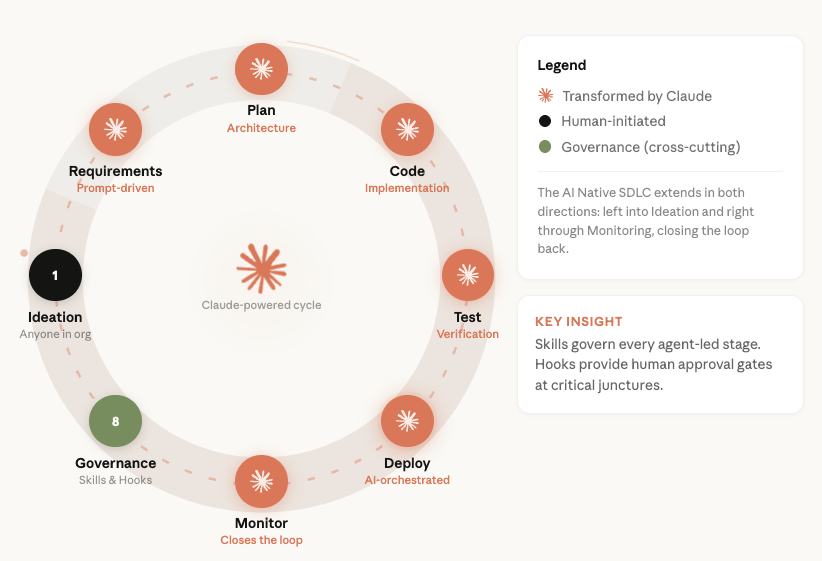
How does @AnthropicAI secure an SDLC where AI authors 80% of the code? 🤔
I thought this was a terrific piece from their CISO team. Anthropic uses a few overarching strategies to keep the team going fast while staying safe.
https://t.co/TflUTkzQLw
I've worked in automation for my entire career. If something was non-deterministic, it wasn't a good candidate for automation.
AI changed that. It adds the ability to add reasoning into an automated flow. Very powerful.
BUT, that doesn't mean you should just give the entire task to AI... that's expensive.
My best agentic workflows use deterministic means as much as possible and call in AI when necessary.
Here's my latest on Rules and Reasoning.
https://t.co/QxNhoXnjXA
People often critique Automind/Universalis by claiming that:
“Proof-carrying code works when the action space is known statically, but many real-world agentic tasks involve dynamic tool invocation — calling arbitrary APIs discovered at runtime. Meijer did not address how his approach scales to that scenario” [0]
This is a red herring and misinformation, so let me address that here.
Just like most traditional development lifecycles, Automind decouples discovery from execution. When it finds a new API, it triggers a so called domain formalization that synthesizes a typed Universalis wrapper for the API and creates and checks the required invariants for that API.
In other words, this is no different that a coding agent generating C++, Python, TypeScript, ... where you import a new package from a package manager or create bindings for a given (REST) API. I would argue that hardly needs to be do at runtime (I did help to add dynamic methods to teh CLR back in the day [1])
But if you do want to discover new APIs during plan execution at runtime for some reason, at runtime, Automind can recursively invoke itself as a tool, generating new code on the fly that inherits and mathematically guarantees the caller's invariant. Like a neural computer operating a meta-reflective compiler.
Turtles all the way down.
It was December last year, and it was much better than I thought it would be.
It certainly validated OSS models are 9 months behind frontier models. So 9 months from now, we could have Sol or Fable level models available to us.
On 24 GB MacBook Air, it felt like Sonnet 4.
Not terrible!!! For 20m.
And super slow.
But the fact that it worked at all was amazing!
Can we trust Chinese open weight models, can we trust closed weight American, models, can we trust French, Canadian models, ...
We shouldn't trust *any* model. Never, ever. Not now, not in the future.
And the good news is that we don't have to. You air gap what the model say from what is does, and prove it is safe before you act.
Simple and trivial math. Problem solved.
https://t.co/vgU35vWaih
To get significant ROI from AI, organizations need to change.
The methods on the table for organizational transformation are too slow and costly, given the rate of AI change.
Here I paint an alternative - one I've been working on for two years:
https://t.co/zK9lokt1UQ