It looks like a scene from *Star Wars*, but this is a real photograph taken by the European Southern Observatory (ESO). We see laser beams from several telescopes aimed at the Tarantula Nebula.
The lasers are part of an adaptive optics system used to correct for atmospheric distortion. They illuminate a layer of atomic sodium at an altitude of 90 km, creating an artificial star. This star is essential for measuring turbulence. By comparing the actual image of the artificial star against a reference, a computer system calculates the atmospheric distortion parameters and then adjusts the shape of the telescopes' secondary mirrors to counteract the effects. This enables ground-based observatories to capture images with quality rivaling that of space telescopes.
This image was taken in November 2025, following the installation of new lasers on the ESO telescopes. One of their first targets was the Tarantula Nebula—a massive star-forming region in the Large Magellanic Cloud, located 160,000 light-years from Earth.
🌙
🌌🌑 Comparing the apparent sizes of Andromeda and the Moon!
The Andromeda Galaxy occupies an area in our sky roughly six times larger than that of the Moon.
❕However, being 2.5 million light-years away, it is far less bright than our natural satellite.
It is difficult to spot with the naked eye without special equipment, though on a clear night—far from city lights—its faint glow can still be seen.
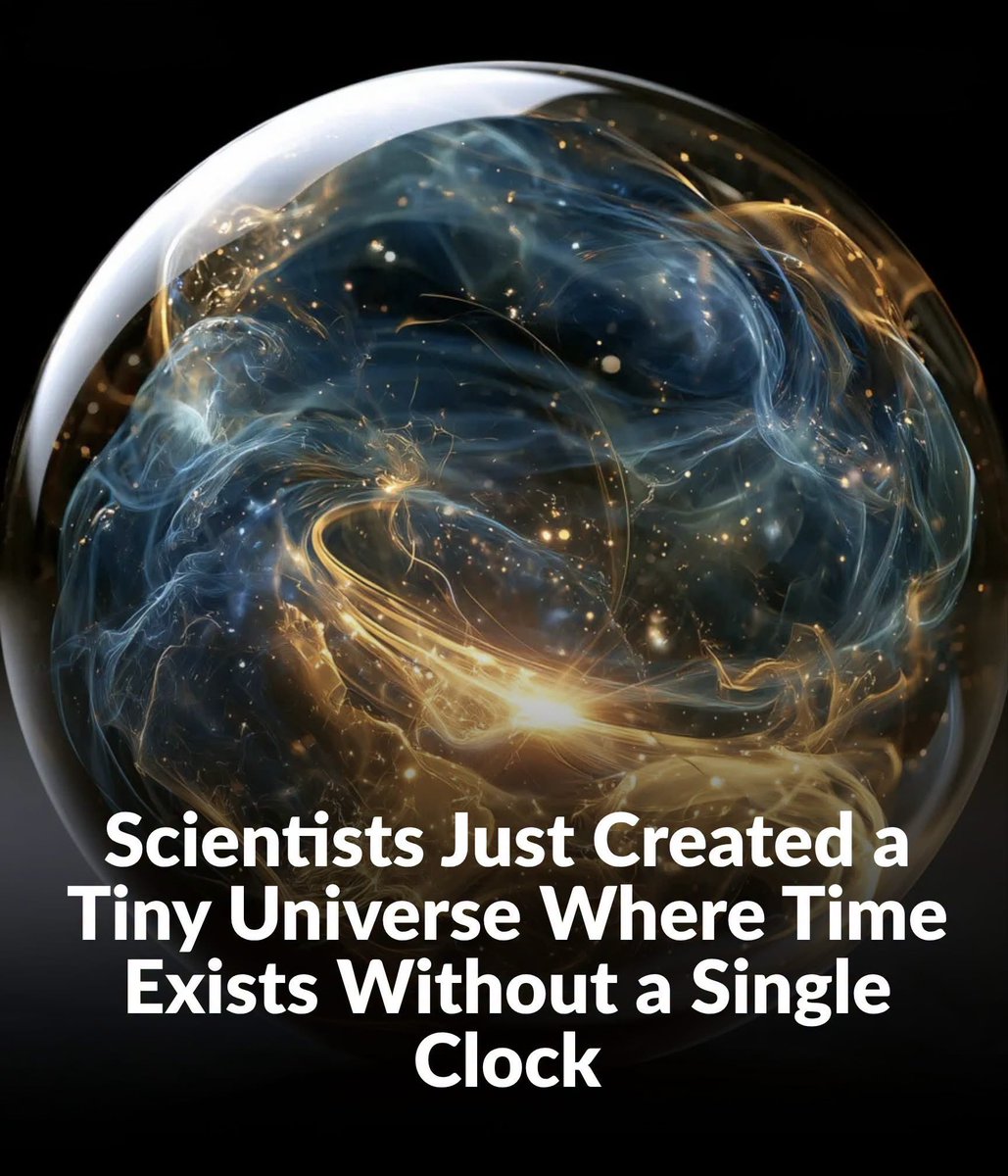
Physicists have created a tiny laboratory "universe" where time emerges naturally - without the need for a clock. The breakthrough could help answer one of physics' biggest mysteries: What is time?
Researchers at the University of Birmingham built a quantum system containing 24,000 ultracold atoms and showed that time can arise from changes occurring inside the system itself, rather than from an external ticking clock. The findings provide the first experimental evidence for a key idea in quantum gravity - that time may not be a fundamental property of the universe, but something that emerges from quantum interactions.
As the atoms evolved, scientists found that time appeared to flow only while entropy - the distribution of particles - continued to change. When those changes stopped, time effectively stopped as well. The results suggest that time may be a consequence of change itself, rather than a built-in feature of reality.
🚨: A small bird with a chirp at 432Hz frequency.
According to research this sound helps release happiness hormones like serotonin, and has the effect of naturally balancing blood pressure and heart rate...
The 4th dimension explained by Carl Sagan with just an Apple.
Imagine a civilization that exists in only 2 dimensions. They know only length and width. They have no concept of "up."
Now pass a 3D apple through their world.
They would never see the entire apple. They would only witness changing 2D cross-sections: first a tiny point, then expanding circles, then shrinking again until it completely disappears. To them, the object would appear and vanish without explanation.
Sagan used this idea, inspired by Flatland, to explain how beings trapped in lower dimensions can observe only fragments of higher-dimensional objects.
He later introduced the concept of a tesseract (hypercube), the 4-dimensional equivalent of a cube, pointing out that we cannot directly visualize it because our brains evolved to perceive only three spatial dimensions. We can only see 3D projections or "shadows" of a 4D object, just as a cube casts a 2D shadow.
This is where the discussion becomes fascinating.
If a genuine 4-dimensional object intersected our 3-dimensional world, would we witness the entire object... or only constantly changing 3D slices of it?
Could something appear out of nowhere, change shape, seemingly violate geometry, and disappear simply because we are observing only a tiny cross-section of a higher-dimensional structure rather than the object itself?
Modern physics already treats spacetime as four-dimensional, although the idea of an additional spatial dimension remains theoretical in models such as higher-dimensional geometry and some advanced physics frameworks.
None of this proves UFOs, extraterrestrials, or hidden dimensions.
But Sagan's demonstration reminds us of something important: The inability to perceive something directly does not automatically mean it cannot exist. Sometimes, the limits belong to the observer, not reality.
In a new quantum experiment, scientists saw something that challenges everything we think we know about time. Instead of flowing forward like a river, time seemed to loop and fold back on itself. Particles behaved as if their future could affect their past, blurring the line between cause and effect in ways that defy ordinary understanding.
This strange behavior was observed through quantum entanglement a phenomenon where two particles remain mysteriously linked, no matter how far apart they are. When scientists changed how they measured one particle, it seemed to alter the history of its partner retroactively. It’s as if “now” and “then” exist together, constantly reshaping each other in a single, connected moment.
The findings hint that time may not be a one-way path but a flexible structure that bends and connects distant events. Your choices don’t rewrite your past, but on a quantum level, the universe might not follow the rules of linear order at all. Reality could be stranger than we’ve ever imagined.
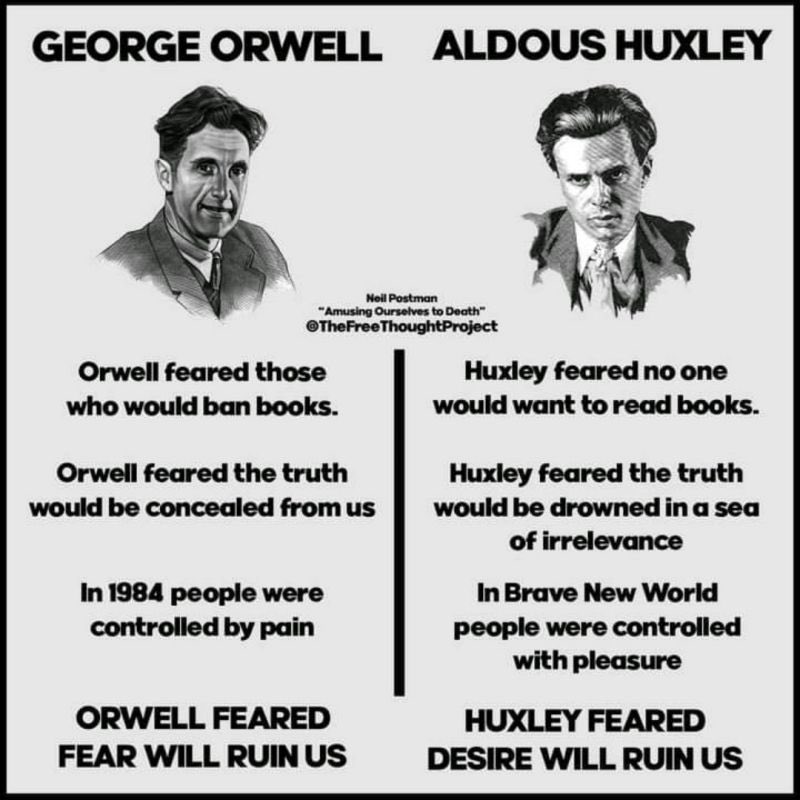
One of my longest-standing arguments is that we are not living in Orwell’s 1984, where truth is centrally suppressed and censored by force (that’s former communist societies, modern-day China, Russia, North Korea).
We are living in something much closer to Huxley’s Brave New World.
The truth is not hidden - it is almost always readily available. But it is buried beneath an industrial quantity of noise: propaganda, outrage, half-truths, conspiracy theories, influencer theatre, algorithmic rage bait and an endless stream of content designed not to inform us, but to keep us emotionally stimulated.
The modern information system does not need to censor the truth when it can simply drown it in noise.
A fact no longer has to be disproven - it only has to be surrounded by a hundred competing claims, stripped of context and nuance, turned into partisan ammunition and pushed into the same feed as celebrity gossip, memes and 15 second videos engineered to deliver the fastest possible dopamine hit. By the time the truth reaches us, it appears as just another piece of content competing for our attention.
That is the more sophisticated form of control: not preventing people from knowing, but exhausting their capacity to care.
Orwell feared a world in which people would be deprived of information. Huxley feared a world in which they would be given so much distraction, stimulation and triviality that they would lose the desire to seek it.
The defining struggle of our age is therefore not simply between truth and censorship, but between truth and indifference.
We aren’t even a level 1 civilization yet…
Humanity currently ranks below the first rung on the scale measuring advanced civilizations.
In 1964, Soviet astronomer Nikolai Kardashev revolutionized our search for extraterrestrial life by shifting the focus from abstract intelligence to measurable energy.
He argued that energy is the only universal metric that scales across species and time, providing a clear framework for measuring a civilization's advancement. The resulting Kardashev Scale categorizes civilizations into three levels: Type I manages the total energy output of its home planet, Type II harnesses the power of its entire star, and Type III controls the energy of an entire galaxy. This hierarchy suggests that survival in the cosmos is directly tied to the ability to command vast amounts of power, making highly energetic species harder to eliminate or ignore.
Today, humanity remains surprisingly low on this cosmic ladder, currently calculated at approximately 0.73. We have yet to reach Type I status, meaning we still fail to fully capture and utilize the total energy available on Earth. While the scale was initially theoretical, it remains the most useful lens for understanding our technological trajectory and the immense gap between our current capabilities and those of a truly advanced species. We are effectively standing below the bottom rung of a three-part ladder, looking up at the first milestone of planetary mastery as we navigate our transition into a more energy-efficient future.
source: Kardashev, N. S. (1964). Transmission of Information by Extraterrestrial Civilizations. Soviet Astronomy.
A new result using NASA’s @chandraxray shows that the outer spiral arms in the Milky Way galaxy may reach wider than previously thought. This finding may lead astronomers to adjust their understanding of our home galaxy’s structure.
READ MORE: https://t.co/WUPrL8pFmc