@ohiain Will you share it? I am curious on what flipped or changed in you to go from not profitable to profitable! Was it more TA knowledge? More emotional management, was it changing your sizing on trades?
Space rolled over first. Then mega caps. Then optics. Now memory under pressure.
Add in the volatility we're seeing out of $XLK and $SMH, and the message seems pretty clear: either tech and semis need several weeks to consolidate, or the theme has peaked for now.
Neither outcome is particularly bullish for aggressive long exposure.
Patience isn't optional here. If you try to force trades before new bases are built, you'll get your ass kicked.
This is my ultimate starter pack for swing trading:
Indicators:
-8/21/50 Exponential moving averages
-Volume
Setups:
-Tight consolidation spots(Wedge, Flag, Pennant)
-Big bases
-Stage 2
Scanning:
-Top down approach (Start with market trend)
-Find the strongest sectors
-Themes/reasons for sectors to go up
-Scan for leading stock in theme (Volume, RS, Base)
Entry:
-Find big daily key levels (Resistance, Support, moving averages)
-Buy relative strength on weakness
-Buy breakouts on the strongest stocks
-Use the lower timeframe to enter
Exit:
-Stop loss at low of day
-Scaling strategy (Never sell the full position)
-Trim into strength and move stop to even
-Use moving average to trail
My entire system comes down to these 5 things.
If anyone tells you that in order to be successful in trading you need to make some unknown discovery on your own... This is a lie!!
- I learned about volatility contraction and progressive exposure from Mark. @markminervini.
- I learned about momentum bursts and Episodic pivots from Pradeep @PradeepBonde
- I learned about the importance of creating a model book for myself with 100s of past examples. As well as the idea of focusing on higher ADR stocks from Kristjan @Qullamaggie
- I learned about stage analysis from Stan @StanWeinstein13
- I learned how to read and interpret COT data from Jason @Crowded_Mkt_Rpt
- I learned the right side of the V concept and proper bet sizing on A+ opportunities from Lance @TheOneLanceB
- I learned to think a little more contrarian from watching @TheShortBear
- I learned about the flat base breakout and value in leading groups from @PatrickWalker56
- I learned about the HVC/HVE edge from @AmeetRai
- I learned about trading more aggressively during high momentum periods from @DanZanger
- I learned about the Undercut and rally or Double top short sale setups from Gil Morales @gilmoandco
- I learned how to think about creating and implementing systems from @Peoplewish
- I learned the failed follow through setup on an intraday timeframe from @InvestorsLive
- I learned about the importance of prior day channels from @danshep55
- I learned about support and resistance gaps for entries from @NickDrendel
- I learned about using the 50sma as a guide to measure extensions from @jfsrev
- I learned about creating a daily trading plan from Marcel Link.
- I learned about the CANSLIM methodology from Bill O'neal
I'm sure there are many I missed but the point is:
Trading knowledge is passed down from one generation to the next. But it is up to us, the trader, to implement what we have learned in a safe manner while we put together all the pieces for ourself.
We live in a time where you DO NOT need to make up some magical elixir for trading in order to be successful.
All the people mentioned above have found an exploitable edge in the market, and like myself relentlessly execute that edge over and over.
I am personally grateful for all of the educators I've had along my journey; which is part of the reason I so willingly share any bit of knowledge I acquire along the way. The same way they all graciously imparted knowledge on me.
@RealSimpleAriel O’Neil observed that late in many bull markets, leadership often rotates away from growth stocks (tech, innovators, high RS names) and into industrials, cyclicals, and old-economy names.
Just a reminder there are some truly exceptional traders offering alpha and knowledge daily on X. If you know who to follow and cut out the BS it’s a cheat code we didn’t have 20 years ago.
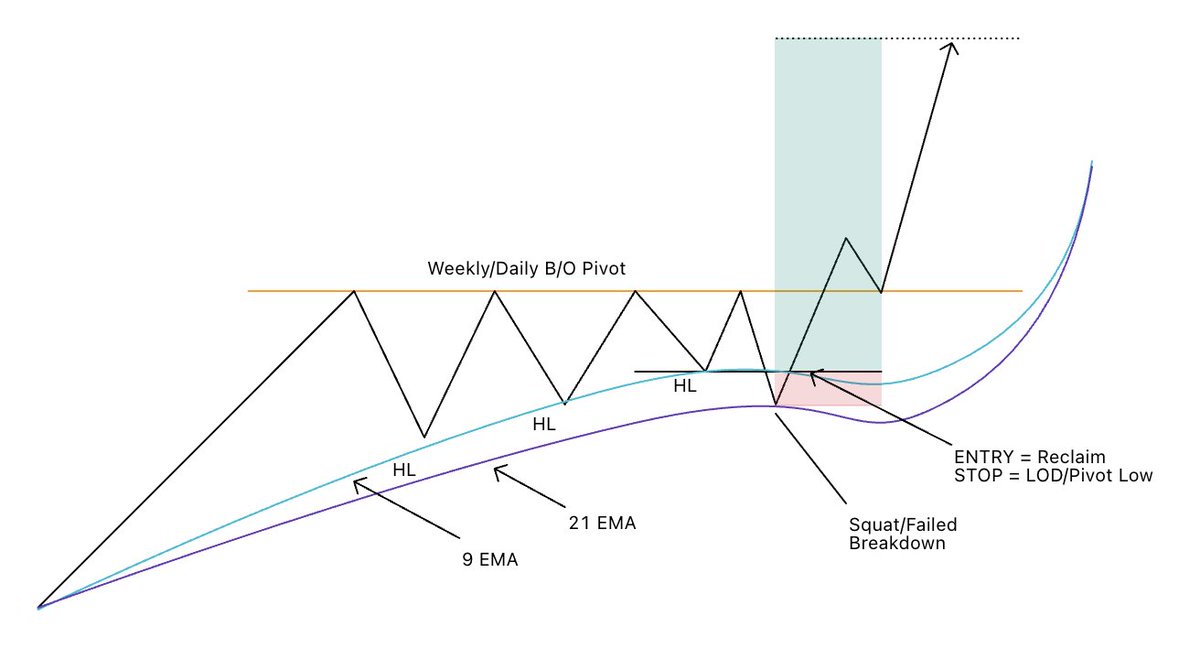
Since the start of the year, 90% of my entries have come from Undercut + Reclaim or (U&R) setups against key EMAs and weekly pivots, and this past week offered a few perfect examples of why this approach is so powerful.
Here’s why U&R setups are so effective in this environment:
Take $RKLB and $APLD, I caught over +100% on 20 Feb contracts in both names. The ideas came from defined risk entries at failed breakdowns, precisely at the points where buyers stepped in after testing support.
Failed Breakdown = Inflection Point.
When a stock undercuts a key level like the 9/21 EMA or a weekly pivot, it triggers weak hands to sell and shorts to feel "confident."
...but if buyers step in immediately, it creates a shift in control, turning a previous low into a "high probability" entry point.
1) Defined Risk (most important):
Your stop is clear, the low of the day (LOD).
If the setup fails, you’re out quickly, keeping losses small.
If it works, the upside is often asymmetric, as you’re positioned ahead of the next leg.
2) Psychology:
U&R setups take advantage of human behavior.
Sellers panic, shorts get trapped, and buyers who understand the structure accumulate at the low, forcing shorts to cover, fueling a leg higher.
The result is compressed volatility followed by expansion, giving a clean, high probability entry.
3) Alignment with Institutions:
By watching RS names and key pivots, you’re essentially tracking where the real money is accumulating.
When the stock reclaims the level, you’re entering in sync with supply/demand, not guessing at breakouts.
4) Simplicity + Repeatability:
Watch the low, wait for the reclaim, enter, risk at LOD.
That’s it.
No chasing, no overcomplicating.
It’s repeatable, definable, and scalable, exactly why it’s been my go to entry since the start of 2026.
Other examples from the past week:
$ASTS
$HUT
$IREN
$RKLB
$APLD
Every single one followed the same U&R logic:
undercut
reclaim
demand showing
tight stop
...and then let momentum do the work.
The market environment this year has been rewarding buyers who enter at these lows, while chasing breakouts has been brutal.
U&R setups give you defined risk, a clear structure, and the ability to stay ahead of momentum before it fully expresses itself.
If you want to trade with asymmetric opportunities in this market, learning to spot and execute U&R setups is a must!
I just posted my epic interview with @Clement_Ang17
✅ Catalyst Gapper Setups
✅ Short Side Trades
✅ Risk and Sell Rules
✅ How to improve as a trader.
Retweet to share! 🔁
This is an interview you don't want to miss 👇
https://t.co/UBvD7avWdq
Everyone says “trade the leaders,” but almost nobody explains what that actually means in practice.
and most people hear that phrase and think it means buying the stock that’s up the most that day.
That’s not leadership... that’s chasing. Real leaders are identified before the crowd, before the breakout becomes obvious, and before the easy trade turns into a painful one.
This post is how I personally do it, step by step, using a top down process that’s been shaped by a lot of mistakes, a lot of screen time, and a lot of hard earned lessons.
Save this, because it’s the framework I come back to over and over.
1) Theme: Start with where money is flowing.
This is always step one for me, because money in the markets does not move randomly. It rotates, and institutions allocate capital into narratives they believe have durability, for example, AI, quantum, energy, rare earths, aerospace, whatever the cycle is rewarding at the time.
I’m not trying to predict the next theme at the exact bottom. My job is to recognize when capital is already leaning in.
The earlier you identify a theme that institutions care about, the more asymmetric your opportunity becomes.
If you skip this step and jump straight to charts, you’re...
"fishing without knowing where the fish are"
2) Leaders: Separate strength from weakness.
Once I know the theme, I want the leaders, not the entire group.
Leaders are the names that:
- Hold above rising EMAs
- Make higher highs and higher lows
- Refuse to break down when the market/sector chops
- Show clear relative strength versus their peers
This is second nature for me now, because I can look at a chart for a few seconds and usually tell if it’s a leader or a laggard.
A stock can have a beautiful technical setup and still be a laggard if its peers already have broken out and ran.
My goal isn’t to buy what’s cheap... It’s to buy what’s in demand by institutions.
3) Setup: Structure creates asymmetry.
Great themes and strong leaders still need structure, and this is where most traders get impatient.
I’m looking for compression, tightening ranges, declining volatility, and volume behaving properly.
I want clear levels where I’m wrong, because the best setups give me a small downside and open ended upside.
That’s asymmetry, because the structure supports it.
No structure = no trade.
I don’t care how good the story/narrative is.
4) Risk: Define it before you click.
Every trade has an invalidation pivot defined before entry. ALWAYS. Risk must come first!
Even the best setups fail.
Risk management isn’t about avoiding losses... it’s about surviving long enough to catch the outsized winners.
I size positions based on where I’m wrong, not on how confident I feel.
A small loss is tuition.
A big loss is ego.
This step alone keeps me alive long enough to improve.
5) Patience: "Let the trade come to you."
This was one of my biggest struggles early on.
I used to know exactly what I wanted to buy, and then buy it too early. If you chase before price confirms your thesis, you’ll spend more time managing pain than managing profit.
...and 99% of the time leaders don’t disappear overnight.
so if you miss it, wait.
There’s almost always another entry if the stock is a true strong leader.
6) Entry: Execute without emotion.
When my setup triggers, execution should feel boring and robotic.
No hesitation.
No second guessing.
No scrolling X for validation.
The thinking was done before the trade, so when the moment comes, I execute the plan I already committed to.
Emotionless execution is a skill, and it only comes from preparation.
7) Patience (again): Let winners work.
This is where most traders sabotage themselves.
The “see green, take green” mindset kills scalability, because if you’re constantly taking small profits but letting losses grow, the math will never work.
Once risk is protected, I want to give my winners room to breathe.
Leaders tend to trend longer than you expect, but only if you don’t micromanage them to death.
8) Trust: Systems over feelings.
If you’ve built a process rooted in logic, repetition, and experience, trust it.
Emotion is what breaks traders, and systems are what build them.
There is no “I made it” moment in trading (I’m still learning every day) but trusting a sound process removes so much unnecessary stress and noise.
9) Exit: Structure decides, not your own EGO.
Whether I’m trimming into strength, trailing stops, or cutting when invalidated, the exit is dictated by structure.
I’m not trying to catch the exact top or bottom.
I want the middle of the move (the repeatable part), and I’m happy to leave the rest.
Consistency beats perfection every single time.
10) Go touch grass!!
like seriously.
Step away.
Reset your brain.
Clear your head.
If you’re glued to every tick, you’re not seeing the bigger picture... you’re just feeding your anxiety.
Trading is a mental game as much as a technical one.
Go touch grass and come back sharper, because the markets will always be here!!
This is how I trade leaders.
...and no it’s not flash or beasy, but it’s repeatable, scalable, and rooted in my own process!
If this helps even one trader slow down, think differently, and trade with more intention, it was worth writing.
Happy Sunday, and God bless! HAGW.
If drawdown control isn’t your primary obsession, you’re playing the wrong game.
I see so many people spending an unhealthy amount of time fantasizing about upside targets, take profit targets, and what if scenarios.
Almost nobody wants to talk about drawdown loss control... even though that’s the one thing that determines whether you’re still in the game six months from now.
Losses are inevitable.
... and they’re (usually) not a sign you’re doing something wrong. The mistake is letting them get big, emotional, or compounding losses to a hole in your portfolio.
It often takes me two or three attempts to get into the same stock, and that’s normal. What matters is how I’m entering. I’m always trying to buy as close to my invalidation level as possible. If I’m wrong, I want to know quickly without risking too much capital.
that’s why a lot of my favorite entries come from undercuts and reclaims of MAs or major pivots. When I buy there, my risk is defined before I even click the button.
I’m executing against a level that already proved demand was present.
This week was a perfect example of why that mindset works. I caught $RDDT and $PATH early in the week for over 100%. They were the result of tight entries, clean structure, and letting winners breathe.
Yesterday and today, I took two small losses in $RIVN. Both trades were invalidated, and I got out.
... simple right?
Here’s the part most people miss:
one winner paid for multiple small losers.
and it only works if you’re ruthless about keeping losses small. If those $RIVN trades had turned into “maybe it’ll come back” situations, the entire week would’ve looked different.
This is the edge nobody wants to talk about because it’s boring and uncomfortable to admit to yourself.
When you stop focusing on how much you can make and start focusing on how little you lose when you’re wrong, everything changes.
Your psychology and process sharpen.
and suddenly, you don’t need to be right very often to make real progress.
I’ve been working on something for the beginners… and it’s finally time 👇
This Thursday I’m dropping a FREE trading eBook — the exact foundation, mindset, and simple frameworks I wish someone handed me on day one.
If you’re trying to get out of the “confused beginner” stage and actually understand what you’re doing… this is for you.
Like and Retweet if you want it the moment it drops.
Time to level up 🔥
My reasons to be a trader are that I genuinely enjoy trading it’s exciting, and when I understand the market, it becomes fun.
Trading is a path to financial independence. I’ve already experienced the early stage of blowing accounts, but have tasted the opportunity in the horizon, now I’m committed to discipline and improvement.
With dedication and strategy, trading can be a profitable journey that will lead me to financial success.
Victor Recio @SRxTrades@TraderLion@RichardMoglen@WishingWealth@EliteOptions2@RedDogT3@Prof_heist