New @RecountingC paper out in BJC, with @IanBruntonSmith, @cernat_a and @JPinaSanchez ‼️
We assess and compare the quality of measurements of crime derived from police records and victim surveys at the regional and local level
https://t.co/4BHoYcd8OQ
Please, disseminate widely‼️
Call for papers for a special issue on 'Calling the Police: Theoretical Insights and Practical Implications' in @CrimeScience
Deadline: 5 April 2024
In the second we use data from the Cyber Security Breaches Survey to explore the impact of memory failures in reports of phishing attacks. We also look at misclassification of remorse in the Magistrates Court Sentencing Survey. We show how we can adjust these problems using SIMEX
If you want to learn more sensitivity analysis tools to explore the impact of different forms of measurement error and misclassificaiton, we have a couple of new workshops using simulations, SIMEX and MC-SIMEX in R,
https://t.co/wJJMBMtUJJ
https://t.co/yFYOV1Qcsc
In the first practical we look atthe effect of ethnic homogeneity, unemployment, and collective efficacy on criminal damage. We show how to explore the impact associated with systematic and differential errors in police data using simulations and our own package rcme.
Excellent example of why it’s important to understand how crime data was generated before you analyse it:
@metpoliceuk changed the software it uses to record details of people who have been arrested and the number of people recorded as being arrested for murder dropped by ~80%.
[CALL FOR PAPERS]
@DrLauraHuey and I are guest editing a special collection in @CrimeScience. We welcome contributions advancing explanations of crime reporting and studying the practical implications of under-reporting for the criminal justice system
https://t.co/g4F4PeWae0
If you are modelling police recorded crime counts, and want to find a way to adjust for measurement error, check our latest tutorial, 'Adjusting for Measurement Error in Police Recorded Crime Counts Using Bayesian Statistics',
https://t.co/lMcd0Fp3Au
Our latest research note 'Measuring crime in place: Distinguishing between area victimisation and area offences' in Significance, https://t.co/xZuZQjyTDr
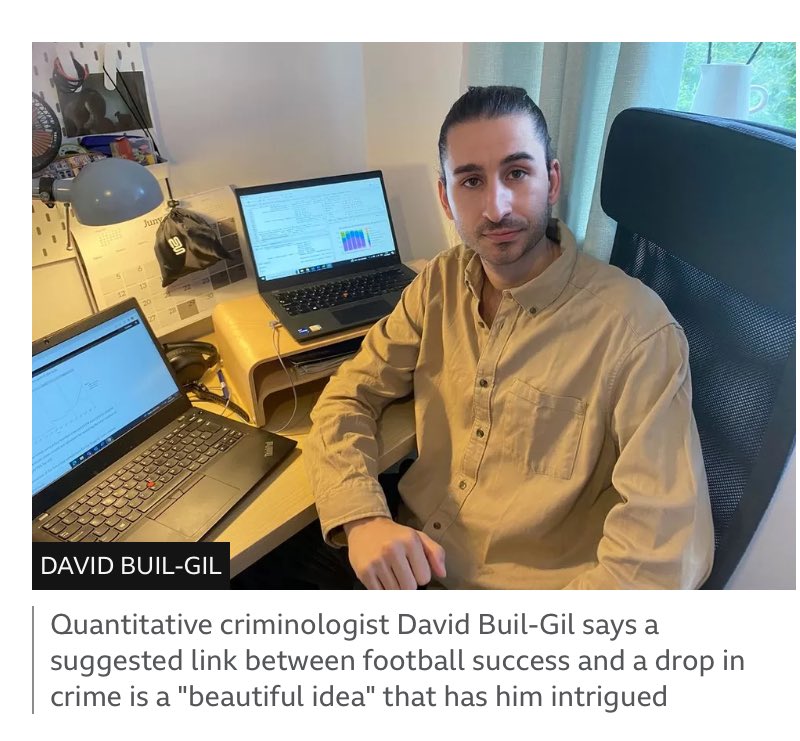
The BBC asked me about the possibility that the promotion of Luton Town to the Premier League led to a decrease in crime, and of course I had to talk about measurement and causality😂
(I also showed the world that I am the only person who doesn’t use the dark mode in RStudio)
@FerhatTura19@DavidBuil@CrimRxiv@IanBruntonSmith@cernat_a @JPinaSanchez Yes, we think so, even when aggregated at a high area level like PFA, the sampling error makes it more unreliable than police data.
However, if we need accuracy not precision, e.g. to estimate the extent of crime, monitor trends across time, etc. then the CSEW is still the best.
The latest from the @RecountingC team:
"The Impact of Measurement Error in Regression Models Using Police Recorded Crime Rates"
https://t.co/YMp27WpsMF