Nope! I always say there is no such thing as self-made. It’s a myth.
It took millions of people - from my parents to mentors to friends to competitors to fans and voters - to write my success story. I did not write it alone.
That’s the American Dream - not a lie about going it alone - but the truth that none of us do, and there is always someone with their hand out to lift us up.
When I write about the long-run consequences of population decline, I’ve noticed that most people cannot grasp what a total fertility rate (TFR) of 1.1 means. Many of my readers look at 1.1 and treat it as not that different from 2.1. This is the wrong way to think about it: TFRs are like interest rates; they compound over time.
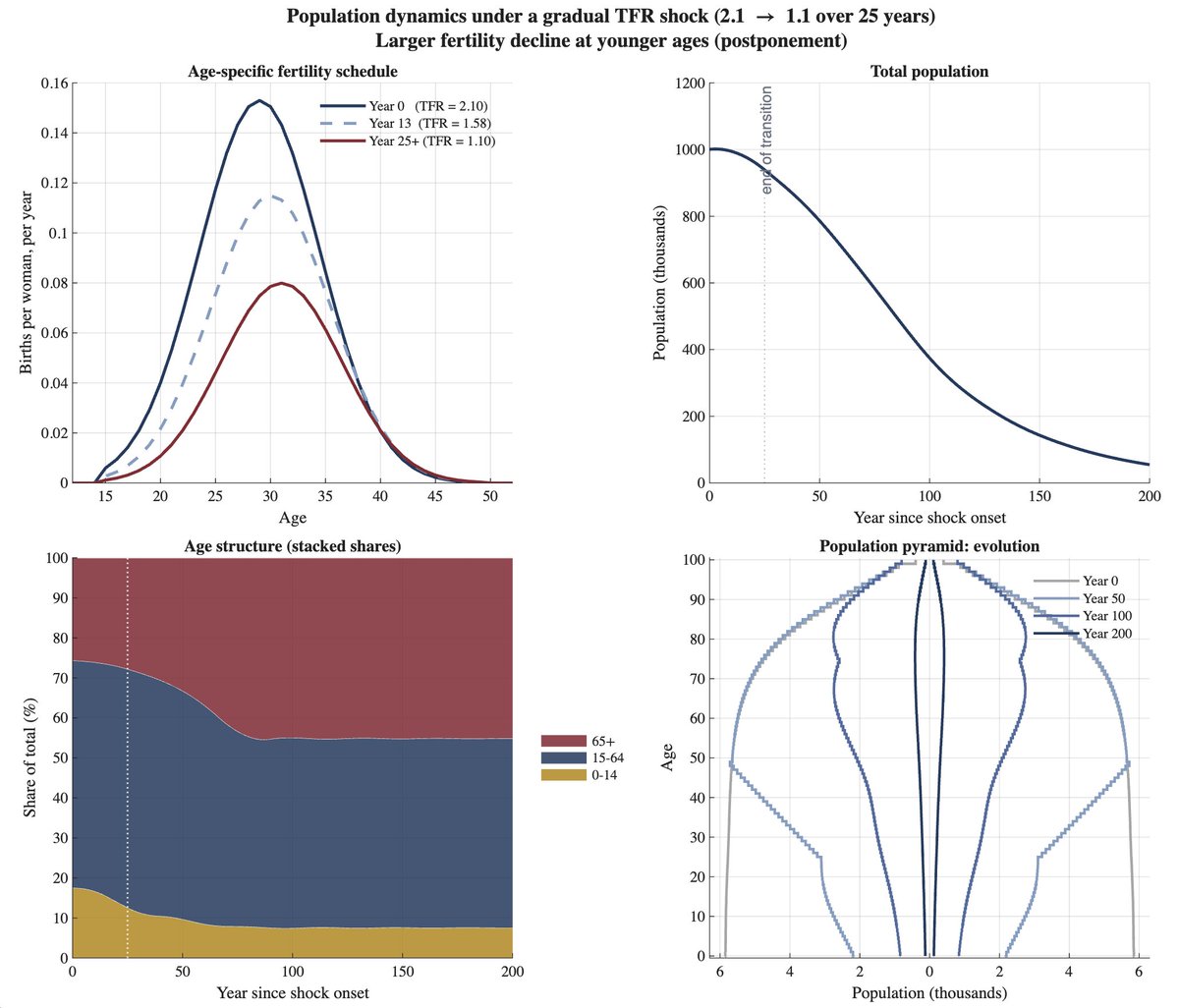
To make the point, I ran the following simulation. I built the population structure of a country with 1 million inhabitants, a TFR of 2.1 (just at replacement level), and a life expectancy of 85 (with realistic survival rates). Thus, this country has a stationary population over time.
I then hit this country with a reduction in the TFR from 2.1 to 1.1. The reduction, which takes 25 years to complete, is similar in size and duration to what we’ve seen in many advanced and middle-income economies. It is also concentrated among younger women, with fertility postponed to later years. I plot the initial, middle, and final TFR in the top-left panel of the figure.
I then simulate the next 200 years of this population. By the year 200, the original 1 million has fallen to 54,900, a 95.5% reduction. The top-right panel illustrates this evolution. This is not a minor adjustment: it means closing 95 of every 100 universities, hospitals, and shops. Since the population is likely to concentrate in a few remaining cities, nearly the whole country becomes a population desert.
The bottom two panels show the population structure and pyramids. The population stabilizes at a median age of 61 and an old-age dependency ratio of 95.21%.
You might argue that TFR is unlikely to remain at 1.1 for so long because higher-fertility subgroups (e.g., the highly religious) would grow as a share of the population. Fair enough. But I am not offering this simulation as a forecast. I am illustrating how, at current rates, countries of 50 million people (roughly South Korea or Spain) would become countries of 2.75 million, ignoring immigration.
These are the issues for the next century.
“I regard consciousness as fundamental. I regard matter as derivative from consciousness. We cannot get behind consciousness. Everything that we talk about, everything that we regard as existing, postulates consciousness.”
Max Planck, 1931, The Observer
@ExoAcademian Early in most new technologies, they experience exponential growth. Over time they tend to follow Michaelis-Menten kinetics that limit improvement. There is nearly always one or more limiting resource.
Breaking: Incredible story written by Leslie Kean and Ralph Blumenthal about our closed-door meeting with members of Congress and firsthand witnesses to the 1996 UFO incident in Varginha Brazil. This is a must read — spread far and wide. Thank you Debrief.
https://t.co/HknQ6qB7ea
@kellychasemedia Interpreting "reality" with, as Don Hoffman says "a time-space" headset is one of the links in the chains in Plato's cave that keep us looking at the shadows on the wall.
Is it likely that our perceptions of the colors and sizes of things tell us about the structure of external reality? Evolutionary game theory says no: the probability is zero. The structure of reality is hidden by our headset. Here is a technical paper.
https://t.co/LhBS9g5AKz