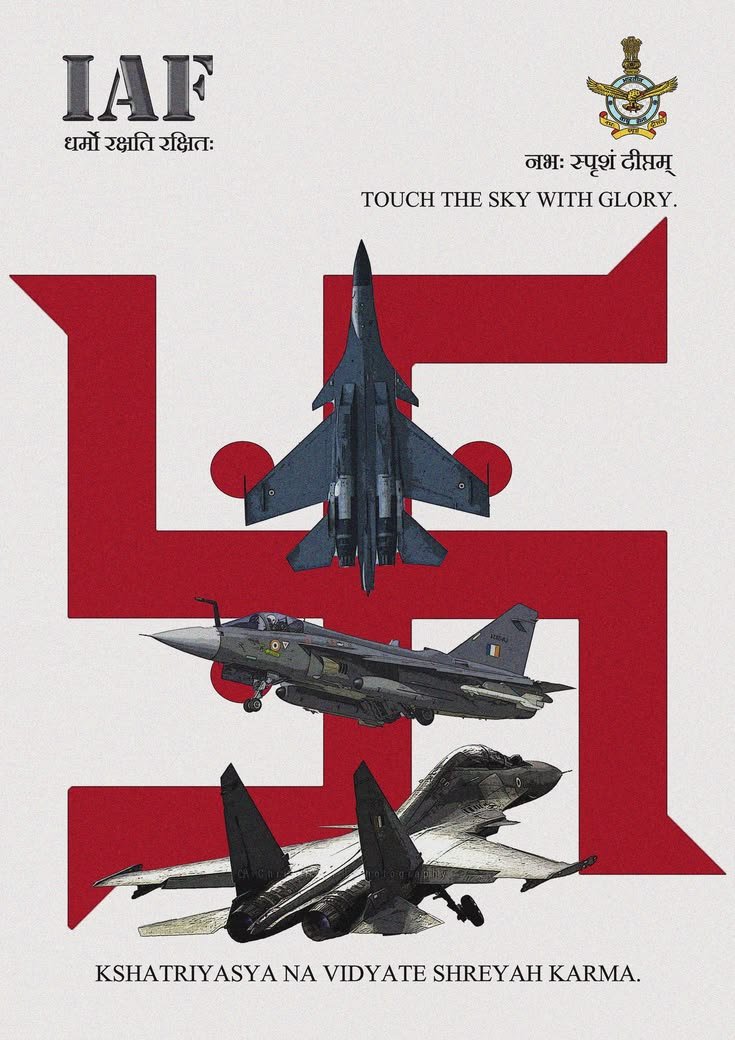
यं पालयसि धर्मं त्वं धृत्या च नियमेन च।
स वै राघवशार्दूल धर्मस्त्वामभिरक्षतु
The duty which you are carrying out with courage and selfdiscipline,
O tiger among the descendants of Raghu will alone protect you.
My my my… this @ARanganathan72 stripping of @BBCWorld is classic. Will go down as one of his best that #BBC should frame & present to its trainees. 🤓
CERN shut its collider on June 29th.
Four years of darkness.
Official word: maintenance.
The internet went mad anyway.
Some blamed the occult.
Some said beings are being summoned inside.
Some connected it to Purnima.
All wrong.
Let them argue.
The real mystery isn't trending.
By design.
Because some people don't want it discussed.
There's a 2 metre bronze statue in CERN's courtyard.
800 kilos.
Cast in Bharat.
Shipped to Switzerland in 2004.
His name is Nataraja.
You know him as Shiva.
Dancing.
Not gently.
One foot crushing a demon.
A ring of fire around him.
Why does an international science agency keep a Hindu god at its front door?
CERN runs on contributions from 25 nations.
Thousands of scientists.
Thousands of engineers.
Some of the sharpest minds alive,
hunting the building blocks of reality.
And at the center of that campus stands Shiva.
Not in a museum.
Not in a temple.
At the heart of the most advanced machine humans ever built.
Standing.
Nobody there calls it controversial.
Those who don't understand Bharat call it occult.
Those who do, know exactly what they're looking at.
Physicist Fritjof Capra saw it first.
Wrote it down in 1975.
Said CERN's particles perform Shiva's Tandava.
Creation and destruction, on loop, faster than the eye catches.
Rudra doesn't just destroy.
He clears the field for what comes next.
Nataraja's damaru, the drum, beats first sound into being.
His agni, the fire, ends one cycle so another begins.
This is Kalachakra.
The wheel of time.
Not myth.
Particle mechanism.
Under his foot lies a dwarf.
Apasmara.
His name means forgetting.
Ignorance.
Loss of awareness.
Shiva doesn't kill him.
He dances on him.
Pinned, not destroyed.
Ignorance never fully disappears.
It stays underfoot,
held by the rhythm of a god who sees both ends of existence.
That's exactly what's at play at CERN.
Ignorance of the universe, still there.
Kept underfoot, while they chase its secrets.
Then, in 2012, CERN found the Higgs boson.
The particle that gives everything mass.
They called it the God particle.
Existence, born from a field always present, waiting to be disturbed.
Vedic science had a word for that field before Geneva had a tunnel.
Prakriti.
The substrate beneath all form.
Bharat wrote this in verse.
The West needed a 27 km machine and 60 years to catch up.
Now the punchline.
Put Nataraja on a campus in Geneva, it's science, heritage, poetry.
Put the same statue on an Indian university lawn, watch the noise start.
Suddenly it's religious.
Suddenly it's unconstitutional.
Suddenly someone's shouting fascism.
Ask yourself who's actually afraid of Bharat's own knowledge.
A nation that forgets its Vedic science isn't secular.
It's just empty.
Democracy needs a civilization under it,
not a vacuum born in 1947.
Next time someone calls you a fascist for knowing your own gods, look closely at who's speaking.
You'll surely be seeing a fascist, or an Apasmara.
Topji said literally the same thing on Bpillers
Want 24 hrs power but opposes dams, solar parks & power plants
Doesn’t want mining to be done but asks about rare earth minerals
Asks about AI but opposes data centres and semiconductor plants
In 2018, as an analyst and writer with huge expertise in T20 cricket, @fwildecricket (co)-wrote a book with a chapter called "Why RCB Lose".
He has then gone on to join RCB as their head of analysis, and win the IPL.
I think that's pretty fucking cool
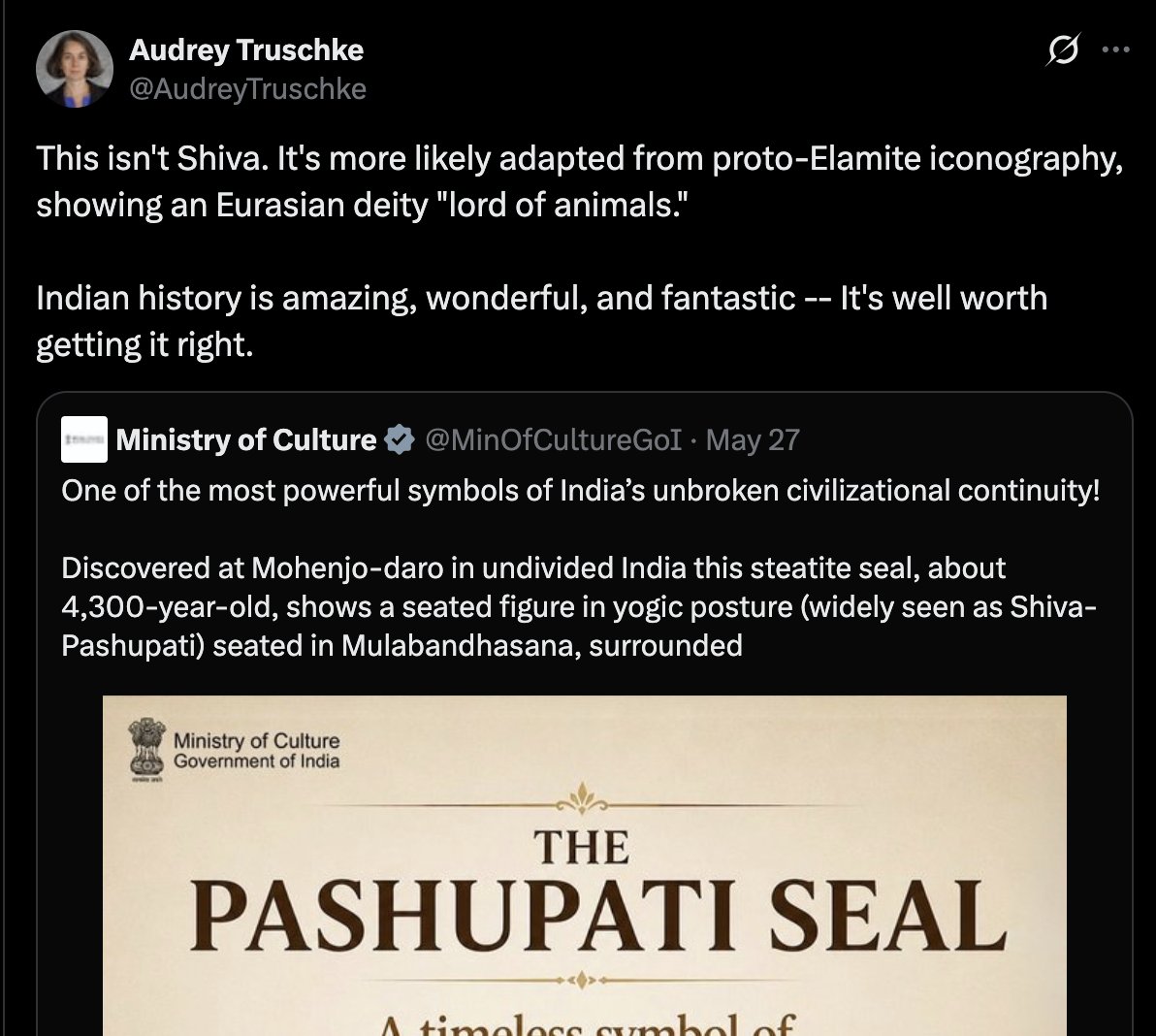
The seal creators, the ancient Indians, were much smarter than these fake professors.
They put a Rhino, an Elephant, and a Tiger together on the seal along with a Yoga pose to ensure it is not appropriated by such charlatans saying it is from Elam (Iran) or the West or China.
These charlatans work in universities under the funding from the GLISCO-DS, the Globalists, Islamists, and Communists. You know the countries.
All three groups are on a mission to appropriate everything Indian and making them Western, Islamic, or Chinese to bankrupt India of its civilization and make Indians gullible to them.
Now see them invent reasons in their universities, publish papers, and tell Indians how Iran had Tigers, Elephants, and Rhinos. And how all three came to India from Europe, Arabia, and China.
Sadly, many young Indians will believe them too and fight with you for them saying there's no deep state or agenda here. This is because of the state's apathy in allowing its young generation to be programmed by social media.
Happy Mother's Day to all Mothers out there! 🙏
या देवी सर्वभूतेषु मातृरूपेण संस्थिता।
नमस्तस्यै नमस्तस्यै नम्स्तस्यै नमोनमः॥
yā devī sarvabhūteṣu mātṛrūpeṇa saṁsthitā |
namastasyai namastasyai namstasyai namonamaḥ ||
Meaning: I bow to Her, who is stationed in all beings as the motherly instinct!
PS: In Indian tradition, one should remember & be grateful to Mother everyday. Special days for various people/things were created in the modern world mostly as a marketing ploy. Nonetheless, one can go with the flow and celebrate. 🙏
🚨 OPERATION SINDOOR - THE COST OF DETERRENCE
How India became the first nation to strike a nuclear-armed state - and shook an American base in the crossfire.
A Strategic Deep Analysis - One Year After Operation Sindoor
At 2:09 AM on May 10, 2025, Indian BrahMos missiles and precision drones struck Pakistan’s Nur Khan Airbase - just kilometres from the nerve centre overseeing Pakistan’s nuclear arsenal.
Hours earlier, the conflict was dismissed as “none of our business.” Within hours of the strike, Washington was in crisis mode, diplomatic channels were activated at breakneck speed, and an “immediate and full ceasefire” was announced.
What changed?
India had crossed a line the world assumed no nation would dare cross - striking deep into the strategic heart of a nuclear-armed state.
This was the moment India called the biggest bluff of the post-Cold War era - and the world watched what happened when that bluff collapsed.
📌 CHAPTER I: THE HISTORICAL THRESHOLD - WHAT INDIA DID THAT NO NATION HAS DONE BEFORE
Before unpacking the Nur Khan dimension, the foundational historical fact must be stated with full clarity.
Operation Sindoor shattered a core assumption of the post-nuclear era. Unlike the restrained responses of 2016 and Balakot in 2019, India struck deep inside Pakistan’s strategic heartland - crossing a line previous doctrines avoided for fear of triggering nuclear escalation.
For decades, Pakistan’s Full Spectrum Deterrence relied on one belief: that the threat of nuclear retaliation would freeze India’s conventional response. Operation Sindoor challenged that belief head-on.
India broke that assumption on May 7, 2025.
For the first time since 1971, India struck across the internationally recognised boundary with Pakistan - reaching Bahawalpur in Pakistan's Punjab province, 600+ kilometres from the Line of Control, targeting the headquarters of Jaish-e-Mohammed and Lashkar-e-Taiba. This was not a surgical strike on a forward operating base. This was a statement that no geography in Pakistan is off-limits when Pakistan exports terrorism onto Indian soil.
Search the entire history of the nuclear era for a parallel. There is none. Israel struck Iraq's Osirak reactor in 1981 - but Iraq had no nuclear weapons. The United States bombed North Korea in the Korean War - before Pyongyang had the bomb. No state, in the post-1945 nuclear era, has struck sovereign territory of a declared nuclear-armed adversary with the depth, scale, and deliberate target selection that India demonstrated in May 2025.
India's deterrence logic was precisely documented by the Bulletin of the Atomic Scientists: "Pakistan's deterrence logic was undermined during the four-day conflict in May, when India ignored Islamabad's nuclear signaling and established what Prime Minister Modi described as a 'new normal.'"
The new normal. India became the first nuclear power in history to bomb another nuclear power's sovereign territory - and survive the nuclear bluff intact.
📌 CHAPTER II: THE COST OF DETERRENCE - HOW PAKISTAN'S 75-YEAR INSURANCE POLICY EXPIRED IN 88 HOURS
Pakistan has been running one of the most successful protection rackets in the history of international relations. Since 1998 - when it conducted nuclear tests days after India's Operation Shakti - Pakistan's strategic doctrine has rested on a single pillar: nuclear weapons as the ultimate guarantor against Indian conventional retaliation for state-sponsored terrorism.
The doctrine had a name: Full Spectrum Deterrence. Its logic was explicit. Pakistan would arm, train, and deploy non-state terrorist groups against India. When India threatened military retaliation, Pakistan would rattle the nuclear sabre, triggering Western - particularly American - diplomatic pressure on India to stand down. The deterrence was not designed to stop a nuclear war. It was designed to stop India from imposing a conventional military cost on Pakistan for terrorism.
India's Operation Sindoor starkly exposed the failure of this strategy. By striking eleven major airbases - from Sargodha to Sialkot, from Nur Khan to Jacobabad - India effectively neutralised Pakistan's capacity to deliver a nuclear warhead via its air vector. Complementing this, India's robust and layered air defence systems constrained Pakistan's missile delivery options. Even if Pakistan possessed a complete nuclear triad - which it does not - the Indian Navy's vigilant containment of the Pakistani Navy in the Arabian Sea would have thwarted any maritime strike.
Pakistan lacks a nuclear-armed submarine for sea-based deterrence, critical for a credible second-strike capability. Without second-strike survivability, Pakistan's nuclear doctrine rests on first-use threat - a threat India calculated, correctly, that Pakistan would not execute given that any Pakistani nuclear strike would be met with total Indian retaliation that would eliminate Pakistan as a functional state. India called that existential bluff. Pakistan blinked.
The numbers behind the conventional dominance that made this possible:
India destroyed an estimated 20% of Pakistan's operational Air Force across four days of combat.
Strikes across 10 Pakistani airbases were completed in just over 22 minutes - designed to paralyse Pakistan's capacity to assess, react, and recover simultaneously.
India's Akashteer system demonstrated a 100% kill rate against Pakistani drones. The S-400 Sudarshan Chakra intercepted all incoming Pakistani missiles successfully - zero Pakistani missiles or drones caused meaningful damage to Indian infrastructure.
Satellite imagery confirmed massive destruction at Jacobabad Air Base including the complete destruction of a large hangar housing US-made F-16 fighters. Pakistan's claims of minimal damage were demolished, literally and photographically.
Massive craters were observed near the hills surrounding Nur Khan airbase, believed to house Pakistan's nuclear storage infrastructure - a deliberate signal of India's capability to reach Pakistan's nuclear architecture without triggering its use.
The cost of deterrence had been imposed. For the first time in 27 years of nuclear Pakistan, the bill had come due. And Pakistan paid it.
📌 CHAPTER III: NUR KHAN - THE BASE THAT CHANGED EVERYTHING
The Nur Khan Airbase strike is the most consequential single action in Operation Sindoor - and the least fully understood.
Nur Khan Airbase in Rawalpindi serves as the hub of Pakistan's Air Force air mobility operations, VIP transport, and strategic operations. It is located kilometres from the Pakistan Army's General Headquarters (GHQ) and the Strategic Plans Division - the command overseeing Pakistan's estimated 170 nuclear warheads.
The New York Times cited a former American official: "Pakistan's deepest fear is of its nuclear command authority being decapitated." The Indian missile strikes on Nur Khan were interpreted as a warning of India's capability to do exactly that. According to Christopher Clary, an associate professor at the University at Albany: "An attack on the facility may have been perceived as more dangerous than India intended."
But here is the dimension that Western reporting consistently buried and that deserves full analytical exposure.
Pakistani security analyst Imtiaz Gul alleges - with significant corroborating evidence - that Nur Khan Airbase operates under de facto American operational control through a covert arrangement, with US aircraft regularly landing and taking off amid limited transparency. Even senior Pakistani military officials are reportedly restricted from accessing certain operations at the base.
During the Cold War, Pakistan permitted US U-2 reconnaissance missions from Peshawar's Badaber Airbase. During the War on Terror, critical facilities - including Shamsi, Shahbaz, Dalbandin, and Nur Khan - were used by US forces for drone strikes, intelligence gathering, and logistical operations in Afghanistan. While less overt today, this military collaboration continues in more discreet and sophisticated forms.
Despite the US withdrawal from Afghanistan, Nur Khan is believed to serve as a forward-operating location for US intelligence, surveillance, and reconnaissance missions - potentially including pre-positioning for potential strikes targeting Iranian nuclear sites or remnants of ISIS-Khorasan.
Now read the sequence of events again with this context.
• May 9, 10:00 PM: JD Vance - "none of our business."
• May 9–10, 2:09 AM: India strikes Nur Khan.
• May 10, morning: Rubio emergency calls activated. White House situation room fully engaged. Trump announces ceasefire on social media by afternoon.
Reuters reported that India's strikes on Nur Khan airbase had alarmed US officials, due to the base's proximity to Pakistan's Strategic Plans Division. According to a senior Pakistani intelligence official, Pakistan viewed the strike on Nur Khan as a red line particularly given its proximity to nuclear infrastructure. "US intervention was necessary to pull the two sides back from the brink," the official said. "The last move came from the president."
Pakistan's Deputy PM Ishaq Dar confirmed in December 2025 that Rubio called him at 8:17 AM on May 10 and conveyed India's readiness for a ceasefire, asking whether Pakistan would agree - effectively revealing that the US had been in direct diplomatic engagement with both sides through the night, activated by the Nur Khan strike.
The analytical conclusion is unavoidable: India did not merely strike a Pakistani military base. India struck a facility with embedded US strategic interests - and that strike is what triggered the most rapid American diplomatic intervention in the India-Pakistan conflict's entire history.
Vance said it was none of America's business. India made it America's business in 23 minutes.
📌 CHAPTER IV: THE GEOPOLITICAL EARTHQUAKE - WHAT THE STRIKE REVEALED
The Nur Khan strike and its aftermath revealed four structural geopolitical truths that will reshape South Asian strategic calculations for decades.
Truth 1: Pakistan's Nuclear Shield Was Always An American Shield
Pakistan's nuclear signaling is primarily aimed at securing third-party intervention - particularly from the United States - when confronted by India's conventional military superiority. The nuclear threat was never primarily about deterring India. It was about triggering American diplomatic intervention before India could impose a decisive conventional defeat. Frontiers
Operation Sindoor revealed the mechanism. Strike close enough to Pakistan's nuclear infrastructure - and specifically, close enough to US covert interests embedded within that infrastructure - and Washington activates immediately. The nuclear shield Pakistan advertises to the world is, in operational reality, an American diplomatic guarantee that gets triggered when American assets are threatened.
India proved it understands this mechanism - and that it can operate within it.
Truth 2: Chinese Weapons Failed Under Real Combat Conditions
Operation Sindoor highlighted that Pakistan's Chinese-supplied air defense systems - J-10Cs, HQ-9 batteries, PL-15 missiles - failed to prevent a single Indian strike from reaching its target. Wiley Online Library
The operation carries longer-term implications for Chinese-supplied air defense worldwide. Systems marketed as peer competitors to Western and Russian alternatives failed completely. Defense procurement officials worldwide are reconsidering contracts built on assumptions that May 2025 demolished. The Wire
This has a direct deterrence implication for Taiwan, for the South China Sea, and for every country that has purchased Chinese air defense infrastructure. China's weapons failed against Indian indigenously developed systems. That is a strategic advertisement for Indian defense manufacturing and a strategic liability for Chinese arms exports that China will spend years trying to counter-narrate.
Truth 3: The Nuclear Threshold Is Higher Than Pakistan Claimed
India demonstrated by striking eleven major Pakistani airbases that it could impose devastating conventional damage without triggering nuclear response. India's strikes effectively neutralised Pakistan's air-vector nuclear delivery capability while its navy contained the maritime vector and its missile defense intercepted all incoming threats. PubMed Central
Indian strategists may increasingly see through Pakistan's nuclear bluff and could pursue a decisive conventional campaign in a future India-Pakistan confrontation. A conventional war under the shadow of Pakistan's nuclear threats is now more plausible, not less, because India has demonstrated the threshold is higher than Pakistan's rhetoric suggested. Frontiers
Truth 4: India Has Redefined the Rules of Engagement for Nuclear-Era Conflicts
India's Chief of Defence Staff General Anil Chauhan articulated the new doctrine explicitly: "There is increased propensity amongst nations and governments to use force because political objectives today can be achieved by short-duration conflicts. Precision strikes create very little collateral damage - hence the cost of war for nations is less." Taylor & Francis Online
Operation Sindoor established three pillars of India's new doctrine: any terrorist attack on Indian soil will be met with assured and proportionate retaliation; India will no longer be deterred by nuclear blackmail in striking terrorist hideouts across the border; India will not differentiate between terrorists and the government that harbours them. PubMed Central
This doctrine - articulated publicly, validated operationally, and enforced with precision - has permanently changed the cost-benefit calculation for state-sponsored terrorism. Every government in the world that uses non-state actors as strategic instruments against a neighbour now has to factor in India's May 2025 precedent.
📌 CHAPTER V: THE IMF FOOTNOTE - HOW THE US PROTECTED ITS INVESTMENT
In May 2025, amid escalating conflict with India following Operation Sindoor, Pakistan secured a crucial US$1 billion disbursement from the International Monetary Fund under its $7 billion Extended Fund Facility. The Tribune
The timing is not coincidental. It is structural.
The IMF disbursement, arriving precisely during the conflict, served multiple US strategic purposes simultaneously: it prevented Pakistan's economic collapse (which would have destabilised US intelligence and military assets in the country), it signalled to Pakistan's military establishment that American institutional support remained operative regardless of the conflict's military outcome, and it gave Pakistan's leadership the financial cushion to accept a ceasefire without appearing domestically as having capitulated.
Pakistan's 2025–26 federal budget included a nearly 20% increase in defence spending, raising the allocation to approximately 2.55 trillion rupees, even as overall public expenditure was reduced by 7%. Analysts argue that such a move would not have been possible without continued external backing from the US through financial assistance and favourable multilateral mechanisms. The Tribune
India demonstrated military dominance. The US ensured Pakistan's military establishment survived financially to fight another day - or rather, to remain useful for American strategic purposes in the region. This is the honest geopolitics that India's strategic establishment must map, plan around, and ultimately work to change through sustained diplomatic investment in Quad architecture, G20 leadership, and the long project of making the US-India partnership structurally more important to Washington than the US-Pakistan arrangement.
📌 THE VERDICT: WHAT OPERATION SINDOOR CHANGED FOREVER
Operation Sindoor didn’t just strike targets - it shattered assumptions.
India called Pakistan’s nuclear bluff, proving that terror attacks can now invite direct military retaliation without fear of nuclear blackmail.
For the first time, India demonstrated a fully indigenous kill chain - BrahMos, Akash, Akashteer, S-400 integration - exposing both Pakistan’s vulnerability and the combat limitations of Chinese weapon systems.
Pakistan paid the price in damaged airbases, crippled operational capacity, and a forced ceasefire request after Nur Khan was struck at 2:09 AM.
The old doctrine of “bleeding India by a thousand cuts” collapsed the moment India showed it could impose a cost far greater than Pakistan’s nuclear shield could prevent.
The bill was delivered with a BrahMos missile. The receipt was the DGMO call requesting ceasefire.
May 7–10, 2025 changed the rules of deterrence in South Asia forever. And the world - from Beijing's defense procurement offices to Washington's situation rooms - has been taking notes ever since.
धर्मो रक्षति रक्षितः Jai Hind 🇮🇳
Remembering the innocent lives lost in the gruesome Pahalgam terror attack on this day last year. They will never be forgotten. My thoughts are also with the bereaved families as they cope with this loss.
As a nation, we stand united in grief and resolve. India will never bow to any form of terror. The heinous designs of terrorists will never succeed.
Never forgive Never forget.. one of the darkest days in history when 12000 innocent devotees gave up their lives for Perumal.. slaughtered mercilessly by the Mughals.. pranams to all our Acharyans who gave their everything to protect our faith, our Dharma 🙏🙏
That is the fraud.
American power on screen is “craft.”
British power on screen is “heritage.”
Indian power on screen is suddenly evidence of political conditioning.
Same cinema. Same nationalism. Different skin colour.
The Economist has a wonderfully colonial rulebook for cinema. When America straps a camera to Pentagon hardware and sells state power with a soundtrack, it is “spectacle.” When a film is made with CIA-adjacent mythology around national revenge, it is “serious storytelling.” But when India puts its own enemies and terrorist attack scars on screen, suddenly the magazine reaches for the psychiatrist’s couch.
That is the real joke here. Fighter jets, spies, commandos and national vengeance are perfectly acceptable as long as the flag fluttering in the background is American or British. Then it is culture. It is craft. It is cinema doing what cinema does. The Economist has invented a very elegant little rule for cinema: Top Gun: Maverick can fly on Pentagon muscle, RAMBO & Zero Dark Thirty can ride CIA mythology, James Bond can sell six decades of British spy glamour, Dunkirk can turn wartime memory into national legend, and all of that is called storytelling. But the moment India puts terror, retaliation and national memory on screen with Dhurandhar, the magazine starts diagnosing the audience instead of reviewing the film.
What @TheEconomist cannot digest is not one film. It is the fact that Indians are no longer outsourcing their memory to London’s approval. A country that has lived through decades of Pakistan-sponsored terror is apparently expected to process all that pain in whispers, with tasteful disclaimers, and preferably under the supervision of foreign editors who still think they are qualified to explain India to Indians.
And that is why the review reeks. Not of sophistication, but of the old imperial tic: Western nationalism on screen is a nation telling its story; Indian nationalism on screen is a pathology requiring diagnosis. The costume has changed. The sneer has not.
The funniest part is that The Economist probably thinks this is fearless criticism. It is not. It is just another imported lecture from people who never mind propaganda when it wears aviators, a tuxedo, or a CIA badge, but develop exquisite moral sensitivity the moment India stops being apologetic on its own screen.
Just FYI: Decades of Pakistan-sponsored terror are apparently meant to be processed quietly, apologetically, and preferably without ever producing a mass-market cultural response. That is the old script. India is no longer following it.
another goated thing which people don’t realize: more than half of Arjuna’s verses are questions to Shri Krishna himself. sanatan dharma is the ONLY one where you can ‘question’ things and make sense of everything.