Solidarity with my queer comrades struggling against the imperialist and capitalist machine, as it tries to capture your identities as use you as a reason for why it needs to carpet bomb.
isn't it funny how being anti-cop & anti-ice is a universal statement but being anti-military is a taboo that will get you called a classist. isn't it interesting how we only judge systems of power when they harm americans but they are not that bad if they affect the global south
if someone broke into your house and stole all your shit and killed your dad but was like "its ok i need the money im poor" would you be like oh ok thats fine
because that's how yall expect people to react to the US military lol its asinine
The insane fallout from the Jacobin article against Chris Smalls should make the author and the defenders pause to think why this happened. Dismissing everyone as having an axe to grind or some trolls online isn’t really facing this objectively. The defense that ‘Most of the arguments were substantial and not about AOC’ misses the mark how it was presented. There are thousands of people upset.
The article’s tone and its swipes at his left-sectarianism (especially without engaging the substance of his critiques of AOC and folding them in as symptoms of his larger narcissism) make it feel more like a takedown than a balanced assessment. A truly critical piece would have spent equal time on the impossible situation Smalls was in, not just his personal failings. More on the structural problems and the agency of a persona like Smalls.
Most people can’t verify many of those claims, we can’t verify whether Smalls actually neglected committee meetings or broke promises to Jane McAlevey years ago. The ‘angry’ threads and tweets we can verify, and most of us don’t think Smalls was sectarian, petty, self-aggrandizing or whatever the charges are in those cases. That alone significantly weakens any other criticisms the author makes because her credibility and the intention of the piece is called into question.
A white woman criticizing him and writing about his hip hop aesthetics, also feels very cringe. It’s not that a white writer can never discuss Black working-class aesthetics, but the framing matters if you’re trying to highlight the departure of this particular brand of union organizing.
No one understands, including me, what was the purpose of this piece anyway. If you wanted to bring Smalls down a notch, it worked against it. Smalls is now even more popular, more people will buy his book. Furthermore, more people are alienated from Jacobin. And it’s giving ammunition to people who want to discredit the ALU’s legacy. Finally, it looks like the author is defending even more powerful elected politicians (and I’d add more narcissistic) AOC and company against a less powerful individual.
The article’s arguments may be common sense in little NYC leftist cliques but what those cliques consider common sense doesn’t stand up to the scrutiny of the larger public who know Smalls through a different lens.
the funniest thing about American socialism is that it often starts from the assumption that the wealth of the imperial core already belongs to the people living there and just needs to be redistributed more fairly
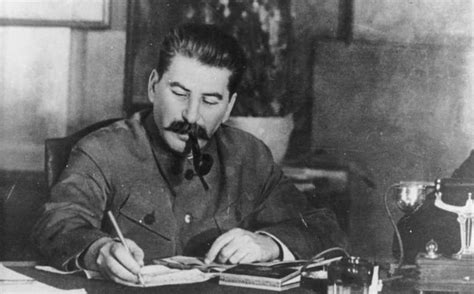
"What would happen if capital succeeded in smashing the Republic of Soviets? There would set in an era of the blackest reaction in all the capitalist and colonial countries, the working class and the oppressed peoples would be seized by the throat…"
The biggest flaw in this study isn't that quantifying a decades-long embargo's effect on GDP is little more than making up numbers; it's that they don't consider effects on policy. Cuban policy wasn't designed to make GDP go up, it was designed to make Cubans survive an embargo.
This is still probably the funniest DM I’ve ever received out of the blue. Only sharing because I didn’t reply at all and thus don’t consider it a private communication. Was in reference to linked comment
be cool if we had an opposition party that could criticize war-mongering without demonizing the target of said war, inflating threats and laying the groundwork for future attacks. It’s incoherent, tedious and draws no meaningful contrast beyond We’re The Competent Imperialists
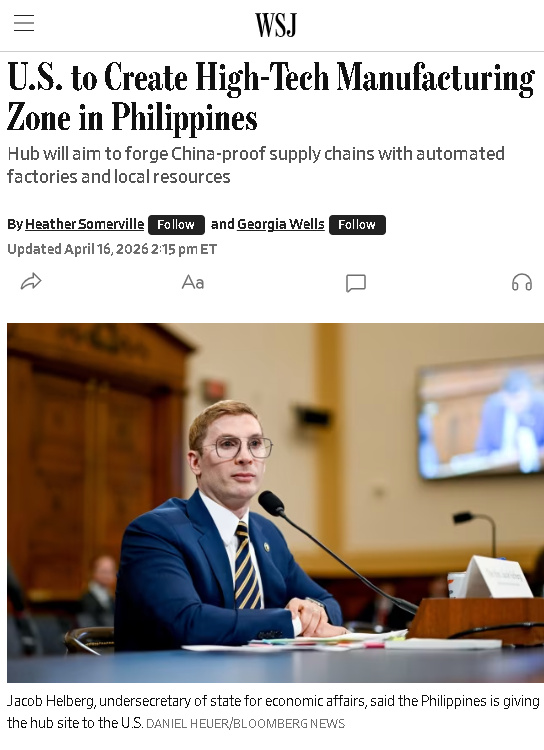
This is pretty insane: the U.S. just tried to literally re-colonize part of the Philippines.
They did so under the so-called "Pax Silica" initiative, the brainchild of - surprise, surprise - an ex-Palantir guy named Jacob Helberg who now runs U.S. economic "diplomacy" from the State Department.
It's causing a big outcry in the Philippines, which is quite a feat given this is by far the most US-friendly country in Southeast Asia.
If you're the US and you're getting the Marcos administration - of all governments - to push back on sovereignty, you've really overplayed your hand.
What is the "Pax Silica" initiative? In a nutshell it's about the US getting other countries to commit to restructuring their AI tech infrastructure around a US-led stack. It's basically vendor lock-in: you hand over your critical minerals, align your export controls with Washington's, regulate AI the way America wants, and in return you get to be a US "trusted partner," whatever that means these days.
In essence, let's not kid ourselves, it's all about China: this is the US's initiative to "win the AI race" by getting other countries to contractually commit to keeping China out of their tech supply chains. When you can't preserve your lead through innovation, you seek to lock countries in contractually.
For instance as a country, this would mean telling Huawei they can't sell you AI chips, and telling Chinese firms they can't invest in your data centers - even if they're better and cheaper. It's not about choosing the best technology, it's about choosing the right flag.
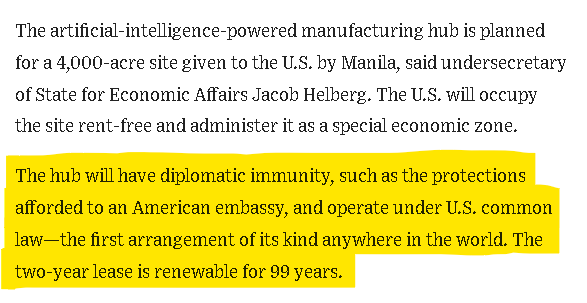
But in this instance, the US went much further still: they literally tried to carve out 4,000 acres of Philippine territory (in New Clark City, 60 miles north of Manila) to be governed under US common law with diplomatic immunity - the first arrangement of its kind anywhere in the modern world.
This is according to the WSJ who ran the story last month (https://t.co/kydhIQfo2A) as if it was a done deal (it wasn't).
Heard about the "French concession" or "British concession" in China during the century of humiliation? Same thing: the US basically asked for an "American concession" in the Philippines.
Unsurprisingly, there was quite a bit of backlash in the country with for instance the Peasant Movement of the Philippines (KMP) calling it a “massive sellout” of the country’s land, minerals, and sovereignty (https://t.co/nkXSajH2Q7).
So much so that the Philippines' government - namely Joshua Bingcang, president and chief executive of the Bases Conversion and Development Authority (BCDA) - issued a statement saying that the Philippines had rejected US proposals that would place the project beyond local jurisdiction (https://t.co/ZmNWJB03eH).
Note, by the way, this delicious irony: the BCDA is the government agency that was created in 1992 specifically to convert former US military bases at Clark and Subic Bay after the Philippines spent decades negotiating their closure. New Clark City - where the Pax Silica's hub would go - is built on the old Clark Air Base.
So the agency whose entire reason for existing is to turn former American colonial territory (i.e. US military bases) into sovereign Philippine land is the one now being asked to hand part of that very same land back under US jurisdiction (and, apparently, declined).
Of course though, blocking this specific jurisdiction grab doesn't change the bigger picture. The Philippines is still a Pax Silica signatory, and Pax Silica itself is structurally neocolonial: you supply the cheap labor and raw materials, align your export controls and regulations with Washington's, cut yourself off from the world's rising technological powerhouse - and in exchange you get assembly jobs and the privilege of getting a pat on the head and being called a "trusted partner."
They dropped the most cartoonishly colonial demand - governing Philippine soil under US law - but the underlying architecture is the same: you serve America's supply chain, on America's terms, and you relinquish your sovereign right to trade with whoever offers the best deal.