Treasuries are quietly emerging as an effective hedge against the AI bubble bursting.
Case in point: the below chart shows the relationship between US government bonds and AI-focused stocks has become increasingly negative, reaching levels last seen a year ago.
In fact, I've been arguing for weeks that Treasuries could be a pretty good place for investors to hide if the AI boom turns into an AI bust.
Here's why. A sharp pullback in AI spending could drag on economic growth, cool inflation, reduce energy demand, and push central banks to cut interest rates.
Meanwhile, Big Tech firms might scale back their bond issuance, reducing competition for investors' cash.
And as nerves spread through the market, investors could flock to the the market’s traditional safe havens.
All of that would be good news for Treasuries.
And here's the kicker: unlike during much of the past two decades, government bonds now offer a very decent yield too.
In other words, one of the oldest diversifiers in the book could offer investors the best of both worlds: a potential cushion if the AI bubble bursts, and a steady stream of income while they wait.
That's a pretty attractive setup...
#AI #Bubble #Bonds #Treasuries $IEF $TLT
Anthropic’s computing costs are soaring, but revenues are increasing even faster.
According to a draft IPO prospectus seen by the Wall Street Journal, the AI giant pulled in about $16.3 billion in the first half of 2026, up from $1.1 billion a year earlier.
Over the same stretch, it spent nearly $9 billion on computing, versus $2.3 billion before. That’s already more than it spent in all of 2025.
The headline net loss of $80.7 billion looks scary, but around $72 billion came from accounting charges tied to changes in the value of convertible notes, not from day-to-day operations.
The bigger worry is the bill still to come.
Anthropic has roughly $450 billion in mostly non-cancelable cloud commitments, and total infrastructure obligations top $600 billion.
Cloud partners increasingly see it as a rival, so access to enough capacity isn’t guaranteed.
Customer concentration is another risk: two customers made up about a fifth of revenue.
Still, with a valuation of up to $2 trillion on the table, investors are betting that growth keeps outrunning the costs.
But at that price, there's very little room for error.
#Anthropic #AI
SpaceX’s Earnings Took Off Like A Rocket
SpaceX blasted past expectations in every division last quarter.
▶ The company’s rockets division saw revenue grow 6% last quarter from a year earlier.
▶ Revenue from SpaceX’s satellite internet service, Starlink, jumped 69%, fueled by a near-doubling in subscribers.
▶ SpaceX’s AI division – now dubbed "Super Intelligence", home to its new data center rental business and the Grok chatbot – saw revenue surge almost tenfold.
🔺 That growth helped the company swing from a $1.1 billion loss in the same period a year ago to a $4.4 billion profit last quarter, trouncing analyst estimates. Investors cheered, initially sending SpaceX’s shares higher.
Takeaways
1️⃣ The bigger picture: It pays to have access to cash.
SpaceX has muscled its way into the neocloud business, building and renting out data center capacity to AI customers.
This year, it struck deals with Anthropic, Google, and open-source startup Reflection AI worth a combined $28 billion in annual revenue.
No surprise that its AI division overtook Starlink as SpaceX’s biggest moneymaker last quarter.
But building data centers takes cash, and not everyone can borrow cheaply – just ask OG neocloud CoreWeave.
Yields on its unsecured bonds have surged past 15%, signaling that investors worry about being paid back. Comparable SpaceX bonds yield just 7%.
That borrowing advantage, combined with its $90 billion cash war chest, gives SpaceX considerable firepower to expand while rivals struggle to bankroll their ambitions.
2️⃣ For markets: Hold on to your hat...
Over the next few days, lockup restrictions covering roughly 35% of SpaceX’s shares are set to expire.
That means early investors and company insiders will be free to sell – and with many sitting on life-changing paper gains, they might be tempted to cash in at least part of their winnings.
⚠️ That potential wave of selling, combined with growing investor jitters around AI, could weigh on SpaceX’s shares in the short term.
$SPCX #SpaceX #AI
🎙️ New Podcast Episode: Why This AI Sell-Off Feels Different
Every week, Finimize analyst Russell Burns and I sit down for a casual chat about all things markets – from the biggest recent headlines and under-the-radar trends to what we’re watching in the week ahead.
In this week’s episode, we look at stress in the credit market, the pressure on CoreWeave, and whether the huge sums being spent on AI can ultimately be justified.
We also unpack why Treasuries are starting to look interesting again, and what the broader market is telling us beneath the headline index numbers.
For the full conversation, check out the latest episode of Market Open on Apple Podcasts, Spotify, or wherever you get your podcasts.
You can also watch the episode on YouTube.
🎧 Apple:
https://t.co/aDJpP5S9lN
🎧 Spotify:
https://t.co/7cU7GBbbvl
📺 YouTube:
https://t.co/ubMuStFkPY
The IT sector accounts for half of global earnings growth this year.
And if you thought that was impressive, just wait until 2027.
According to Citigroup, tech's contribution to global earnings growth is expected to jump from 48% this year to a whopping 68% next year.
That's despite overall earnings growth slowing from 35% to 16%.
That kind of concentration is pretty unusual.
Historically, the top-performing sector has accounted for around 40% of global earnings growth on average.
Next year's forecast would be the second-highest concentration in three decades, beaten only by the energy sector's dominance during the 2022 energy crisis.
The US looks particularly reliant on tech, with the sector expected to account for a staggering 78% of the country's earnings growth next year.
But a market relying so heavily on a single sector and investment theme to keep it afloat is standing on shaky ground.
Investors, beware...
#Earnings #Stocks #AI
🔎 The Focus This Week: China’s Growth
China’s economy grew by 4.5% last quarter, compared with 5% in the first and 4.3% in the second.
That means growth over the past two quarters has been hovering around the lower end of the government’s 4.5% to 5% annual target.
That explains why Beijing rolled out a flurry of stimulus measures in recent weeks, hoping to give the economy enough of a boost to hit the lower end of its full-year target.
Those measures might do the trick in the short term. But they won't solve China's bigger problem: its consumers aren't spending nearly enough – leaving the economy increasingly reliant on exports to keep growing.
Just look at the numbers. Over the past six months, retail sales have grown by an average of just 0.6% year over year, compared with more than 18% for exports.
Now, while that export boom is helping keep China's economy afloat, it's creating headaches for the rest of the world.
See, Chinese manufacturers aren't just churning out cheap toys and electronics anymore. They're increasingly making their mark in higher-value industries, from EVs and solar panels to robotics and advanced machinery.
And thanks to their enormous scale, they can often produce those goods at prices that foreign rivals struggle to match.
What's more, the Chinese government continues to give domestic manufacturers a helping hand through subsidies, cheap financing, and other incentives.
That means China's export dominance isn't likely to fade anytime soon. And while that's good news for its own factories, it's less welcome elsewhere: cheaper Chinese goods are squeezing foreign manufacturers, putting jobs at risk, and stoking trade tensions.
There’s a catch, though: China's export success could end up becoming its Achilles' heel. The US and Europe are already pushing back with tariffs and other trade barriers, and more countries could follow suit.
If that happens, Chinese exporters could find themselves shut out of key markets, threatening the very engine that's keeping the economy running.
That's why China's bigger challenge isn't simply hitting this year's growth target. It's finding a way to get its own consumers spending again, rather than relying on exports and repeated rounds of stimulus to do the heavy lifting.
Until that happens, the country's economic troubles – and the trade tensions they're fueling – aren't going away.
Read the full Finimize Weekly Brief – a recap of last week’s highlights and a preview of the key things to watch in the week ahead – here:
https://t.co/XvINUSQgqM
#China @finimize
CoreWeave's Woes Could Be A Sign Of What's To Come
CoreWeave has become the poster child for the debt-fueled AI spending boom – and perhaps the canary in the coal mine for the wider AI trade.
The company pioneered the so-called “neocloud” business model.
The playbook is simple: borrow heavily, issue shares, use the proceeds to build data centers, and rent them out to AI giants like OpenAI, Anthropic, and Microsoft.
But with borrowing costs shooting higher, cracks are starting to show.
CoreWeave has more than $50 billion in debt on its balance sheet, compared with a market value of less than $40 billion.
Sure, it's sitting on $5.5 billion in cash. But it's also burning through money at a staggering pace.
Free cash flow has averaged negative $5 billion over the past two quarters, and analysts expect a further $30 billion in cash outflows over the next four.
That's nearly six times the cash CoreWeave has in the bank.
In other words, the company will need to find a whole lot more money – whether by taking on more debt, selling shares, or issuing convertible bonds.
And it's no stranger to tapping investors for cash: it's already raised capital ten times this year, averaging roughly once a month.
Trouble is, with its shares and bonds both sliding, raising fresh capital is getting pricier by the day.
Take CoreWeave's bonds maturing in 2032. When they were issued in June, they offered a yield of 9.6%.
Today, that yield has climbed above 15%. That's firmly in distressed-debt territory.
In fact, credit-default swaps – essentially insurance against a borrower going bust – suggest investors see a greater than 50% chance of CoreWeave defaulting within five years.
But there's a more immediate headache.
All else equal, CoreWeave would now have to pay roughly five percentage points more to borrow than it did just a few months ago.
That's a roughly 50% jump in borrowing costs. And that's particularly painful when interest expenses are already swallowing a QUARTER of the company's revenue.
Of course, CoreWeave could always raise money by issuing more shares instead.
But with its stock price under pressure, it'd need to sell more of them to raise the same amount of cash. That means more dilution for existing shareholders.
As if that weren't enough, competition is heating up too.
Deep-pocketed players like SpaceX and Meta are muscling into the neocloud market, armed with stronger balance sheets and access to cheaper capital.
Put it all together, and it's not hard to see why investors are getting nervous.
And if CoreWeave's debt-fueled AI ambitions start to unravel, the big question is whether the rest of the AI trade could get caught in the fallout.
Nvidia, which owns 10% of CoreWeave, might swoop in with a bailout.
But whether CoreWeave defaults or gets rescued, neither outcome would exactly inspire confidence in the AI boom…
#AI #CoreWeave
Image credit: @HedgieMarkets
AI Could Make Us All Richer. Here Are Seven Ways To Spread The Wealth.
AI could make the world a whole lot richer. But it could also put millions of people out of work while funneling even more wealth into the pockets of just a few tech giants.
So policymakers and tech bosses are cooking up ways to spread the gains and soften the blow.
Here are seven proposals, neatly rounded up by Bloomberg's Saijel Kishan – along with my take on each.
1️⃣ AI Dividends
Governments could tax AI companies and distribute the proceeds directly to citizens, recognizing that AI models were trained on data created by ordinary people. However, many AI firms remain unprofitable, making profit-based taxation difficult. A 1% levy on revenue could offer an alternative. Another proposal involves sovereign wealth funds investing in AI companies, although converting investment gains into regular payments presents challenges.
2️⃣ Universal Basic Income
UBI would provide everyone with regular government payments, helping reduce poverty and supporting displaced workers. However, the enormous cost, concerns about work incentives, and America's substantial national debt make widespread adoption unlikely. But taxing AI-generated wealth could help fund such payments.
3️⃣ Universal High Income
Elon Musk envisions AI creating such extraordinary productivity gains that governments could guarantee everyone a comfortable income beyond basic necessities. However, the proposal lacks a clear funding mechanism and depends on an uncertain economic transformation.
4️⃣ Universal Basic Compute
Sam Altman proposes giving everyone access to AI computing power that they could use, sell, or transfer. This would allow individuals to benefit directly from AI productivity without necessarily requiring government spending. However, fluctuating computing costs, volatile credit prices, and distribution challenges could complicate implementation.
5️⃣ Worker Retraining
Retraining programs aim to help displaced workers transition into new industries, including healthcare and manufacturing. Yet retraining is expensive, career transitions are difficult, and supposedly secure jobs could eventually face automation themselves. Providing accessible AI education may offer a more adaptable solution.
6️⃣ Wage Insurance
Wage insurance would temporarily compensate workers who accept lower-paying jobs after AI displacement. While easing financial transitions, it could prove expensive and difficult to administer. Establishing whether AI directly caused a salary reduction would also be challenging. Supporting completely unemployed workers may deserve greater priority.
7️⃣ Worker-Focused Tax Reforms
Governments could tax AI usage to reduce incentives for replacing employees. Bridgewater Associates has proposed taxing businesses’ AI token consumption, potentially raising $600 billion by 2030. Such measures could encourage human employment while generating revenue for worker assistance.
It's Cheaper To Launch A Rocket To Space Than To Hire An Oil Tanker.
Shipping oil has become so expensive that sending a tanker from the US to China now costs more than launching a rocket into space.
Seriously.
At roughly $80 million a trip, that's more than the $74 million price tag of a SpaceX Falcon 9 launch.
The war in Iran is behind much of that eye-watering bill.
With traffic through the Strait of Hormuz disrupted, Middle Eastern oil producers are transferring crude between ships to get it moving, adding roughly a week to voyages.
Meanwhile, attacks on vessels, tankers sailing empty to collect cargo, and lengthy detours around Africa to avoid Houthi strikes are keeping ships tied up for longer.
That's squeezing an already stretched global tanker fleet and sending freight rates soaring – creating a bonanza for tanker owners.
But there's a limit to how far the boom can go.
Refiners are currently making hefty profits turning crude into fuels, thanks in part to a global diesel shortage.
That gives them some breathing room to absorb higher shipping costs.
Still, every jump in freight rates eats into those margins.
And if transporting crude becomes too expensive, refiners could start processing less of it.
That would turn a shipping headache into a much bigger problem for global fuel supplies and inflation.
#Oil #Falcon9 #Shipping @SpaceX
AI could make the world a whole lot richer.
But it could also put millions of people out of work while funneling even more wealth into the pockets of just a few tech giants.
The mass unemployment that many people fear hasn't materialized yet. But AI is starting to squeeze entry-level hiring in certain industries.
So policymakers, economists, and tech bosses are cooking up ways to spread the gains and soften the blow.
That’s today’s Insight: seven AI proposals – and my take on each.
Read or listen to the Insight here:
https://t.co/4QqkYSK0Mk
#AI
🎙️ New Podcast Episode: Can The AI Spending Boom Keep Going?
Every week, Finimize analyst Russell Burns and I sit down for a casual chat about all things markets – from the biggest recent headlines and under-the-radar trends to what we’re watching in the week ahead.
In this week’s episode, we explored whether markets can keep funding the AI spending boom at its current pace and how higher borrowing costs could change the picture.
We also discussed the oil market, nuclear power, what to expect from upcoming bank earnings, and what the latest inflation data could mean for the broader economy.
For the full conversation, check out the latest episode of Market Open on Apple Podcasts, Spotify, or wherever you get your podcasts.
You can also watch the episode on YouTube.
🎧 Apple:
https://t.co/JzrXhPmSBX
🎧 Spotify:
https://t.co/ol3lLuNGTy
📺 YouTube:
https://t.co/T6kEm9ykxp
@finimize
El Niño is turning up the heat – and the global economy could get burned.
The weather phenomenon is on track to become the strongest ever recorded, with Pacific Ocean temperatures potentially climbing 3.7C above normal by year-end. That's comfortably above the previous record of 2.6C set in 2015-16.
Here's why that matters: El Niño reshuffles weather patterns worldwide, bringing droughts to some regions and floods to others.
That can disrupt crop yields, push up commodity-price inflation, slow economic growth (particularly in Australia and emerging economies), strain power grids, worsen public health crises, snarl supply chains, and more.
For perspective, researchers estimate the 2015-16 episode wiped almost $4 trillion off potential global economic output over three years.
And there's another wrinkle. El Niño releases ocean heat into the atmosphere, potentially pushing global temperatures to fresh records. Scientists reckon 2026 has a 26% chance of becoming the hottest year ever recorded.
With the phenomenon expected to persist until at least February, businesses and commodity markets could face plenty more turbulence before the weather settles down.
So how do you hedge against these risks?
Let’s face it, you’re not going to stand in the little boy’s way. But you could look to invest in an ETF that tracks agricultural commodities: that’d give you a strategic hedge against the broader risks posed by El Niño.
Remember, El Niño disrupts typical weather patterns, potentially leading to droughts or floods that can significantly shrink the yield of key crops. That, in turn, can drive up the prices of those grown commodities.
By investing in an agricultural commodities ETF, you could potentially profit from these price jumps – and offset negative impacts of El Niño on other parts of your portfolio.
I cover all of this in more detail here:
https://t.co/IRroaknmxk
#ElNiño #ClimageChange #Commodities #Agriculture
Corporate America’s borrowing binge is getting a whole lot pricier.
A sell-off in US government bonds has sent Treasury yields soaring. Meanwhile, credit spreads on the lowest-rated corporate debt have widened to their highest levels since 2022, as investors demand bigger rewards for taking on default risk.
Together, that’s pushed borrowing costs for the riskiest companies to 17% – their highest since May 2020.
Not everyone’s feeling the squeeze, mind you. AI-focused companies are still borrowing aggressively, betting that building data centers is worth the extra interest expense.
But the bigger headache could be coming. A record $1.45 trillion of investment-grade corporate debt is due to mature between 2026 and 2030, potentially forcing companies to refinance at much higher rates.
If borrowing costs stay elevated, companies could slash investment, acquisitions, and buybacks. And unless profits keep pace, defaults could rise, putting pressure on the broader corporate credit market.
#Credit #CreditSpreads #JunkBonds #Bonds
To Infinity... And Into Debt
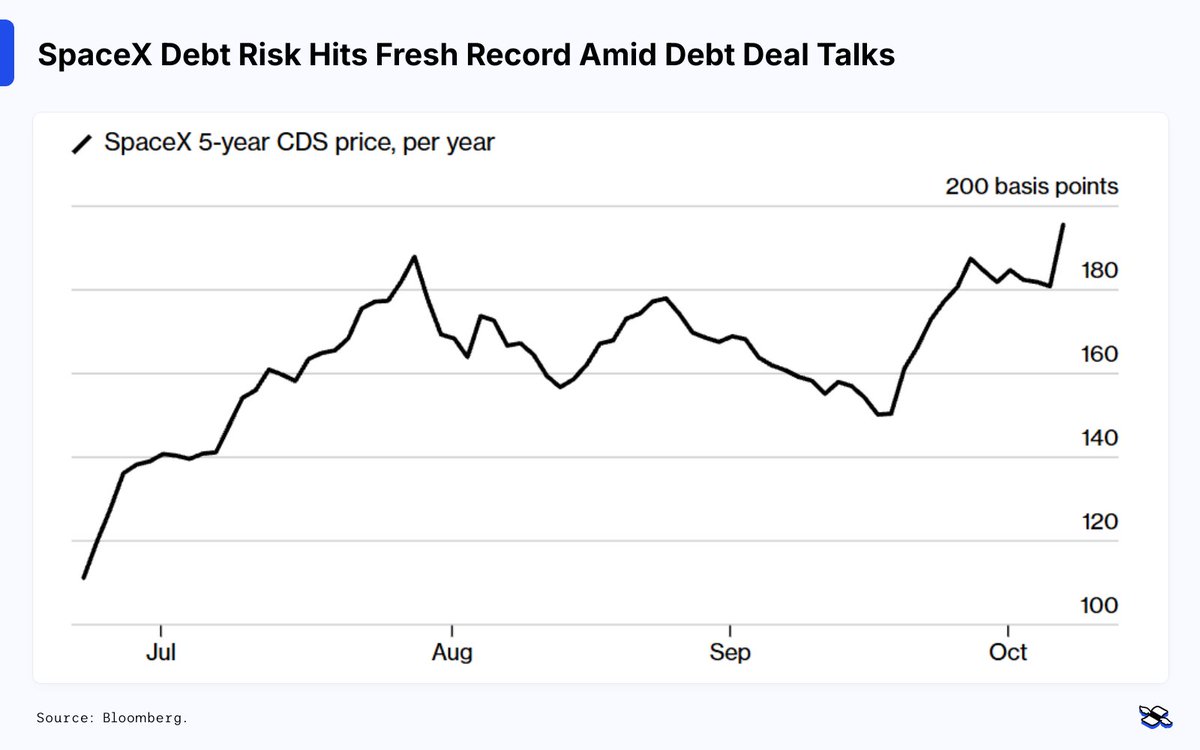
Word has it that SpaceX is looking to borrow $40 billion to outfit its data centers with Nvidia chips – one of the AI boom’s biggest borrowing deals yet.
More specifically, the rockets-and-AI firm reportedly wants $10 billion from banks in loans, and another $30 billion from selling bonds – eye-watering sums that highlight just how much money’s pouring into AI infrastructure.
Fortunately, SpaceX has an “investment-grade” credit rating, marking it as a relatively safe bet for lenders – at least in theory.
That unlocks access to deep-pocketed investors like insurers and pension funds (they’re often restricted from lending to riskier companies).
So when SpaceX comes a-knocking, there’ll probably be no shortage of investors to answer.
Thing is, SpaceX isn’t getting the cheaper borrowing that usually comes with an investment-grade rating.
That’s because investors are demanding a substantial extra return for holding its bonds instead of safe government debt – closer to what they’d want from a riskier borrower.
That suggests investors are worried about SpaceX’s mounting debt and hefty spending plans: this $40 billion isn’t a one-off…
$SPCX #SpaceX @SpaceX
The @finimize chart of the day shows just how much capital the AI buildout requires – and how it’s coming in all shapes and forms.
Hyperscalers, data centers, and neo-clouds have raised $346 billion through debt and equity so far in 2026 – more than double 2025’s $172 billion haul.
And debt is doing plenty of the heavy lifting: Alphabet, Amazon, Meta, Microsoft, and Oracle raised around $159 billion in bonds through early June – already 47% more than they issued during all of last year.
But investors are starting to demand more compensation for taking on that debt. Credit spreads across AI-related investment-grade, high-yield, and convertible bonds have widened, while credit default swap spreads have jumped for hyperscalers.
That makes borrowing more expensive and signals growing doubts about whether these firms can earn enough on their huge AI investments to comfortably repay their debt.
And the timing isn’t ideal, because the borrowing binge is expected to accelerate. Goldman Sachs reckons the five hyperscalers could issue $250 billion of debt this year and $400 billion in 2027.
So the AI boom increasingly depends not just on technological breakthroughs, but on capital markets keeping the cash flowing – at borrowing costs that don’t become prohibitively expensive.
#AI #Debt #Equity
AI is making diversification harder than it looks.
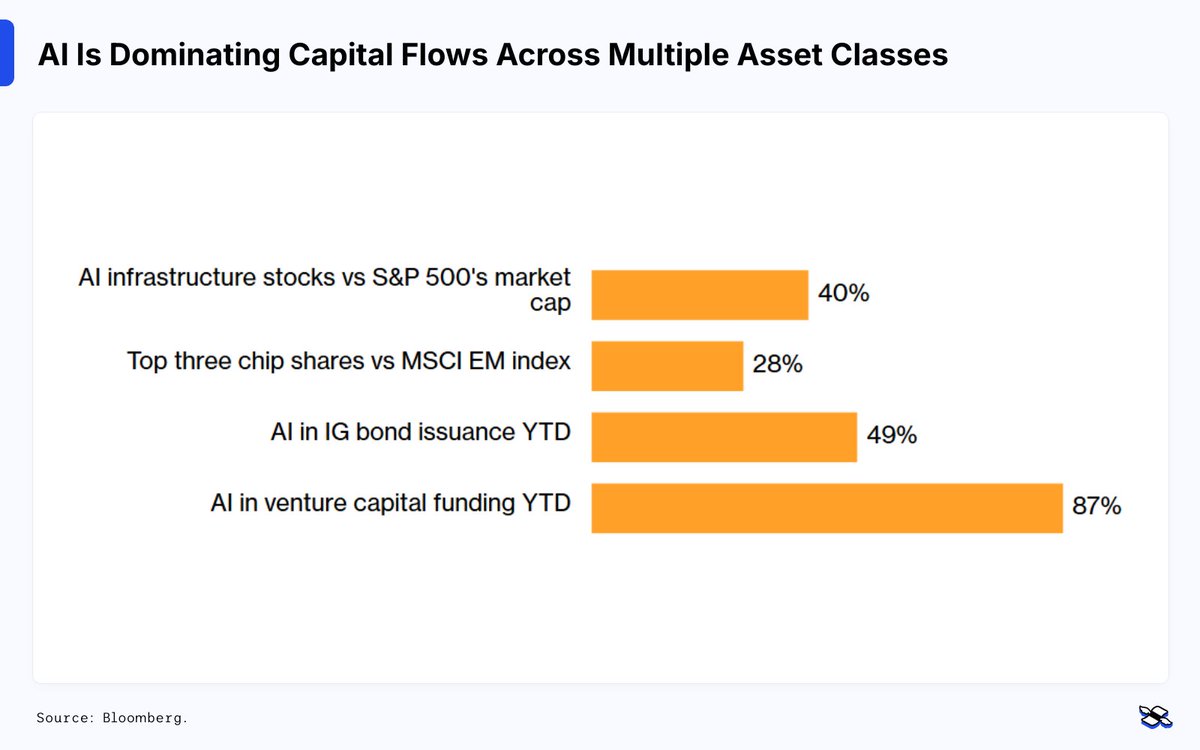
The technology isn’t just driving a handful of US megacap stocks anymore: its influence is spreading across equities, bonds, commodities, venture capital, private markets, and infrastructure.
That means investors who think they’re spreading their bets may still be loading up on the same underlying theme.
Take stocks. Developed-market indexes are heavily weighted toward tech, while emerging-market benchmarks have their own AI concentration through South Korean chipmakers and Taiwan’s TSMC.
The same dynamic is showing up in credit markets, where hyperscalers are issuing more corporate debt to fund their buildout.
That supply is even spilling into government bonds by competing for investor demand and nudging yields higher.
Then there’s energy. Data centers need enormous amounts of electricity, and the AI buildout is adding to power demand at the same time as energy supply remains constrained.
Copper is part of the story too. After all, data centers, power grids, and the infrastructure connecting them all require plenty of the metal.
And the effects stretch into private markets. Data centers and their supporting infrastructure are becoming an increasingly important theme across private equity and private credit, while venture capital has become heavily concentrated in AI startups.
So the diversification problem isn’t just that AI is everywhere. It’s that seemingly different assets can react to the same shock.
That raises an obvious question: where can investors hide if the AI boom turns into an AI bust? Government bonds may be one answer.
A sharp pullback in AI investment could weaken growth, cool inflation, reduce energy demand, and prompt central banks to cut interest rates.
Hyperscaler bond issuance could also fall, easing competition for capital, while a risk-off move could send investors toward traditional safe havens.
Those forces would all tend to support government bonds. And unlike much of the past two decades, bonds now offer investors a meaningful yield while they wait.
In other words, government bonds could provide both income today and a potential hedge against the very theme that is making diversification harder in the first place.
#Bonds #AI #Treasuries
Google-parent Alphabet just signed a 20-year deal to secure 890 megawatts worth of nuclear power from Constellation Energy.
Constellation is the largest nuclear power operator in the US, with a big sideline in renewables and natural gas.
It’s also a “merchant generator”, selling electricity in competitive wholesale markets and to big customers through long-term contracts.
And lately, its nuclear plants have become hot property.
See, data centers guzzle huge amounts of electricity, and tech firms don’t want those growing energy needs to derail their climate commitments.
Enter nuclear, which offers reliable power – around the clock – without carbon emissions.
This deal follows the multi-year agreements that Constellation has already inked with Microsoft, Meta, and Amazon.
👉 Takeaways
1️⃣ Nuclear’s having a moment.
Governments are also eyeing nuclear power – and not just for its climate cred. This year’s Middle East conflict has rattled oil and gas markets, sending countries scrambling for an energy supply less vulnerable to geopolitical shocks.
Uranium prices tend to be more stable than fossil fuels, thanks to long-term contracts and predictable demand. And if prices do swing, the fact that it’s only a fraction of a plant’s costs helps (the lion’s share comes from actually turning the metal into power).
Plus, uranium’s incredibly energy-dense, so countries can stockpile years’ worth in very little space. All of that makes nuclear a stable, domestic power source that’s less exposed to geopolitical shocks.
2️⃣ Betting on energy security.
I recognized how valuable Constellation’s nuclear fleet could be in the age of AI, so I added the stock to the @finimize portfolio back in January 2025 as part of my utilities strategy. It’s still a core holding – and this deal with Alphabet shows why.
I’d already built a portfolio targeting the nuclear industry beforehand, betting on its long-term growth possibilities. And despite nuclear stocks wobbling last month, I still see a bright future.
$CEG $GOOGL #Nuclear @ConstellationEG #AI
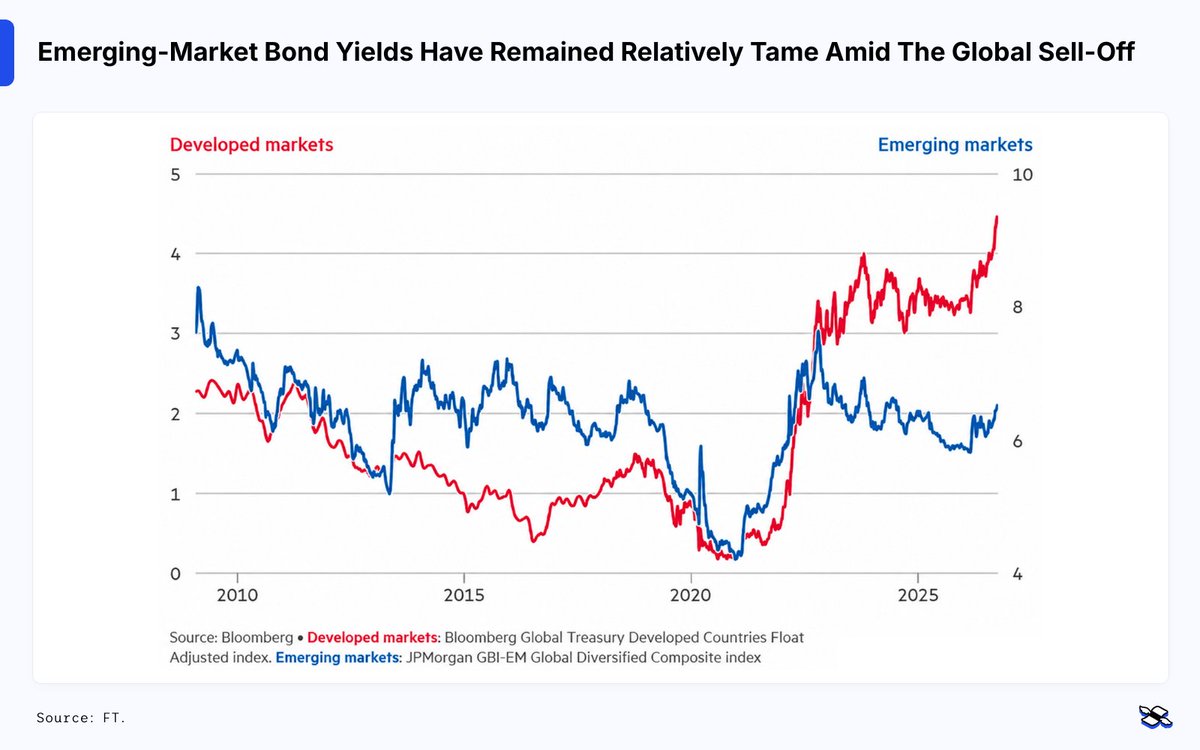
Emerging markets are doing something unusual: holding their own while the global bond market takes a beating.
US 10-year Treasury yields have jumped from 4.8% to 5.3% in a month, yet yields in countries including South Africa and Chile have risen far less – while Brazil’s have actually fallen.
That resilience has been years in the making.
Many emerging economies tightened fiscal policy, strengthened their central banks, and tackled post-pandemic inflation earlier and more aggressively than their developed-market peers.
The payoff is showing up now.
JPMorgan’s index of emerging-market local-currency bonds gained 18% last year and is still flat in 2026 despite September’s sell-off.
Developed-market bonds, meanwhile, are down 4.5% year-to-date.
There’s another advantage: deeper domestic capital markets.
Countries like South Africa, Thailand, and Malaysia are less reliant on dollar borrowing than they once were, giving them some protection as US rates and the greenback climb.
But the picture isn’t universally rosy.
Argentina and Egypt, for example, have large amounts of short-term debt to refinance, leaving them more exposed to higher borrowing costs.
The bigger picture is that emerging markets no longer look like the automatic weak link when global borrowing costs rise.
Years of tougher policymaking and deeper local markets have given many of them a buffer that was missing in past sell-offs.
If US yields stay higher for longer, that resilience will face a sterner test.
But for now, the old rule that a Treasury rout spells trouble for emerging markets isn’t holding.
#EMD #EmergingMarkets #Bonds